
The Brutal Reality of AI in 2026 (From a Marketer)
I sat down with Marlon Roldan to talk through the reality of AI in 2026, and the honest version is less exciting than your feed suggests.
The Reality of AI in 2026 Video Guide
Most AI content is built to make you feel behind. This conversation goes the other direction.
I run a six-figure marketing agency, and that work is about 75% of what I do. The rest goes into my YouTube channel, where the whole premise is showing what actually applies to real client work instead of reacting to every model release.
If you want to go deeper on the systems side of this, I put together a Claude Code Skills Stack with the skills and workflows I use daily.
Why the Models Are Already Good Enough
Here is the part nobody monetizes: the model race stopped mattering for most of us.
Somewhere around Opus 4.5, in my experience, the models got good enough to handle something like 99% of knowledge work. Drafting an email. Writing content. Making an image. Building a landing page. I am not talking about frontier research or complex engineering. I mean the work most people actually do between 9 and 5.
So when GPT 5.6 ships on a Tuesday, Fable 5 shipped the week before, and Opus 4.8 the week before that, the correct response is usually nothing. You do not need to drop your work and test it.
Stop asking which model to use. Ask whether your systems are built so the answer never matters.
That reframe changes what you spend your time on. Instead of testing releases, you go find the bottlenecks. What is eating the most hours in your week? What is costing you the most money? As a solopreneur, I look at the SaaS tools I pay for and ask whether a model plus a system replaces one of them. The same math applies to which model you run, since a cheaper open source model can do more of the work than you expect once the system around it is solid. Swap two or three of those and the savings add up fast at scale.
Building a Model Agnostic AI System
Ask yourself a harder question than “is AI hype real.” Ask what happens to your work when your favorite tool disappears.
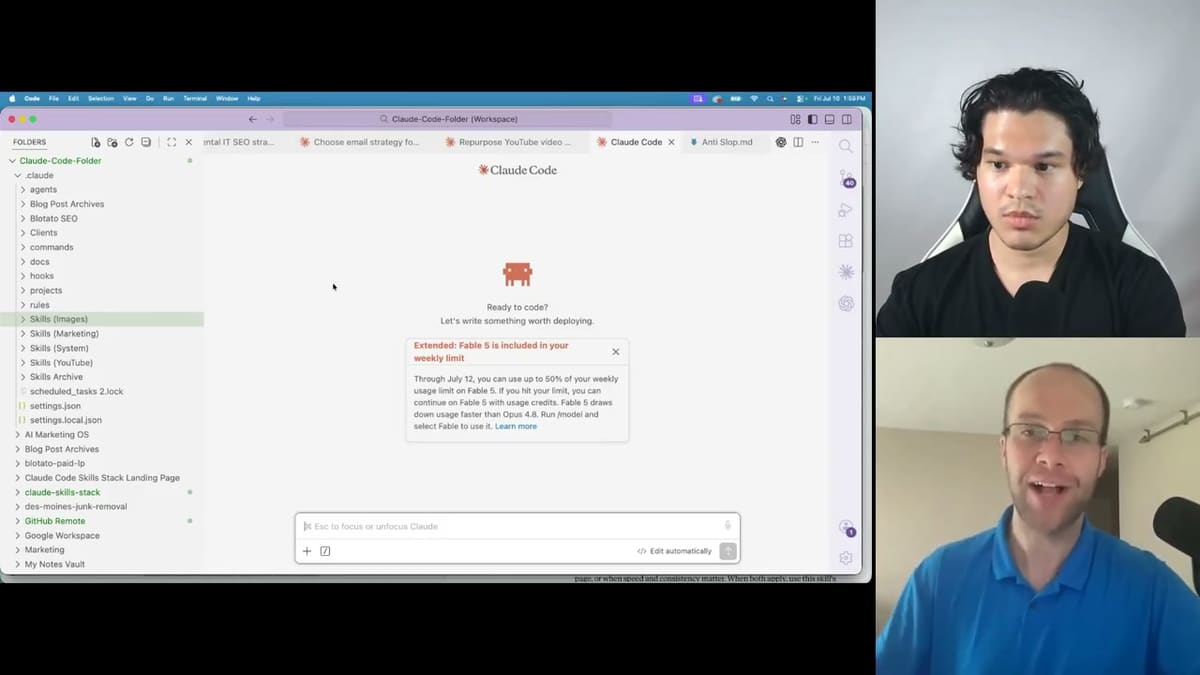
I use VS Code as my interface, with the Claude Code extension and Codex both connected. That choice is deliberate, and slightly paranoid. If I worked inside the Anthropic desktop app, Anthropic has every incentive to make competing models feel worse in their own product. Same story with the Codex app. A neutral editor gives me fairer play across Anthropic, OpenAI, Google, and open source models.
The bigger reason is portability. Everything lives in local files and folders on my machine, backed up to Google Drive. If Claude Code and Codex both vanished tomorrow, I would install whatever coding agent replaced them, point it at the same folders, and it would pick up where the last one stopped.
Compare that to building projects inside claude.ai or custom GPTs on chatgpt.com. Those live on someone else’s server. You are renting.
A few specifics from my setup:
- VS Code as the IDE, which is free and just a friendlier wrapper around a terminal
- Claude Code (requires a paid Claude plan, minimum $20/month) plus Codex for a second opinion
- An AGENTS.md file as the brain, which Codex responds to better than a CLAUDE.md when you run multiple agents
- MCP, API, and CLI connections to DataForSEO, my social tool, and Google Search Console
That last point matters more than it sounds. I rarely leave the editor, because every tool I need is already connected to it.
I use Opus 4.8 for most work on the $100/month max plan. If you are on the $20 plan, Sonnet 5 is your realistic default, and it handles most knowledge work fine.
Context Is the Only Real Moat Left
Everyone has the same models. Almost nobody has your context.
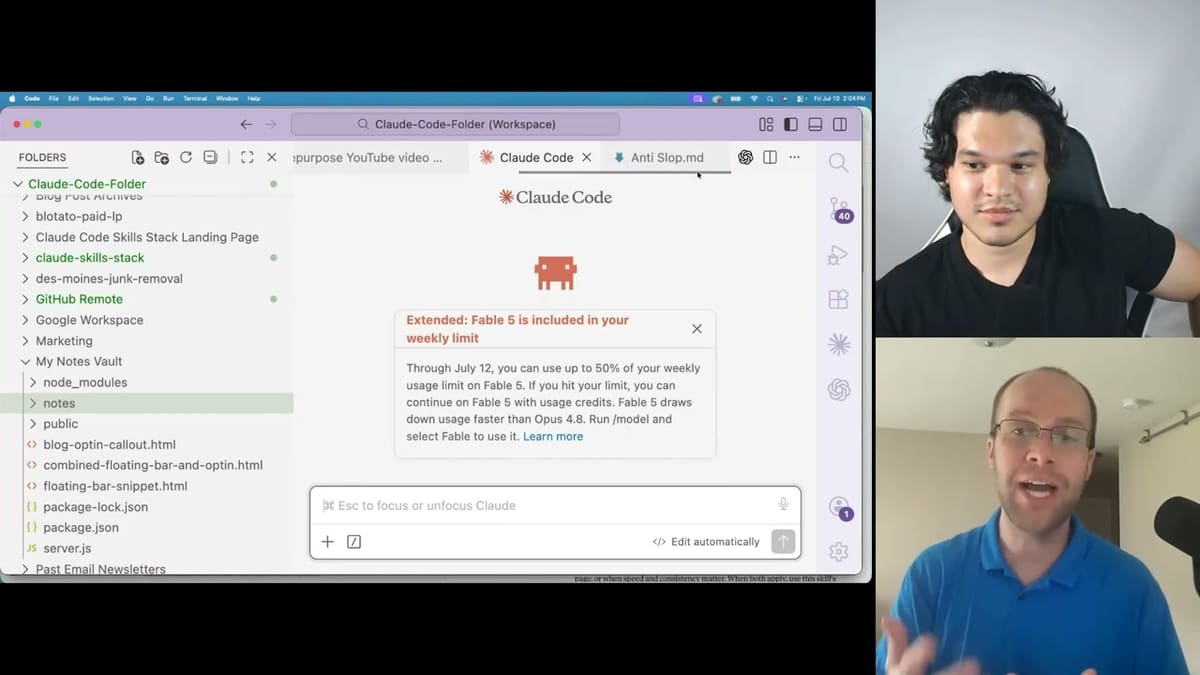
I vibe coded my own second brain, a notes vault that automatically saves a markdown file of every Claude Code and Codex conversation. What did I work on, what were the decisions, what were the takeaways. It spans back to March now, and it backs up to Google Drive automatically.
The client version of this is where it gets valuable. On one large SaaS account, every meeting, every podcast appearance, and every weekly office hours session with customer questions gets saved into a growing pile of context.
When I write SEO content for them, the AI reads that pile. The result is an article the competition physically cannot recreate, because they do not have the raw material. Most competitors open the front page of Google and rewrite the same five articles into a sixth.
You probably already have this raw material sitting around. Sales transcripts. Meeting notes. Years of email threads. Organizing it is boring work that takes a few hours. It also compounds for years.
The second thing that makes context useful is knowing what good looks like. Telling a model “build me a landing page that makes a million dollars” produces nothing useful, because you have not told it what good means. I know from a decade in marketing that a landing page needs social proof above the fold, a real call to action, proof of results, testimonials, a clear who-it-is-not-for section, and FAQs. That subject matter expertise is what turns a generic skill into a useful one.
Which is why I would push you to get granular with Claude Skills. A newsletter email, a sales email, and a drip sequence email are three different jobs. One master “email skill” moves nothing. Three specific ones do.
Is SEO Dead, or Just Renamed
AEO. GEO. LLMO. Insert next week’s acronym here.
I call it AI search and leave it there. Here is the practical read: yes, you can technically surface in an AI answer without a website, because those systems pull from YouTube, Reddit, and LinkedIn too. For most competitive queries, that is not going to carry you.
My own site is the proof I trust most, mostly because the numbers are unimpressive on paper. Ryandoser.com sits around a 20 domain rating. I started publishing on it around February and early March from zero, with no authoritative backlinks and nobody helping.
Traffic went up anyway, and I credit two things.
The first is the YouTube channel at roughly 37,000 subscribers. My read is that the brand presence carries weight, though I cannot prove the mechanism. The second is repurposing every long form video into a genuinely well built article. That tactic is old. Doing it well is not. Those articles are AI-assisted, which now also means watermarked, and I wrote up why Claude watermarks do not worry me as a publisher.
I built a skill that takes a video URL and a target keyword and writes the post. It embeds the video, adds internal and external links, sets the heading structure, sends an agent to watch the video, pulls screenshots from the meaningful moments, compresses them, uploads them, captions them, and decides where each one belongs.
Did version zero work? No. Version three or four is where it started earning its keep. That is the actual lesson.
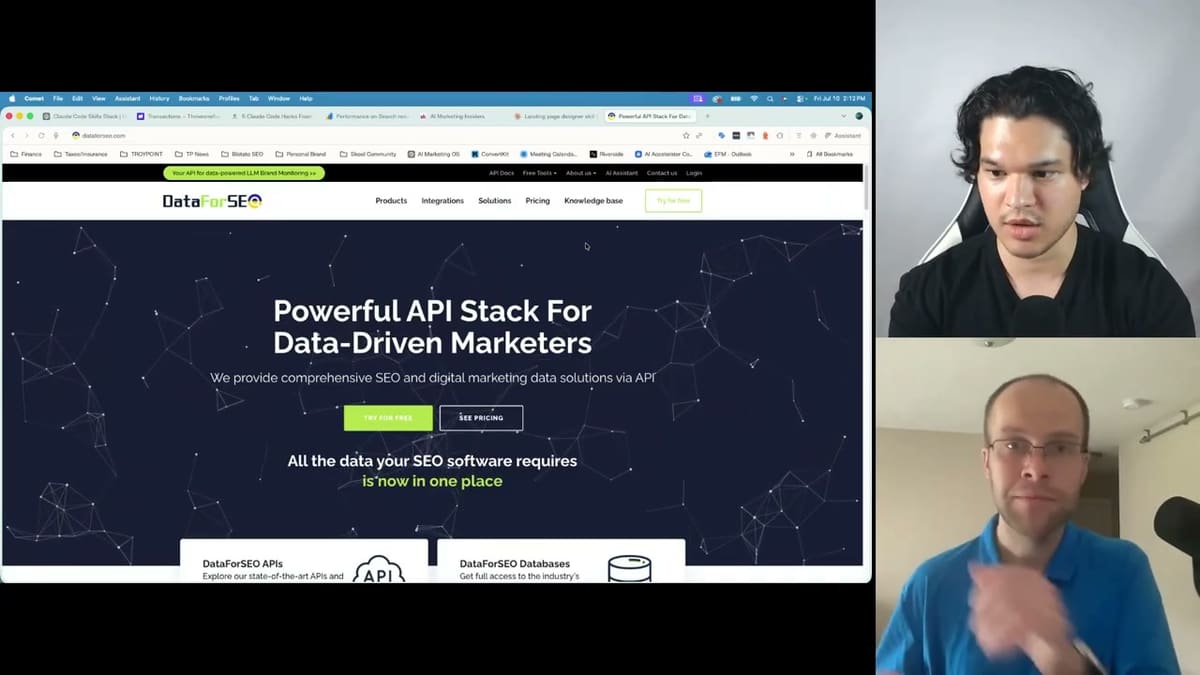
For keyword data, I use DataForSEO connected over MCP. I put $50 in two months ago and I am still sitting near $45 after running keyword research and SERP analysis constantly. That daily use eventually turned into a complete DataForSEO review. Is it as good as Ahrefs or Semrush? Probably not. It gets you 80 to 85% there, and for most people that is the whole job. I put that question to a proper test in DataForSEO vs Ahrefs, where the answer turns out to depend on whether you are buying data or an index. Those bigger platforms have a moat because of the first party data they collected over years, which is the same moat argument as everything else in this article.
Free options work too. Google Trends and Google Keyword Planner cost nothing.
How to Tell Real AI Content From Hype
One filter separates the two, and it takes about five seconds.
Does it apply to reality? A video titled “new model just dropped” is worth skipping. A tutorial that shows you how to save five hours a week is worth your time. Practical versus theoretical, that is the whole test.
X is genuinely good for news and updates. It is also full of AI generated posts with thousands of bookmarks written by people who never built the thing. YouTube is still where the builders are. Mark Kashef is excellent on Claude Code. Sabrina Ramonov, a friend of mine, actually ships.
Two things stop most people, and neither is intelligence. Resistance to change has scared humans since forever, and genuine information overload does the rest. If a new model lands every week, why learn anything today? That logic feels reasonable and it is the exact trap the hype creates.
Ryan’s Final Thoughts
Most AI content is engineered to make you feel behind, and feeling behind makes people freeze. Ignore the release cycle. Pick one bottleneck, connect one system, and get an hour back this week.
I would not sugarcoat the career piece though. If you work a white collar job and never pick this up, the spots get thinner over time. You do not need my Claude Code workflows. You do need enough of an edge that you are not the easy cut. Claude Code for business owners is a reasonable next step if you want one. And if you would rather have a person in the work with you than another article, the AI Concierge is built for exactly that.
Reality of AI in 2026 FAQs
Is AI hype real or overblown in 2026?
Both. The capability is real. In my own work, current models handle close to 99% of knowledge work tasks like writing, email, and image generation. The hype is in the framing. Most AI content covers model releases rather than practical application, which makes people feel behind without teaching them anything usable.
Do I need to switch AI models every time a new one launches?
No. Models are close enough in quality for everyday knowledge work that switching rarely changes your output. Build a system that works with any model instead. Store your files locally, use a neutral editor, and keep your context portable so you can swap models without rebuilding anything.
Will AI replace white collar jobs?
Not wholesale, and that is the wrong thing to watch. My honest read is that you become the least equipped person on the team, and that is who gets cut first. Learning to automate even a few hours of weekly work builds enough of an edge that you are not the obvious name on the list during layoffs.
What is the best free way to start using AI for keyword research?
Google Trends and Google Keyword Planner both cost nothing and give usable data. If you want API data inside an AI workflow, DataForSEO runs cheap. A $50 balance lasted two months of regular keyword and SERP analysis in my own account.
Why use VS Code instead of the Claude or Codex desktop apps?
A neutral editor avoids vendor lock-in. Model providers have an incentive to make competing models perform worse inside their own apps. VS Code also keeps your files local, so if a coding agent disappears, you install a replacement and it picks up from your existing folders.