
Claude Watermarks Are Here: Why Good Marketers Shouldn't Panic
Anthropic just announced that every new model will embed a Claude watermark in generated text, and half the internet is treating it like a scarlet letter.
What the Claude Watermark Actually Does
Before you panic, look at what Anthropic actually shipped. The reality is narrower and less scary than the headlines suggest.
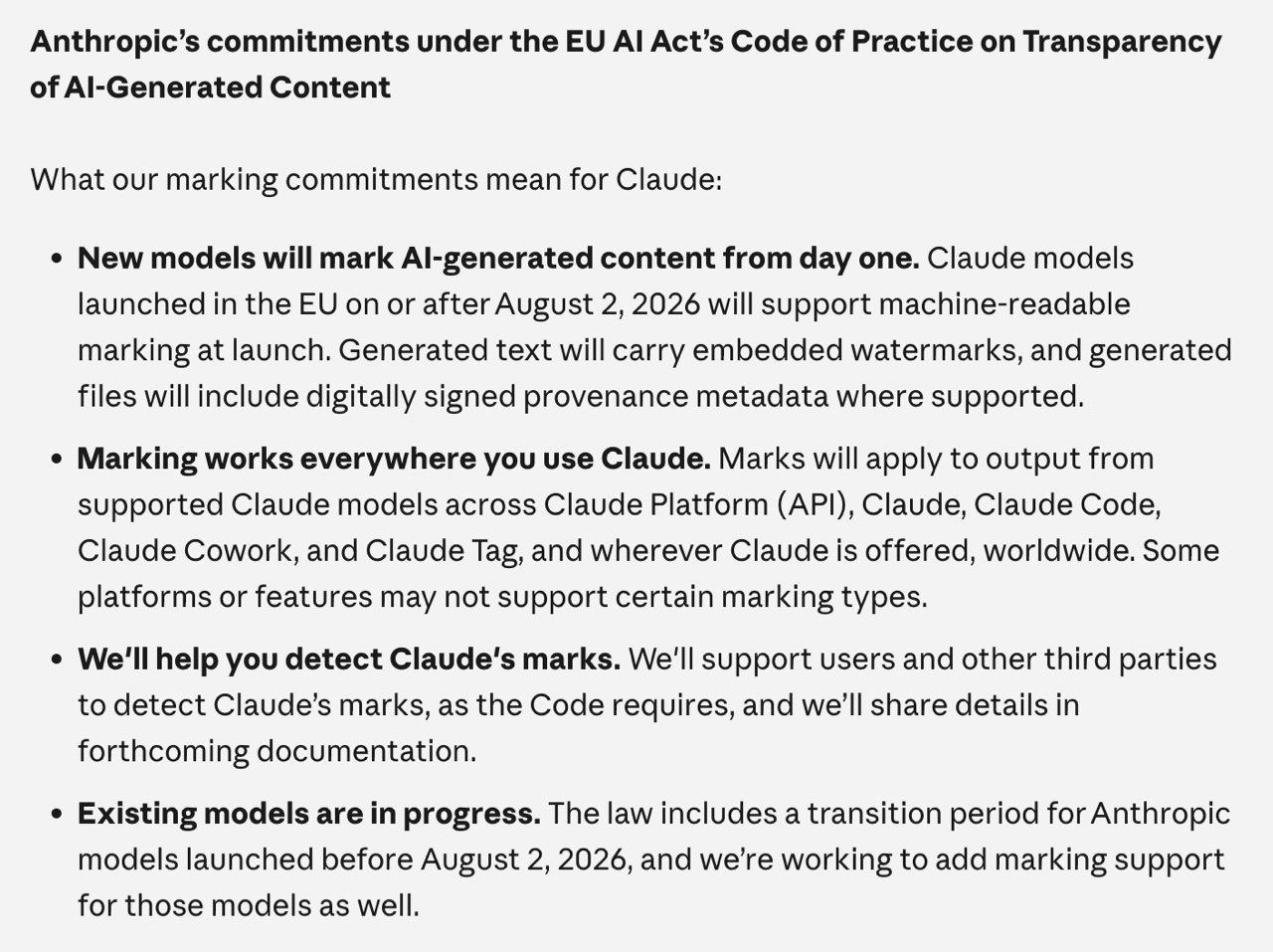
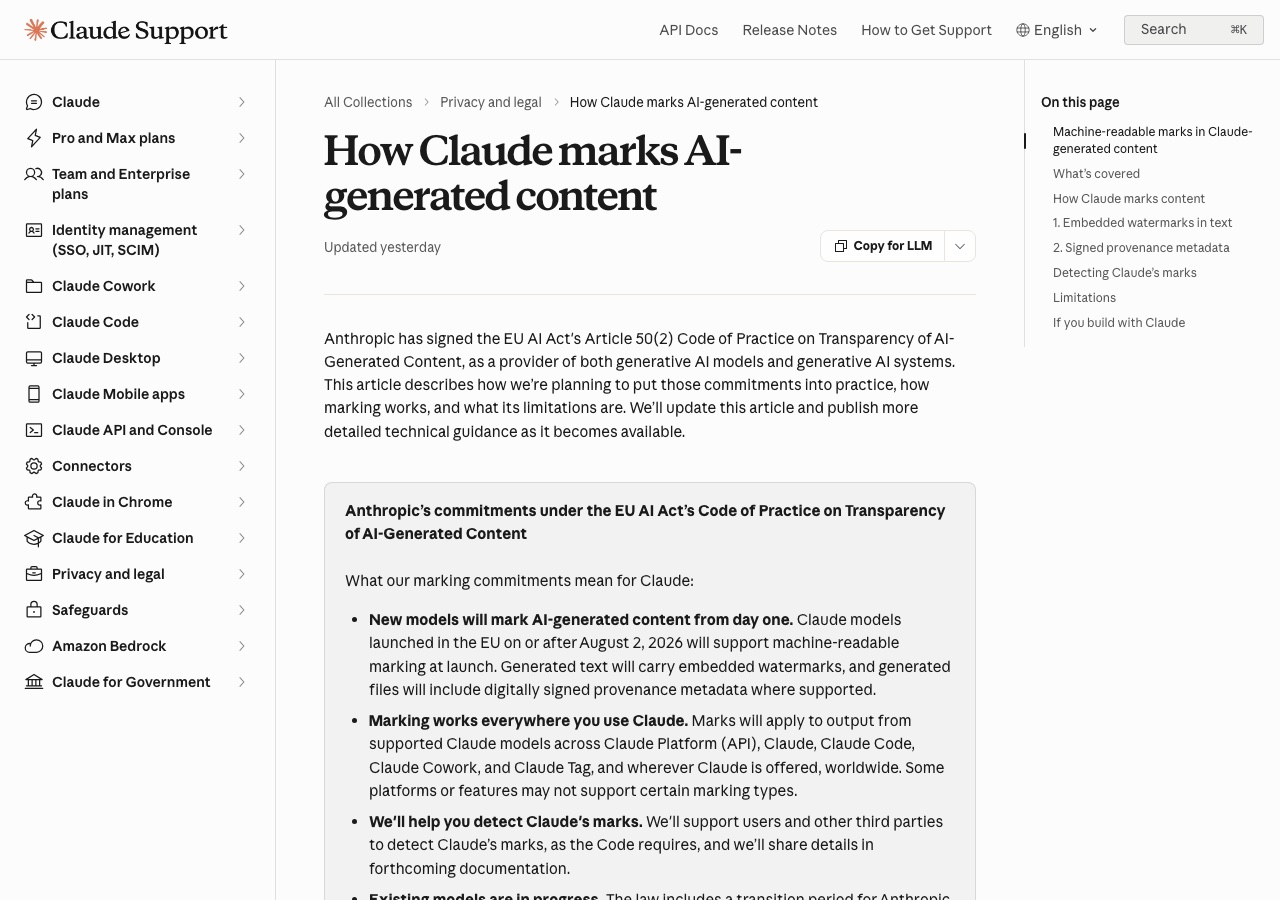
Anthropic signed the EU AI Act's Article 50(2) Code of Practice on Transparency of AI-Generated Content. To comply, Claude models launched on or after August 2, 2026 mark their output in two ways.
First, generated text carries an imperceptible watermark woven into the words themselves. You can't see it or feel it while reading, yet it travels with the text when copied elsewhere.
Second, generated files like .png, .jpg, and .svg get signed provenance metadata following the C2PA open standard. That metadata records the file was processed by Claude and whether anyone tampered with it afterward.
The marking happens at the model level, so it applies across the API, the Claude apps, Claude Code, and Claude Cowork, worldwide. Older models are getting retrofitted, which means the safe assumption is that any Claude output may carry a mark.
If you want to go deeper on how I run AI content systems that hold up under this kind of scrutiny, I put together a free resource with my Claude Code skills, automation templates, and systems. Grab the AI Marketing Essentials Guide to follow along.
Can You Remove or Detect a Claude Watermark?
Here is the part almost everyone gets wrong. A detected mark does not prove Claude wrote something, and a missing mark does not prove a human did.
Anthropic says this directly in its own limitations section. A mark only signals that content "may have been processed by Claude," because people use Claude to proofread, translate, and summarize material they wrote themselves.
The signal also degrades. Heavy editing, paraphrasing, translation, and short passages can weaken the text watermark, and file metadata gets stripped by screenshots, format conversion, or a simple re-save.
So should you try to scrub it out? No, and not for ethical reasons alone.
There is currently no penalty attached to the mark, so stripping it solves a problem that does not exist. Rewriting good copy through another model just to dodge detection is how you turn strong content into mush.
Will Google Penalize Watermarked AI Content?
This is the fear driving the freakout, and the evidence says it is misplaced. Neither Google nor Bing has announced any web search ranking treatment tied to provenance marks.
Google's published guidance on AI-generated content rewards helpful material regardless of how it gets produced. What Google punishes is scaled content abuse: mass-produced pages built to game search rather than help a reader. If you want to see what that looks like as a purchasable product, I reviewed one that publishes 30 unreviewed articles a month.
Notice what that distinction means. A human pumping out templated garbage gets hit by the same policy as a bot doing it.
I broke down how Google actually treats AI content in my post on Google's AI search guidelines. The short version holds here: the quality bar is the ranking system, not the authorship test.
That could change someday, and I'm watching for it. Until Google announces provenance-based rankings, changing your workflow over watermarks is solving an imaginary problem.
My Honest Take on AI Content Watermarks
While everyone freaks out about the announcement, here is what I keep coming back to. Four things, none of them comfortable for the panic crowd.
You should always assume AI-generated content carries watermarks. Anthropic told us, but every major lab is under the same EU transparency pressure, so treat marking as the default condition of working with these tools.
AI-generated content can still provide value. A watermark records which tool touched the text, and it says nothing about whether the reader got what they came for.
AI content ≠ AI slop. Slop is a quality failure, and lazy output earns that label no matter what produced it.
Human slop still exists. The thin, keyword-stuffed articles that polluted search for a decade were written by people, and no watermark scheme addresses them at all.
My position as an AI-first marketer is simple, and I'm obviously biased here since AI runs half my business. I'm not hiding that I build content with Claude, because the work is reviewed, fact-checked, and published under my name.
How I Updated My Claude Skills for This
You've probably wondered whether your own AI workflows need a rethink after this news. Mine needed about twenty minutes of edits, and none of them touch the watermark itself.
I added context to my Claude Skill markdown files covering exactly what this policy changes and what it leaves alone. The instructions are blunt: never attempt to strip or launder a mark, never claim content is human-written, and never degrade a draft chasing undetectability.
Then the same files double down on preventing the slop fingerprints I can control. Banned-word lists, structure rules that kill templated patterns, mandatory fact verification against primary sources, and a review gate before anything goes live.
One line from my internal policy doc sums up the whole stance: "Quality is the defense, not mark-avoidance." Every content skill I run loads that rule before drafting a word.
The focus is producing relevant, highly valuable content for your ICP anyway. If your stuff only survives because nobody can tell a machine helped, the watermark was never your real problem.
This skill-file approach is the same one I use across my whole content operation. You can see how I structure those instruction files in my Claude Code Skills Stack, and my guide to AI SEO strategy covers where quality gates fit in the bigger picture.
Ryan's Final Thoughts
Watermarks make AI usage visible, and the marketers with the most to lose are the ones betting nobody finds out. Keep publishing content that earns its ranking, disclose honestly, and let the panic crowd burn their energy on detection arms races.
It will be interesting to see how this plays out, especially once Anthropic ships its detection tools and other labs follow. My bet stays the same: quality wins, provenance is just context.
Claude Watermark FAQs
Does Claude watermark all of its output?
Models Anthropic has launched since August 2, 2026 support marking from day one, with text watermarking applied at the model level rather than per product. That coverage spans everything from the consumer app to the developer surfaces. Generated files get C2PA provenance metadata where supported, and Anthropic is retrofitting older models too, so treat marking as the default across every generation.
Can you remove the Claude watermark from text?
Anthropic acknowledges the signal fades when text gets substantially rewritten, translated, or blended into other writing, so it is not indestructible. Trying to defeat it on purpose is still a bad trade. No search engine penalizes the mark today, and rewrites aimed at dodging detection reliably damage the quality that actually determines whether content performs.
Does a Claude watermark prove content was written by AI?
No. Anthropic's own documentation frames a detected mark as evidence Claude may have touched the content, which covers proofreading, translating, or summarizing text a human wrote. The reverse holds as well, since an unmarked passage could come from an older model or edited output. Treat the mark as one provenance signal, never as an authorship verdict.
Will watermarked AI content hurt my SEO?
Not based on any current policy. Google and Bing evaluate whether content is helpful and original, and neither has tied web search rankings to provenance marks. The real SEO risk remains scaled, low-value publishing, which gets penalized whether a human or a machine produced it. Watch for official announcements before changing your workflow over watermarks.