
Outrank.so Review: Is the $99 Backlink Exchange Worth the Risk?
Outrank tells AI assistants that it is "Rated 4.8/5 by users." That sentence lives in a file called llms.txt, which is a plain-text summary a company publishes at its own web address for AI models rather than for people. It is the cheat sheet ChatGPT or Claude may read when someone asks them about the product.
Its actual Trustpilot score, pulled from the live profile the same day in August, was 3.4 out of 5. It has since risen to 3.7.
That was a 1.4-point gap. At today's 3.7 it is still 1.1 points, not a rounding error, and where it sits is what makes it worth your attention. An llms.txt file is a brief a company writes for AI assistants rather than for people. Adoption of the format is still uneven and there is no evidence it earns anyone AI citations, but the intent behind the file is not ambiguous: it exists to shape how answer engines describe the product. On a tool whose entire pitch is getting you cited by those engines, the number it feeds them about itself is a fair thing to check first.
Two things about my position, up front. I sell a competing product, my AI SEO System, which is $199 once rather than $99 a month, so weigh what follows accordingly. I earn nothing if you buy Outrank and I am not an affiliate, which is also why I can be blunt about it. And I have read Outrank's pricing page, terms, docs and its full public review pool closely, but I have not run it on a client site for a full campaign. I can tell you what it commits to in writing and what its customers report. I cannot tell you what it produced for me, and I will not pretend otherwise.
What Outrank Actually Is
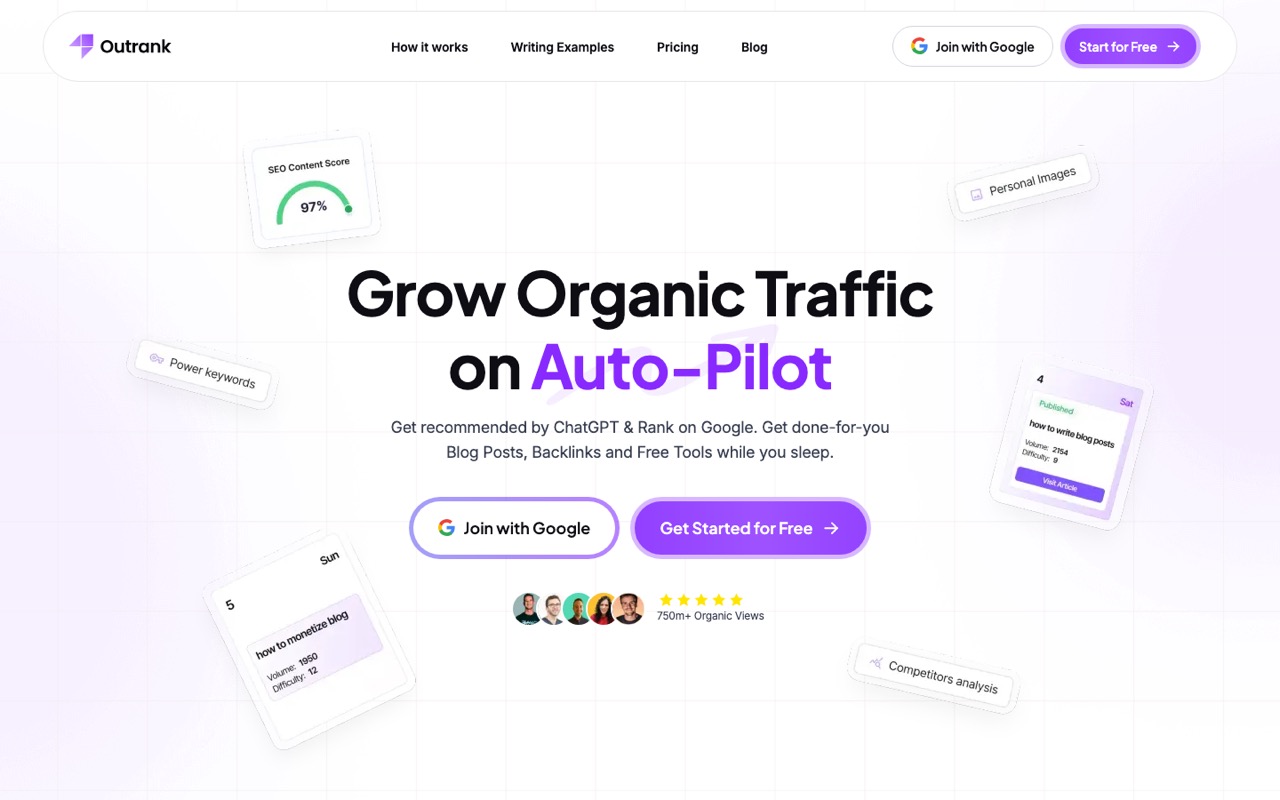
Outrank is an AI SEO platform that publishes for you. You connect a site, it researches keywords, writes articles, generates images, and pushes finished posts into your CMS on a schedule without you touching them.
The integration list is genuinely broad: WordPress, WordPress.com, Webflow, Shopify, Wix, Framer, Notion, Ghost, Next.js, and a custom webhook. It publishes real posts into your site rather than rendering changes through a JavaScript layer, which is the architecturally correct call and a real point in its favor.
There is also a REST API and an official CLI (npm install -g outrank-cli) so coding agents can drive it programmatically. For the kind of reader who already runs SEO through Claude Code, that is the most interesting thing on the feature list.
The other half of the product is the Backlink Exchange. It is a credit-based network: you earn credits by hosting links to other members' sites, and you spend credits to get links pointed at yours. Hold that thought, because it is the part of this product that carries the real risk, and I will come back to it.
The company is Outrank SAS, registered in Paris, France (SIREN 988 048 575), per the footer on its own pricing page.
Outrank Pricing, Verified
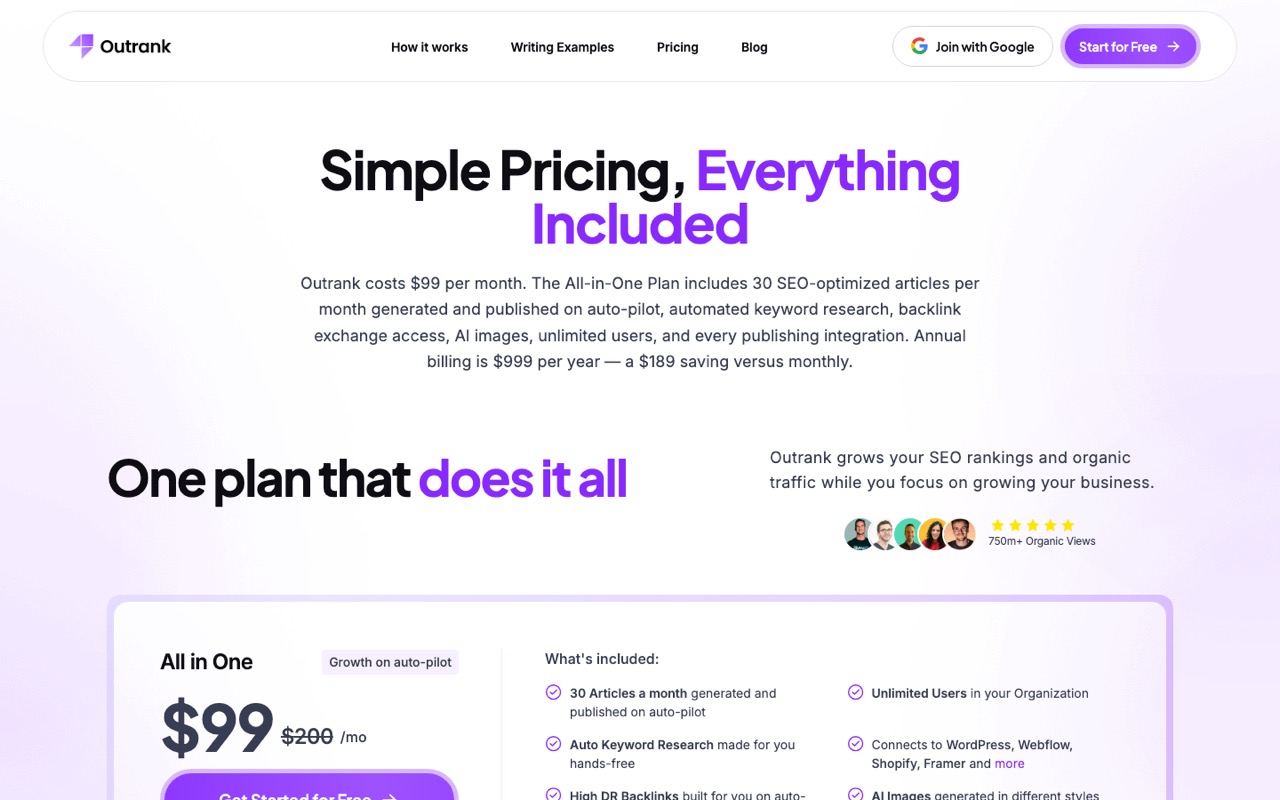
Outrank's pricing page renders with JavaScript, so I pulled a full render rather than trusting a cached copy. As of August 18, 2026, there is exactly one plan.
| Item | Price | What it covers |
|---|---|---|
| All-in-One Plan | $99/month or $999/year | 30 articles/month, unlimited keyword research, backlink exchange access, AI images, unlimited users, all integrations |
| 60 articles/month | +$85/month | Add-on, doubles output for one site |
| 90 articles/month | +$160/month | Add-on, triples output for one site |
| Human Curated Service | $1,399/month | Human editors review and fact-check every article |
| Backlink Premium | $199/month | Extra backlink credits |
| Backlink Enterprise | $899/month | High-volume backlink credits |
| Free Tools Builder | $199/month | One interactive SEO tool per week |
| Premium Images | $49/month | Better image model |
| Directory Submission | $500 one-time | Submission to 100+ directories |
Annual billing at $999 saves $189 against monthly. Volume discounts apply automatically: 10% off for 2 to 4 sites, 15% for 5 to 19, and 20% for 20 to 25.
Two things on that table deserve a flag.
The first is the $1,399 Human Curated Service. That is the add-on where "professional human editors review, fact-check, and polish every article before publication." Read that next to the base product and the implication is hard to miss: fact-checking is not what the $99 plan does. It is a fourteen-hundred-dollar upgrade. For a tool publishing 30 articles a month to your domain under your name, that is the single most important line on the pricing page.
The second is that the base plan is genuinely cheap for what it does mechanically, and I am not going to pretend $99 for 30 published articles is a bad deal on volume alone. It is not. The question is whether volume is the thing you actually need, and I will get to that.
The Trustpilot Distribution Is the Story
Update: As of September 30, 2026, the profile reads 3.7 across 87 reviews, 81 of them from the past twelve months, and Trustpilot still notes that Outrank has no recent history of inviting reviews. The breakdown below is the August 18 snapshot.
On August 18, Outrank held a 3.4 TrustScore across 71 reviews, 70 of them in the last twelve months. That number alone undersold what was happening underneath it.
I pulled the profile's underlying data rather than eyeballing the page. Of the 20 most recent reviews at the time, 13 were one star and 7 were five star. There was nothing in the middle. Trustpilot's own count put 23 negative reviews in the pool overall.
Then I checked how those reviews arrived, and this is the part that gives the number its weight.
Trustpilot publishes a transparency breakdown for every profile. For Outrank, all 70 reviews in the past twelve months came in organically: zero invited, zero automatic, zero redirected. Trustpilot states outright that it has no recent record of Outrank asking customers for reviews.
That matters more than it sounds. Most vendor ratings you read are inflated by solicitation, because a company sending review requests to its happiest customers reliably lifts its average. Outrank is not doing that. The 3.4 is what people said when nobody prompted them, which makes it a more honest signal than most scores in this category, and a worse one for Outrank.
One more number from the same profile data, as it stood on August 18, 2026. Outrank had replied to 17.4% of its negative reviews, with an average reply time of 10.5 days, and its most recent reply to a negative review was logged in January 2026. That leaves seven months of one-star reviews after it with no public response.
What the One-Star Reviews Are Actually About
I read the negative pool rather than only counting it, because the count tells you nothing about the failure mode. The complaints are strikingly uniform, and almost none of them are about SEO quality.
They are about billing and cancellation. Here is the pattern, in customers' own words:
"I tried to cancel my subscription months ago, but there is no way to cancel from within the website. I emailed support multiple times requesting cancellation and received no response."
"Charged me $99 after I tried to cancel before the trial ended. There is no cancel button in the app. The Stripe billing portal doesn't show one either."
"They lure you into a trial, then there is no support, no help, no nothing. They charge you $99 every month without you knowing, only the bank notification."
"I have been charged by this company for approximately six months, despite never knowingly using their services."
Now put that beside what Outrank's own pricing page says, in bold type, directly under the price: "Cancel anytime. No questions asked!"
Those two things cannot both be true, and I want to be careful about what I am claiming. I have not tried to cancel an Outrank subscription myself, so I cannot tell you from firsthand experience that the button is missing. What I can tell you is that multiple unrelated customers, across several months, independently describe the same specific mechanic: no self-service cancellation, and support that does not answer. That is a consistent enough signal to take seriously before you hand over a card.
The Refund Policy Is Real, and It Is Documented
This is worth knowing precisely, because one reviewer quoted it correctly and said it was not honored.
Outrank's Terms of Use, section 8.3, states verbatim: "First-time subscribers may request a full refund within seven (7) calendar days of the initial subscription payment by emailing [email protected]. Refunds are limited to one per customer and will be issued to the original payment method. After the 7-day period, all sales are final and non-refundable."
So the policy exists and it is clear. A customer wrote that he was charged $99 on July 3rd, emailed support the same day citing exactly that clause, emailed again on July 7, and had received nothing over a week later "from a company that advertises 24/7 support on every page."
I cannot verify any individual customer's account of what support did or did not do. What I can verify is the policy text, the date it was quoted, and that the complaint matches the written terms rather than misreading them. If you buy this, that seven-day window is the entire safety net, and you should treat it as a hard deadline rather than a courtesy.
The DR Challenge and Its Missing Refund Process
Outrank runs a public promotion at outrank.so/dr-challenge headlined "+10 DR in 60 days or your money back." The page states one hard qualifier, that your site must start under DR 30, alongside the steps it expects: run Outrank for 60 days, let it auto-post, and keep backlink generation on.
A customer reported following the program for the full 60 days, not getting the 10-point Domain Rating increase, requesting the refund under the stated terms, and receiving neither the refund nor an explanation.
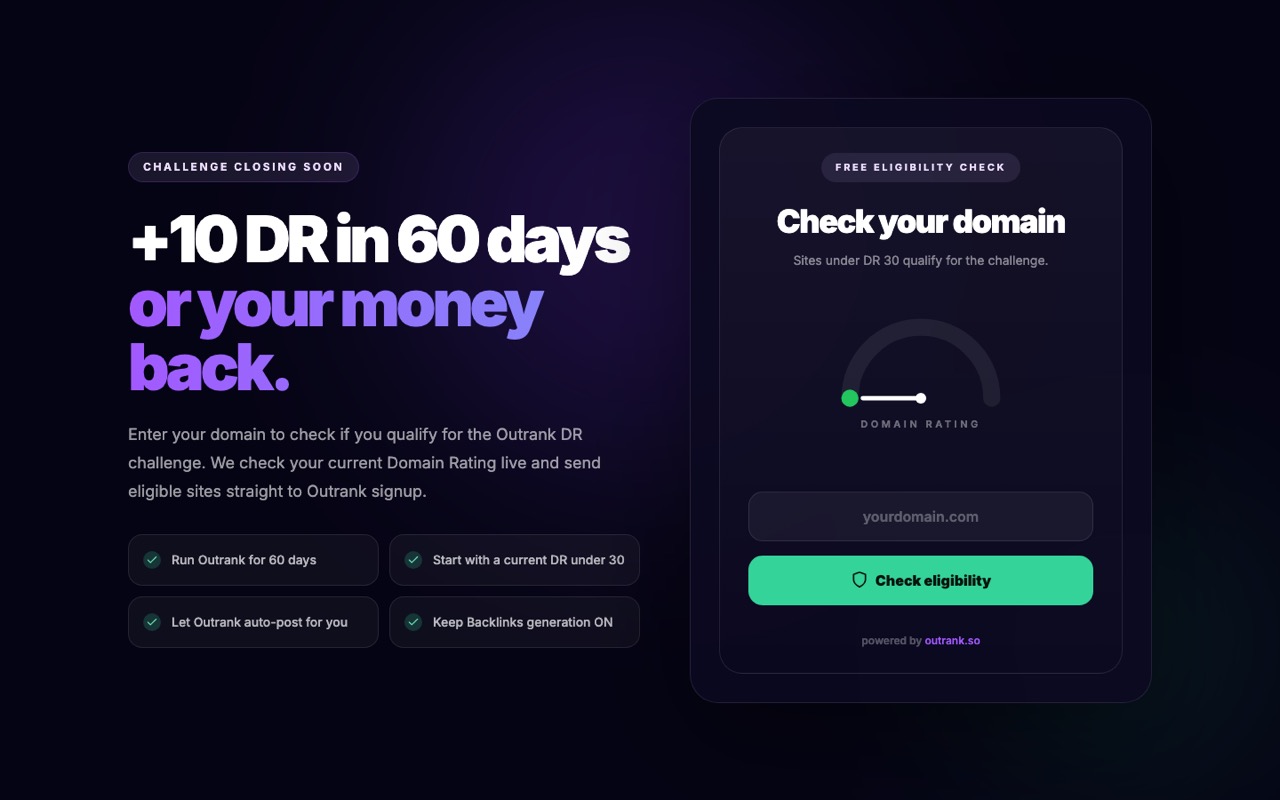
Here is what I can verify independently, and it is the part that matters. I rendered that challenge page in full. It states the guarantee and the qualifying terms, and it contains no refund claim process whatsoever. There is no form, no deadline, no named contact, no description of what evidence you submit or who adjudicates whether your DR moved. A guarantee with qualifying conditions but no documented mechanism for claiming it puts the entire burden on the customer to chase a company whose review pool is dominated by people saying support does not reply.
That is not an accusation of bad faith. It is a structural observation about a promise, and it is checkable by anyone who opens the page.
The Backlink Exchange Is the Real Risk
This is where I stop talking about billing and start talking about your site, because this is the part that can cost you something you cannot refund.
The Backlink Exchange works exactly as it sounds. You host links to other members' sites to earn credits, then spend those credits to receive links back. Outrank claims 25,000+ backlinks added across the network.
Google's spam policies name this directly. Under "Link spam," the documentation lists as a violation: "Excessive link exchanges ('Link to me and I'll link to you') or partner pages exclusively for the sake of cross-linking."
That is not my interpretation, and it is not a gray area someone is reading uncharitably. It is the mechanic the product is built on, described almost word for word in Google's own published policy.
The r/SaaS thread about this tool, which held the number one organic result for this query when I pulled the SERP on August 18, 2026, lands in the same place. Google's own snippet of it reads: "The articles are okay, but the backlink exchange is pretty bad. You are getting backlinks from low-authority websites, which look like spam."
Notice what the Outrank success stories lead with. Of the six featured on its success-stories page, the headline results are framed around Domain Rating rather than revenue, qualified leads, or even organic traffic. "DR 15 to DR 25 in 4 weeks." "Domain authority from 13 to 36 in four months." Domain Rating is an Ahrefs metric. Google does not use it. You can move it reliably by acquiring links, which is precisely what an exchange network does, and you can move it without moving a single thing that pays you.
So the headline result this product advertises is a third-party score that responds directly to the mechanic Google names as link spam. That is the sentence I would want someone to read to me before I connected this to a domain I cared about.
Read Section 7 of the Terms Before You Turn Links On
Everything above is inference from Google's policy. This next part is Outrank's own contract, and it is the most important thing in this review.
In plain English, before I quote any of it: Outrank publishes links to your website without showing them to you first, and you agree in advance that if Google punishes your site for those links, the loss is yours and Outrank owes you nothing.
Both halves of that are written down. Section 7.2 says that when you activate a backlink package, Outrank's system "automatically creates and publishes the agreed-upon links," and that "no manual preview or approval step is provided." No sample, no queue, no approval screen. It also means the reviewer who reported finding a competitor's link inside an article on his own site was describing something the contract expressly allows.
Section 7.3 handles the consequences: "Search engines set and update their own rules. They may reduce visibility or penalize sites they believe use links in ways that violate those rules. By choosing to use the Backlink Exchange you accept that risk and agree to indemnify and hold us harmless from any related penalties, losses, or liabilities."
Read that twice. Outrank has written into its terms that its link product may get you penalized, and that if it does, you carry the loss and agree to hold Outrank harmless. To be fair, section 7.4 says the company monitors industry guidelines and refines its placement systems to align with best practices, and indemnity clauses of this shape are standard legal hygiene rather than an admission of guilt.
But note who is holding which end. The vendor takes $99 a month, publishes links to your domain without showing them to you first, and has you sign away recourse if Google reacts. That is a clean transfer of the entire downside onto the customer, and it is in writing on their own site.
The Second Google Policy Problem
There is a second exposure, and it applies to the content half of the product.
Google's spam policies define "scaled content abuse" as "when many pages are generated for the primary purpose of manipulating search rankings and not helping users," and specifically name "using generative AI tools or other similar tools to generate many pages without adding value for users." I broke down where that line actually falls in practice separately.
Read that carefully, because the distinction is the whole game and most people get it backwards. Google's policy does not say AI content is banned. It says pages generated at scale without adding value are. Volume is not the violation. Valuelessness is.
I want to be fair here: 30 articles a month is not automatically scaled content abuse, and I publish AI-assisted content myself on the site you are reading. The trigger is publishing pages that add nothing, which is a function of what goes into them and who checks them, not of how they were drafted.
Which brings you back to that $1,399 line item. The version of Outrank where a human fact-checks every article costs $1,498 a month all in. The $99 version publishes 30 unchecked articles to your domain. Those are two genuinely different products with two genuinely different risk profiles, and the pricing page is honest about which is which if you read it closely.
Does It Work on Outrank's Own Site?
This is the test I apply to every tool in this category, because a company selling automated SEO has unlimited budget, full control and every incentive to prove the method on itself. It is the most honest demo available.
Outrank passes the first half. Its domain ranks for 2,477 keywords in the US, per a DataForSEO rank pull I ran on August 18, 2026, which is a real footprint and more than most tools in this price band manage. The method demonstrably produces pages that rank.
What those pages rank for is the part worth your attention. Sorted by traffic value, the top results are:
- "search google or type a url" at position 5, which alone accounts for the overwhelming bulk of the site's organic traffic
- "search engines other than google" and "google alternatives" at positions 8 to 10
- "blog entry examples for students" at position 1
- "googlebot login" at position 42
These are informational browser-and-homework queries. A person searching "search google or type a url" is trying to fix their address bar. A person searching "blog entry examples for students" is doing an assignment. Neither is buying SEO software, and the traffic is concentrated in essentially one page.
I want to be fair about what this proves. It proves the content ranks, which is a genuine result and more than many competitors can show. It does not prove the content reaches anyone who buys anything, and on the site where the tool is best resourced, the commercial keywords are largely absent from the top of the list.
There is a tell worth noting on top of that. BabyLoveGrowth, a completely separate $99 competitor I looked at the same week, ranks for an overlapping set of the same filler terms, including student blog examples and article-length queries. When two rival tools independently converge on the same low-commercial-intent topics, that is the shape of the underlying keyword strategy showing through, not a coincidence.
What Outrank Genuinely Does Well
The critique only means something if the credit is honest first, so here is the credit.
The integration coverage is real and broad, and direct CMS publishing is the right architecture. The API and CLI are a legitimately good idea that most competitors in this price band do not offer. Unlimited users on a $99 plan is generous when rivals charge per seat. Article generation in 150+ languages is a real capability. And the seven-day refund policy, whatever the disputes about honoring it, is written down clearly rather than buried.
The five-star reviews are not empty either. One reads: "I have been really happy with my first few weeks of using outrank. The quality of the blogs it produces are really good. I go through and check everything."
Read that last sentence again, because it is the most useful line in the entire positive pool. "I go through and check everything." The happiest reviewer in the set is describing a workflow where a human reviews every article before it goes live. That is the correct way to use this category of tool, and it is the opposite of the auto-pilot the marketing sells.
Who Should Actually Buy Outrank
Buy it if you will treat it as a drafting engine and edit everything. At $99 for 30 drafts with CMS publishing and an API, it is priced fairly as a content pipeline. Turn the backlink exchange off, review every article, and you have a reasonable tool. That is not how it is marketed, but it is how the satisfied customers describe using it.
Do not buy it if you are turning on auto-pilot and walking away. The default configuration publishes unreviewed AI articles to your domain and points exchange links at it, which lines up with two separately named Google spam policies at once. If nobody is reading the output, you are not saving time. You are accumulating a liability on an asset you own.
Do not buy it if you cannot afford a billing fight. I am not going to soften this. The most common complaint in the public record is that cancellation is hard and support does not answer, and Outrank has replied to under a fifth of its negative reviews with a seven-month gap in responses. If that would be a genuine problem for you, use a virtual card with a hard limit or skip it.
Do not buy it if what you actually lack is judgment. This is the honest one. If you cannot tell whether an article is worth publishing, a tool that publishes 30 of them a month is not solving your problem, it is scaling it.
The $99 Question Nobody Frames Correctly
My bias is loudest here, so discount it accordingly.
The debate about tools like this usually gets framed as cheap software versus expensive agency. That framing is wrong, and it is why people buy the wrong thing.
Outrank sells two products bundled at one price. The first is a content pipeline: research, drafting, images, CMS publishing on a schedule. That is real engineering and $99 is fair for it. The second is a link scheme, and it is not priced at all, because its cost is contingent. It is zero if Google never reacts and it is your domain if Google does. You cannot evaluate a bundle where one component has an unpriced tail risk by comparing its monthly fee to anything.
The pipeline half is also the half that has changed most in the last year. Drafting and publishing on a schedule is now something an AI assistant does directly when you give it a defined process. What no tool sells you, at $99 or $499, is the judgment about which pages are worth publishing, and that is the part that actually determines whether any of this works.
I can be concrete about that because I tested it on my own domain rather than a client's. This site started at zero in February 2026 with no backlinks and no domain history. Six months later it had 5.77K clicks and 890K impressions in Google Search Console, 12.1K AI citations tracked in Bing Webmaster Tools, and over $100K in attributable revenue. No exchange network and no partner links, which matters here specifically because it means the growth is not resting on the mechanic this post spends 2,000 words warning you about. The charts are on my AI SEO consulting page if you want to check them.
I turned that process into an AI SEO System, at $199 once, and the structural argument for it over a subscription is simple: it runs on AI tools you already pay for, and you keep it when you stop paying me. If you would rather someone just look at your site and tell you what to fix first, a consulting session does that instead.
The Ten-Minute Audit You Can Run on Any AI SEO Tool
Everything in this review came from six checks that took less time than a demo call, and none of them required a subscription. Tools in this category launch constantly, so the method is worth more to you than the verdict on this particular one. Run these before you enter a card anywhere.
- Read their llms.txt against reality. Try
vendor.com/llms.txt. It is the file they write for AI models, so it is where the most flattering version of their numbers lives. Compare any rating it claims to the live review profile. - Read the Terms, not the sales page. Search the terms for "refund," "cancel," and "indemnify." Where the marketing page and the contract disagree, the contract is the one you signed.
- Check Trustpilot's transparency tab, not just the score. It is at
trustpilot.com/review/<domain>/transparencyand it shows whether reviews arrived organically or by invitation, how many reviews the company has reported, and how many of those reports were ruled invalid. - Ask whether a guarantee has a claim process. A promise with qualifying conditions but no stated deadline, form, or contact is a marketing asset, not a warranty.
- Rank-check the vendor's own domain. They have unlimited budget and full control, so their own site is the most honest demo of their product. Look at what it actually ranks for, not how much.
- Match the link mechanic against Google's spam policy wording. If the product description and the policy describe the same thing in nearly the same words, that is your answer regardless of how the vendor frames it.
Applied to BabyLoveGrowth, the same six checks surfaced a different and arguably worse problem, which is a decent sign the method travels.
My Verdict on Outrank
Outrank is a competent publishing pipeline attached to a link scheme that Google's documentation describes as spam, sold alongside a self-published rating, in the file it hands to AI models, that is 1.1 points above its actual one.
Each of those three things is verifiable in about ten minutes, and I would rather hand you the method than the verdict. Open outrank.so/llms.txt and read the rating it claims. Open the Trustpilot profile and read the real one. Open Google's spam policy page and read the link exchange line. Then decide.
If you buy it, use it as a draft generator, edit every article, leave the exchange off, put a calendar reminder on day six of the refund window, and pay with a card you can cap. That is the version of this product I would not argue with.
Outrank.so Review FAQs
How much does Outrank.so cost?
Outrank costs $99 per month or $999 per year on a single All-in-One Plan covering 30 auto-published articles, unlimited keyword research, backlink exchange access, unlimited users and all CMS integrations. The add-on worth knowing about is the Human Curated Service at $1,399 per month, which is where human fact-checking of your articles lives. Volume discounts run 10% to 20% for multiple sites. Verified on a full render of outrank.so/pricing, August 18, 2026.
Is Outrank.so legit?
Outrank is a real company, Outrank SAS, registered in Paris, France under SIREN 988 048 575, with a working product and paying customers. Legitimate as a business is not the same as safe for your site. Its Trustpilot score is 3.7 across 87 reviews, its backlink exchange matches the practice Google's spam policies name as "excessive link exchanges," and the most common complaint in its public review pool is that self-service cancellation does not exist. Treat it as a real product with real risks rather than as a scam or as a safe default.
What is Outrank.so's actual Trustpilot rating?
3.7 out of 5 across 87 reviews as of September 30, 2026, up from 3.4 across 71 on August 18. Both are materially lower than the "Rated 4.8/5 by users" claim Outrank publishes in its own llms.txt file, which is the file AI assistants read when asked about the product. On August 18, the 20 most recent reviews were 13 one-star and 7 five-star with nothing in between, and Trustpilot recorded all 70 recent reviews as organic, with zero collected by invitation. Trustpilot still states it has no recent record of Outrank asking customers for reviews.
Is Outrank's backlink exchange safe for SEO?
It carries real risk. Google's spam policies explicitly list "excessive link exchanges ('Link to me and I'll link to you') or partner pages exclusively for the sake of cross-linking" as link spam, and a credit-based network where you host links to earn links is that mechanic by design. Customers on Reddit and Trustpilot independently describe the resulting links as coming from low-authority sites that "look like spam." Note also that of the six customer stories featured on its success-stories page, the headline results are framed around Domain Rating, an Ahrefs metric Google does not use, which responds to link acquisition without necessarily reflecting traffic or revenue.
Can I cancel Outrank.so anytime?
Outrank's pricing page states "Cancel anytime. No questions asked!" Multiple recent Trustpilot reviewers dispute this in specific terms, independently reporting no cancellation option inside the app or the Stripe billing portal and unanswered support emails, with several describing continued charges afterward. Separately, the written Terms of Use section 8.3 gives first-time subscribers a full refund within seven calendar days of the initial payment by emailing support, limited to one per customer, after which all sales are final. If you subscribe, treat that seven-day window as a hard deadline.
What is the best alternative to Outrank.so?
It depends which half you need. If you want a drafting and publishing pipeline, most tools in this band do the same job, and I compare them in my best AI SEO tools roundup alongside Rankability and Adaptify, and I priced seven auto-publishers against Outrank from their live rate cards. If what you are missing is knowing which pages to write and how to get cited by AI assistants, that is a skill rather than a subscription, and it is what I packaged into my AI SEO System for a one-time $199. What I would not do is replace a link exchange with a different link exchange.
How I sourced this: pricing, terms, llms.txt, success-story and DR Challenge figures were read off full JavaScript renders of outrank.so on August 18, 2026. Trustpilot ratings, review counts, review text, verification sources and reply statistics were pulled from the live Trustpilot profile the same day. Google policy language is quoted verbatim from Google Search Central's spam policies documentation. G2 blocks automated access, so third-party claims of a G2 rating for this product are not verified here. I am not an Outrank affiliate and earn nothing if you buy it. I sell a competing AI SEO product, which is disclosed at the top of this post. Full disclosure.