
OpenSEO Review: Is This Open Source Semrush Alternative Worth It?
In February, Google Ads data put US searches for "openseo" at 10 a month. In August the same estimate was 2,900. Its GitHub repository passed 20,000 stars in under seven months.
OpenSEO is an open source SEO platform for keyword research, rank tracking, backlinks, site audits and AI visibility, with an MCP server built in. MCP (Model Context Protocol) is how an AI assistant such as Claude or Codex plugs into another tool and uses its data mid-conversation. The hosted version costs $10 a month.
Almost all of its SEO data comes from DataForSEO, a pay-as-you-go data service I run every day inside Claude Code and Codex. OpenSEO's own GitHub page explains how the hosted service makes money: it charges "28% extra for every request we make to DataForSEO."
So the useful question is narrower. What does the markup and the monthly fee buy you, and does an AI agent already connected to DataForSEO make that layer redundant?
Where I stand: I have not used OpenSEO myself. This review works from OpenSEO's public code and live pricing pages, plus comparable requests I ran through my own DataForSEO account. I am a DataForSEO affiliate, and I sell a competing AI SEO product.
What OpenSEO Is and Who Builds It
OpenSEO is built by Ben Senescu, a former Klaviyo software engineer, and the company behind it is Every App, Inc. The code is MIT-licensed, which means anyone can use, modify or copy it for free.
The repository was created in February 2026 and has shipped 37 releases since, the latest being v0.1.9 on September 17. For a buyer, "pre-1.0" means features, setup steps and pricing behavior can change faster than they would in a mature product.
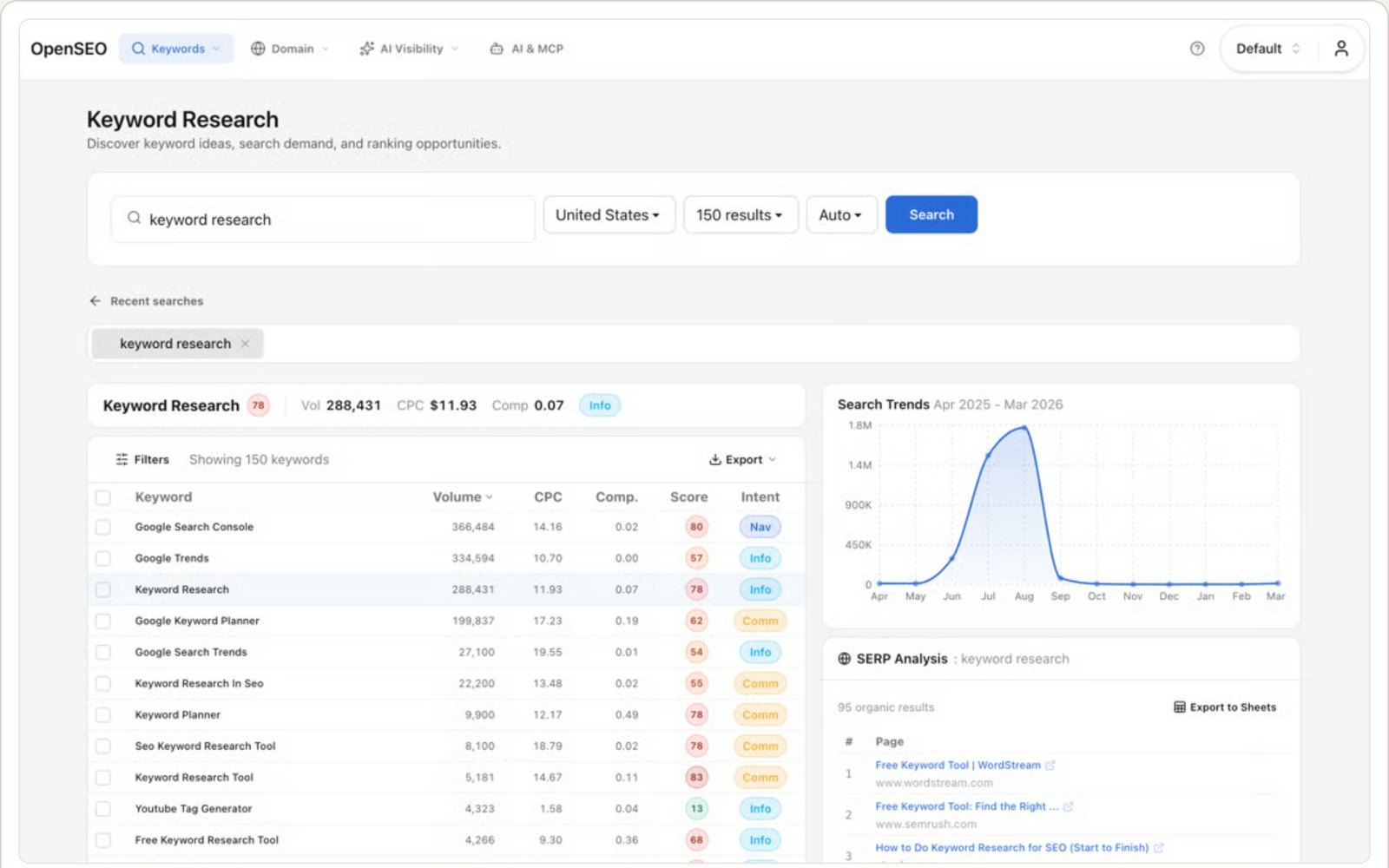
The web app covers the jobs most small teams buy Semrush or Ahrefs for. You can find keyword ideas, check a competitor's rankings and backlinks, track your own positions, audit a site, and look up how often AI assistants mention a brand.
The homepage pitch has shifted toward agents. The headline reads "SEO made simple," followed by "Connect your favorite AI agent in 2 minutes." The MCP server exposes 57 tools, and ten packaged skills walk an agent through jobs like competitor analysis and link prospecting.
You can run it two ways. Hosted, at openseo.so, for $10 a month. Or self-hosted for free, where you bring your own DataForSEO account and pay DataForSEO directly.
For most marketers reading this, hosted is the practical choice. Self-hosting takes technical setup, and the simplest local version runs without a login, so it is meant for a private machine rather than the open internet.
Where the Data Actually Comes From
My starting assumption was that OpenSEO is a friendly screen over DataForSEO and not much else. For the third-party SEO numbers, that turned out to be right.
OpenSEO's public code shows keyword ideas, search volume, live Google results, competitor rankings, backlinks, local results and AI mentions all requested from DataForSEO behind the scenes. OpenSEO does not collect that data itself.
It does not hide this either. The homepage says it outright: "An SEO tool is nothing without quality data. That's why OpenSEO uses DataForSEO. But we also do much more."
One more detail from its GitHub page: the DataForSEO link there carries OpenSEO's own affiliate code. So OpenSEO earns from DataForSEO signups the same way I do, and anyone recommending either path is sending money to DataForSEO.
The "much more" holds up, and it is where my first read was too simple. Several pieces are OpenSEO's own work:
- Its own site audit crawler. OpenSEO chose to build one rather than use DataForSEO's. Only the optional page-speed check goes to DataForSEO.
- Google Search Console and Google Analytics connections, pulled straight from Google and free of credits.
- Memory between sessions. Each project stores your business overview, goals and saved keywords, and your agent reads them when it starts work.
- Scheduled rank tracking with history, plus saved reports you can share with a link.
- An in-app assistant called SAM, currently in beta, which runs on an outside AI model rather than DataForSEO.
So the fair description is a DataForSEO client with a workflow layer and its own crawler. The data is rented. The memory, scheduling and reporting are built.
If you already have an AI agent connected to DataForSEO, you have the data half. The question is whether you need the other half.
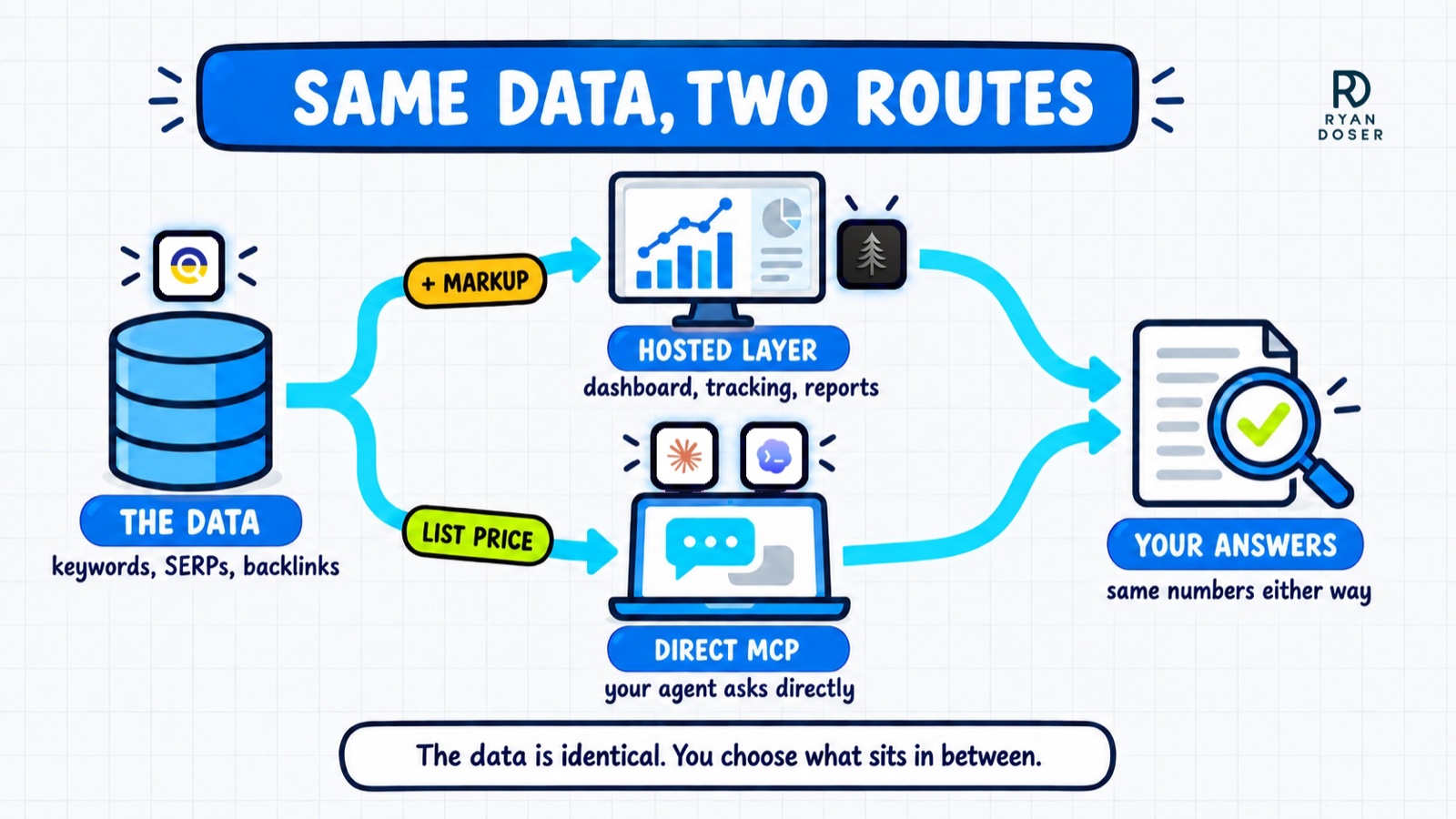
What the Direct Route Looks Like in Claude Code
I walked through the direct setup on my YouTube channel, using keyword research as the example. The written version lives in my guide to keyword research in Claude Code.
The setup has three parts. A keyword research skill, which is a saved set of instructions telling Claude Code how you want the job done. A DataForSEO account connected through its MCP server. And a plain prompt, such as asking for 15 keyword ideas around a root topic.
Claude Code comes back with a table of search volume, keyword difficulty, cost per click and intent. If some ideas are off-target, you say so and Claude revises the list, and you can update the skill so the fix sticks next time. The keywords you keep can go straight to a blog-writing skill in the same session. I run the same setup in Codex as well.
In the video, a full keyword run, which can involve several requests, cost me roughly five to ten cents. The keyword research skill is the direct-route counterpart to OpenSEO's packaged skills, with one difference: it encodes your own process.
The video also covers the upgrade path. Ahrefs Lite at $129 a month includes MCP access, and I still rate Ahrefs' keyword data above DataForSEO's. That ceiling on the underlying data applies to OpenSEO too, since it runs on DataForSEO.
Affiliate links below. Full disclosure.
If you want to try this route, DataForSEO's free starting credit covers a few test runs before you deposit anything.
What $10 Buys Once the 28% Comes Out
There is one plan. The OpenSEO pricing page lists the Base Plan at $10 a month, and that $10 includes $10 of usage. There is no annual option. Prices below were checked on September 23, 2026.
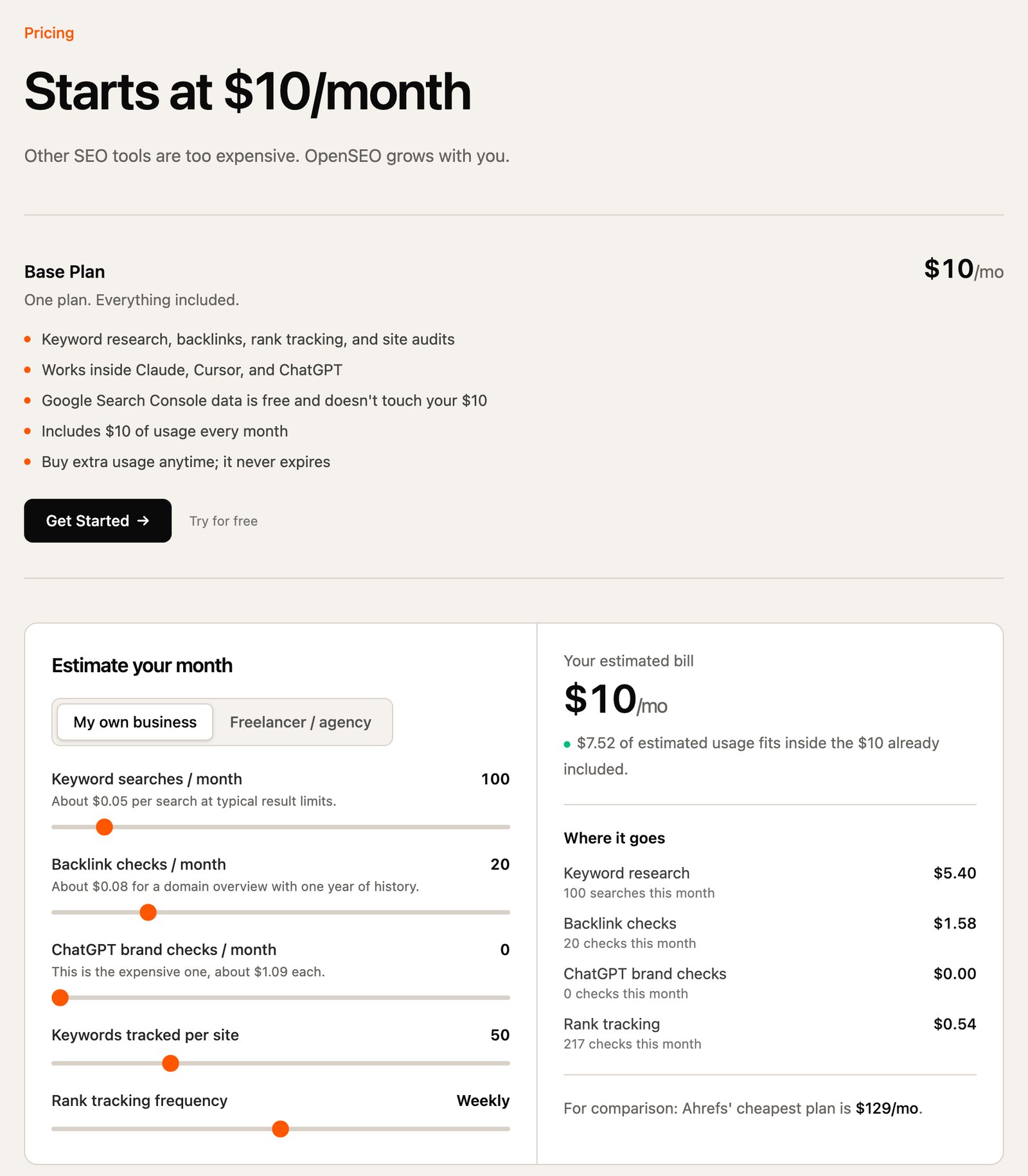
The usage works like a prepaid balance. Each task draws it down, and the page's estimator prices the common ones: about $0.05 per keyword search, about $0.08 per backlink check, and about $1.09 per ChatGPT brand check, which the page calls "the expensive one."
How the balance behaves matters as much as the price:
- The included $10 resets every billing cycle, so whatever you do not use that month is gone.
- Extra top-up credits "roll over indefinitely," but you still need an active subscription to spend them.
- When credits run out, tasks return errors instead of billing you more. No surprise invoices, which I like.
The free trial is $0.50 of credits, enough for roughly ten keyword searches.
Take the 28% out and the $10 plan buys about $7.81 of DataForSEO requests. OpenSEO's billing code also charges SAM's AI model costs to the same credit pool, which the pricing FAQ does not mention.
OpenSEO's pricing page compares itself this way: "Ahrefs' cheapest plan is $129/mo." That is Ahrefs Lite, its entry full suite. The live Ahrefs pricing page also lists a limited $29 Starter plan and a free tier, so the gap is smaller than the line suggests.
Semrush sits in the same band as Ahrefs Lite. Its entry SEO plan is $139 a month, or $117.33 a month billed annually, on the Semrush pricing page. Against either full suite, $10 is a very different purchase. The closer comparison is DataForSEO itself.
I Ran Comparable Jobs Straight Through DataForSEO
To see what the markup means in dollars, I ran requests matching OpenSEO's estimator tasks directly through DataForSEO in Claude Code, on my own account. DataForSEO reports the exact cost of every request, so the left column is what I was charged.
| Task | DataForSEO direct (my charge) | OpenSEO's estimate |
|---|---|---|
| Keyword research, 150 ideas | $0.03 | About $0.05 |
| Backlink overview plus a year of history | $0.048 | About $0.08 |
| One live Google results page | $0.002 | Part of rank tracking |
| AI brand lookup, ChatGPT side (three requests) | $0.30 | About $1.09 |
| AI brand lookup, Google side (three requests) | $0.32 | About $1.09 (same per-platform rate) |
The whole run cost me about 70 cents. Adding OpenSEO's stated 28% to that exact run would make it about 89 cents.
The estimates run higher than my charges because they assume typical result sizes, and my test brand returned very few rows. DataForSEO prices the AI brand data at about $0.10 per request plus a fraction of a cent for every mention returned.
OpenSEO's pricing page labels its $1.09 a ChatGPT check, but its pricing code budgets that amount per platform, and every brand lookup covers both ChatGPT and Google. A brand with more mentions costs more.
That cuts against my own starting position: at small volume, the 28% markup is pocket change. Nobody should skip OpenSEO to save 20 cents.
Where the two differ more is how you pay. OpenSEO bills $10 every month and wipes the unused part. DataForSEO asks for a $50 minimum deposit, and new DataForSEO accounts start with $1 of free credit to test first.
That DataForSEO balance never expires. If your usage is $3 a month, OpenSEO still charges $10, while a $50 deposit at that pace lasts more than a year. Heavy users see the markup grow with every request instead.
What the AI Visibility Data Says About OpenSEO Itself
OpenSEO has two AI search features. Prompt Explorer runs one-off live prompts across ChatGPT, Claude, Gemini and Perplexity. The AI Visibility brand lookup reads DataForSEO's LLM Mentions database, a stored collection of ChatGPT and Google AI answers, and it is the one I ran direct above.
For openseo.so, that database held zero ChatGPT answers and 13 Google AI answers. Running the same query for Semrush returned 3,224 ChatGPT mentions, so the query itself worked.
Yet when I asked ChatGPT, Claude, Gemini and Perplexity about OpenSEO by name, with live web search on, all four identified DataForSEO as its data source and quoted its $10 price. That is a different test, since a named lookup only shows an assistant can research a brand when asked.
The takeaway for a buyer: on a young brand, the brand lookup can read near zero on the task OpenSEO calls "the expensive one." Going direct returns the same stored result, since it is the same database. Check live answers too, which Prompt Explorer can run inside OpenSEO.
One more detail for agent users: none of OpenSEO's 57 MCP tools cover AI visibility yet. It lives in the web app only, and scheduled prompt tracking is listed as coming soon on the public roadmap.
What OpenSEO Does Better Than a Raw DataForSEO Connection
Rank tracking with history. A DataForSEO connection answers "where do I rank right now?" and keeps no history of your tracked keywords. OpenSEO runs tracking on a schedule and stores the history, which an agent-only setup has to rebuild on its own.
A site audit you do not have to design. Its crawler checks up to 10,000 pages on the paid plan. With DataForSEO alone you would pay per page for its site audit data and decide what to check yourself.
Memory your agent can use. Saved business context, keywords and reports mean you do not re-explain your site every session. Shared report links, labeled "Made with OpenSEO," are easy to send to a client or teammate.
Less setup. Connecting DataForSEO yourself means an account, a deposit, an MCP connection and knowing what to ask for. OpenSEO charges partly for making those decisions for you, and $10 is a smaller first step than a $50 deposit.
A screen for people who avoid terminals. A teammate who will never open Claude Code can still use the web app.
The Weak Spots in a Young Tool
One person writes nearly all of the code. GitHub lists 19 contributors, but Ben Senescu accounts for the overwhelming majority of the work. That is normal for a young open source project, and it is also a risk if you build a client workflow on it.
Its backlink data can only be as complete as DataForSEO's. In my DataForSEO review I noted its backlink data does not match the depth of Ahrefs' index, and OpenSEO inherits that gap along with the data.
"No subscriptions" only applies if you self-host. The GitHub page lists "No subscriptions" as a reason to use it, while the pricing FAQ says "you need an active subscription in order to use OpenSEO." Both are true for different setups, but a buyer reading one page gets the wrong idea.
The name is crowded. Google's AI Overview for "openseo review" currently summarizes employee reviews of an engineering firm called Openso. Perplexity mixed in two unrelated projects with the same name. The product in this review lives at openseo.so and github.com/every-app/open-seo.
Usage billing is hard to forecast at agency scale. The estimator has a freelancer and agency preset, about $25 a month for 15 sites, but it sets AI brand checks to zero. At the estimator's $1.09 example, one ChatGPT brand check for each of ten clients would use more than the included $10 on its own.
OpenSEO vs the DataForSEO MCP in Claude Code
| OpenSEO (hosted) | DataForSEO MCP, direct | |
|---|---|---|
| Cost to start | $10 a month, $10 of usage included | $50 minimum deposit, $1 free credit to test |
| Data source | DataForSEO, plus a 28% markup | DataForSEO at list price |
| Unused credit | Included credit resets monthly | Balance never expires |
| Agent access | 57 MCP tools, no AI visibility yet | Broader access to DataForSEO's catalog, including AI mentions |
| Rank tracking history | Built in and scheduled | Not included, you rebuild it |
| Site audit | Own crawler, up to 10,000 pages | DataForSEO's audit data, priced per page |
| Search Console | Built in, free | A separate free MCP, with its own setup |
| Web interface | Yes | None, your agent is the interface |
My own setup is the right-hand column, paired with the free Search Console server covered in my SEO MCP servers roundup. If you have not connected an MCP server before, my guide to setting up MCPs in Claude Code covers the process.
For research, that combination covers what OpenSEO's data half does, without the monthly fee or the markup, and with more of DataForSEO's catalog in reach. If you already work inside an agent all day, the agent is the interface, and a second interface on top adds little for research.
Should You Pay for OpenSEO?
Pay for it if a Semrush or Ahrefs seat is out of budget and you want a dashboard for a small site. At $10 it is a low-risk way to find out whether you like working this way.
It also makes sense when scheduled rank tracking and shareable reports matter more to you than raw data, or when teammates and clients need a screen to look at.
Go direct instead if you already use Claude Code or Codex daily and are comfortable setting up a data connection. Add the free Search Console server, and you have the research side without the monthly charge.
Be careful with the AI Visibility brand lookup on a young brand, for the reasons above. The dedicated trackers in my AI visibility tools roundup are the comparison to make before you spend on it.
And leave self-hosting to people who already run their own servers. It saves the markup, but it adds a setup job most marketers do not need.
Where I Land on OpenSEO
OpenSEO is unusually open about its business. The GitHub page states the markup, and the homepage names the data source. That is more than most SEO tools tell you.
It is also mostly a way of buying DataForSEO with a workflow wrapped around it. For a small business owner who values a dashboard and scheduled tracking, $10 a month is a reasonable price for that wrapper.
For the marketers who read this blog, the practical choice is OpenSEO's MCP or DataForSEO's MCP, plugged into the same Claude Code or Codex. On that comparison, I still think you are better off connecting the DataForSEO MCP directly.
Three reasons, all from the numbers above. The direct connection reaches AI mention data that OpenSEO's MCP does not. You pay for what you use, with no $10 monthly floor wiping unused credit. And the balance never expires. For on-demand research, your agent already does the job.
The clearest exception is rank tracking. If a scheduled ranking history is the job you are hiring for, OpenSEO does that for $10 a month without you building anything.
OpenSEO Review FAQs
What is OpenSEO?
OpenSEO is an open source SEO platform built by Ben Senescu, a product of Every App, Inc., and released under the MIT license. It covers keyword research, rank tracking, backlinks, site audits and AI visibility, and it includes an MCP server for AI agents like Claude Code and Codex. Most of its SEO data comes from DataForSEO. The hosted version is at openseo.so.
Is OpenSEO free?
The code is free, and you can self-host it at no charge, but you still need your own DataForSEO account and pay DataForSEO for the data. The hosted version costs $10 a month. Its free trial includes $0.50 of credits, enough for roughly ten keyword searches.
How much does OpenSEO cost per month?
Hosted OpenSEO costs $10 a month for a single Base Plan that includes $10 of usage. The included credit resets each billing cycle, extra top-ups roll over, and tasks stop with an error instead of overbilling when credits run out. Checked on the live pricing page on September 23, 2026.
Does OpenSEO use DataForSEO?
Yes. OpenSEO says so on its homepage, and its public code requests keyword, search result, backlink, competitor and AI mention data from DataForSEO. According to its GitHub page, the hosted service charges 28% on top of DataForSEO's cost for every request. Its site audit crawler and its Search Console and Analytics connections are its own.
Is OpenSEO worth it?
For a small site on a tight budget, yes. It covers keyword research, rank tracking, backlink checks and site audits for $10 a month, against $139 for Semrush's entry SEO plan and $129 for Ahrefs Lite, though Ahrefs also sells a limited $29 Starter plan. If you already use Claude Code or Codex, connecting DataForSEO directly costs less at light usage.
Where this came from: OpenSEO's pricing and positioning come from its live site, its data sources, markup and MCP tools from its public GitHub code, and competitor prices from the Ahrefs and Semrush pricing pages, all checked on September 23, 2026. DataForSEO costs are charges on my own account that day. I have not used OpenSEO myself. I earn a commission on DataForSEO signups through my links, and I sell a competing AI SEO product. Full disclosure.