
DataForSEO vs Semrush: Which AI SEO Tool is Better?
A Semrush subscription is not one product. It is roughly a dozen products sold under one login and one monthly charge, and most people paying for it use two or three of them.
So the honest answer to which one is better is that they are not competing for the same job. Semrush is better at almost everything it sells, and DataForSEO is better at the one thing they overlap on, which is buying search data cheaply.
That is the part every comparison of these two tools skips. It sets up a duel, picks a winner, and never asks the question that actually decides your bill.
Before you compare DataForSEO to Semrush, open your last invoice and work out which parts of that bundle you opened this month. The answer changes what this comparison even means for you.
Affiliate links below. Full disclosure.
I run DataForSEO through Claude Code most working days, across my own site and client work. I have used Semrush in the past and do not pay for a seat today, so what follows on the Semrush side is read off its live pricing page, its documentation and its feature set rather than off a dashboard I log into.
If you are weighing the other big suite instead, I ran that comparison separately in DataForSEO vs Ahrefs, and it lands somewhere different, because Ahrefs sells a narrower product than Semrush does.
Semrush Is an Adobe Company Now
The logo on semrush.com reads "An Adobe Company," and that is the newest fact on this comparison by a wide margin.
Adobe completed its acquisition of Semrush on April 28, 2026, and Semrush told customers nothing changes for now on contracts, features, billing or support.
I take that at face value and would still prefer monthly billing over an annual commitment while a new owner settles in.
Neither company has said anything specific about the API or the MCP server, which is the part an agent workflow depends on.
The Plans Changed, and the PAA Box Still Has the Old Ones
When I pulled the search results for this comparison on August 22, 2026, Google's People Also Ask box answered "How much does Semrush cost per month?" with a table listing Pro at $139.95 and Guru at $249.95.
Those are not the plans a new buyer sees. The pricing page now sells SEO, Starter, Pro+ and Advanced, and the numbers moved with the names.
The old names still exist inside Semrush's modular toolkit model, where the help centre maps SEO Pro to Starter and SEO Guru to Pro+. What changed is what you are quoted when you go to buy.
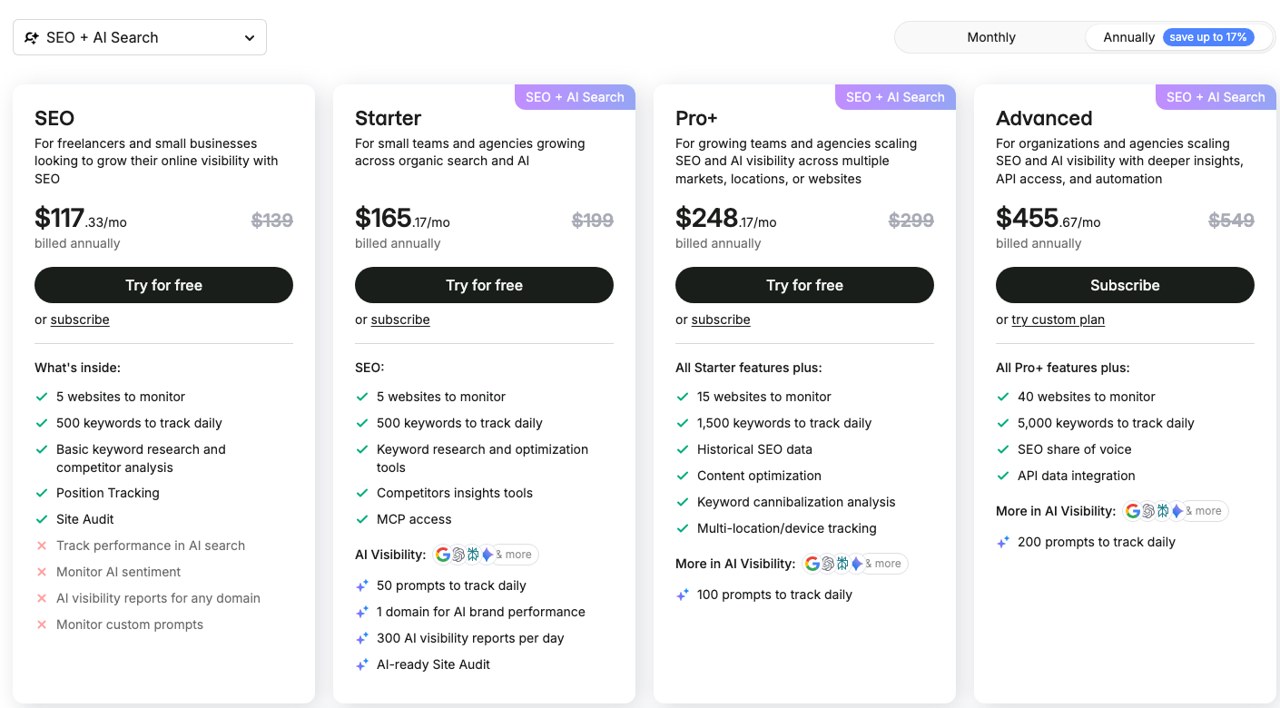
Verified on semrush.com/pricing today, the monthly rates are $139 for SEO, $199 for Starter, $299 for Pro+ and $549 for Advanced. Paying annually takes those to $117.33, $165.17, $248.17 and $455.67 per month.
One detail matters more than the rest for anyone reading a comparison post. MCP access starts at Starter, which is $199 a month, and the $139 SEO plan does not list it.
MCP stands for Model Context Protocol. In plain terms it is the plug that lets Claude or ChatGPT reach into a tool and fetch real data on its own, so you ask in a sentence instead of writing code. There is still a one-time setup, and it is a connection to authorise rather than a thing to build.
So if your reason for looking at either tool is connecting SEO data to an AI assistant, the entry price on the Semrush side is not the number on the front of the pricing page.
What You Are Actually Renting for $199 a Month
Here is the case for the bundle, made properly, because a comparison that undersells the incumbent is not worth reading.
A Semrush seat covers work that spans far past keyword research. Competitor and keyword gap analysis, traffic and market data on domains you do not own, position tracking that runs on a schedule, and site audits.
Then the AI visibility layer, which tracks prompts and brand sentiment across AI engines and is now bundled into the same plans rather than sold separately.
Check the tier before you assume a given feature is yours. Content optimization and historical data start at Pro+, share of voice and API access at Advanced, and extra users and white-labeled reporting are paid add-ons on top. Ahrefs gates its API differently, starting much lower than most sources claim, which I covered in Ahrefs API pricing.
Underneath all of it sits the thing that is easiest to overlook and hardest to replicate. It is an interface a non-technical person can be productive in on their first afternoon.
Hand a junior marketer a Semrush login and they will produce something useful today. Hand them raw API access and you have given them a project, not a tool.
I said as much in my roundup of the best AI SEO tools, where Semrush earns its spot as the all-in-one default rather than as the cheapest option on the page.
The One Slice DataForSEO Actually Buys Back
Now the narrow part. DataForSEO sells search data by the request from a prepaid balance, with no seat and no renewal.
The overlap with Semrush is real but thin. Keyword volume, live SERP results, backlink data as raw rows, and AI search surfaces.
What that costs, verified today on DataForSEO's own published rate card, is the reason people keep bringing this comparison up. Every figure below is on a public page you can open without an account.
A Google Organic SERP in the standard queue is $0.0006, which is sixty cents per thousand. High priority in that same queue is $0.0012, and live mode, which returns in seconds, is $0.002.
Google Ads search volume runs $0.06 per task in the standard queue, and one task covers up to 1,000 keywords. A full thousand-row backlink pull lands at about six cents.
The minimum payment is $50, so this is prepaid rather than free to begin. That balance does not expire and no month renews it.
Put a number on the slice. Say you pulled 1,000 SERPs in a month, 20 keyword volume tasks covering up to 20,000 keywords, and 20 full thousand-row backlink pulls.
In the standard queue that is $3.00. Pull all 1,000 SERPs in live mode instead and it is $4.40, because the speed tier is the only line that moves.
That is the arithmetic doing the work in every "replace your SEO suite" post you have seen. It is also, on its own, misleading, which is the next section.
What Leaves With the Subscription
Cancel Semrush and buy data per request instead, and here is the honest inventory of what stops existing.
Position tracking that runs on a schedule and charts itself. Site audits that crawl on a cadence and flag what changed. Keyword gap analysis. Paid search and ad copy research. Traffic analytics on competitor domains.
Content optimization tooling, local listings management, scheduled and white-labeled client reporting, and the AI brand sentiment layer.
Then the two that people underestimate most.
The interface, and anyone on your team who is not you. Raw JSON is not a deliverable. If a teammate or a client needs to look at something themselves, someone has to turn that raw output into a view first, and that someone is you.
Anything that depends on remembering last month. DataForSEO returns what is true at the moment you ask. Storing it, scheduling it and charting it is work you now own.
On raw data depth, I have been consistent about this and will stay consistent. Semrush and Ahrefs are ahead of DataForSEO, which I said plainly in my DataForSEO review. DataForSEO's keyword volumes arrive in Google Ads buckets, while the suites blend clickstream data on top.
So the trade is not "same thing, cheaper." It is a much narrower thing, much cheaper, with real work handed back to you.
One Publishes Every Price. The Other Will Not Tell You.
There is a difference between these two companies that has nothing to do with features, and it surprised me while checking figures for this post.
DataForSEO publishes a per-request price for every endpoint it sells, on public pages, with no login. Every figure I quoted above is one you can check in a browser right now.
Semrush does not publish what an API unit costs.
That gap, and the plan confusion underneath it, is the whole subject of my breakdown of Semrush API pricing.

Its developer documentation explains units thoroughly. How they are consumed, how to check your balance, what happens when you run out, even a parameter for limiting rows to spend fewer of them.
What it never states is a price. The docs go as far as telling you how many units each report consumes, ten per line for live data and fifty for historical, then route you to sales for a quote. The balance page sits behind a login.
What I can verify is the access rule. Semrush's MCP page states that MCP access is included in Semrush One and SEO Classic plans and is also available for API users.
For a marketer trying to budget an agent workflow before committing, that gap is the finding. On one side you can model your monthly spend to the cent before you deposit anything. On the other you cannot model it at all until you are already a customer.
The Third Option Nobody Puts on the Comparison Table
There is a path that is neither tool, and it showed up in Google's AI Overview for this query, which is how I found it.
People are building Semrush-shaped interfaces on top of DataForSEO data. The most serious is OpenSEO, an MIT-licensed project covering keyword research, rank tracking, backlinks, site audits and AI visibility, hosted at $10 a month.
It is worth watching and not worth betting a client on yet, because it is pre-1.0 at version 0.1.9 with roughly 95 percent of its commits from one maintainer. The hosted plan resells DataForSEO data at a 28% markup, and self-hosting means supplying your own DataForSEO key and clearing that $50 minimum underneath it. I priced what the hosted layer adds in my OpenSEO review.
It ranked fourth in my roundup of the best SEO MCP servers, and that placement still reads right to me.
Four Ways This Actually Goes
Do the audit first, then pick. List the parts of the bundle you opened in the last thirty days, and next to each one write what it would cost you in time or money to replace it.
Frequency alone is the wrong test. One position-tracking report that goes to a client every month can justify the whole subscription, and three tools you clicked once can justify nothing.
Keep the full suite, unchanged, if anything on that list would be genuinely painful to rebuild, or if anyone besides you logs in. The bundle is doing its job, and per-request pricing does not pay you back for work you now have to do yourself.
Downgrade a tier if the list is short and everything on it sits in a cheaper plan. Semrush now runs four tiers, so the gap between $549 and $199 is a real lever, and this is the outcome most people in this position actually need.
Keep the suite and add DataForSEO if you are running volume work that your plan meters, such as SERP checks across a roster of client sites. A $50 balance is cheap next to upgrading a tier to buy headroom, and the two do not conflict.
Leave, and accept the losses, only if your month is almost entirely keyword volume and live SERP research, you work in Claude or a similar assistant already, and nobody else needs a login. That reader exists and I am one of them for my own site, but they are rarer than the switching posts imply.
What should not decide it is a monthly price sitting next to a per-request price, because those two numbers are not measuring the same purchase.
What I Would Tell a Friend Over Coffee
The reason this comparison keeps getting written badly is that it flatters the reader. Cancel the expensive thing, buy the cheap thing, feel clever.
The real answer is duller and more useful. Plenty of people paying $199 a month would be just as well served at $139, and the fix is a plan audit rather than a migration.
DataForSEO is genuinely excellent at the slice it sells, and I use it daily because live SERP and AI search data at those prices beats paying a subscription for the same pulls. That is a narrow endorsement, deliberately.
If you cannot name what you used your Semrush plan for this month, you have a bundle problem. Buying an API is one way to solve it. Dropping a tier is the way almost nobody writes a post about, and it is usually the right one.
DataForSEO vs Semrush FAQs
Can I use DataForSEO instead of Semrush?
For one part of Semrush, yes. DataForSEO covers keyword volume, live SERP data, backlinks as raw rows and AI search surfaces, billed per request. It does not replace position tracking, site audits, keyword gap analysis, paid search research, local listings, client reporting or the interface itself. If those are why you subscribe, this is not a swap.
Does Semrush have an MCP server?
Yes. Semrush's MCP page states that access is included in Semrush One and SEO Classic plans and is also available for API users, with documented setup for ChatGPT, Claude, Claude Code, Gemini, Perplexity, Cursor and VS Code. On the current pricing page, MCP access is listed starting at the Starter plan at $199 a month, not on the $139 SEO plan.
How much does Semrush cost per month?
Verified on semrush.com/pricing, the monthly rates are $139 for SEO, $199 for Starter, $299 for Pro+ and $549 for Advanced. Annual billing brings those to $117.33, $165.17, $248.17 and $455.67 per month. Posts still quoting Pro at $139.95 and Guru at $249.95 are using legacy SEO Toolkit names, which Semrush maps to Starter and Pro+.
What is the best alternative to Semrush?
It depends which part of Semrush you are replacing. For raw search data at volume, DataForSEO is far cheaper per request. For an all-in-one dashboard, Ahrefs is the closest like-for-like. For your own site's traffic and impressions, Google Search Console is free and reports your actual numbers rather than an estimate of them. For a cheap open source interface, OpenSEO is worth watching while it is pre-1.0.
Is Semrush owned by Adobe?
Yes. Adobe announced the deal in November 2025 and completed it on April 28, 2026, all-cash and valued at roughly $1.9 billion. Semrush was delisted from the New York Stock Exchange and now runs as an Adobe subsidiary, with site branding reading "An Adobe Company." Semrush says contracts, features and billing are unchanged for now, and nothing specific has been announced about the API or MCP server.
Who are the competitors of Semrush?
Ahrefs and Moz are the direct suite competitors, with SE Ranking and Mangools sitting below them on price. DataForSEO competes on only one dimension of the product, selling the underlying search data per request rather than an interface. Serper and SerpApi compete on live SERP data specifically, and I broke down what each of those actually charges per thousand. Google Search Console overlaps for free on your own properties.
Methodology and disclosure: every figure in this post was verified against primary sources, specifically semrush.com/pricing rendered in a browser with the toggle state confirmed, semrush.com/mcp, developer.semrush.com, DataForSEO's per-endpoint rate card pages and dataforseo.com/pricing, plus the GitHub API for the OpenSEO repository figures and Adobe's newsroom and Semrush's SEC filing for the acquisition. The $1.9 billion figure comes from the November 2025 announcement rather than the April 2026 completion release. Semrush API unit pricing is not published on any public page I could find, and I have not stated a figure for it. I am a DataForSEO affiliate and earn a commission if you sign up through my link. I am not a Semrush affiliate, earn nothing if you buy Semrush, and do not currently pay for a Semrush seat, so the Semrush assessment here is based on its published pricing, documentation and feature set rather than on current daily use. I also sell an AI SEO product, which is a competing interest you should weigh. Prices and plan structures change often, as this post documents. Full disclosure.