
7 DataForSEO Alternatives and What They Actually Cost
Almost every page ranking for DataForSEO alternatives is published by a company that sells one. I pulled the results on August 29, 2026 and counted it: SE Ranking's own blog, cloro's own comparison, Bishopi's own decision guide, a LinkedIn post from a vendor, and DataForSEO's own page about its competitors sitting at the top of the organic results.
I am not switching. I have run DataForSEO every working day this year, across my own site and a roster of client work, and I have no plans to leave.
That is a strange reason to write this, and it is also the reason it is worth reading. A vendor comparing itself to DataForSEO has already decided how the comparison ends. What follows is the version from someone with no switch to sell you.
Three terms, once, in plain English, because the rest of this post leans on them. An API is the paid pipe that lets software pull search data directly instead of a person exporting it from a dashboard. MCP, the Model Context Protocol, is the connector that lets Claude or ChatGPT pull that same data for you in a chat, with nothing to build. A credit or unit is whatever the vendor decides to count when it bills you, and the whole difficulty of this comparison is that no two of them count the same thing.
If you only ever want to ask Claude a question and get search data back, the second one is the only term that matters to you.
What Actually Sends People Looking
The reason is almost never the headline price. DataForSEO charges $0.0006 for a Google SERP in its standard queue, which is sixty cents for a thousand of them, and that is genuinely cheap.
What sends people to a search box is the shape of the thing. You submit a job, wait in a queue, then come back for the answer. There are three speed tiers priced differently, and a prepaid balance that starts at a $50 minimum payment. If you just want one search result right now, in one go, that is a lot of machinery to stand up.
One option keeps DataForSEO underneath and hides the queue and the deposit behind an interface. OpenSEO does exactly that, and I priced what that wrapper actually adds.
There is a second reason, and it rarely makes it into a comparison post.
The Multipliers On DataForSEO's Own Rate Card
Sixty cents per thousand is the floor, not the bill. DataForSEO publishes a table of cost multipliers that most people never scroll to, and any one of them changes the arithmetic.
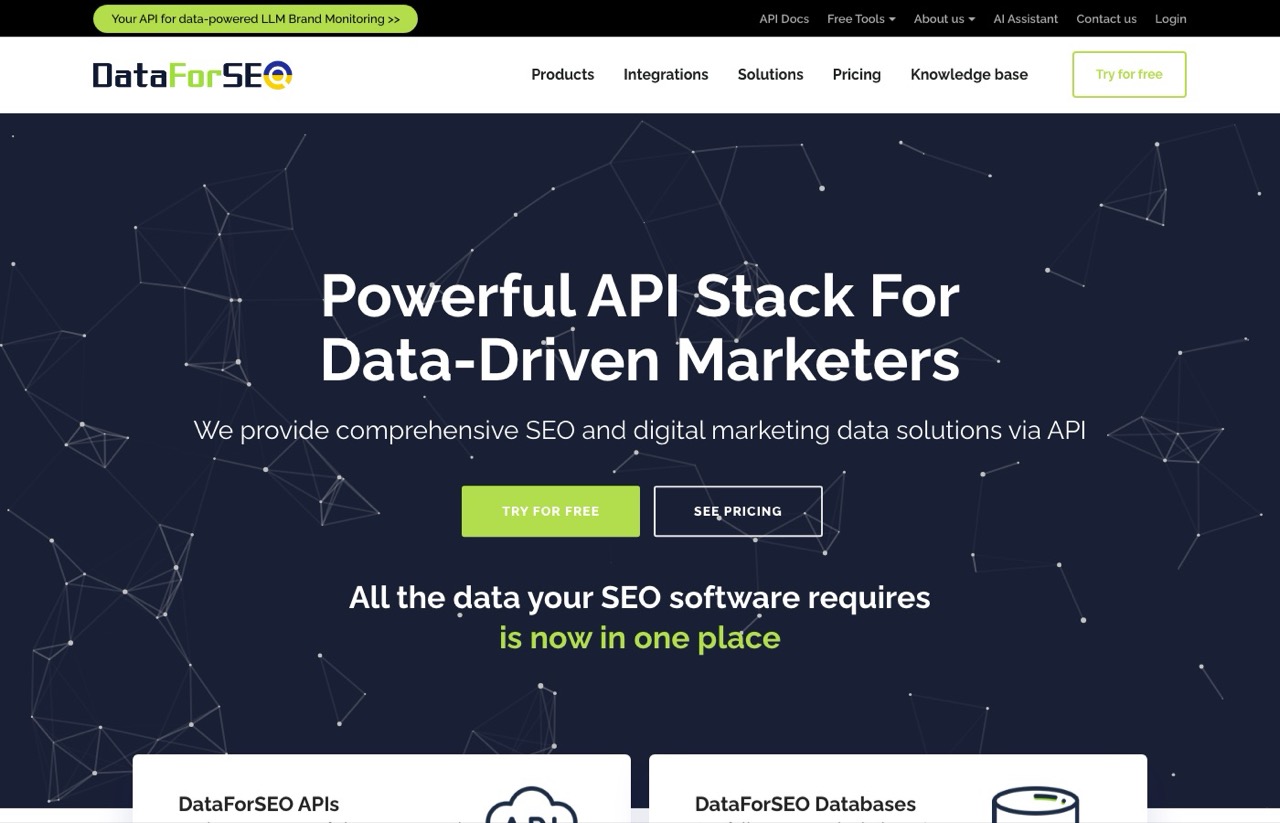
Its Google Organic SERP API pricing page states the following, checked live:
- A search operator such as site:, intitle:, inurl: or filetype: multiplies the cost by 5, for each operator used
- Loading the AI Overview adds a full extra base price
- Expanding People Also Ask adds $0.00015 per click
- Going past 10 results multiplies the price for each additional 10
Run a single site: query in Live mode with the AI Overview loaded and you are no longer paying $0.002. You are paying five times that for the operator, plus another base price for the overview.
This matters more in 2026 than it did in 2023, because AI Overview data is a large part of why people buy search APIs now. The parameter that answers the current question is the one carrying a surcharge.
None of this is hidden. It is published on DataForSEO's own site, in a table, which is more than several vendors here manage. The problem is that a roundup comparing sticker prices has no reason to scroll that far, and a single operator multiplying by 5 does more to your bill than any gap between the vendors below.
Which of These I Actually Pay For
One boundary before the list, because it changes how you should read every ranking below.
DataForSEO is the only tool here I run in production. I have not put the other seven through a real workload as a data source, so what follows is a pricing and architecture read taken from each vendor's live rate card, plus the questions I ask because I have watched this specific kind of bill every month this year.
I have used the Ahrefs and Semrush platforms, and written separately about what the Ahrefs API costs and how Semrush prices API access. Whether their APIs replace DataForSEO is a different question, and I have not run that test.
DataForSEO Alternatives Compared on Price and Billing Model
Read the billing model column before the price column, and read this first: the table holds two different units. DataForSEO, Serper, Bright Data, SearchApi and SerpApi sell you a search. SE Ranking, Ahrefs and Semrush sell you credits or units instead, priced by how much data comes back, with Ahrefs charging at least 50 units for any request at all. You cannot put those on one per-thousand line without lying slightly, so I have not.
| Tool | Entry cost | Billing model | Free tier | Best for |
|---|---|---|---|---|
| DataForSEO | $0.60 per 1,000 SERPs | Prepaid, $50 minimum, no expiry | Free trial credit | Running high volume at the lowest per-call rate |
| Serper.dev | $50 for 50,000 queries ($1.00 per 1,000) | Prepaid top-up, credits expire in 6 months | 2,500 queries, no card | Google-only lookups inside an app |
| Bright Data | $1.50 per 1,000 requests | Prepaid wallet, or $499 monthly plan | 5,000 shared credits monthly | Sites that fight back against scrapers |
| SearchApi | $40 per month for 10,000 searches | Monthly subscription | 100 requests, no card | Predictable monthly cost at low volume |
| SerpApi | $25 per month for 1,000 searches | Monthly subscription | 250 searches monthly | Search engines beyond Google |
| SE Ranking | $50 wallet, or $179 per month API-only | Prepaid wallet, or annual API subscription | Free trial, full API access | Wanting a dashboard and an API together |
| Ahrefs | $129 per month (Lite) | Subscription, API units metered | Free test queries | Backlink data you cannot rebuild later |
| Semrush | $549 per month for API access | Subscription, API units metered | Free trial | Teams already inside Semrush |
The Seven Worth Considering
Ordered by how close each one sits to the job DataForSEO actually does, not by preference.
1. Serper.dev (Best for Google-Only Lookups)
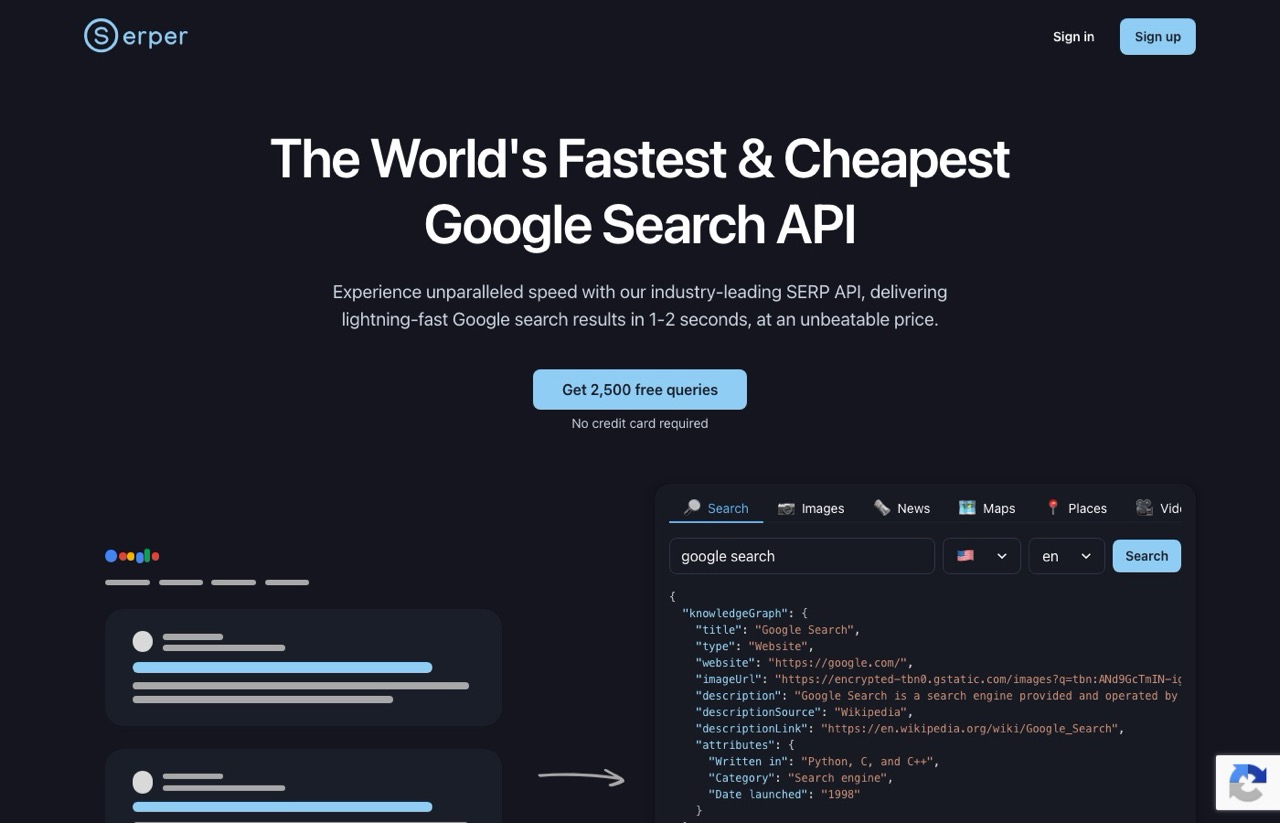
Serper is the closest thing here to a straight swap for one specific DataForSEO job: give me Google results, fast, in one call. It returns in one to two seconds and there is no queue to manage.
Pros:
- 2,500 free queries with no credit card, and no card means no accidental first bill
- No subscription, you top up credits and spend them
- You ask once and the answer comes straight back, with no queue to wait on or job to check later
Cons:
- Credits expire after 6 months on every tier, which its own pricing cards state four times
- Google only, so a Bing or Baidu requirement rules it out
- Its "cheapest" claim holds at volume and not at the door, where $1.00 per 1,000 is more than DataForSEO's standard queue charges
Best for: Developers who want Google results in one call and will spend the credits inside six months.
Pricing: Top-up model, no subscription. $50 for 50,000 credits ($1.00 per 1,000), $375 for 500,000 ($0.75 per 1,000), $1,250 for 2.5M ($0.50 per 1,000), $3,750 for 12.5M ($0.30 per 1,000).
Free trial: Yes, 2,500 queries, no card required.
Bottom line: Serper markets itself as the cheapest Google search API, and at volume it is. At the entry tier it is not cheaper than DataForSEO's standard queue, and the six-month expiry means unused credits are a real cost if your usage is lumpy.
2. Bright Data (Best for Sites That Fight Back)
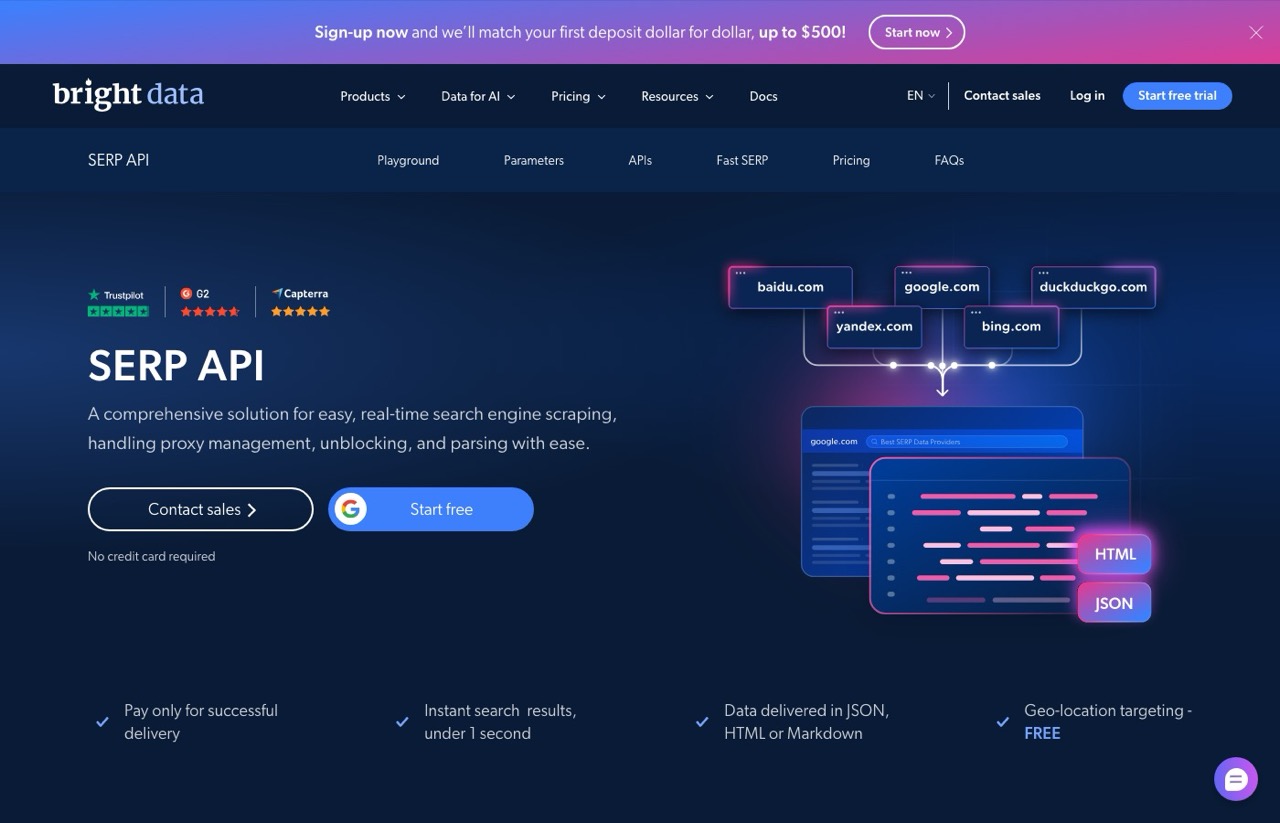
Bright Data is an infrastructure company that happens to sell a SERP API. You are buying proxy management, unblocking and CAPTCHA handling, with search results as the output.
Pros:
- 5,000 free credits every month, not a one-time trial
- Prepaid wallet that stops hard, so there is no surprise invoice
- Covers seven engines: Google, Bing, DuckDuckGo, Yahoo, Naver, Baidu and Yandex
Cons:
- Its own navigation advertises "from $1/1k" while the live plan card charges $1.50
- Monthly free credits reset on the 1st and do not roll over
- The product surface is enormous, so SERP data is one door into a sprawling platform built for something else
Best for: Anyone whose real problem is being blocked rather than being billed.
Pricing: $1.50 per 1,000 requests pay as you go on a prepaid wallet with no commitment, or a $499 per month Scale plan that includes 380,000 requests and charges $1.30 per 1,000 after that. Free tier is 5,000 credits per month shared across several products.
Free trial: Yes, 5,000 credits monthly, no credit card.
Bottom line: Check the plan card rather than the navigation. Bright Data's product menu says the SERP API starts from $1 per 1,000, and the live pay-as-you-go card charges $1.50, which is a 50% gap on the number most roundups quote. Its MCP server is free to connect, and the requests you make through it bill at the same rate as any other.
3. SearchApi (Best for a Predictable Monthly Number)
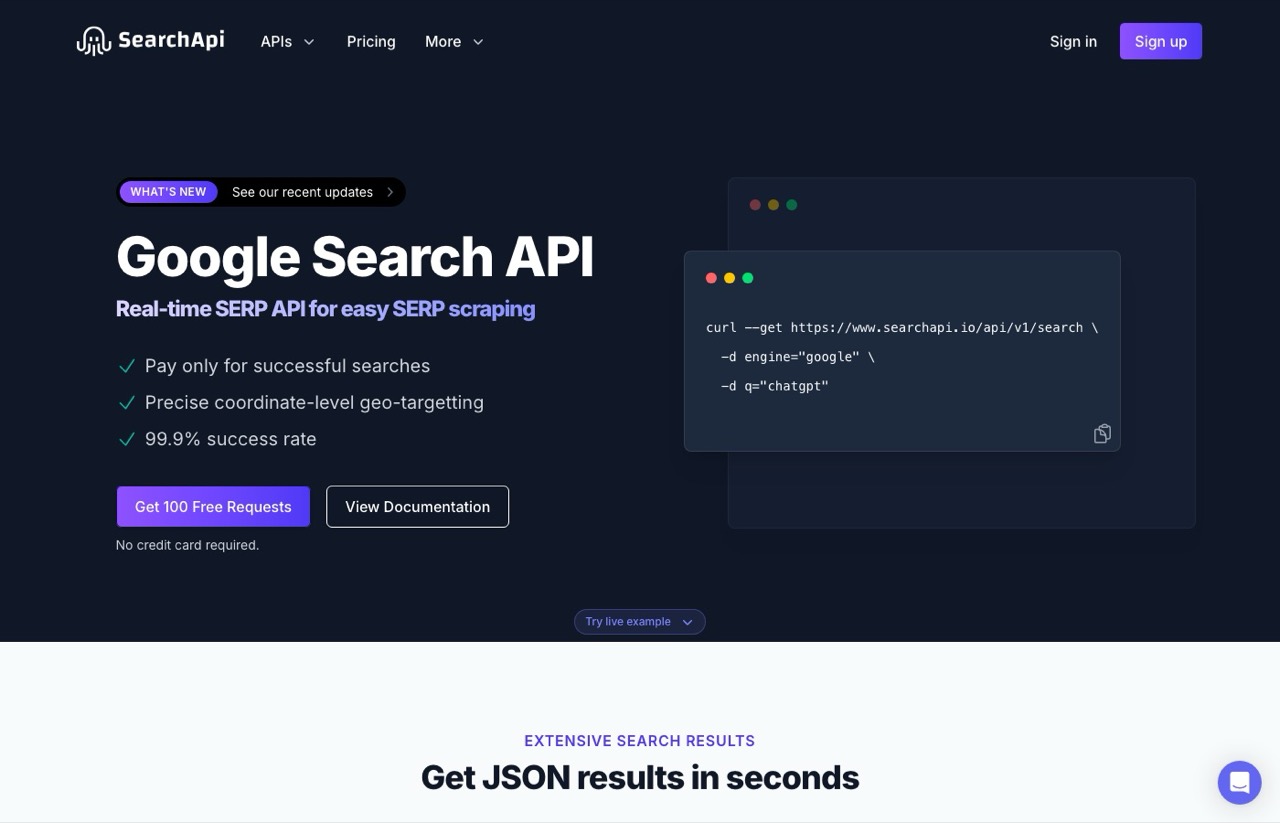
SearchApi answers the complaint that a prepaid balance is hard to budget. You pay a subscription, you get a search allowance, and the number on your card is the same every month.
Pros:
- Failed requests are not billed, only a 200 response costs you
- Covers AI surfaces including Google AI Mode, Gemini and ChatGPT
- Cancel from the dashboard without contacting anyone
Cons:
- You can only spend 20% of your plan's credits in any single hour, so a big overnight batch has to be paced across five hours
- Allowances do not bank, so a quiet month is money you simply do not get back
- The $2M Legal Protection Guarantee starts at the $100 Production plan, not the $40 entry plan
Best for: Agencies that need to forecast a line item rather than watch a balance drain.
Pricing: Developer $40 per month for 10,000 searches ($4 per 1,000). Production $100 for 35,000 ($2.86 per 1,000). BigData $250 for 100,000 ($2.50 per 1,000). Scale $500 for 250,000 ($2 per 1,000).
Free trial: Yes, 100 requests, no card required.
Bottom line: A subscription costs more per call than DataForSEO at almost any volume. What you are buying is the absence of a balance to monitor, and for some teams that is worth the premium.
4. SerpApi (Best for Search Engines Beyond Google)
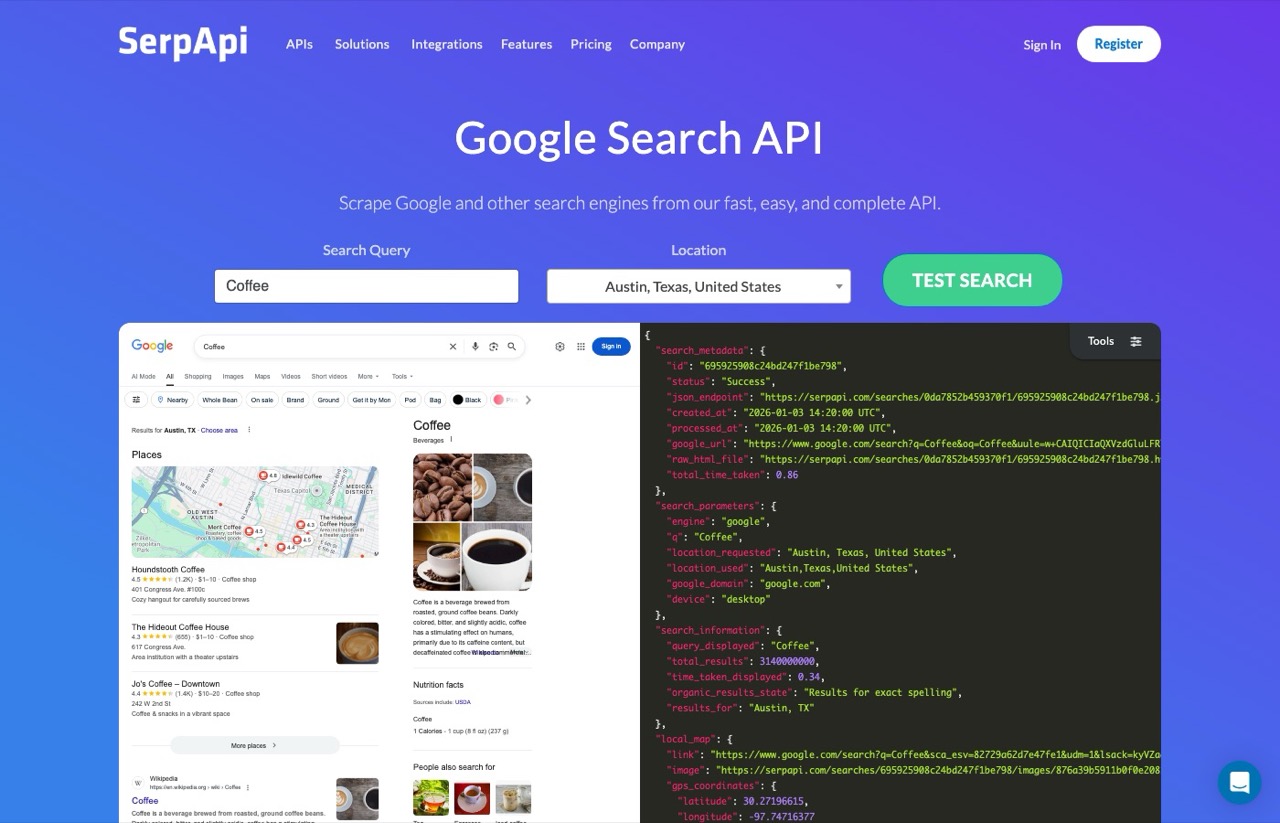
SerpApi is the name that comes up most often in this category. It is also the only vendor here that publishes a plain-markdown rate card at serpapi.com/pricing.md, which meant its numbers were the fastest of the eight to verify, and a company that machine-readable about price is usually machine-readable about the rest.
Pros:
- Over 100 API endpoints, reaching engines Google does not cover, including Baidu, Naver and Yandex
- Cached, errored and failed searches do not count against your quota
- A result set counts as one search whether it returns 100 rows or zero
Cons:
- The $2M US Legal Shield starts at the $150 Production plan, so the $25 and $75 tiers do not have it
- Faster speed modes multiply the base price by 2x or 4x
- Unused searches do not roll over, the plan simply renews
Best for: Products that need a search engine Google is not.
Pricing: Free $0 for 250 searches. Starter $25 per month for 1,000. Developer $75 for 5,000. Production $150 for 15,000. Big Data $275 for 30,000. All month to month, cancel anytime.
Free trial: Yes, a permanent free tier of 250 searches per month.
Bottom line: At $25 for 1,000 searches, the entry plan works out to $25 per 1,000 against DataForSEO's $0.60. You are paying for engine breadth and polish, and if you only need Google that is a lot of money for it.
5. SE Ranking (Best If You Want a Dashboard Too)
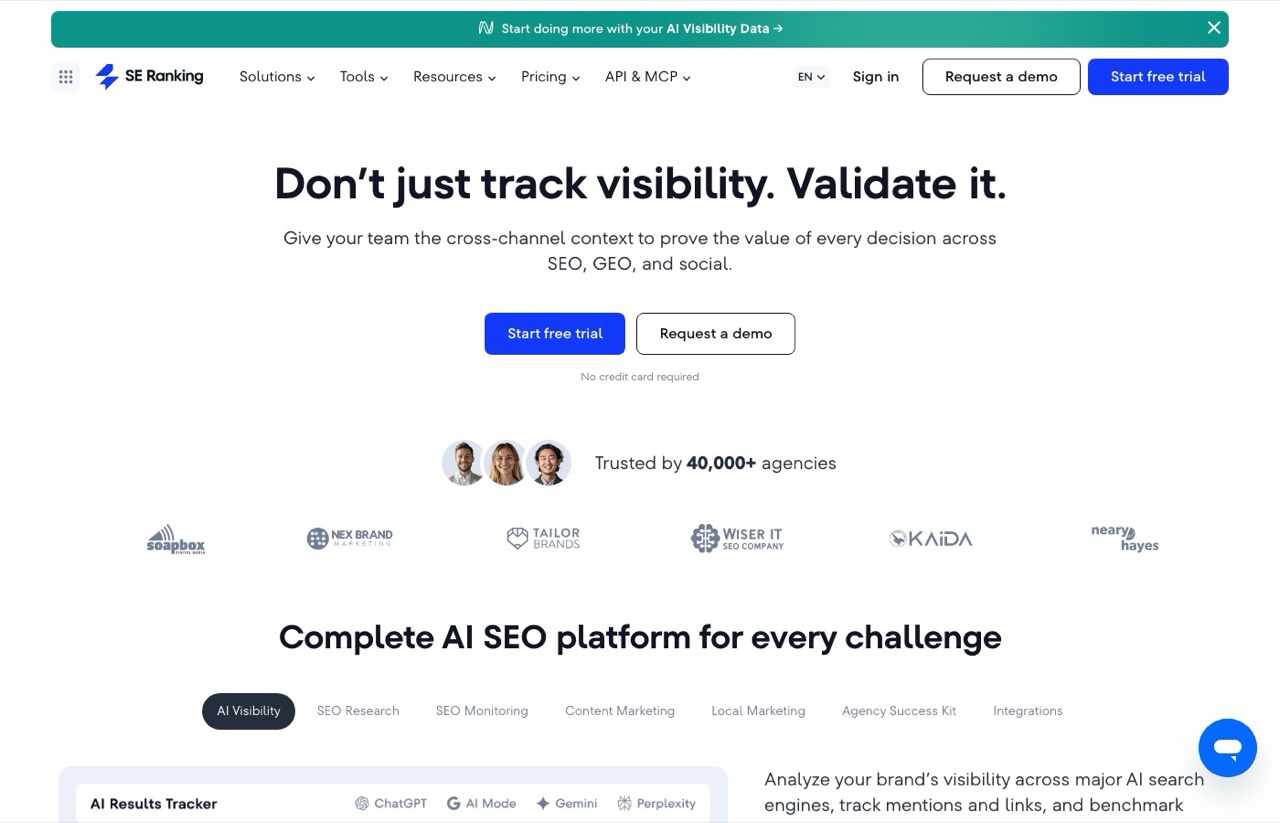
SE Ranking ranks its own comparison post on page one for this query, which is worth keeping in mind when you read where it places itself in that list.
Pros:
- A working interface, so non-technical teammates can use the data too
- Platform plans bundle API credits and MCP access rather than charging separately
- AI visibility tracking across ChatGPT, Gemini, AI Mode and Perplexity
Cons:
- The $179 standalone API plan is billed annually only, so month-to-month means the wallet or a platform seat
- Credits are charged by which data you ask for and how much comes back, so it will not line up against a flat per-search rate
- The platform seat is priced for people who open the interface, which a pure data buyer never will
Best for: Small agencies replacing two tools with one.
Pricing: Three separate routes. A $50 Wallet buys 250,000 credits with no recurring fee and, unusually for this list, the purchased credits never expire. The standalone Data API plan is $179 per month on annual billing only. Platform seats run Core $129 monthly (or $103.20 annually) with 25,000 API credits and MCP access, and Growth $279 monthly (or $223.20 annually) with 100,000 credits.
Free trial: Yes, no credit card required.
Bottom line: The $50 non-expiring wallet is the closest thing on this list to DataForSEO's own prepaid shape, and it is the option most roundups skip in favor of quoting the platform price. Buy the seat only if someone on your team will actually open the interface.
6. Ahrefs (Best for Data You Cannot Rebuild Later)
Ahrefs belongs on this list for one reason that has nothing to do with SERP scraping. Its backlink index and historical data are things you cannot reconstruct after the fact, no matter how many live SERPs you buy.
Pros:
- API access and an MCP server now ship on every plan, including $129 Lite
- Backlink depth and historical keyword data that live SERP calls cannot produce
- Free test queries on all plans before you spend units
Cons:
- Every request costs at least 50 units, even one asking for a single row, so small frequent queries waste the most
- A unit price moves with how many rows and columns come back, which is harder to forecast than a flat per-search rate
- Consumed units are non-refundable
Best for: Link analysis and historical trend work, alongside a cheaper SERP source rather than instead of one.
Pricing: Lite $129 per month, Standard $249, Advanced $449, Enterprise $1,499 with an annual commitment. Included API units run from 200,000 monthly on Lite to 4M on Enterprise.
Free trial: No free tier, though free API test queries are available on all plans.
Bottom line: One correction worth making loudly, because plenty of comparison posts still get it wrong. Ahrefs API access is no longer Enterprise-only. I go deeper on how the two compare for agent work in DataForSEO vs Ahrefs. What Enterprise buys now is the largest unit allotment and unlimited rows per request, and if you read otherwise somewhere, that page is out of date.
7. Semrush (Best If Your Team Is Already There)
Semrush is the most expensive route to API data in this post by a wide margin, and it earns a place only in one situation: your company already pays for it.
Pros:
- Data spanning SEO, PPC and competitive intelligence in one place
- MCP access starts at the $199 Starter tier, well below full API access
- A per-request display limit lets you reduce unit consumption
Cons:
- Full API access requires the $549 per month Advanced tier
- API units are a separate balance from your subscription
- Priced for a marketing team, which makes it hard to justify as a pure data source
Best for: Teams with an existing Semrush contract who want to script against it.
Pricing: API access requires Advanced SEO plus AI Search at $549 per month billed monthly, or $455.67 per month billed annually. The $199 Starter tier includes MCP access but not full API access.
Free trial: Yes, on the platform.
Bottom line: The $549 buys eligibility, not volume, since API units are a separate balance on top. I break down what that subscription actually rents you in DataForSEO vs Semrush. For scale, that same $549 is roughly 900,000 standard-queue SERPs at DataForSEO's rate. The comparison is unfair because you are also buying a large platform, and it is still the arithmetic anyone evaluating this purely as a data source should run.
What About Firecrawl, Exa and Tavily?
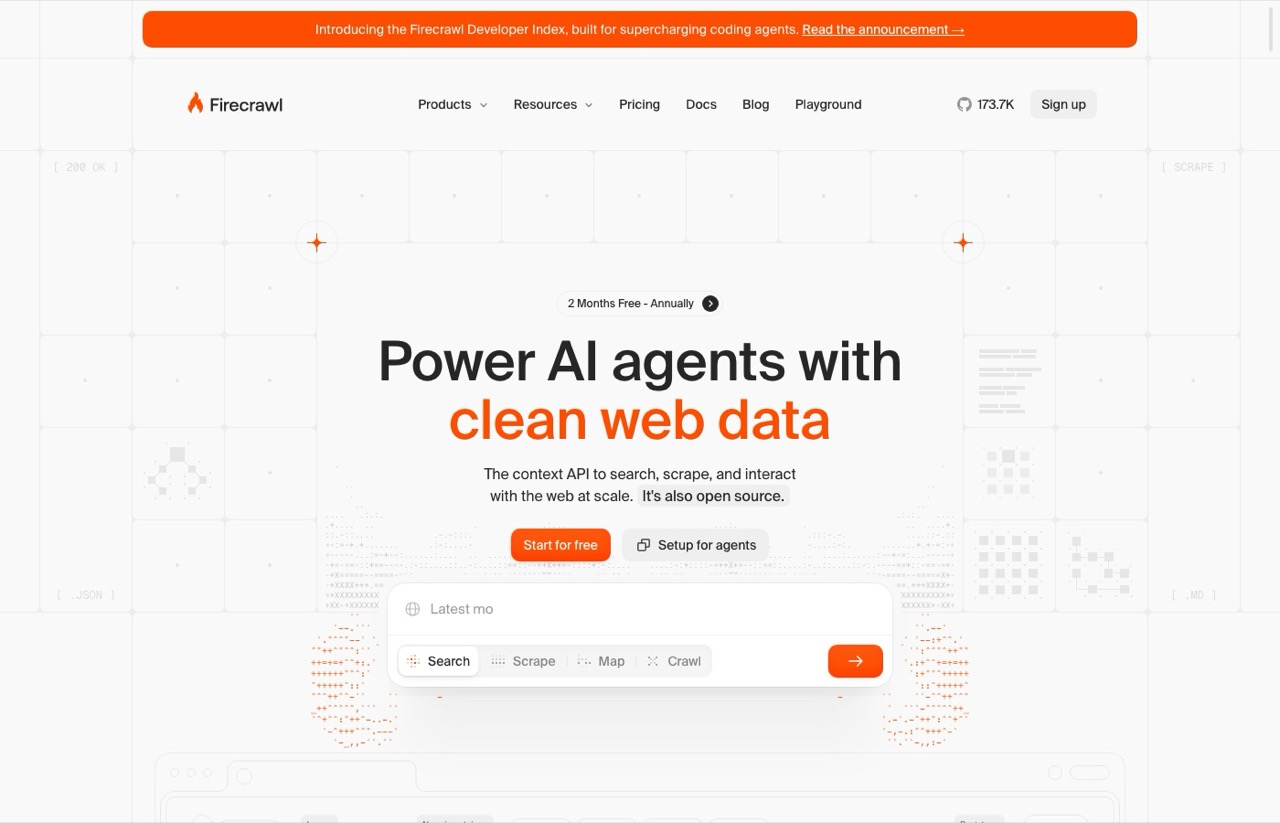
These three surface constantly on this keyword and I have deliberately left them out of the ranking.
Firecrawl, Exa and Tavily are retrieval tools built to feed context to an AI agent. They fetch pages and return clean text, and Firecrawl is open source if you want to read how.
What they do not return is rank position, search volume, keyword difficulty or a backlink profile. Replacing DataForSEO for SEO work with a retrieval API leaves you without the numbers the work depends on. For grounding an LLM they are a better fit than anything above, and the question you are asking is not really this one.
Four Questions That Narrow This Fast
These are the same questions I ask on every client build before picking a data source.
Is your volume steady or lumpy? Steady volume suits a subscription, where the monthly number never surprises you. Lumpy volume suits prepaid, where a quiet month costs nothing. Watch for expiry, since Serper's credits die at six months and Bright Data's free tier resets on the 1st.
Do you need Google, or search engines generally? If it is Google alone, Serper is the simplest call and DataForSEO the cheapest queued one. For Baidu, Naver or Yandex, check the engine list before the price, because SerpApi, Bright Data and DataForSEO all cover ground beyond Google and they do not cover the same ground.
Is your problem the bill or the blocking? These get confused constantly. If your calls are failing rather than costing too much, you have a proxy problem. Most of these vendors bill only for successful delivery, so compare their unblocking claims rather than their rates. Bright Data is the one that sells the proxy network itself.
Does anyone besides you need to see this data? If a client or a teammate needs to open something and look at it, a wall of raw data in a text file is not that thing. That is the case for a platform seat over a raw data provider, and it is worth what it costs only if someone actually logs in.
Why I Am Still Paying DataForSEO
Two reasons, and the first one is not the price.
It is the only provider I found here that sells SEO data, live search results and AI search visibility from a single balance. I can pull a SERP, then keyword volume, then what ChatGPT and Perplexity say about a brand, without a second vendor or a second invoice. Splitting that across a SERP API plus a keyword tool plus an AI visibility tool costs more and breaks more.
The second is that it connects to Claude over MCP, which is how I actually use it. I ask a question in a sentence and the data arrives, which is also true of several tools above and worth checking before you assume it is a differentiator. I wrote up that setup in my full DataForSEO review and in a broader piece on the SEO MCP servers worth connecting.
The honest limitation is the one I opened with. The prepaid balance takes a $50 minimum, the queue takes patience, and the multipliers mean the advertised sixty cents is not what a real month costs. I have watched a careless site: query in a loop cost more than a week of normal pulls.
If you want one call with no queue, Serper hands you 2,500 queries without a card, which is enough to find out whether the simpler shape is worth the higher rate. That is not the workload I have, and it may well be yours.
DataForSEO Alternatives FAQs
What is the cheapest DataForSEO alternative?
At small volume, none of them beat DataForSEO's own standard queue at $0.60 per 1,000 SERPs. Serper's entry tier is $1.00 per 1,000 and Bright Data's pay-as-you-go card charges $1.50. Serper becomes cheaper at scale, reaching $0.30 per 1,000 once you buy 12.5 million credits up front. Compare the rate at the volume you actually run, not at the top tier.
Are there free alternatives to DataForSEO?
There are free tiers, not free providers. Serper gives 2,500 queries with no card, Bright Data gives 5,000 credits every month that reset on the 1st, SerpApi has a permanent 250-search monthly tier, and SearchApi gives 100 requests. Those are enough to test a workflow. None of them carry real client work past the first week.
What is the difference between SerpAPI and DataForSEO?
Billing shape and breadth. SerpApi sells a monthly subscription starting at $25 for 1,000 searches and publishes over 100 API endpoints, counting Google Search, Images and Maps separately rather than 100 distinct engines. DataForSEO sells prepaid credit at $0.0006 per SERP with a $50 minimum and no subscription. SerpApi costs far more per call and is simpler to budget. DataForSEO is cheaper at volume and sells keyword, backlink and AI search data the SERP-only providers do not.
Is DataForSEO cheaper than Semrush or Ahrefs?
For buying search data, yes, by a wide margin. Ahrefs API access requires the $129 Lite plan or higher, and Semrush needs the $549 Advanced tier for full API access, while DataForSEO bills per request with no subscription. They are not really substitutes though. Ahrefs and Semrush sell backlink indexes and historical data that you cannot reconstruct later, which no volume of live SERP calls replaces.
Does DataForSEO have an MCP server for Claude?
Yes, and so do most of the alternatives here. DataForSEO, SerpApi, Bright Data, SearchApi, SE Ranking, Ahrefs and Semrush all ship one, which means MCP support is no longer a reason to pick any of them. Serper is the exception and does not advertise a hosted MCP server. Treat it as table stakes and compare on billing model instead.
Why is my DataForSEO bill higher than $0.60 per 1,000?
Almost certainly a cost multiplier. A search operator such as site: or intitle: multiplies the price by 5 for each operator used, loading the AI Overview adds a full extra base price, requesting more than 10 results multiplies again for each additional 10, and expanding People Also Ask adds $0.00015 per click. Live mode also costs $0.002 per SERP against the standard queue's $0.0006.
Disclosure: this post contains no affiliate links. I pay for DataForSEO myself and it is not a client. Links to SerpApi, Serper, Bright Data, SearchApi, SE Ranking, Ahrefs, Semrush, Firecrawl, Exa and Tavily are plain links. The seven alternatives are priced and assessed from their live rate cards and documentation, with monthly billing selected where a toggle exists. Full disclosure.