
DataForSEO Review: The Best SEO MCP for AI Agents
Every SEO review you have read compares tools by their monthly price. That framing does not work here, because DataForSEO has no monthly price. A Google SERP costs $0.0006 in the standard queue. One thousand of them cost sixty cents.
I pull that data every working day through Claude Code and Codex, for SEO and AI search work across my own site and a roster of clients. It is the paid SEO MCP server I would hand an AI agent before any other.
MCP is the Model Context Protocol, the standard that lets an assistant like Claude pull from an outside tool on its own. You ask a question in plain language instead of writing code.
Pair it with the free Google Search Console server, which reports your own traffic rather than the market. DataForSEO covers everything Search Console cannot see, which is every competitor, keyword and SERP outside your own property.
The price is the least interesting thing I have to tell you. DataForSEO quietly shipped a new version of its Claude connector that deprecates the old one, and the change is significant enough that most tutorials published before this month now describe a setup that no longer ships.
What DataForSEO Actually Is
DataForSEO sells the data layer that sits underneath an SEO tool, and stops there.
Affiliate links below. Full disclosure.
Try DataForSEO with $1 in free credit
There is no dashboard to log into, no rank tracker, no site audit report waiting for you on a Monday morning. What you get is an API: you send a request describing the data you want, and you get structured JSON back. Keyword volumes, live SERP results, backlink profiles, competitor rankings, on-page crawls, and increasingly, what AI models say when asked about a topic.
This is the single most important thing to understand before you buy, and it is where most reviews mislead people. If you want to open a tab, type a domain, and look at a chart, DataForSEO is the wrong purchase and no price advantage will fix that.
There is a middle option. OpenSEO puts a $10-a-month dashboard on top of DataForSEO's data, and I weighed whether that layer is worth paying for in my OpenSEO review.
Ahrefs and Semrush sell you an interface, an opinion about what matters, and a set of decisions already made on your behalf. DataForSEO sells you the raw material those interfaces are built from.
The trade is real in both directions. You give up the interface. You get data that is roughly two orders of magnitude cheaper and that you can point at anything you want.
If you are weighing the two against each other rather than reading up on DataForSEO alone, I compared them directly in DataForSEO vs Ahrefs. If the subscription you are questioning is a Semrush one, that is a different calculation, and I worked through it in DataForSEO vs Semrush.
The Pricing Model, With Real Numbers
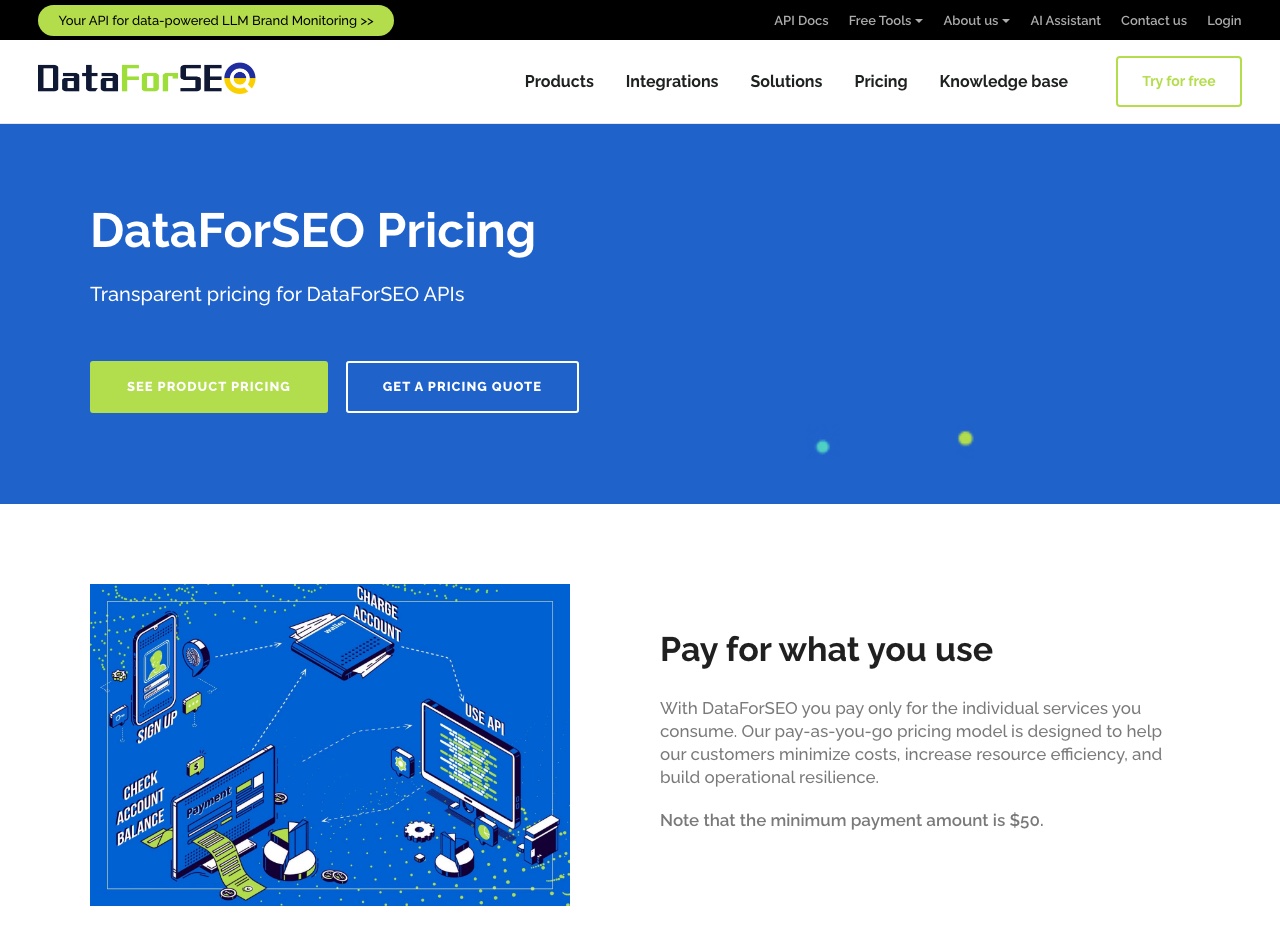
DataForSEO runs pay-as-you-go with a $50 minimum deposit. There is no subscription, no seat count, and no monthly renewal. You put money in the account and it draws down as you make requests. Unused balance does not expire.
New accounts get $1 in free credit without a credit card, which sounds trivial and is not. DataForSEO puts that at 833 SERPs on high-priority tasks, or 20,000 backlinks, or 20,000 keywords with Google Ads metrics.
That is more than enough to decide whether the data is any good before you spend anything. Test it that way before depositing the $50.
Here are the live rates, pulled from DataForSEO's own pricing pages on August 22, 2026.
Google Organic SERP API
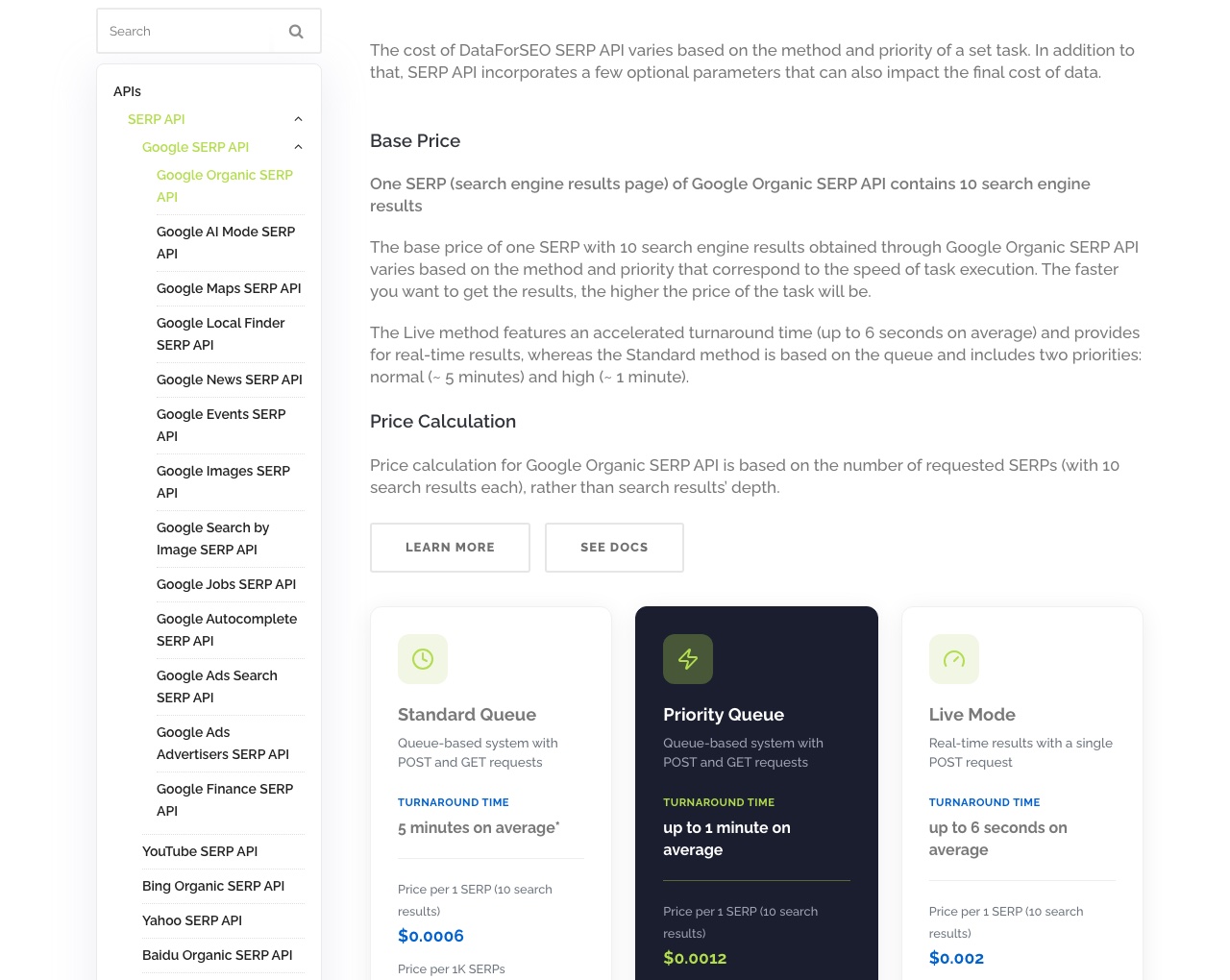
| Mode | Turnaround | Per SERP | Per 1,000 SERPs |
|---|---|---|---|
| Standard Queue | ~5 minutes | $0.0006 | $0.60 |
| Priority Queue | Up to 1 minute | $0.0012 | $1.20 |
| Live Mode | Up to 6 seconds | $0.002 | $2.00 |
The three-tier structure is where people overspend without noticing. Live mode costs more than three times the standard queue, and it buys you seconds.
Running a scheduled overnight job across a thousand keywords? You have no reason to be in live mode. Asking Claude a question and waiting on the answer? You do.
I use live mode constantly, because my volume is low and my patience during a working session is lower. But it costs 3.3 times the standard rate and I know I am paying it.
Run 50,000 pulls a month and the choice is $100 in live mode against $30 in the standard queue. Defaulting to live costs an extra $70 a month to save time nobody is awake to notice.
Keyword and Ranking Data
| Endpoint | Price per task | Price per item |
|---|---|---|
| Google Ads search volume (Live) | $0.09 | Up to 1,000 keywords per task |
| DataForSEO Labs (most endpoints) | $0.012 | $0.00012 per item |
| Backlinks (Live) | $0.024 | $0.000036 per row |
That backlinks row is the one that tends to stop people. A thousand rows of backlink data costs six cents, calculated as the $0.024 task price plus $0.000036 per row.
The AI Search Data
This is the newest part of the platform and the reason I would still be here even if the price advantage disappeared. DataForSEO sells structured access to AI search surfaces:
- Google AI Mode SERP API: $0.0012 per page in the standard queue, $0.0024 priority, $0.004 in live mode
- LLM Responses API: $0.0006 per task in live mode, or $0.0002 in the standard queue, plus whatever the underlying model charges
- AI Keyword Search Volume and LLM Mentions for tracking how often a brand surfaces in AI answers
Being able to ask, programmatically, "what does ChatGPT say when someone asks about this category, and are we in the answer" is a genuinely different capability from rank tracking.
Note the pricing shape on LLM Responses. DataForSEO's own fee is tiny, and you also pay whatever the model's API charges. On the standard queue that arrives as a $0.01 automatic prepayment, refunded in part if the model bills less. Your real spend depends on which model you query.
One Real Workflow, Start to Finish
Here is an actual sequence rather than a description of one, because "ask Claude for the data" is easy to write and vague to act on.
I was deciding whether this post was worth writing. In Claude Code I asked for search volume and the twelve-month trend on "dataforseo" and a set of related terms. One request came back showing 3,600 a month against 1,300 the previous August, with the curve stepping up rather than decaying. That is the check that decided the post, and at Labs rates it cost a fraction of a cent.
Then I asked for the live SERP for "dataforseo review" to see what I would be competing against. That returned the top ten plus the AI Overview and the People Also Ask questions.
That is where most of the FAQ section at the end of this post came from. Those questions are not invented, they are what Google already shows people searching this term. The pull ran in live mode at $0.002.
The whole research pass, volume plus trend plus SERP plus the AI Overview citation list, cost me under a nickel and took about four minutes of wall-clock time. The equivalent on a subscription tool is $129 a month whether I run it once or two hundred times, and the AI Overview citation list is not something most of them will hand me at all.
That is the case for this thing, and it only works because the model sits between me and the JSON. I never opened a documentation page or wrote a request body.
The Cost Comparison Everyone Wants
Ahrefs Lite, the entry tier most solo SEOs land on, is $129 per month billed monthly. That tier is also where Ahrefs API and MCP access begins, which I broke down in Ahrefs API pricing. Set against $0.60 per thousand SERPs, the arithmetic looks absurd, and this is where most reviews stop and declare a winner.
It is not that simple, and I want to be straight about why.
At $129 a month, Ahrefs gives you a crawler with its own index, a rank tracker that remembers yesterday, a site audit that interprets what it finds, and a UI a junior team member can use on day one.
To match that with DataForSEO you would build the storage, the scheduling, the deduplication, the charts and the interpretation layer. That build is not free even when the data is nearly free.
The honest comparison puts $129 against $0.60 plus however many hours you spend building the parts Ahrefs already shipped.
Which is exactly why the AI angle changes the calculation, and why I think this tool got dramatically more interesting in the last eighteen months rather than gradually cheaper. The interpretation layer used to be the expensive part. Now I can ask Claude for it in a sentence.
What Changed: The v3 MCP Server
DataForSEO has now shipped a v3 MCP server, and the previous version is formally deprecated. The old repository has been renamed with a "deprecated" suffix. This is not a minor version bump, and if you set this up from a tutorial written before this month, you are looking at instructions for software that is no longer the current release.
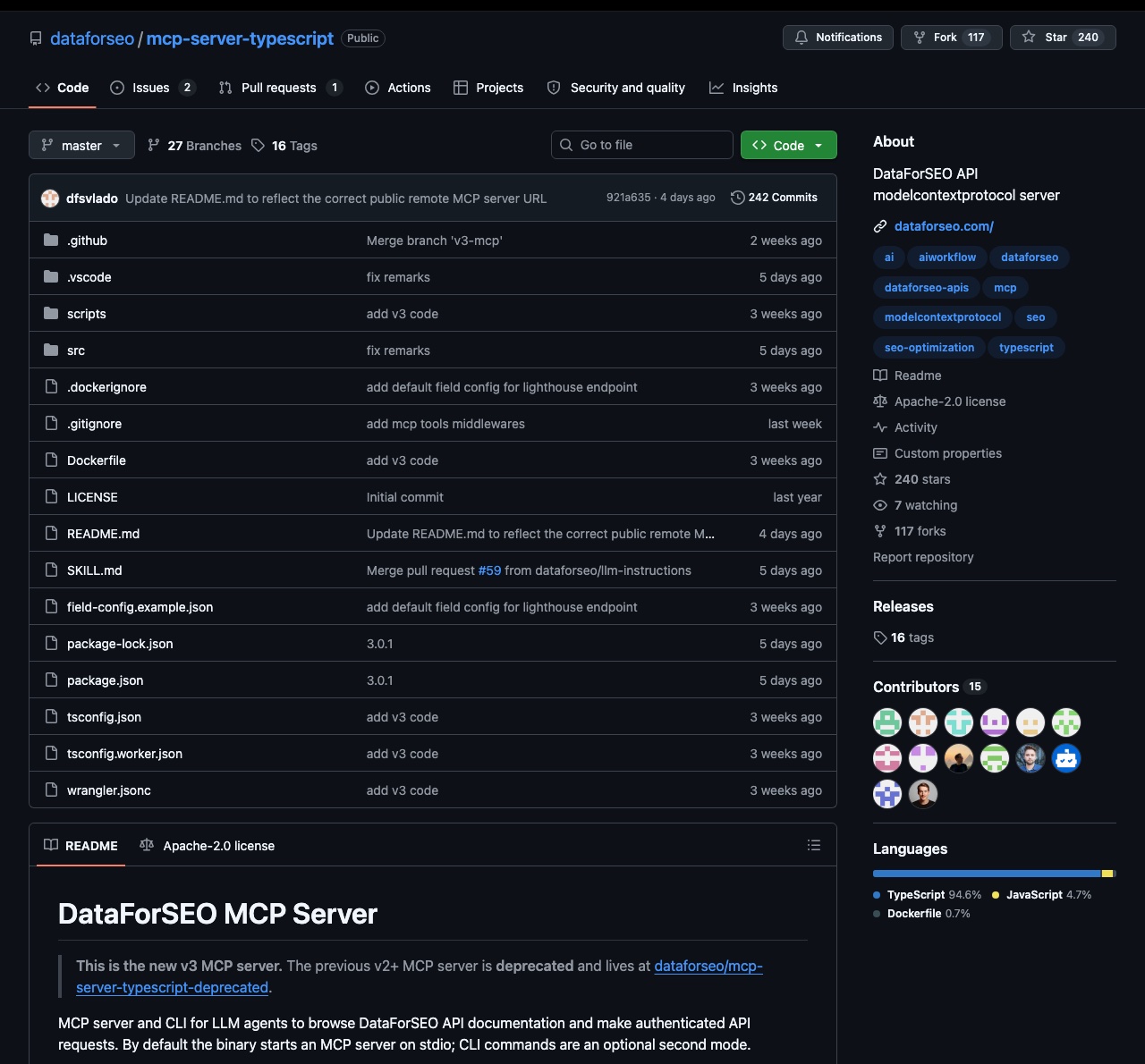
The architectural change is the interesting part. The old server exposed a separate named tool for every endpoint across ten modules, so Claude saw serp_organic_live_advanced and dataforseo_labs_google_keyword_ideas as distinct capabilities.
The v3 server replaces all of that with four general-purpose tools. The model reads DataForSEO's documentation and builds the request itself, so new endpoints get picked up automatically instead of going stale. It is a trade rather than a pure upgrade, because the model now looks something up before it can act, which is an extra step and an extra chance to get an unusual request wrong.
I found this because the DataForSEO connection I use in Claude Code every day still points at the older multi-tool build. It is the kind of change you only notice when you already have a working setup.
Being straight about the limit of that: I have read the v3 repository closely and I am still on v2. I can tell you what v3 ships and how it is designed, not how it feels after a month of daily use.
If you are on v2 like me, nothing has broken and there is no fire drill here. New setups should start on v3, and the hosted endpoint below makes that the easier path anyway.
Connecting It to Claude
There is now a hosted remote endpoint at https://mcp.dataforseo.com/v3/mcp that uses OAuth, so you authorize in a browser instead of pasting credentials into a config file. That is a meaningful quality-of-life change and the path I would point most people at.
If you have never connected a tool this way, I walk through the general process in my guide to setting up MCPs in Claude Code, and I cover how this fits a research workflow in keyword research in Claude Code.
What I Actually Use It For
Concrete, from real working sessions:
Validating a keyword before committing to a post. I ask for volume, the trend curve, and the live SERP in one request. The trend curve is the part that earns its keep, because a keyword averaging 300 a month can be 80% off its peak and still falling, and the annual average hides that completely. I have killed planned posts on this signal alone.
Reading the actual SERP instead of guessing. Volume tells you people search. The SERP tells you whether you can win. When page one is the vendor's own documentation answering a question only that vendor can answer, a third-party post is not the result Google wants there, and knowing that before writing saves a day.
Checking AI visibility separately from rankings. These diverge more than people expect. A page can rank third and go completely uncited in AI Overviews.
I pull the AI Overview and read which domains sit in its citation list, and which sentence each one is credited for. Being cited as research while a competitor gets named as the recommendation is a different problem from ranking badly, and it needs a different fix. It is also why I ignore the AI ranking numbers some tools report, since there is no standing position to report on.
Client audits. Ranked keywords, competitor overlap and backlink profiles across five domains lands in single-digit dollars at the rates in the tables above, against a subscription I would keep paying between engagements whether or not I had an audit to run.
Where It Falls Short
Five real limitations, and the first one is the big one.
The data quality is a step behind Ahrefs and Semrush, and I am not going to dance around it. This is the one genuine downside that matters, and it is worth understanding before you deposit anything.
DataForSEO's default keyword volumes come from Google Ads data, so they arrive in the same rounded buckets Keyword Planner gives you. Ahrefs and Semrush lead with clickstream-blended estimates that carry more texture.
There is a clickstream-refined volume option, but the Ads-based figures are what the standard endpoints and the MCP hand you unless you ask for it. In my own pulls, the backlink data also does not match the depth I am used to from Ahrefs' index.
For the way I work the trade is worth it, because the keyword data is decent and the SERP pulls are live and exact. But if your work lives or dies on volume precision or backlink completeness, that gap is real and you should know it walking in. This is the one place where paying Ahrefs genuinely buys you something DataForSEO does not have.
There is no interface. I keep returning to this because it disqualifies more buyers than every other factor combined. If nobody on your team is comfortable in a terminal or an AI assistant, this will sit unused. The $50 you deposited will still be there in a year.
Nothing remembers anything. Every request is a snapshot. Rank tracking, in the sense of a chart showing movement over eight weeks, requires you to store results yourself on a schedule. Subscription tools do this by default and it is a larger part of their value than their marketing suggests.
Costs are hard to forecast. Per-request pricing is only predictable once you know your request count, and you do not know that on day one. A runaway loop can spend real money before you notice, which is an argument for starting with the free credit and watching the balance rather than depositing $200 and assuming.
Index gaps are real. DataForSEO returns no measurable volume for genuinely new terms, and that reads as "no demand" when it often means "too new to be indexed." I have watched a keyword go from unmeasurable to thousands of searches in four months. Treat a zero as one input, never as a verdict, and check the live SERP alongside it.
Who Should Buy This
Buy it if you already work through Claude Code, Codex or a similar assistant, you are comfortable when something needs debugging, you run data across many domains, or you want AI search visibility data most subscription tools do not sell at all.
Testing costs nothing, since the first dollar is free. Committing costs $50 plus the afternoon you spend wiring it into your workflow, and that afternoon is the real price of entry.
Skip it if you want to look at charts, you manage one or two sites where a subscription's flat fee is simpler than metering, you need historical tracking without building it, or you would be the only person on the team who could operate it. Ahrefs at $129 is priced for someone who wants the interpretation included, and that is a legitimate thing to want.
Workflow fit decides this, not budget. The real question is whether you want data or answers.
The Verdict
For an AI agent doing SEO work, this is the MCP server I would install first among the paid options. It also sits in the wider marketing stack I run, next to the publishing and video servers it does not overlap with. Three things keep me on it every day despite that gap.
It is very affordable at scale, and the bill tracks what I actually use across client work instead of renewing whether I worked or not. If the per-request model is the part you want, I compared it against the seven closest alternatives on price and billing shape. The keyword and SERP data is decent, and the SERP side in particular is live and exact rather than a cached index.
DataForSEO was also one of the first SEO data vendors I saw ship an MCP server, which means they were building for AI agents doing SEO work before most of the category had noticed the protocol existed. That head start shows in how well the connector actually works.
What earns the recommendation from me is that the interpretation layer, which used to be the entire reason to pay for a subscription tool, is now something I can ask an AI assistant for. That flips the calculation. Raw data plus a capable model beats a fixed interface for the work I do, and it did not beat it two years ago.
The v3 MCP change is a genuine improvement and it is also a warning about the category: this moves fast enough that a six-month-old tutorial can describe deprecated software. Go to the source repository rather than trusting a blog post, including this one, six months from now.
If that sounds like your kind of workflow, DataForSEO gives you $1 of real API credit with no card required. Spend that before you spend the $50.
DataForSEO FAQs
How much does DataForSEO cost?
There is no monthly fee. You deposit a minimum of $50 and draw it down per request.
Google SERP results cost $0.0006 each in the standard queue ($0.60 per thousand), $0.0012 in the priority queue and $0.002 in live mode. Most DataForSEO Labs endpoints cost $0.012 per task plus $0.00012 per item, and backlink data runs $0.06 per 1,000 rows. New accounts get $1 in free credit without a credit card.
What is the catch with DataForSEO's pricing?
Two things the rate card does not spell out. Live mode costs 3.3 times the standard queue for the same data, so defaulting to it on scheduled jobs quietly multiplies your bill.
The $50 minimum is also a deposit rather than a subscription, so the money is not wasted, but you cannot start with $5. The genuine risk is a runaway loop spending faster than you notice, so start small and watch the balance for the first week.
Does DataForSEO work with Claude?
Yes. DataForSEO ships an MCP server that connects it to Claude Code, Claude Desktop, and other MCP-capable assistants. As of the v3 release there is a hosted remote endpoint at https://mcp.dataforseo.com/v3/mcp using OAuth, or you can run it locally with npx dataforseo-mcp-server@latest and API credentials in your environment.
What is the difference between the v2 and v3 MCP servers?
The v2 server exposed a separate named tool for each API endpoint, spread across ten modules. The v3 server exposes four generic tools that let the model read DataForSEO's documentation and then construct requests itself. The v3 approach uses far less context and picks up new endpoints automatically. The v2 server is deprecated and now lives in a separate repository marked as such.
Is DataForSEO the best SEO MCP server?
For market data, yes, and it is the one I run daily. The honest ordering is to install the free Google Search Console MCP first, because it reports your own impressions and positions rather than an estimate.
DataForSEO is the best paid SEO MCP and the one to add second. Live SERPs, keyword volume, backlinks and AI Overview citation data are all things Search Console cannot show you.
Ahrefs and Semrush both ship MCP servers with better data depth, but each is gated behind a paid subscription. Ahrefs MCP requires a paid plan starting at $129 a month, and Semrush includes MCP access on its Semrush One and SEO Classic plans. DataForSEO asks for a $50 balance you draw down at your own pace.
How I sourced this: all pricing was read off full JavaScript renders of DataForSEO's own rate-card pages on August 22, 2026, because those pages load their prices with JavaScript and a plain fetch returns empty fields. MCP server details, including the v3 tool list, the deprecation of the v2 server, the npm package name and the remote endpoint URL, were read from the official DataForSEO MCP repository rather than from marketing pages. Ahrefs Lite pricing was taken from its public pricing page the same day. Free-trial credit terms come from DataForSEO's own help center. This post contains affiliate links to DataForSEO, so I earn a commission if you sign up through them, at no additional cost to you. I also sell a competing AI SEO product. Full disclosure.