
Ryan Doser research · Analysis · Data through October 9, 2026
Poisoned Google SERPs: What They Are and How to Spot Them
Since mid-September, rank trackers have been logging ranking drops that real searchers may never have seen, because some of the Google pages they collect come back with the usual websites swapped out. I had Claude agents work through Nozzle's public data on 27.5 million collected SERPs to show when it surged, where it hit hardest and how to spot it.

- 27.5 million SERPs, Sep 13 to Oct 9, 2026
- 49 countries
- Desktop and mobile
Free to use with a link to this page. Press questions: [email protected]
On this page
Source data: "Poisoned Google SERPs" by Nozzle, published October 10, 2026, with new charts and takeaways on this page.
What Are Poisoned Google SERPs?
A poisoned SERP is a full Google results page that looks normal but has most of the keyword's usual sites swapped out. There is no error and no captcha, so a rank tracker saves it as real data.
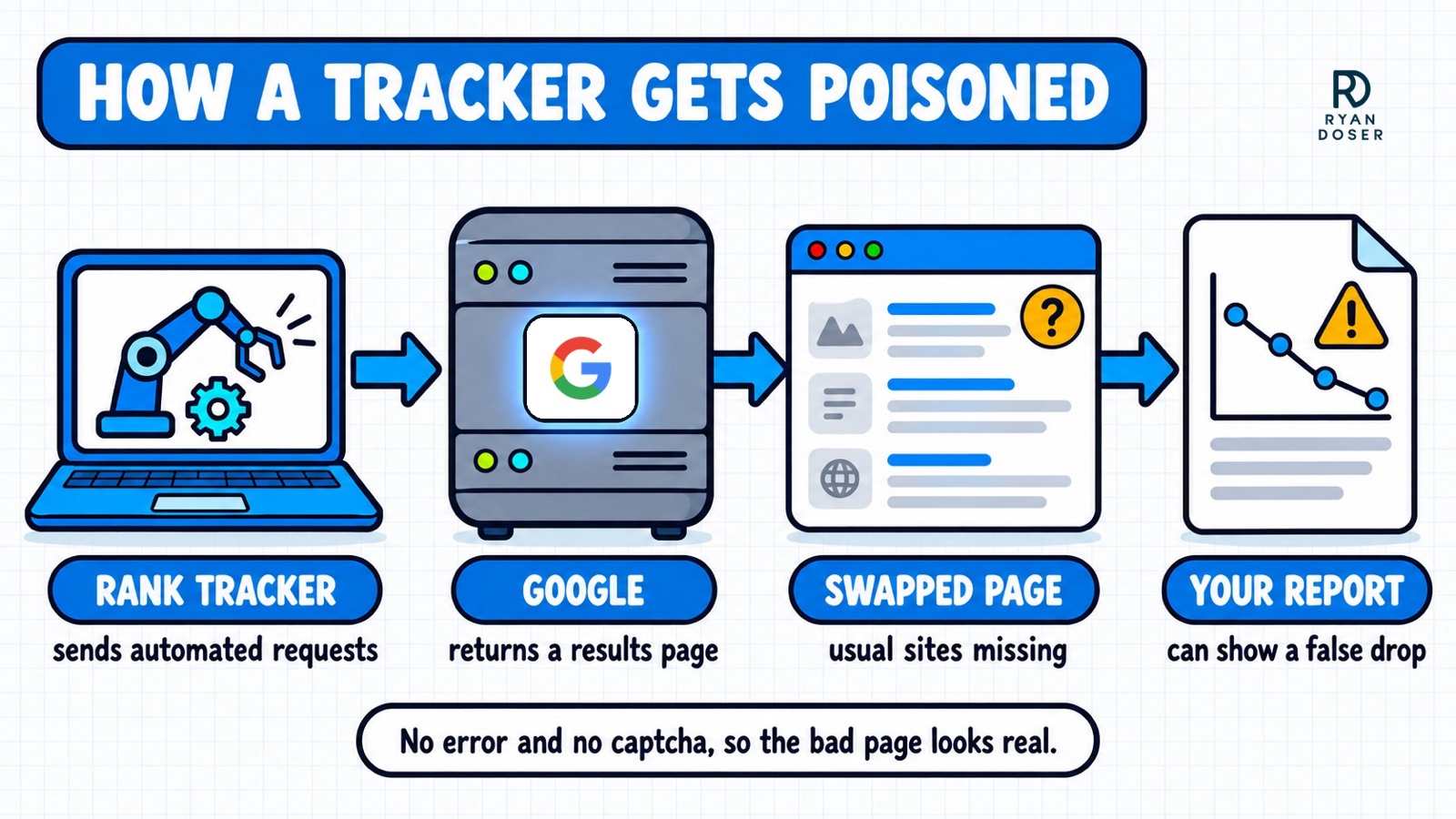
Nozzle, an enterprise rank tracker, put a name and a number on it in an October 10 study and published the data behind it.
Key findings
- 8.0% of the 17.8 million SERPs that could be judged came back poisoned from September 13 to October 9, 2026, against 0.17% from August 20 to September 9.
- Poisoned pages keep just 20.7% of the keyword's previous organic sites, against 88.5% before. Reddit, Facebook and LinkedIn show up more often in their place.
- The poisoned share took off on September 20 and peaked at 27.0% on September 29, during Google's September 2026 spam update, though the rise began four days before the update started.
- UK SERPs were hit far less than North American ones. On September 29, 2.8% of UK SERPs were poisoned against 48.1% in Canada, and the UK ran below the US on all 20 days from September 20 to October 9.
Blocked First, Then Poisoned
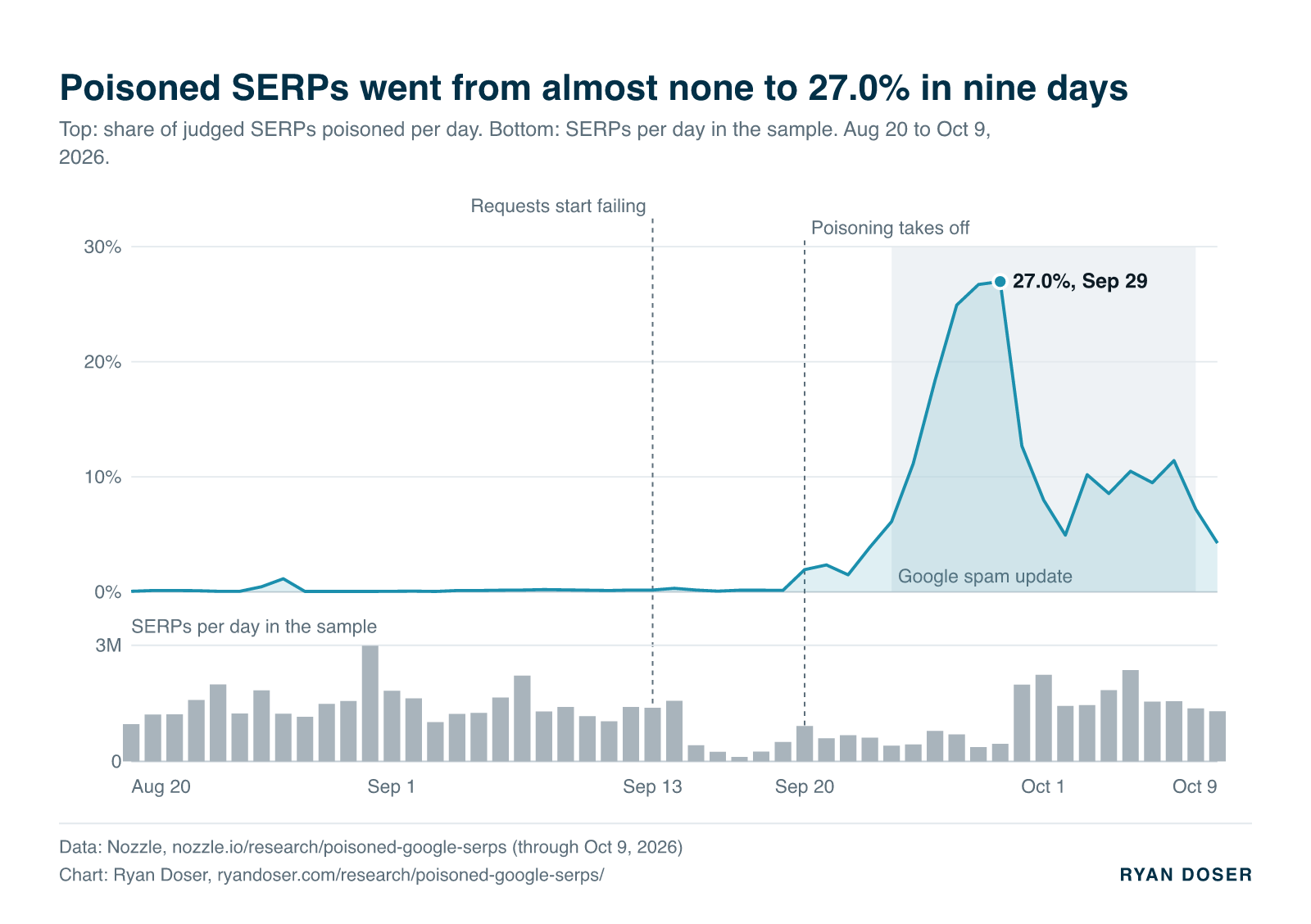
On September 13, a big share of requests to Google started failing, and by September 17 the daily SERP count in the sample had dropped 92% below its earlier average.
The SERPs that got through were mostly normal until September 20. Then the poisoned share took off, hit about a quarter of judged SERPs from September 27 to 29, and ran between 4.2% and 11.4% a day from October 1 to 9.
Poisoned SERPs went from almost none to 27.0% in nine days
Top: share of judged SERPs poisoned per day. Bottom: SERPs per day in the sample. Aug 20 to Oct 9, 2026.
Show this chart as a table
| Day | Poisoned | Judged SERPs | SERPs in sample |
|---|---|---|---|
| Aug 20 | 0.06% | 937,095 | 964,379 |
| Aug 21 | 0.12% | 1,137,704 | 1,209,831 |
| Aug 22 | 0.12% | 933,999 | 1,216,216 |
| Aug 23 | 0.11% | 1,097,483 | 1,589,040 |
| Aug 24 | 0.05% | 993,230 | 1,987,163 |
| Aug 25 | 0.05% | 1,089,001 | 1,238,618 |
| Aug 26 | 0.45% | 1,324,350 | 1,835,765 |
| Aug 27 | 1.15% | 1,146,448 | 1,230,673 |
| Aug 28 | 0.04% | 1,100,991 | 1,155,325 |
| Aug 29 | 0.04% | 1,197,012 | 1,488,089 |
| Aug 30 | 0.04% | 1,043,040 | 1,561,302 |
| Aug 31 | 0.04% | 1,252,272 | 2,989,765 |
| Sep 1 | 0.05% | 948,502 | 1,827,941 |
| Sep 2 | 0.07% | 1,241,572 | 1,627,191 |
| Sep 3 | 0.04% | 987,715 | 1,013,703 |
| Sep 4 | 0.12% | 1,200,368 | 1,227,264 |
| Sep 5 | 0.12% | 978,110 | 1,256,537 |
| Sep 6 | 0.15% | 1,142,666 | 1,652,625 |
| Sep 7 | 0.16% | 1,034,224 | 2,215,524 |
| Sep 8 | 0.20% | 1,125,779 | 1,292,762 |
| Sep 9 | 0.18% | 1,018,813 | 1,409,200 |
| Sep 10 | 0.15% | 1,121,881 | 1,170,003 |
| Sep 11 | 0.12% | 991,655 | 1,037,939 |
| Sep 12 | 0.17% | 1,098,064 | 1,406,987 |
| Sep 13 | 0.17% | 888,364 | 1,386,528 |
| Sep 14 | 0.31% | 718,036 | 1,565,623 |
| Sep 15 | 0.16% | 294,126 | 417,209 |
| Sep 16 | 0.07% | 187,238 | 247,078 |
| Sep 17 | 0.15% | 109,952 | 116,383 |
| Sep 18 | 0.15% | 234,441 | 256,687 |
| Sep 19 | 0.13% | 367,975 | 501,083 |
| Sep 20 | 1.93% | 597,749 | 913,955 |
| Sep 21 | 2.35% | 303,965 | 596,142 |
| Sep 22 | 1.48% | 550,114 | 677,520 |
| Sep 23 | 3.88% | 433,705 | 615,570 |
| Sep 24 | 6.11% | 367,449 | 405,873 |
| Sep 25 | 11.15% | 406,244 | 438,907 |
| Sep 26 | 18.38% | 645,700 | 786,115 |
| Sep 27 | 24.93% | 448,890 | 697,533 |
| Sep 28 | 26.71% | 146,156 | 372,878 |
| Sep 29 | 26.97% | 344,855 | 453,785 |
| Sep 30 | 12.68% | 1,233,742 | 1,982,998 |
| Oct 1 | 7.98% | 1,004,109 | 2,238,533 |
| Oct 2 | 4.93% | 1,196,122 | 1,435,485 |
| Oct 3 | 10.19% | 957,652 | 1,452,863 |
| Oct 4 | 8.55% | 1,117,691 | 1,839,807 |
| Oct 5 | 10.49% | 1,009,781 | 2,361,221 |
| Oct 6 | 9.49% | 1,107,417 | 1,543,874 |
| Oct 7 | 11.41% | 1,002,183 | 1,555,688 |
| Oct 8 | 7.18% | 1,101,965 | 1,369,046 |
| Oct 9 | 4.24% | 992,346 | 1,295,546 |
What Changes on a Poisoned SERP
The organic results take the biggest hit. Of the sites a keyword showed on its previous SERP, a poisoned page keeps just 20.7%, against 88.5% before.
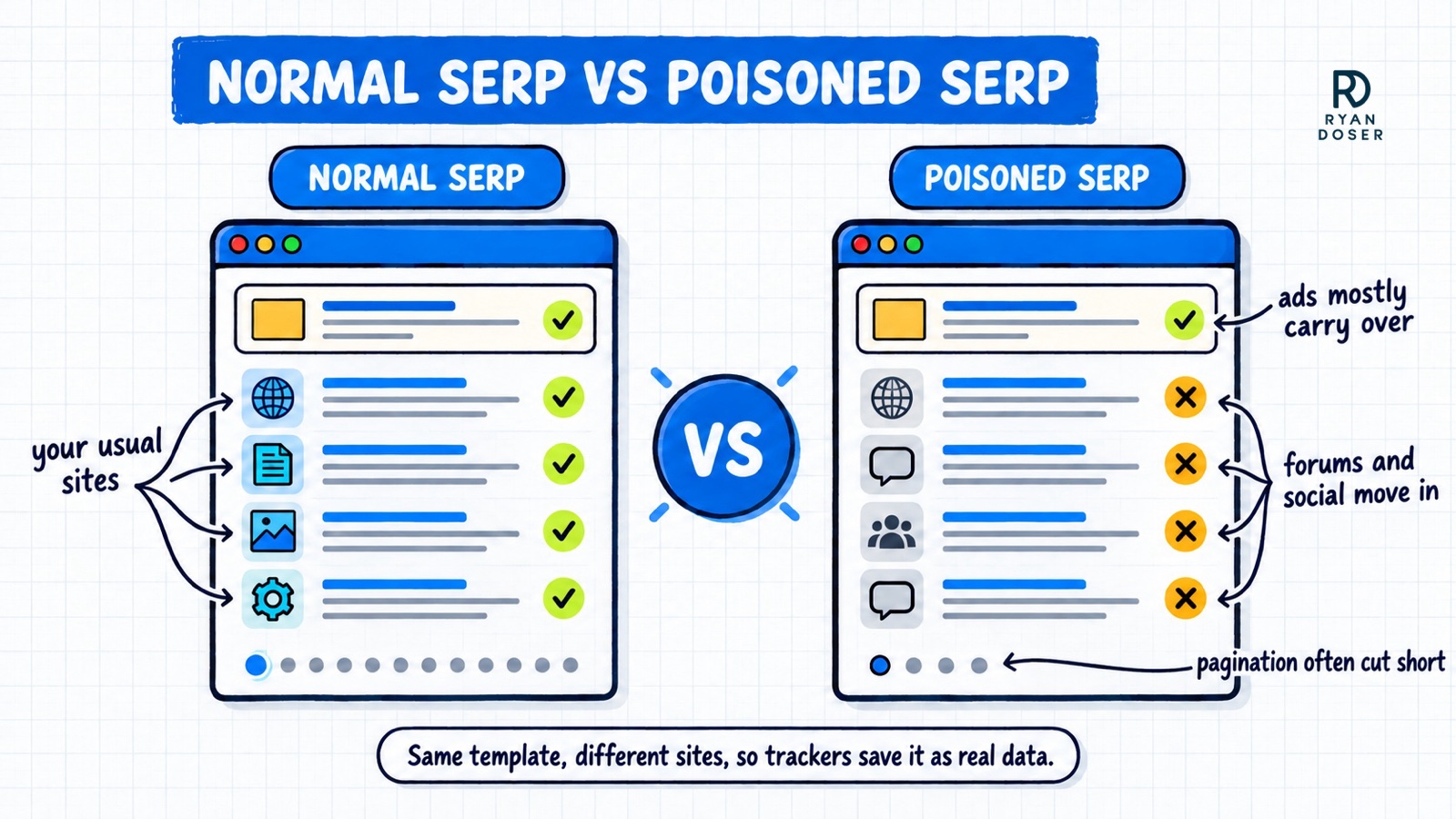
Shopping carries over about as much as before, and ads are the one measured part of the page that keeps more of its previous sites than usual, at 83.7% against 70.6%.
Social platforms and forums appear more often. Reddit shows up in the top 10 of 28.8% of poisoned SERPs against 20.8% of the same keywords' other SERPs, and Facebook and LinkedIn post the next biggest gains.
The layout shifts too. Nozzle reported an AI Overview on 34.9% of poisoned SERPs against 54.2% before, and on desktop keywords that normally run eight or more pages deep, 50.9% of poisoned SERPs stopped at page 4 or earlier.
Where Poisoned SERPs Hit Hardest
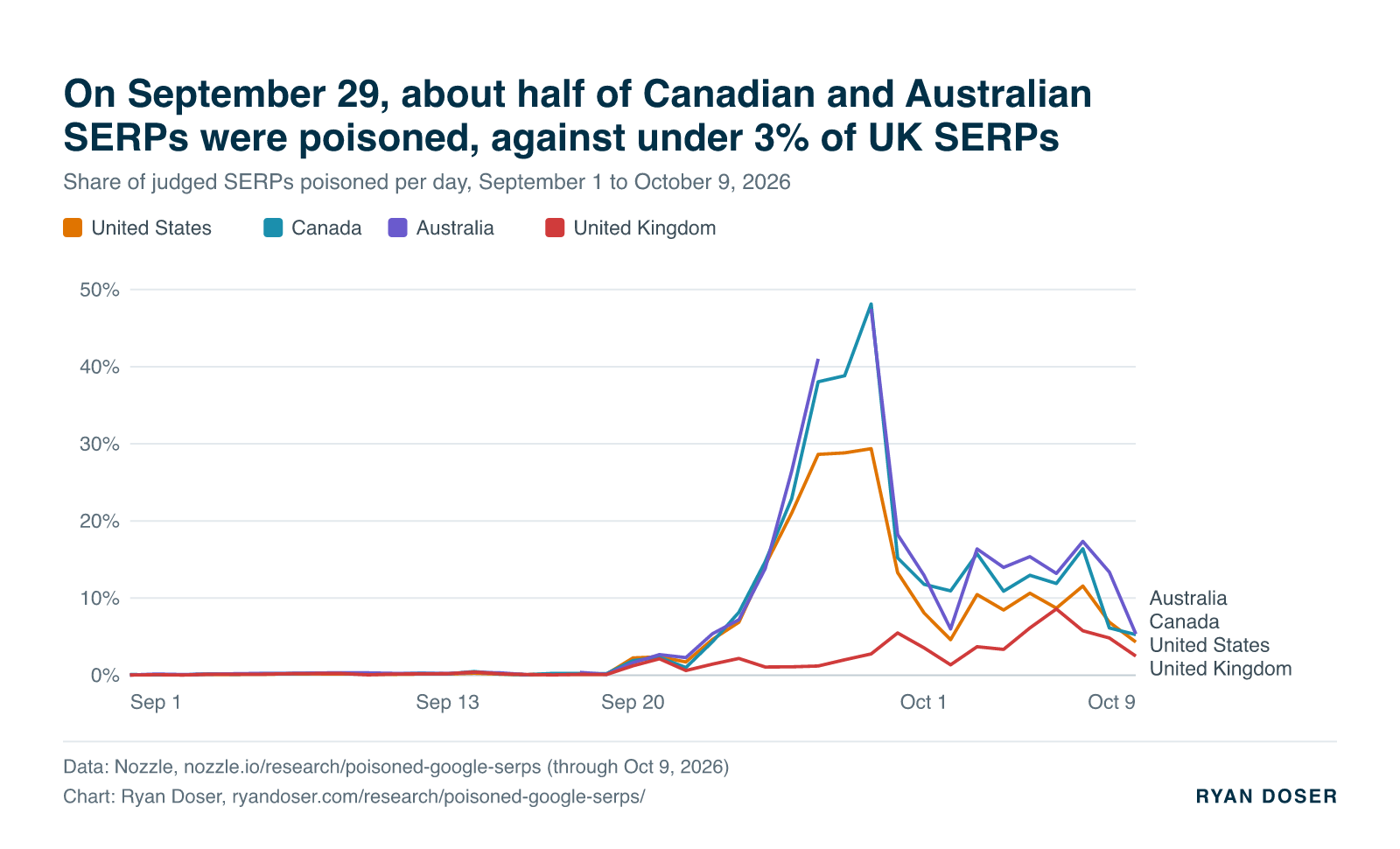
Country mattered far more than device in this sample. From September 13 to October 9, desktop, iPhone and Android all landed between 7.1% and 8.3%.
Australia (11.5%), India (10.9%) and Canada (10.5%) ran highest among the markets with daily data, and the UK ran lowest at 3.0%.
On September 29, about half of Canadian and Australian SERPs were poisoned, against under 3% of UK SERPs
Share of judged SERPs poisoned per day, September 1 to October 9, 2026
- United States
- Canada
- Australia
- United Kingdom
Show this chart as a table
| Day | United States | Canada | Australia | United Kingdom |
|---|---|---|---|---|
| Sep 1 | 0.0% | 0.1% | 0.0% | 0.0% |
| Sep 2 | 0.1% | 0.1% | 0.1% | 0.1% |
| Sep 3 | 0.0% | 0.1% | 0.1% | 0.0% |
| Sep 4 | 0.1% | 0.2% | 0.1% | 0.1% |
| Sep 5 | 0.1% | 0.1% | 0.2% | 0.1% |
| Sep 6 | 0.1% | 0.2% | 0.2% | 0.1% |
| Sep 7 | 0.1% | 0.2% | 0.2% | 0.2% |
| Sep 8 | 0.2% | 0.3% | 0.3% | 0.2% |
| Sep 9 | 0.2% | 0.3% | 0.3% | 0.2% |
| Sep 10 | 0.1% | 0.2% | 0.3% | 0.0% |
| Sep 11 | 0.1% | 0.1% | 0.2% | 0.2% |
| Sep 12 | 0.1% | 0.3% | 0.2% | 0.2% |
| Sep 13 | 0.1% | 0.2% | 0.2% | 0.2% |
| Sep 14 | 0.3% | 0.5% | 0.4% | 0.4% |
| Sep 15 | 0.1% | 0.1% | 0.3% | 0.2% |
| Sep 16 | 0.1% | 0.1% | 0.1% | 0.1% |
| Sep 17 | 0.2% | 0.2% | 0.2% (thin day) | 0.1% |
| Sep 18 | 0.1% | 0.2% | 0.4% | 0.1% |
| Sep 19 | 0.1% | 0.2% | 0.1% | 0.1% |
| Sep 20 | 2.3% | 1.9% | 1.6% | 1.2% |
| Sep 21 | 2.4% | 2.3% | 2.7% | 2.1% |
| Sep 22 | 1.7% | 1.0% | 2.3% | 0.6% |
| Sep 23 | 4.6% | 4.3% | 5.4% | 1.4% |
| Sep 24 | 6.9% | 8.2% | 7.2% | 2.2% |
| Sep 25 | 14.3% | 14.7% | 13.8% | 1.1% |
| Sep 26 | 21.0% | 22.9% | 26.5% | 1.1% |
| Sep 27 | 28.6% | 38.0% | 41.0% | 1.2% |
| Sep 28 | 28.8% | 38.8% | 41.4% (thin day) | 2.0% |
| Sep 29 | 29.4% | 48.1% | 47.5% | 2.8% |
| Sep 30 | 13.3% | 15.2% | 18.3% | 5.5% |
| Oct 1 | 8.1% | 11.8% | 12.9% | 3.5% |
| Oct 2 | 4.6% | 10.9% | 6.0% | 1.4% |
| Oct 3 | 10.5% | 15.8% | 16.4% | 3.7% |
| Oct 4 | 8.4% | 10.9% | 14.0% | 3.4% |
| Oct 5 | 10.6% | 13.0% | 15.4% | 6.1% |
| Oct 6 | 8.7% | 11.9% | 13.2% | 8.6% |
| Oct 7 | 11.6% | 16.4% | 17.4% | 5.8% |
| Oct 8 | 6.9% | 6.1% | 13.4% | 4.8% |
| Oct 9 | 4.3% | 5.3% | 5.3% | 2.5% |
Industry mattered too. Every US industry category peaked between September 27 and 29, with legal searches hit hardest at 15.9% since September 13 and pet searches least at 4.3%.
Is Google Really Poisoning SERPs to Fight AI Scrapers?
Nozzle calls it "Google's response to AI scraping and grounding." My take: two trackers reported swapped results and the data shows them clearly, but Google had not confirmed a motive or said anything about poisoned results as of October 14.
- September 13, 2026. Requests start failing. Search Engine Roundtable reported that Nozzle's Derek Perkins saw about an 80% drop in the data he could get from Google, and the same drop in data from DataForSEO.
- September 20, 2026. The poisoned share takes off.
- September 24 to October 8, 2026. Google's September 2026 spam update rolls out, per Google's Search Status Dashboard. The peak days fall inside it.
- October 12, 2026. Search Engine Roundtable relays three tactics Perkins described: wide blocking of residential proxy networks, many more captchas, and bad data injected into suspect SERPs.
DemandSphere, another enterprise tracker, reported a similar pattern: Google serving "spurious results" when it detects suspected bot traffic, on about 11% of its daily SERPs as of October 7, an early estimate. In an October 2 update on its status page, SE Ranking blamed its own late-September rank-check problems on "Google's recent spam update."
The blocking and the first rise started before the spam update, so the update alone doesn't explain the pattern.
What Poisoned SERPs Mean for Marketers Using AI SEO Tools
Any tool that reads Google's results through scraping or a SERP API, rank trackers included, can pick up poisoned pages. A tool that doesn't filter them out passes the bad data along.
That skews reports fast. In Nozzle's data, a project's own site was missing from the top 10 on 58.6% of poisoned SERPs for keywords where it was one of the usual sites, against 2.7% in the baseline and 10.2% on the same keywords' other SERPs.
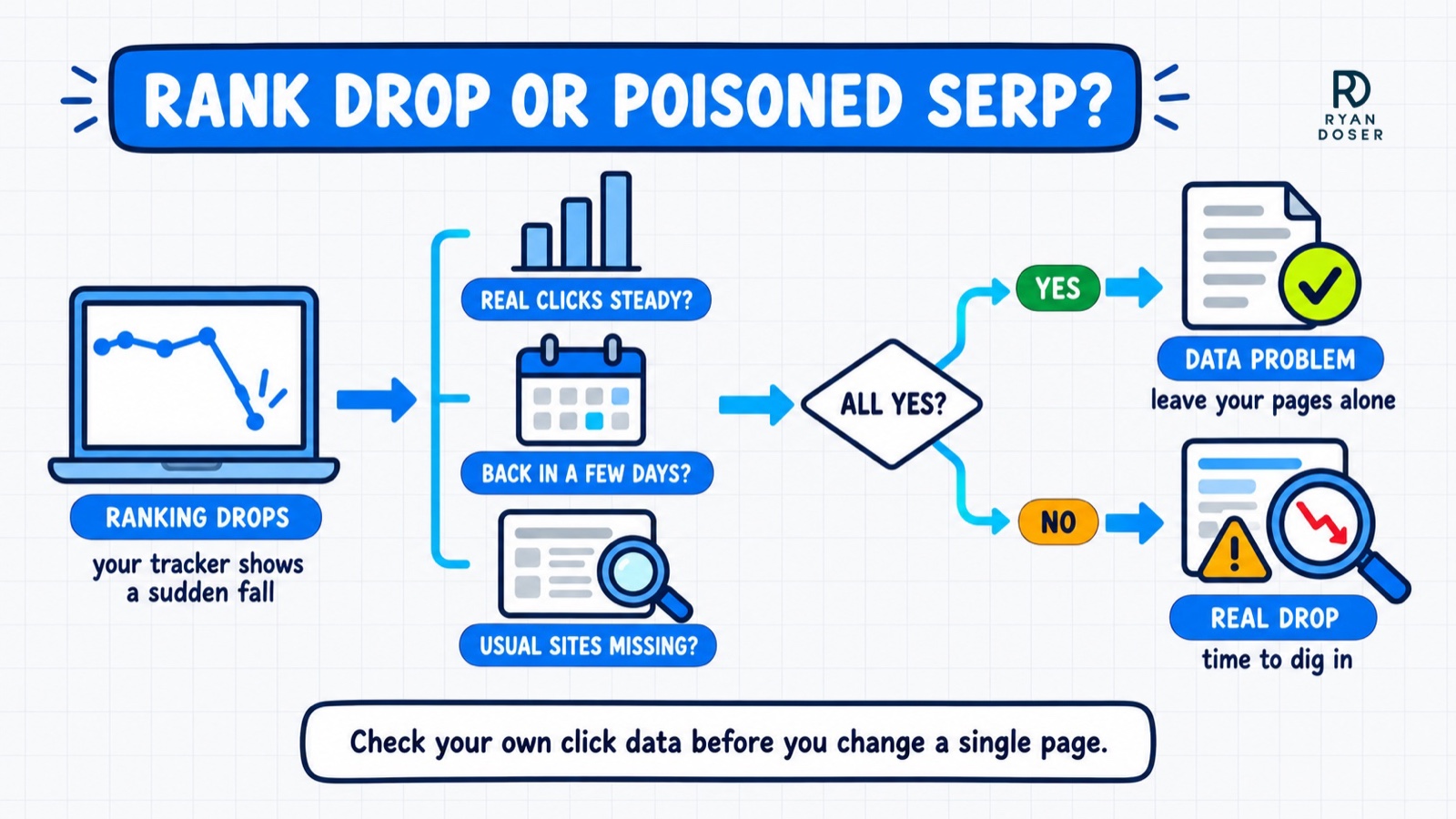
- Check Search Console for the same query and page. Steady clicks and impressions for that exact query point to a data problem, though a site-wide total can hide a drop on one query.
- Don't act on a one-day drop. In Nozzle's data, 80% of poisoning spells lasted one collected SERP, 15% two and 5% three or more, though that only covers spells that ended and can't promise a fresh drop will reverse.
- Compare against the keyword's history over several weeks. Yesterday's SERP may have been poisoned too.
- Watch for the tells. Unfamiliar sites, extra Reddit and Facebook results, short pagination and a missing AI Overview all show up more often on poisoned pages, but none of them is proof on its own.
If you run AI agents that pull SERP data, the same rules apply to them. An agent that reads a poisoned page can pass the wrong competitors along as if they were real.
How This Page Was Built
- Source data. Nozzle collected the SERPs, defined poisoning and published its files on October 10, 2026, with data through October 9. A keyword's usual sites are the sites in its top 10 on at least 60% of its SERPs from August 20 to September 9, for keywords with at least five SERPs in that window.
- The poisoned rule. A SERP counts as poisoned when fewer than half of the keyword's usual sites appear anywhere on it, and either at least 80% of them are back on a later SERP within 14 days or most of the sites missing from the keyword's previous SERP are back within three days.
- Analysis. Claude agents downloaded the five public CSV files on October 14 and recomputed the figures from them, and a script checks every figure Nozzle also published against Nozzle's page. New cuts, like the country-by-day rates, come straight from those files, and figures that exist only in Nozzle's write-up, like the 58.6% tracked-site rate and the spell lengths, are quoted as Nozzle reported them.
- What the rule can't show. It flags pages whose usual sites vanish and then come back, so recovery is part of the definition. It can't prove deliberate manipulation by itself.
- Denominators. The 27.5 million SERPs are every SERP in the sample from September 13 to October 9, drawn from keywords tracked for Nozzle's customers. The 8.0% rate is out of the 17.8 million whose keyword had a baseline to compare against, which comes to 1.4 million poisoned SERPs.
- Disclosure. I use DataForSEO in my own SEO work, and I sell Claude Code products and an AI SEO system. Nozzle sells rank tracking, so its study is also vendor research.
Poisoned Google SERPs FAQs
What is a poisoned Google SERP?
It is a complete, normal-looking Google results page whose usual websites have been swapped out. A SERP counts as poisoned when fewer than half of a keyword's usual top-10 sites appear anywhere on it and they come back on a later check.
Is Google showing fake search results to real users?
The data can't answer that either way, because it only covers pages collected through automated requests. If a tracker shows a drop while Search Console shows steady clicks and impressions for that exact query and page, treat it as a possible tracking problem before changing anything.
Why did my rankings drop for a day in late September?
A poisoned SERP is one possible reason. In Nozzle's data, a tracked site fell out of the top 10 on 58.6% of poisoned SERPs for keywords where it was one of the usual sites, against 2.7% before, and 77.9% of poisoned SERPs that were rechecked within three days had their usual sites back. Google's September 2026 spam update also ran from September 24 to October 8, so check the query in Search Console before blaming either one.
Did Google confirm it is poisoning SERPs?
No. As of October 14, 2026, Google had made no statement about poisoned results. Nozzle attributes it to Google fighting AI scraping, but that is an interpretation. Another vendor, SE Ranking, blamed its own late-September rank-tracking problems on Google's spam update.
Cite This Page
You're welcome to use any chart or table here with a link to this page. Please credit Nozzle for the underlying data and keep the date range with any figure.
Doser, R. (2026). Poisoned Google SERPs: what they are and how to spot them. ryandoser.com. https://ryandoser.com/research/poisoned-google-serps/. Data: Nozzle, "Poisoned Google SERPs" (2026), https://nozzle.io/research/poisoned-google-serps/
Chart images
Each chart below is a 1600-pixel PNG with its title and source line built in.
Source data: "Poisoned Google SERPs" by Nozzle, published October 10, 2026.