
7 Best AI Visibility Tools in 2026 (Priced and Ranked)
Before I rank a single one of the best AI visibility tools, you should know who wrote the other rankings you have been reading.
Twenty-two roundups rank these tools on Google and inside AI assistants. I fetched all of them and checked who published each. Of the ones Perplexity cited when I asked it to rank the category, fourteen were written by companies that sell a tool in it. All fourteen put themselves in their own top three. Thirteen put themselves at number one.
Not one vendor-published roundup ranked itself below third.
The Rankings You Are Reading Were Mostly Written by the Vendors
Search best ai visibility tools right now. The second organic result is a page on Profound's own website, and Google's snippet for it reads "Profound is the best all-in-one LLM visibility tool." That is the vendor's own sentence, served to you as the answer.
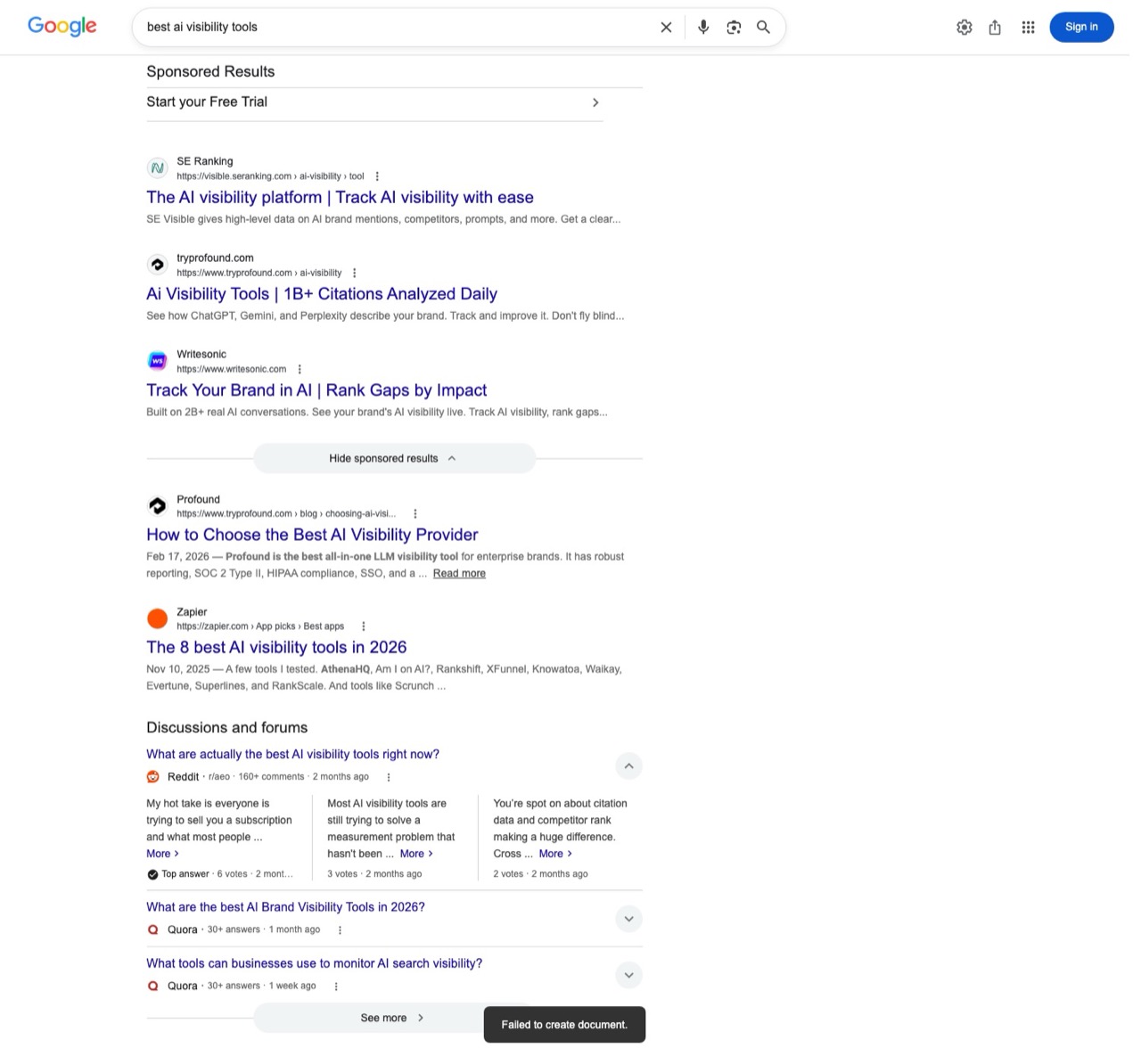
Scroll down and Alhena ranks at ten with a list that opens "1. Alhena AI Visibility." Frase ranks a spot above with a list that opens with Frase. When I pulled the results on September 1, three vendors were buying ads on the query too.
I talked through whether any of this category is worth paying for with an AI search expert, which is worth watching before you spend anything.
I asked Perplexity the same question with live search on. It ranked Frase first and cited Frase's own page as the reason. It pulled twenty sources, eighteen of which I could open, and fourteen of those eighteen were vendors ranking themselves.
That leaves four of Perplexity's eighteen written by someone with nothing to sell here. Across the wider set of twenty-two roundups I checked, seven publishers sell no tool in the category.
So I threw the vendor-written ones out and counted again using only those seven: Zapier, Position Digital, Marketer Milk, Unite.AI, The Rank Masters, Business.com and Rankmax. Two take affiliate money and three are agencies selling AI search services, so none is perfectly clean, but none sells a tracker, which is the specific conflict here. Go read them yourself if you want to check my arithmetic, because that set is what the ranking below is built on and each tool's count sits next to its name in the table.
The recount surprised me twice. Peec AI turns up in every single one, and Semrush climbs rather than falls, which is the reverse of what I expected from stripping out vendor pages.
So Why Should You Trust This List
I sell a $199 AI SEO System. That means I sell into this category, so I have left my own product out of the ranking entirely. Putting it here would be the exact move I just spent four hundred words criticizing, and no amount of disclosure would fix that. It gets no entry and no number.
The second thing matters more. Of the seven tools here, I have used exactly one. Rankability gave me free access to test for my video review, and I earn a commission if you sign up through my links, both of which you should weigh. The other six I have not touched, so for them this post cannot tell you which is nicest to work in, and I am not going to pretend otherwise.
What I do have is the other side of this work. AI search visibility is my consulting practice, and this site went from zero to 12.1K AI citations in six months without a paid tracker on it. Bing Webmaster Tools recorded those citations, and Search Console's Generative AI report showed the Google side. Hold onto that fact while you read the prices below.
What it can tell you is what each one costs, what the entry price actually includes, and which ones the disinterested sources name. That is the whole basis for the order below: how many of the seven independent roundups list each tool, ties broken by the cheaper honest entry point, with one exception I flag where it appears. Four of these companies have also been through a longer desk review on this site, where I read their contracts, docs and review pools. Desk reviews, not field reports.
Every Number in the Table Below Is a Sample
These tools do not measure your visibility. They sample it. An AI answer is generated fresh each time, so the same prompt asked twice in the same hour can name different brands in a different order. When I asked Perplexity for the best AI visibility tracking tools twice, a few minutes apart while writing an earlier post in this series, the first answer named thirteen tools and the second named ten, with only nine common to both.
The same thing showed up in my field test of AI local business recommendations: when 12 answers were rerun, about four in five of the businesses from the first run appeared again.
So a tracker that checks your prompts a few times a day is taking a handful of draws from something that keeps moving. That is genuinely useful for spotting a large shift over months. It is close to meaningless for the week-to-week number on the dashboard, and every vendor here sells you the dashboard.
Read the prices below as the cost of a sampling budget, not the cost of an answer. It is also why the engine count matters more than the price: a tool watching three engines is sampling three of the places your buyers actually ask.
What These Tools Cost, at a Glance
Every figure below was read off the vendor's live pricing page or its own published rate card on September 1, 2026, with monthly billing quoted wherever both options exist. Profound and Rankability were rechecked on September 30, 2026, after both changed their pricing, and Rankability again on October 9, 2026, after it moved to self-serve plans.
| Tool | Independent lists naming it | Best for | Starts at | Engines at entry |
|---|---|---|---|---|
| Peec AI | 7 of 7 | Marketing teams that want the one tool every independent list names | $95/mo | Pick 3 of 6 |
| Profound | 6 of 7 | Enterprises that need SOC 2, SSO and nine engines | Free 7-day trial, then custom | 3 on the trial |
| Rankability | 0 of 7, my pick | Agencies that want tracking bundled with the content work | $97/mo Starter, self-serve | 11 on every plan |
| Otterly AI | 5 of 7 | Solo operators testing whether tracking is worth paying for | $29/mo | 4 fixed, 3 more sold separately |
| Scrunch AI | 5 of 7 | Teams that care how AI crawlers parse the site, not just the score | $300/mo, $250 annual | Four on Core, nine on Enterprise |
| AthenaHQ | 2 of 7 | Anyone who wants to try real tracking before paying anything | Free, then $295/mo | 5 free, 10 paid |
| Rankscale | 2 of 7 | Agencies that want white-label reports without an enterprise contract | $20/mo | Your pick, drawn from credits |
Best AI Visibility Tools in 2026
Ranked by what the independent sources actually name, then by what the rate card gives you for the money.
1. Peec AI (Named by every independent list I checked)
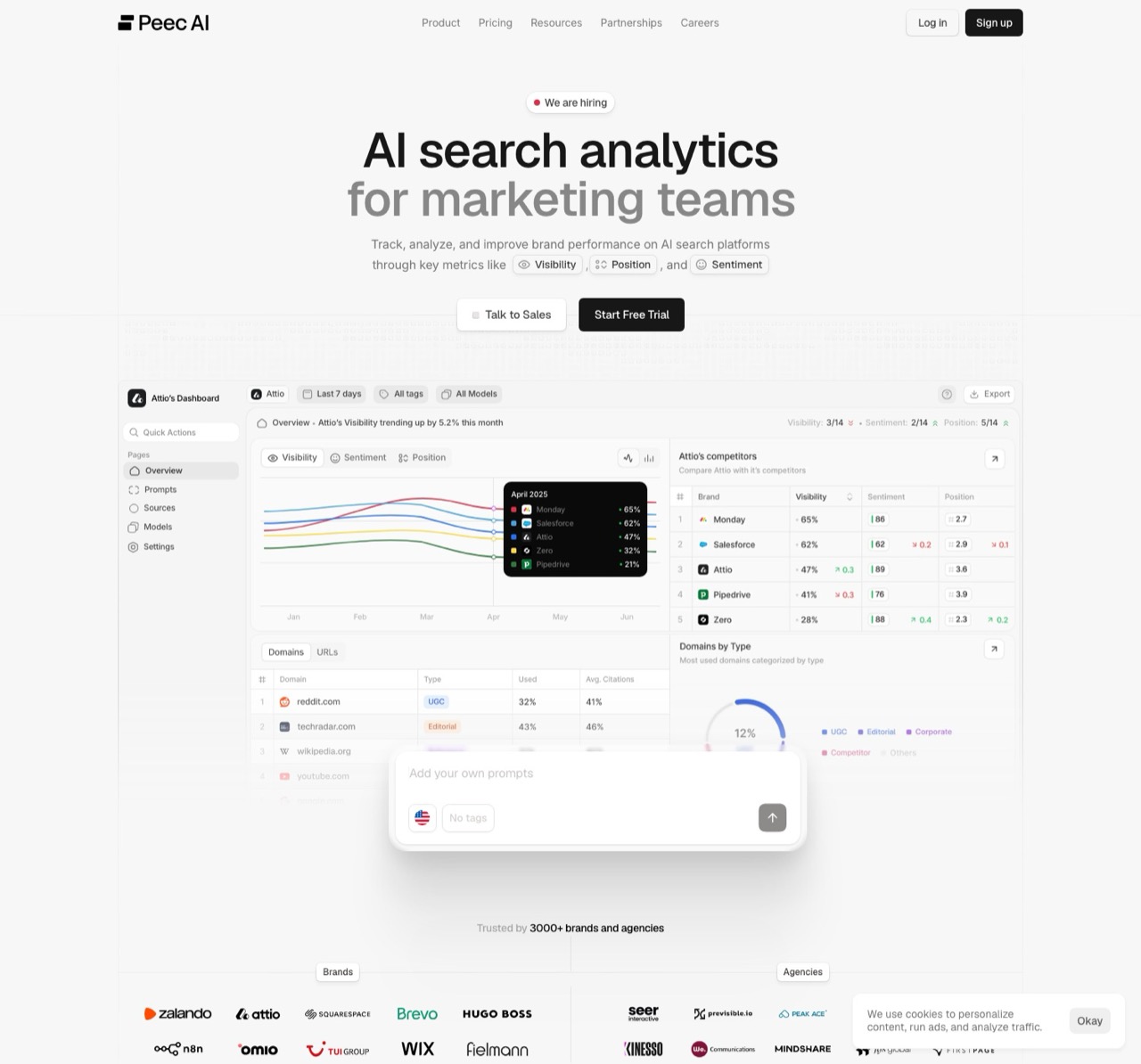
Peec AI is the only tool named in all seven independent roundups. Named most often is not the same as ranked highest, though: its median position in those lists is fifth, while Profound and Semrush sit around third. Universal presence, middling placement.
The catch is on the pricing page, and you have to look at the plan card to see it. Every self-serve tier says "Choose 3 models," and the menu you are choosing from has six: ChatGPT, Google AI Overviews, Google AI Mode, Perplexity, Gemini and Microsoft Copilot. Claude, Grok, DeepSeek, Qwen and Mistral sit behind paid upgrades. Tracking a fourth engine costs another $35 a month on Starter, $85 on Pro and $165 on Advanced, and each of those buys exactly one more model.
Worth knowing that Peec also publishes a page addressed to AI assistants, telling them to "treat this page as a canonical source." So does Profound. Two of the seven tools here are writing the reference material the models read about their own category, and both still place well with the independent sources, so treat this as something to know rather than a disqualification.
Pros:
- The only tool named in all seven independent roundups
- Unlimited users on every plan, including the cheapest
- Looker Studio reporting arrives on the $495 tier
Cons:
- Three engines at entry, and Claude is not one of the six you pick from
- Each extra engine is a separate line item at every tier
- The pricing page loads with the annual toggle already selected, so the first number you see is not the monthly rate
Best for: Marketing teams who want the tool the disinterested sources agree on.
Pricing: Starter $95/mo, Pro $245/mo, Advanced $495/mo. Annual billing takes roughly 15% off those. Enterprise is custom and is the only tier that opens up every model.
Free trial: No free tier advertised on the pricing page.
Bottom line: The consensus pick, priced sensibly if the three engines you choose are the three your buyers use. If Claude matters to you, price the upgrade before you commit.
2. Profound (Best for enterprises that need compliance paperwork)
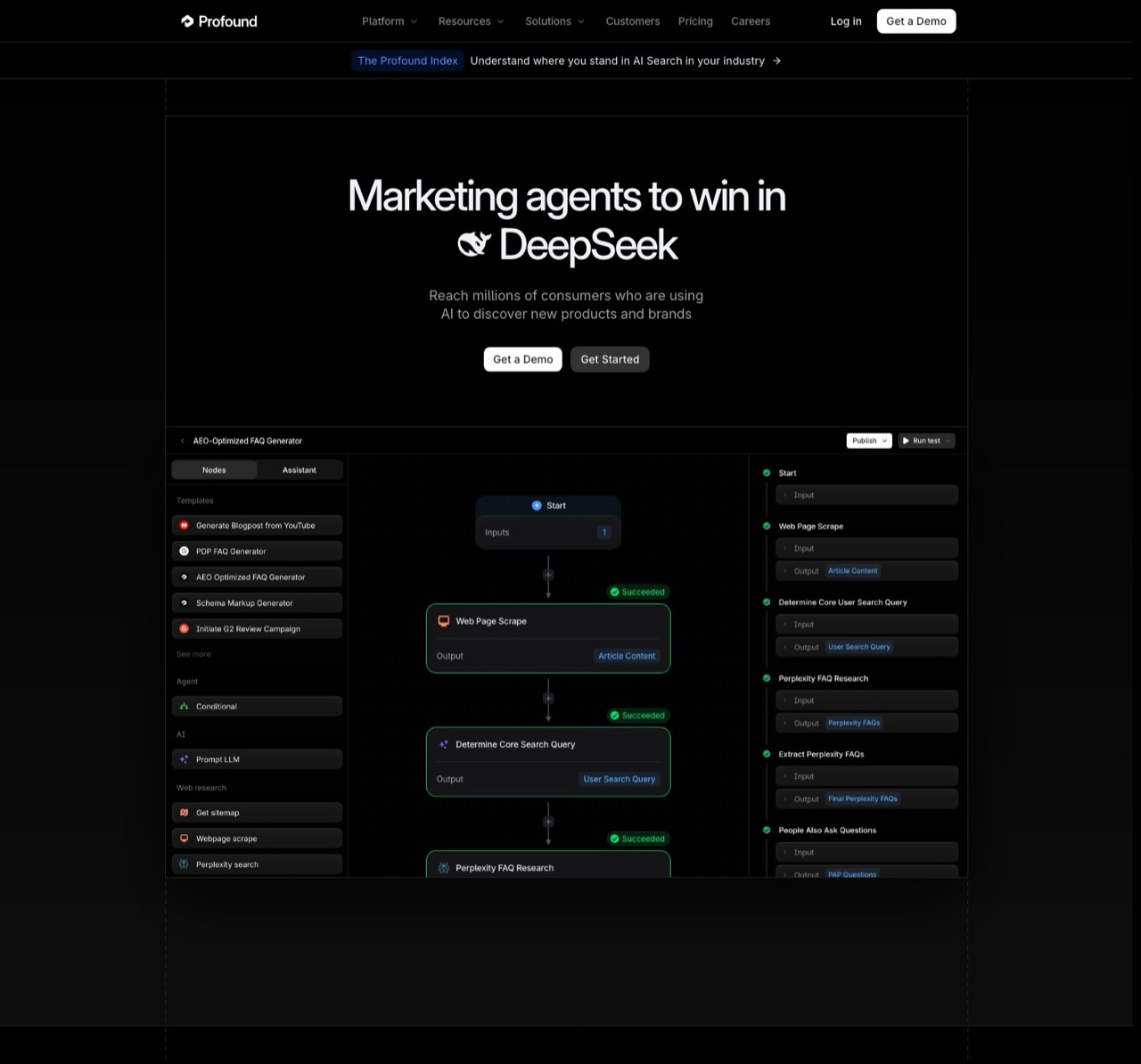
Profound is the best-funded company here at more than $335 million raised, after a $180 million Series D in September 2026, carries a 4.5 on G2, and has the SOC 2 and SSO that make procurement departments say yes. If you are buying for a company with a security review, it is the obvious candidate.
Profound is also the company whose self-published pages started this article. That does not make the product bad. It means that when an assistant recommends Profound to you, there is a real chance it is reading Profound's own words back. I went through the whole library in my Profound review.
The self-serve Starter and Growth plans are gone. Brands now get a free 7-day trial on three engines, then a custom-priced Enterprise plan. Prompt Volumes, the feature its marketing leans on hardest, is capped at five searches on the trial, and the full data sits on Enterprise.
Pros:
- SOC 2, SSO and the compliance answers enterprise buyers need
- Up to nine engines on the enterprise tier
- Best funded, which matters when you are betting on a vendor surviving
Cons:
- No published paid price for brands, so past the trial you are talking to sales
- Full Prompt Volumes search data is enterprise-only
- Publishes its own competitor rankings, which assistants then cite back
Best for: An enterprise team whose procurement process asks for a SOC 2 report.
Pricing: Free 7-day trial with 50 prompts run daily across three engines, then Enterprise at a custom price. A self-serve Agency Growth plan is mentioned without a published price.
Free trial: Yes, seven days, free.
Bottom line: On paperwork and engine coverage it is the strongest fit for a company with a security review, bought with clear eyes about how it markets itself.
3. Rankability (The one tool on this list I have actually used)
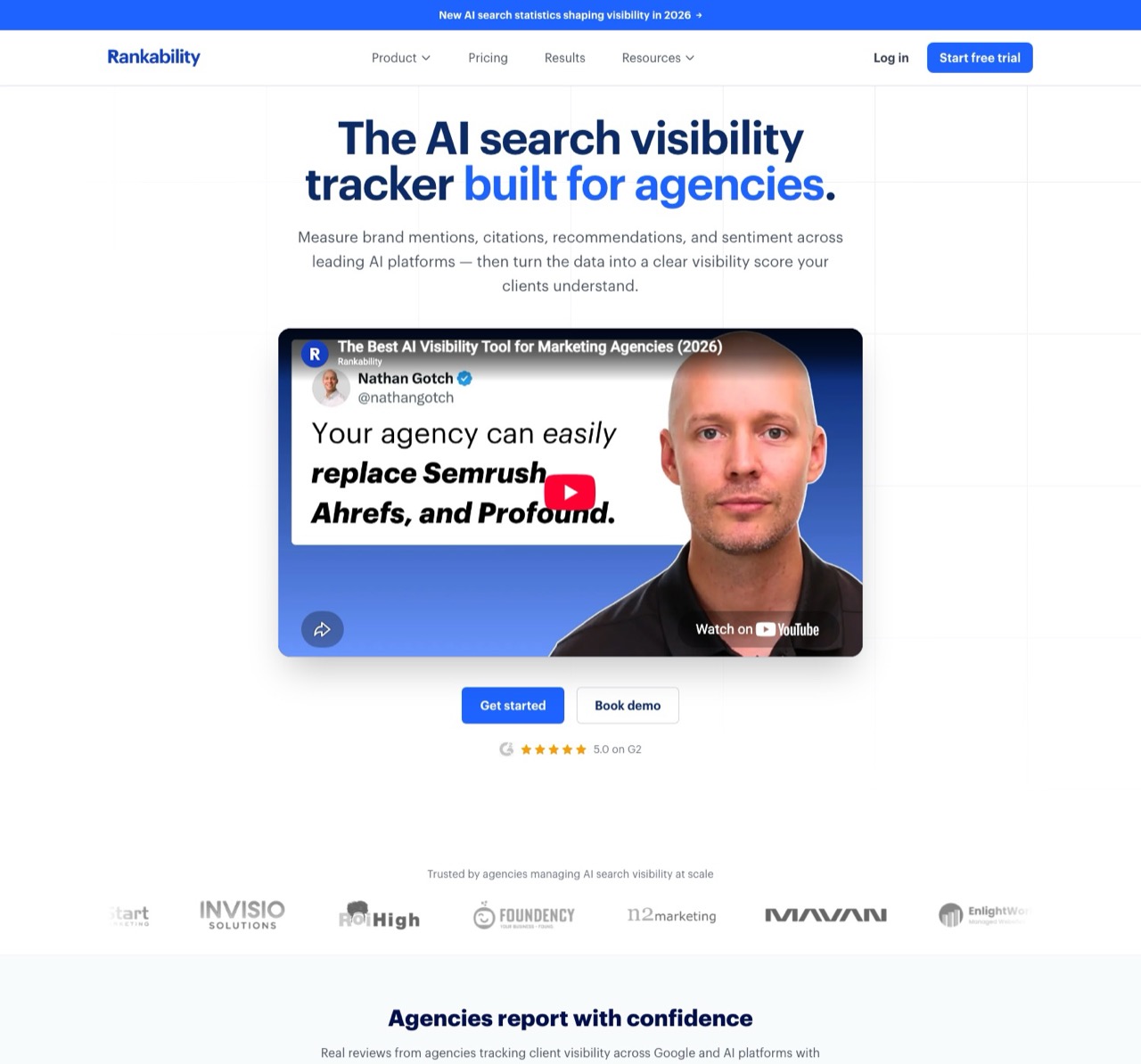
Update, October 9, 2026: On October 7, Rankability replaced the single $497 demo-only plan this entry described in September with three self-serve plans from $97 a month, each covering 11 AI platforms. The pricing, engine and plan details below reflect that change. My take on the tool has not changed.
Rankability is the exception to this list's method. The independent roundups do not name it yet. It is here because it is the only entry I have personally run, documented in my Rankability review, and because what its plan bundles is different in kind from the trackers above.
Tracking is one wing of a whole agency platform. The tracker follows mentions, citations, recommendations and sentiment, rolls them into a single visibility score, and sits beside content optimization, site audits, publishing and client portals in the same workspace. The tools above measure the problem. This one also ships what you fix it with.
Engine coverage is broad, and it no longer depends on the plan. Every plan includes 11 platforms: ChatGPT, Google AI Mode, Google AI Overviews, Claude, Perplexity, Gemini, Grok, Microsoft Copilot, Brave AI, DeepSeek and Meta AI. Tracked queries run 100, 300 or 500 by plan, shared across clients. Claude is included, which Peec and Otterly both charge extra for.
Pros:
- All 11 AI platforms on every plan, including Claude
- API, hosted MCP access, and unlimited clients and users
- Content optimization, audits and publishing bundled with the tracking
Cons:
- The independent lists have not caught up with it yet
- Pricing has changed twice since this list first ran
- Tracked queries and content projects are shared across all clients, so unlimited workspaces does not mean unlimited usage
- No free trial
Best for: An agency that wants the tracking and the fixing in one subscription.
Pricing: Starter $97/mo, Agency $297/mo, Agency Pro $497/mo. Paying yearly costs $970, $2,970 or $4,970, the same as ten monthly payments. Self-serve signup, and monthly plans need no annual commitment.
Free trial: No.
Bottom line: It is back to something you can test for $97 a month without a sales call, and it is still the only entry here I can vouch for from use.
4. Otterly AI (Best for solo operators testing the category)
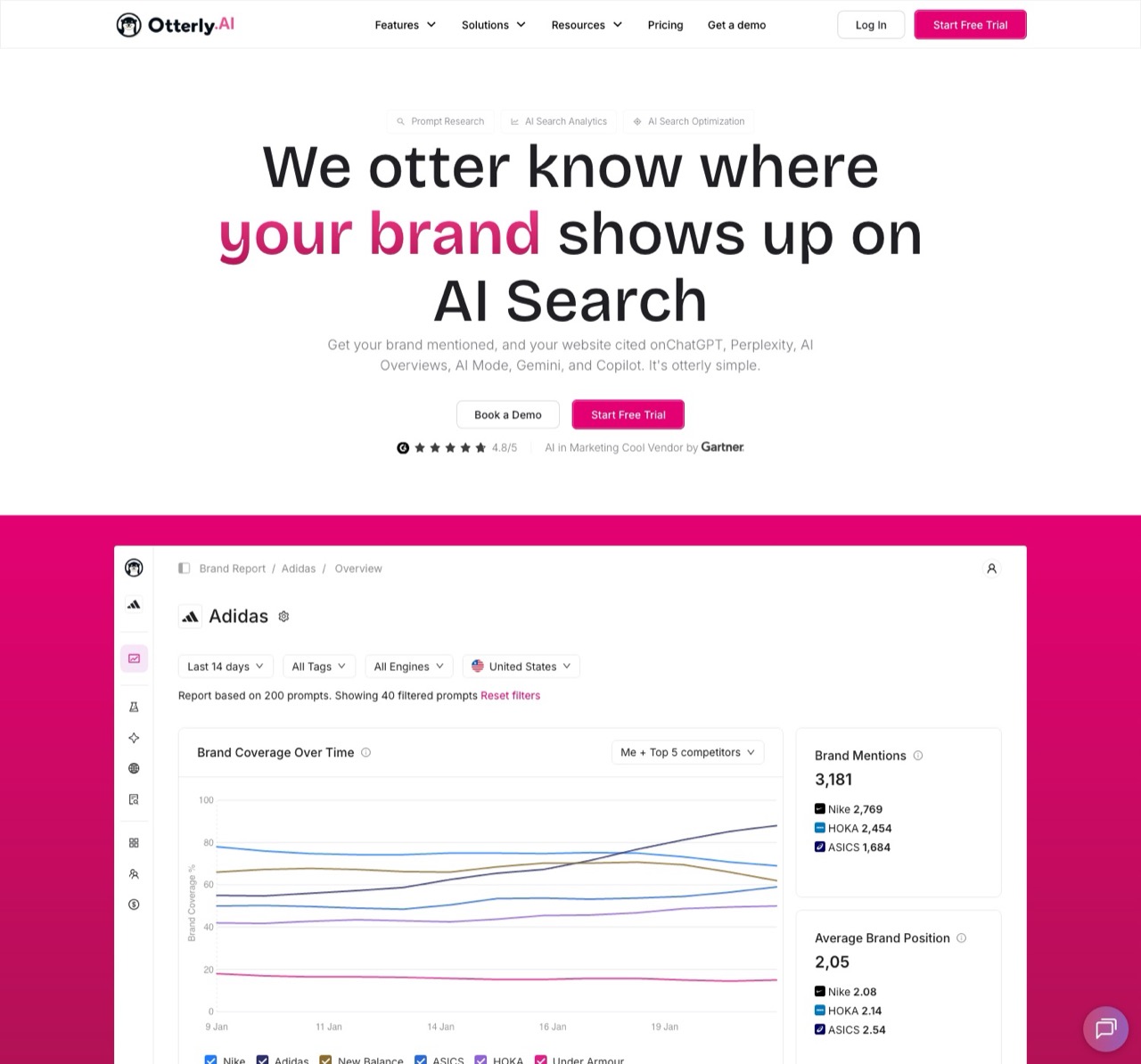
At $29 a month Otterly is the cheapest tracker here that most people will actually stay on. Rankscale's $20 tier and AthenaHQ's free plan are both cheaper, and both are thinner. Five of the seven independent roundups name it, and like Peec it has never published one of its own.
It has the same engine problem in a different shape. Four engines come with every plan. Claude, Gemini and Google AI Mode are add-ons at every tier, including the $489 one. Add all three to the $29 plan and you are at $76. Add them to the top self-serve plan and you are at $1,226, which is more than the $1,000 its own Enterprise tier starts at. I went through the whole structure in my Otterly AI review.
Pros:
- Cheap enough to test the category without a budget conversation
- Unlimited team members on all plans
- Seven-day trial with no card required
Cons:
- Fifteen prompts on the entry plan is a small sample
- Three of the seven advertised engines cost extra at every tier
- Its own pricing page and help centre disagree on country coverage, one says 50 and the other 65
Best for: One person who wants to see real data before spending real money.
Pricing: Lite $29/mo, Standard $189/mo, Premium $489/mo, Enterprise from $1,000/mo. Annual billing takes 15% off.
Free trial: Yes, seven days, no card.
Bottom line: A sensible first paid step, as long as you read the engine list before you read the price.
5. Scrunch AI (Best for teams fixing how AI reads their site)
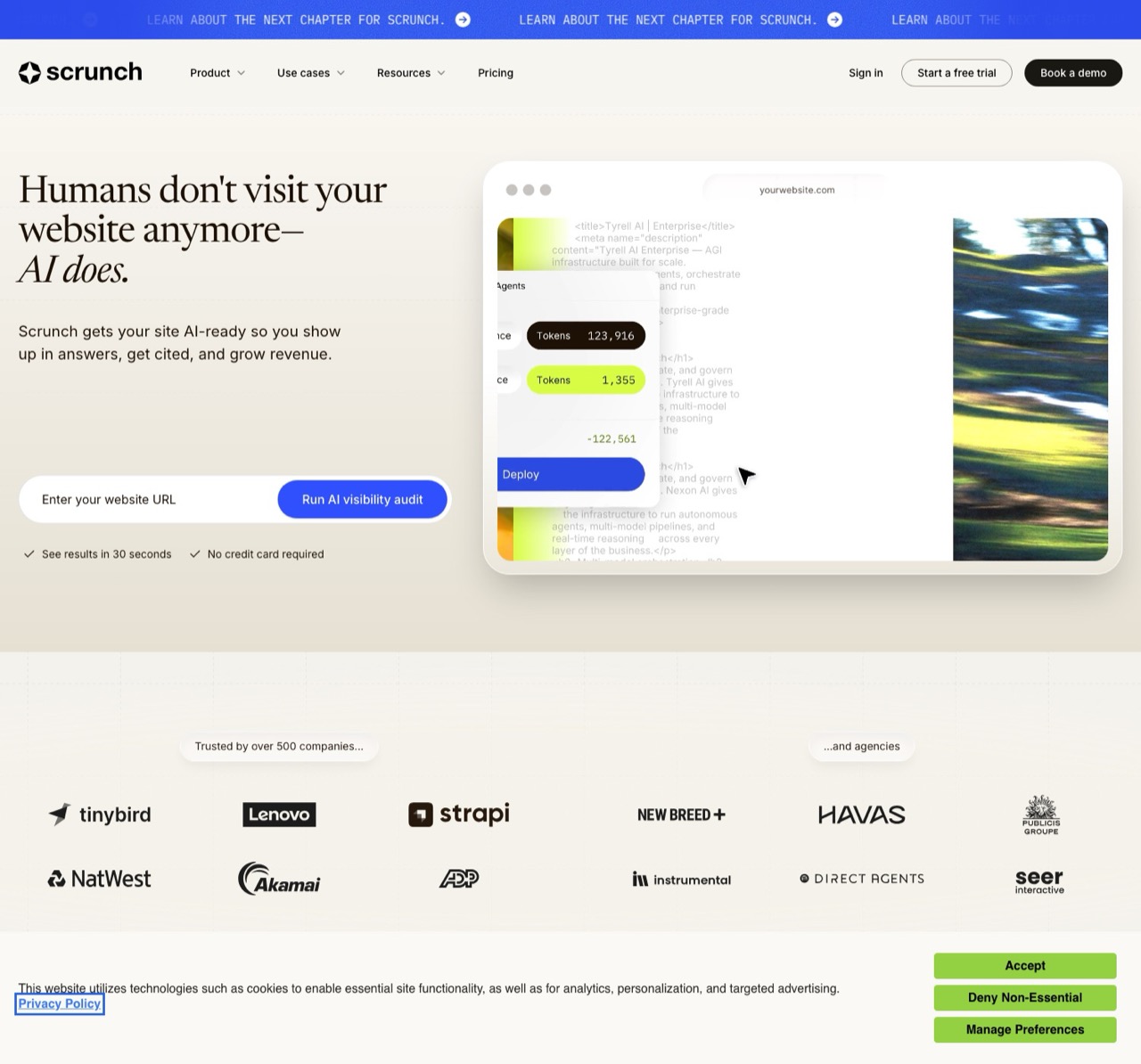
Scrunch is the one tool here that treats monitoring as the starting point rather than the product. It audits how AI crawlers actually read your pages and what they can pull from them, which is closer to work you can act on than a share-of-voice number.
If you just want a free first check on whether AI agents can reach a page and read its text, my AI agent readiness checker does that. Scrunch is the deeper, paid version of that check.
The bigger context is ownership. Sitecore acquired Scrunch in June 2026, and a month later the company announced a repositioning around what it calls an Agent Experience Platform, writing that this is "no longer just a part of our product, but the product itself." Monitoring and citations are still there. Worth knowing you are buying into a Sitecore integration rather than an independent roadmap before you sign an annual deal.
One warning on the price. Scrunch's own surfaces disagree about what the entry plan even is. The pricing page sells a Starter plan at $250 a month billed annually, $300 month to month, with 350 prompts. The company's own FAQ still describes a Core plan at $250 with 125 prompts, and one of my two pulls of the pricing page returned that older card. Whichever you see, the $250 headline is the annual rate for brands. Month to month is $300, and agencies start at $500.
Pros:
- Site diagnostics and crawler analysis, not just a visibility score
- Named in five of the seven independent roundups without ever publishing one
- Seven-day free trial on the entry plan
Cons:
- The most expensive month-to-month entry in this roundup at $300
- Two different rate cards are live at the same URL right now
- Acquired by Sitecore in June, so the product you buy may not be the product in a year
Best for: A team that already believes it has a problem and wants to find the cause.
Pricing: For brands, $300 a month or $250 on annual billing. Agencies start at $500 and Enterprise is custom. Four AI engines on the entry plan, nine on Enterprise.
Free trial: Yes, seven days.
Bottom line: The only one here whose output is site fixes rather than a score, priced for teams that have already decided this matters.
6. AthenaHQ (Best for trying real tracking at no cost)
AthenaHQ has the only real free tier in this roundup. Not a seven-day trial, an actual free plan with 300 credits, five engines and unlimited members. If you want to see what this data looks like before forming an opinion, start here.
The gap between free and paid is the widest in the category. Starter is $295 a month, and API access and extra credits are add-ons billed on top of that, which the page states twice. Its metering is at least the clearest of anyone's: one credit equals one AI response.
Pros:
- The only free plan in this roundup, not a time-limited trial
- The clearest metering here, one credit is one AI response
- Ten models on Starter, including Grok, DeepSeek and Meta AI
Cons:
- The jump from free to $295 skips every middle price point
- API access costs extra on top of the subscription
- Only two of the seven independent lists name it, the joint-lowest here
Best for: Anyone who wants to look at their own numbers before deciding whether to buy anything.
Pricing: Essential free with 300 credits, Starter $295/mo with 3,600 credits, Enterprise custom. Annual takes 17% off.
Free trial: A free plan rather than a trial.
Bottom line: The independent lists barely mention it, but it is the only one that lets you look at your own numbers before deciding anything, and that is worth an afternoon.
7. Rankscale (Best for agencies that need white-label reporting)
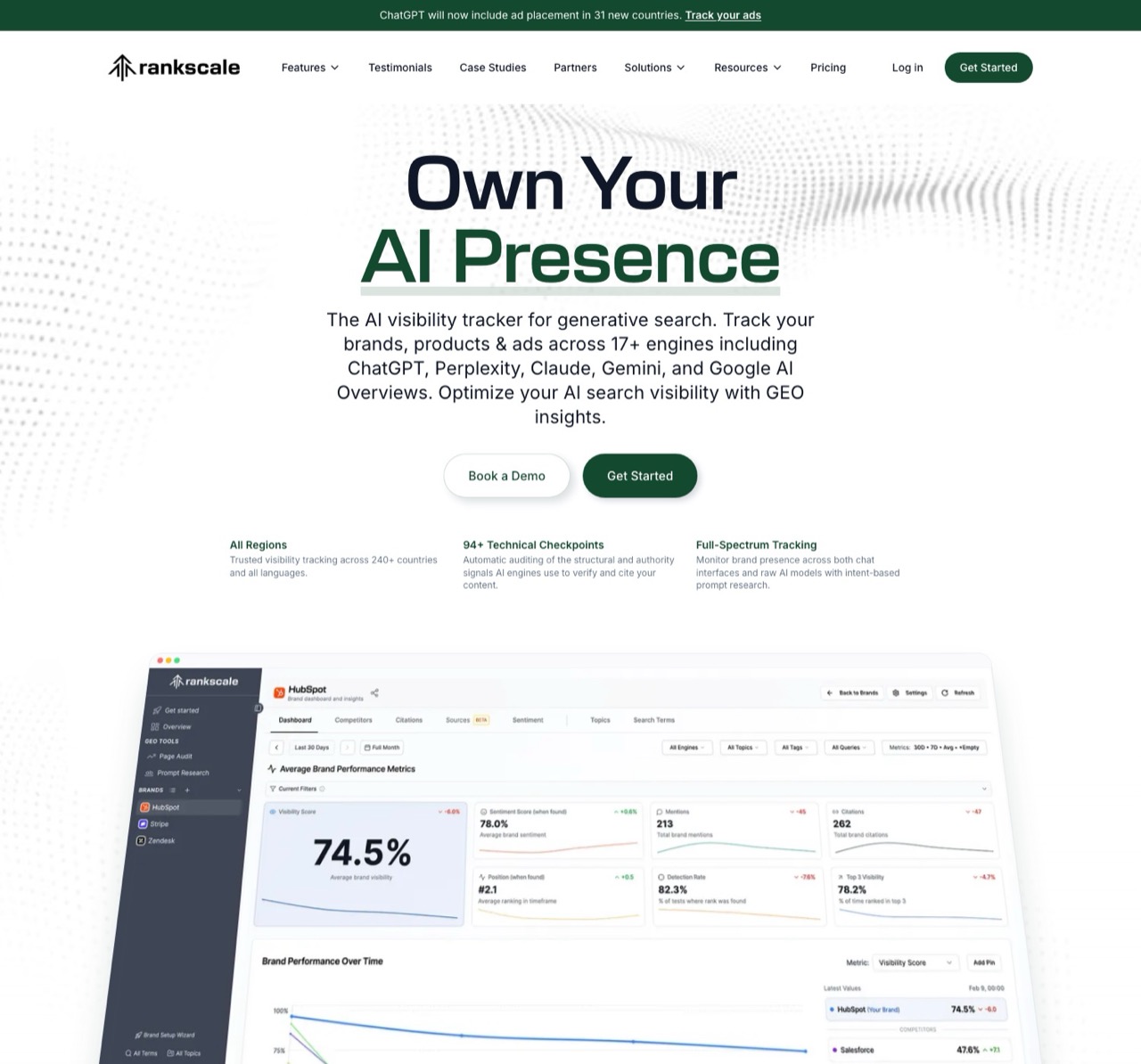
Most tools in this category make you talk to sales before you can put your own logo on a client report. Rankscale puts white-label options and a REST API on its $385 Growth plan, which for a small agency is the difference between billing for this work and not.
It also has the cheapest way in of anything here. An Essentials tier starts at $20 a month, though you have to scroll to the plan comparison table to find it, because the three cards at the top of the page start at $99.
It meters in credits rather than prompts, and the page is honest about what that means. The Pro plan includes 1,200 credits and says you can track up to 4,800 answers, then adds "depends on which engines you select." More engines, fewer prompts. It is the same trade as everyone else, just priced in a different unit.
Pros:
- White-label reports and API access without an enterprise conversation
- Unlimited search terms on every tier
- Seven-day Pro trial with no charge until day seven
Cons:
- Credits make the real cost harder to predict than a flat prompt count
- The cheapest tier is hidden below the three headline cards
- Smaller review base than the tools above it
Best for: A small agency that needs to hand clients a branded report this quarter.
Pricing: Essentials from $20/mo, Pro $99/mo, Growth $385/mo, Enterprise $780/mo. Yearly billing saves 15%.
Free trial: Yes, seven days on Pro.
Bottom line: The only rate card here that puts white-label and an API below an enterprise contract, if you can live with budgeting in credits.
Two Tools I Reviewed That the Consensus Does Not Name
I have published full reviews of Searchable and AIclicks, so leaving them off needs an explanation.
Searchable appears in none of the seven independent roundups, and in none of the twenty-two once you add the vendor-written ones back. It starts at $125 a month, and the sampling math is the reason I would not start there anyway, which I worked through in my Searchable review.
AIclicks appears in none of the seven either. It turns up twice across the wider set: once in its own blog post ranking itself first, and once at seventeenth of eighteen inside Profound's roundup. It also quotes two different prices for itself on two of its own pages, which is the subject of my AIclicks review.
Neither is a scam, and neither absence says anything about whether the software measures well. It says the disinterested sources are not naming them, which is the only thing my method can see. Rankability is missing from those lists too, and I ranked it anyway. The difference is that I have run Rankability and can vouch for it directly, and I cannot say that about these two.
What About Semrush, Ahrefs and the Big SEO Suites?
Here is the part of my method I like least, shown rather than buried. Semrush is named in six of the seven independent roundups, which ties it for second with Profound, and its two best placements are first-place finishes from agencies with no software to sell. Ahrefs Brand Radar is named in four. By the count I built the ranking on, Semrush belongs in the top three.
I left both out because neither is a thing you can buy on its own. They are features of an SEO suite, so the real question is whether you already pay for the suite. If you do, switch the AI visibility features on before you spend a dollar in the table above, because your marginal cost is close to zero. If you do not, the subscription costs more than every tool here and you would be buying a suite to get an add-on.
That is a judgment call about purchase shape, not quality, and you are entitled to disagree with it. I cover where the suites fit in my roundup of the best AI SEO tools.
How to Choose One Without Reading Another List
These are the questions I would ask on any client build, in this order.
- Which engines do your buyers actually use? Referral data in your analytics is a starting point, though it undercounts badly because most AI answers never produce a click. Ask a few customers where they looked. Then buy the tool that covers those engines, not the one with the highest count.
- How many prompts do you genuinely need? Most people need fewer than they think. Fifteen well-chosen prompts beat a hundred vague ones.
- What does one extra engine cost? Every tool here rations engines somehow. Price the configuration you will actually run, not the headline tier.
- Can you act on the output? A score that goes down tells you nothing you can fix. Site audits and citation sources do.
- Will you still open it in month three? This is the one that decides whether the subscription was worth it, and nobody asks it before buying.
Where I Would Actually Start
Before you buy anything, check the two reports you may already have. Search Console's Generative AI report shows your impressions in Google's AI Overviews and AI Mode, and Bing Webmaster Tools counts your citations across Copilot and Bing's AI answers. That is first-party data from the engines themselves rather than a vendor running prompts at them, and it costs nothing. Neither shows competitors or individual prompts, which is the gap the paid tools fill.
Never looked at this data before: AthenaHQ's free plan, this week, for nothing. Want a paid tracker and your buyers live in ChatGPT and Perplexity: Otterly at $29. Running client work: Rankscale white-labels without a sales call. Procurement needs a SOC 2 report: Profound, and the decision was never really yours.
Run an agency and want the measuring and the fixing on one bill: Rankability, from $97 a month with self-serve signup, which I have used myself. Buying one tool for a team and you want the safest consensus choice: Peec AI, at $95 with three engines. It is first on this list because the disinterested sources agree on it, and I would rather hand you that than my own preference about software I have not used.
And if none of those sound worth $29 a month, run your ten most important prompts yourself and keep the answers in a spreadsheet. My free AI visibility audit writes starter questions and keeps the tally, after it checks whether your site lets AI in at all. Given how much these answers move, that is a spot check and so is a cheap subscription. No vendor list will ever tell you that.
Best AI Visibility Tools FAQs
What are AI visibility tools?
AI visibility tools track whether ChatGPT, Perplexity, Google AI Overviews and similar engines mention your brand when someone asks about your category. They run a set of prompts on a schedule, record which brands and sources each answer names, and chart your share over time. The work is also sold as GEO or AEO.
How much do AI visibility tools cost?
Published entry pricing runs from free to $300 a month. Otterly starts at $29, Rankscale at $20, Peec AI at $95, Scrunch at $300 monthly for brands, AthenaHQ has a free tier before its $295 plan, and Rankability starts at $97. Profound offers a free 7-day trial and quotes paid plans through sales. Watch the engine limits, because most tools include only three or four AI engines at the entry price and sell the rest separately.
Are AI visibility trackers accurate?
They are directionally useful and precisely unreliable. AI answers change between identical runs minutes apart, so any single number is a sample rather than a measurement. Most tools check each prompt only a few times a day, which is far below what published research suggests you need. Treat large moves as signal and small ones as noise.
Linkifi measured that churn over three weeks. Two answers to the same question asked on the same day shared only 40% of their sources, as I cover in Linkifi's AI visibility volatility study.
Is there a free AI visibility tool?
Start with two free reports before any free tool: Search Console's Generative AI report shows your impressions in Google's AI Overviews and AI Mode, and Bing Webmaster Tools counts your AI citations across Copilot. They cover your own site only. Among trackers, AthenaHQ has the only free plan here, with 300 credits and five engines, and Ahrefs runs a free checker for one-off lookups.
Do I need an AI visibility tool at all?
Only if you will act on what it tells you. If a falling score would change what you publish next month, a tracker earns its price. If it would just make you anxious, check your own prompts by hand once a month and spend the money on the content that actually gets cited.
Disclosure: Rankability gave me free access to test and pays me a commission on signups, and it is the only tool here I have used. I sell a competing AI SEO product and left it off this list. All pricing checked September 1, 2026, with Profound and Rankability rechecked September 30, 2026, and Rankability again on October 9, 2026. Full disclosure.