
Rankability Review: The Best AI SEO Tool in 2026?
Rankability is an AI SEO platform built for agencies that need content to get cited by ChatGPT and Claude, not just ranked on Google. This Rankability review covers the current pricing, the feature worth paying for, and the one change since I recorded my video that you need to know before you buy.
Rankability gave me free access to test the platform for my video review. I was not paid for it, and I do earn a commission if you sign up through my link.
Here is the part most reviews will not tell you. The tool I recorded is not the tool you buy today.
Rankability rebuilt its pricing, moved to a single demo-only plan starting at $497 a month, and dropped the free trial I recommended in that video. I went back through the current site and help docs line by line to write this.
What Rankability Actually Does in 2026
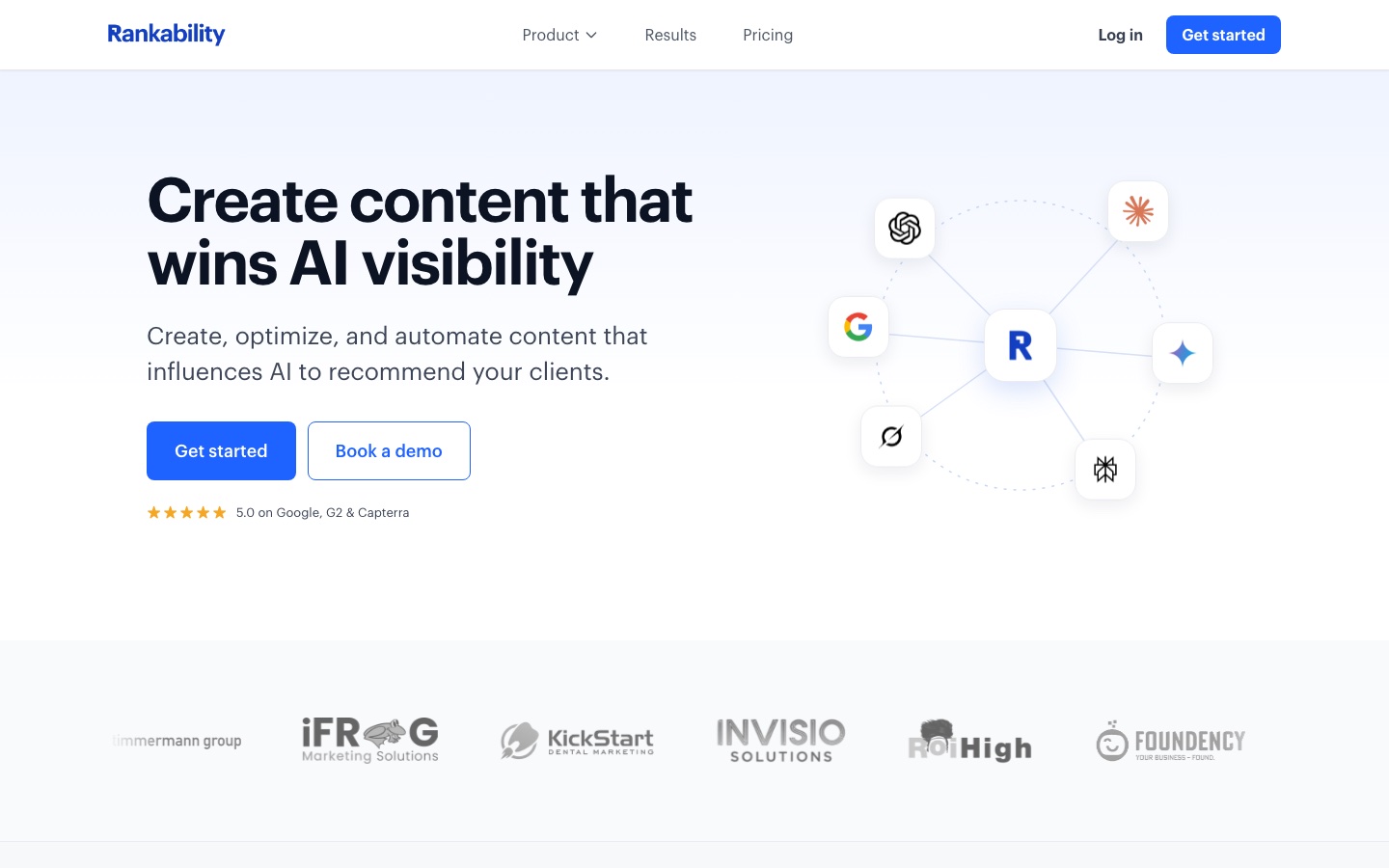
Rankability positions itself around one job: create content that influences AI systems to recommend your clients. The homepage headline is "Create content that wins AI visibility."
The workspace splits into Research, Create, Audit, Promote, and Track, with an AI advisor called Serena sitting across all of it. Serena chat is free and consumes no credits, which matters more than it sounds like.
Keep two things separate as you read the plans. Research platforms are the sources that inform a draft, while Track is the separate module that measures whether you got cited.
That is a genuinely different product from the one in my video. Back then it was three features: keyword research, content optimizer, and content monitor.
The optimizer is still the core. The platform grew around it.
Rankability Pricing: What It Costs Now
This is where the biggest change happened, and where most published reviews are wrong. Rankability no longer sells self-serve tiers.
The pricing page now lists one package, starting at $497 a month on a 12-month agreement. Paying $4,970 upfront for the year saves $994 against twelve monthly payments, and the only way in is booking a demo.
| What the package includes | Detail |
|---|---|
| Price | From $497/month on a 12-month agreement, or $4,970/year |
| AI visibility tracking | 500 active prompts across ChatGPT, Google AI Mode, Google AI Overviews, Claude, Perplexity, Gemini, Grok, Copilot and Meta AI |
| Clients and users | Unlimited |
| Tools | Content research, creation, optimization, audits, backlink prospects and Serena |
| Agents | Agent API and MCP access |
| Support | Dedicated account manager, onboarding call, quarterly reviews, Gotch Inner Circle |
That is a different buying decision from the one I reviewed. The Core, Scale and Advanced plans at $99, $299 and $799 that sat on this page in August are gone, and so is signing up without talking to anyone.
One place the two official surfaces disagree. The package names nine AI platforms, while the help center still documents eleven, with per-platform credit costs. Ask which model applies to you on the demo call.
You will also find articles quoting $149, $199, or a Starter and Growth tier. Those come from an even older lineup.
If you want to go deeper on how I run AI search and content systems day to day, I put together a free resource with my Claude Code skills, automation templates, and systems. Grab the AI Marketing Essentials Guide to follow along.
The Free Trial Is Gone, and That Changes the Advice
In my video I told you to take the 7-day free trial before committing. That advice no longer works.
I checked this against the archive rather than assuming. Rankability's pricing page on September 29, 2025, two days after my video went live, carried a "Start Your Free Trial" button.
Today that language appears nowhere. There is no trial on the pricing page, and searching the entire help center documentation returns zero mentions of a free trial.
So the honest version of my recommendation is different now. There is no cheap first month to evaluate it with. You book a demo and sign a 12-month agreement at $497 a month, or pay $4,970 upfront.
Budget for that before the call. If a lower entry price matters more to you than the feature depth, Surfer starts at $59 a month.
The Content Optimizer Is Still the Reason to Buy
I said this in the video and I still believe it. The optimizer is the strongest thing Rankability does.
You give it a target keyword and it analyzes the pages currently ranking, then scores your draft on relevance against them. Optimal is 70 and above.
The score is a relevance measure rather than a quality grade. It reflects how semantically complete your page is against the pages already ranking.
What I liked while testing was the granularity underneath the score. It surfaces the exact outline of every top-ranking competitor, broken down by H2 and H3, with their own score and word count beside it.
That is a competitive research workflow, not just a writing assistant. I could see how the pages above me had structured the topic, and where my draft was thin by comparison.
The brief that comes with it recommends a URL, title, meta description, and target word count derived from what actually ranks. The URL recommendations matched how I build URLs myself, which is a small signal that a practicing SEO designed this.
AI Search Tracking Is the Biggest Addition Since My Video
This did not exist when I recorded. Rankability's help center documents citation tracking across eleven AI answer platforms, including ChatGPT, Perplexity, Gemini, Claude, Grok, Copilot, DeepSeek, and Meta AI.
It captures whether you were mentioned, whether you were cited, and the sentiment attached. You can filter to citations only or mentions only per platform.
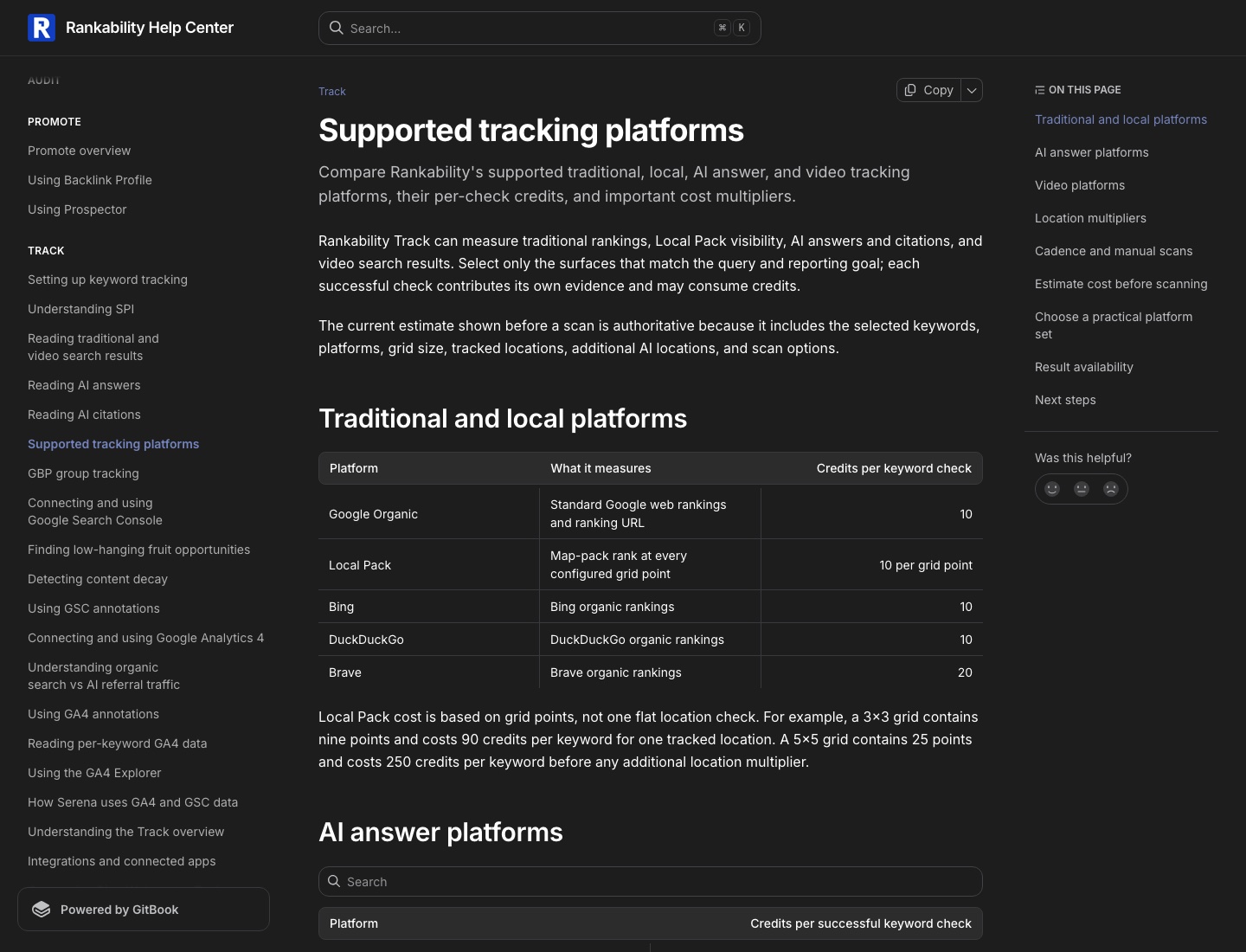
The cost model deserves a flag, with one caveat. The help center meters tracking in credits and prices the platforms very differently, but it has not caught up with the 500-prompt package, so confirm how those credits apply to you on the demo.
Gemini runs 75 credits per keyword check, Perplexity 50, and ChatGPT 40, while Google AI Overview is 10. Under that credit model, choosing every platform by default gets expensive quickly.
Local Pack tracking is the one that can genuinely surprise you. It bills per grid point, so a 5x5 grid costs 250 credits per keyword for a single location before any location multiplier.
If you run local clients, ask how that grid pricing applies to the current package before you turn on daily scans. Under the documented credit math, it is the fastest way to run through an allowance.
Rankability Connects to Claude and Codex via MCP
The package includes Agent API and MCP access, and the hosted endpoint means there is nothing to install locally.
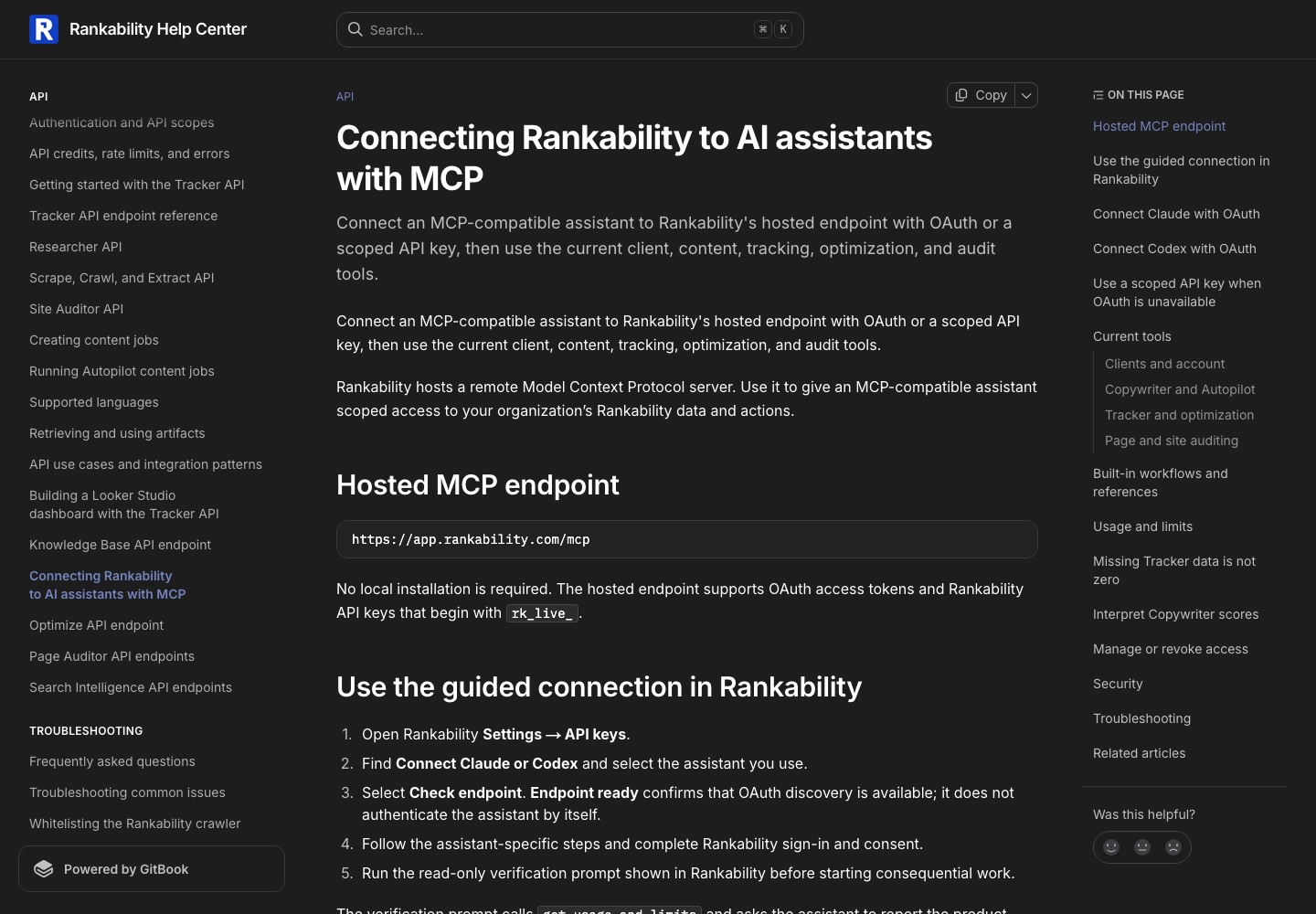
You connect Claude through OAuth as a custom connector, or Codex through streamable HTTP. The help center documents API ceilings of 30, 60, and 120 requests per minute by plan level, so ask which one the current package gets.
This is the piece that fits how I actually work. If you already run SEO research through an assistant, I compared the SEO MCP servers worth connecting separately.
One detail I appreciated in the docs: Rankability tells you to run a read-only verification prompt before letting an agent start billable work. That is a thoughtful default for a metered tool an agent can spend money inside.
What the Founder Told Me About Who This Tool Is For
I interviewed Nathan Gotch on my channel and asked him directly what separates Rankability from every other AI SEO tool. His answer explains the product better than the marketing page does.
He was blunt about the target market. Other tools want to be the next Ahrefs or Semrush and serve everyone, while Rankability is built for agencies specifically.
His reason for that focus is the interesting part. He runs coaching calls twice a week for an academy where he says 95 percent of members are agencies, and product decisions come out of that feedback loop.
He said they deliberately leave out vanity related things and fancy bells and whistles that do not move the needle for an agency. That is his framing, and the stripped-down feel of the tool matched it when I tested.
He did not discuss pricing in that conversation, so this next part is my read rather than his. A tool built around agency pain has little reason to run a cheap tier for hobbyists, and dropping the free trial fits that same logic even if buyers dislike it.
One thing he said stuck with me on the wider AI search debate. He argued that AI platforms perform retrieval through public search engines, so calling SEO dead means claiming search engines are not used for retrieval.
Rankability vs Surfer vs Ahrefs
These are the three tools people cross-shop, and the honest answer depends on what job you are hiring the tool for.
| Rankability | Surfer | Ahrefs | |
|---|---|---|---|
| Entry monthly | From $497, 12-month agreement | $59 Discovery | $129 Lite |
| Mid tier monthly | One plan only | $119 Standard | $249 Standard |
| Users included | Unlimited | 1 to 10 by plan | 1, extra seats $40/mo |
| AI answer tracking | 500 prompts, 9 platforms | Yes, prompt-based | Yes, 5 prompts on Lite |
| Backlink index | No, prospect lists only | No | Yes, industry leading |
Surfer's monthly rates are $59 Discovery, $119 Standard, $219 Pro, and $359 Peace of Mind. Its pricing page defaults to annual, so the lower numbers you see first are yearly rates.
Against Surfer, the entry price now favors Surfer by a wide margin. What narrows it is team size: Rankability includes unlimited users and clients, so one $497 plan covers your whole writing team and every account.
Against Ahrefs, it is not really a fair fight in either direction. Ahrefs has a backlink index and keyword database Rankability does not attempt to match, and Ahrefs Lite includes one user with additional seats at $40 each.
I said it in the video and it still holds. If you mainly need keyword research and competitor analysis, buy Ahrefs.
If that is the direction you are leaning, I weighed Ahrefs against the cheaper pay-as-you-go option in DataForSEO vs Ahrefs.
If your bottleneck is producing and optimizing pages that get cited, Rankability is the better spend. Most agencies I know end up running one of each rather than choosing.
I broke down how these tools compare across the category in my roundup of the best AI SEO tools.
Where Rankability Falls Short
The keyword research is the weakest module, and that has not changed. It works, but you get fewer metrics and less automatic long-tail expansion than a dedicated tool.
During testing I had to apply a filter manually to surface longer-tail variants of a base keyword. Ahrefs hands you those automatically on the first search.
The billing model takes real effort to understand. The pricing page sells a 500-prompt package while the help center still meters tracking in credits per platform, and the two do not map onto each other cleanly.
There is also no native mobile app. It is browser-only, which is fine for agency work but worth knowing.
And the price is the price. At $497 a month on a 12-month agreement with no trial, this is not a tool you buy to see what happens.
Who Should Actually Buy Rankability
This is built for agencies and consultants doing high-value SEO, and the pricing makes that obvious.
If you charge clients real money for content that has to rank against serious competition, the optimizer plus AI citation tracking is a defensible line item.
You can show a client whether they got cited in ChatGPT last month, across the major AI answer engines, which is a report most SEO tools still cannot produce.
The unlimited users detail matters more than it looks. If you have three writers and an account manager, per-seat tools get expensive fast and Rankability does not.
Skip it if you are a solo creator writing a few posts a month. Most of the package will go unused, and a cheaper optimizer or a sharper AI SEO strategy will serve you better.
Also skip it if you need backlink data. That is not what this tool is.
If you are comparing agency SEO platforms at this price point, I put Search Atlas and Adaptify through the same test. Both sell to agencies and price very differently.
Final Notes from Ryan
Rankability was a good content optimizer when I reviewed it, and it has become a more serious platform since. The AI citation tracking is the addition that justifies revisiting it. If you want citation tracking for far less, a $99 platform bundles it with auto-publishing and a link exchange, and the tradeoffs there are worth reading before you compare on features alone. There are six more selling that same bundle at prices that are not always what the page says.
Nathan Gotch being the founder still matters to me. He is one of the few SEOs I genuinely respect, and the product decisions read like they came from someone who has actually run client work.
Removing the free trial is a real downgrade for buyers, and I am not going to soften that. Combined with the new pricing, it moves this from test it risk-free to a demo call and a year-long commitment at $497 a month.
My honest take: if you run an agency and content optimization is your bottleneck, Rankability belongs on your shortlist next to Surfer. If you are still deciding whether SEO is a line item for you, this is not where you start.
Rankability Review FAQs
How much does Rankability cost in 2026?
One package, starting at $497 a month on a 12-month agreement, or $4,970 paid annually, which saves $994. It includes 500 tracked prompts across nine AI platforms, unlimited clients and users, API and MCP access, and a dedicated account manager. The earlier $99, $299 and $799 plans are no longer on the pricing page, and buying now starts with a demo.
Does Rankability have a free trial?
Not anymore. An archived copy of the pricing page from September 2025 shows a Start Your Free Trial button, and that offer is gone from every current surface, including a help center search that returns no results for it. This is the single biggest change since my video review, where I recommended trialing before buying. Expect a demo call and a 12-month agreement instead.
Is Rankability better than Surfer SEO?
They win on different things. Surfer starts at $59 monthly for Discovery against Rankability's $497, so the entry cost favors Surfer by a wide margin. Rankability includes unlimited users and clients, which narrows the gap for an agency where several writers and account managers need their own logins. Choose on team size and whether AI citation tracking matters to your clients.
Can I connect Rankability to Claude or ChatGPT?
Yes, through a hosted MCP server that needs no local installation, and it is included on every plan. Claude connects as a custom connector over OAuth, while Codex uses streamable HTTP. The help center documents request ceilings of 30, 60, and 120 per minute by plan level. Serena, the built-in advisor you chat with inside the product, is free and burns no credits.
What AI platforms does Rankability track?
The help center documents eleven answer engines: ChatGPT, Perplexity, Gemini, Claude, Grok, Copilot, DeepSeek, Meta AI, Brave AI, plus Google AI Overview and AI Mode. For each one it records mentions, citations, and sentiment, and the help center prices them in credits, from 75 per keyword on Gemini and 50 on Perplexity down to 10 on Google AI Overview. The current pricing package names nine of them, leaving out DeepSeek and Brave AI, inside 500 tracked prompts, so confirm on the demo which model applies.
Disclosure: some links in this post are affiliate links, specifically Rankability. If you buy through them I may earn a commission at no extra cost to you. Rankability provided free access to the platform so I could test it for my video review. Full disclosure.