
Search Atlas Review: Is This SEO Tool Worth It?
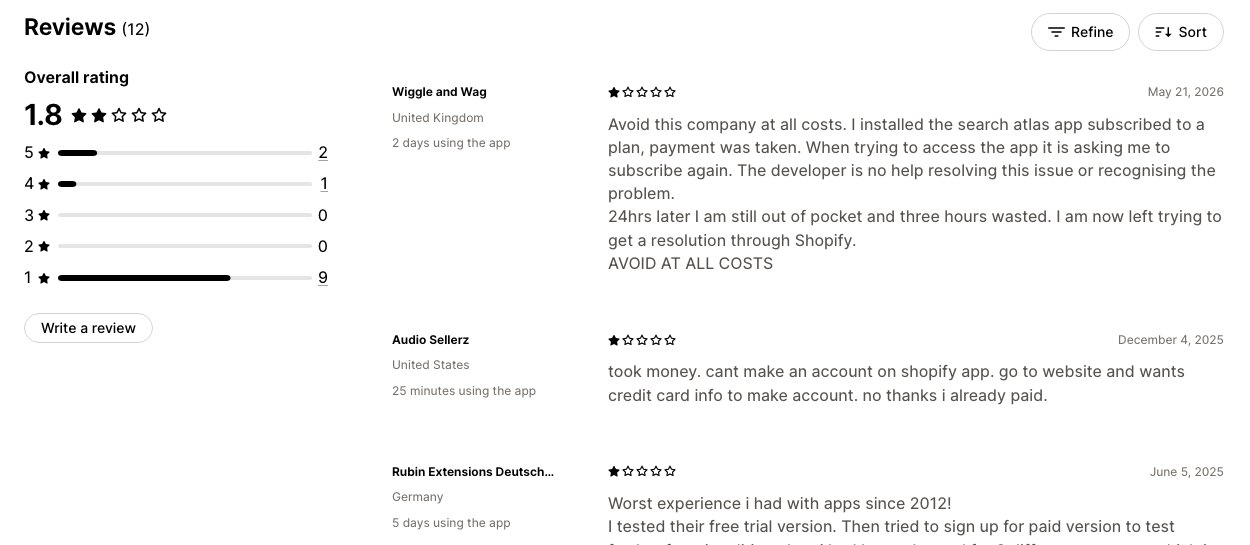
Search Atlas held a 4.0 on Trustpilot across 337 reviews when I pulled the data in August, and read 3.9 across 359 when I rechecked on September 30. On the Shopify App Store it held a 1.8 at the same time, where 9 of its 12 ratings were one star. In that August pull it was the same company, same product, same period, opposite verdicts.
Most reviews you will read quote one of those numbers and ignore the other. That is the interesting part of this Search Atlas review, because the two pools are not complaining about the same thing. What the Shopify reviewers describe is billing and app access. The Trustpilot pool is dominated by people rating the SEO platform itself.
Two things about my position, up front. I sell a competing product, my AI SEO System, which is a one-time $199 rather than a subscription and runs on the AI tools you already pay for. So weigh what follows accordingly. I earn nothing if you buy Search Atlas, which is also why I can be straight with you about it.
And I have spent time inside Search Atlas and read its documentation and public review pools closely, but I have not run it on a client site across a full campaign. So I can tell you what it is, what it costs, and what its own pages commit to. I cannot tell you what it moved for me, and I am not going to pretend otherwise.
What Search Atlas Sells
Search Atlas is an SEO platform whose headline feature is OTTO, an agent that does not merely suggest fixes but deploys them. In the company's own words on its pixel page: "The OTTO Pixel is a single script that connects your website to Search Atlas. Once it's live, OTTO SEO reads your pages, fixes what's holding your rankings back, and deploys the changes straight to your site, on its own, across any CMS."
That is a genuinely useful proposition if you are carrying technical debt you have no time to clear. Approval mode exists too, so the automation is optional: "Want to sign off first? Turn on approval mode to review every change before it goes live, and roll back anything, anytime."
I have written before about why I tell clients not to let OTTO run unsupervised, in my roundup of the best AI SEO tools. I am not going to re-argue that here. This piece is about something the roundup did not have room for: what the review pools actually say, and what the vendor commits to in writing when you stop paying.
The Pricing, Then and Now
In August I had to render the pricing page, because Search Atlas injected its pricing with JavaScript and a plain fetch returned nothing. It has been rebuilt since I first wrote this, and the prices now appear in the page itself. On September 30, 2026 it showed four plans behind an annual toggle that saves 20%:
- Starter is $79 per month billed annually ($950 a year), about $99 month to month, with 1 seat, 1 project and OTTO included.
- Growth is $159 per month billed annually, about $199 monthly, with 3 seats, 2 projects and AI Visibility across ChatGPT, Gemini and Google AI Mode.
- Pro is $319 per month billed annually, about $399 monthly, with 5 seats, 4 projects, Copilot and Perplexity added, and white-label reporting.
- Agency starts at $999 per month billed annually, with 10 seats and 10 or more projects.
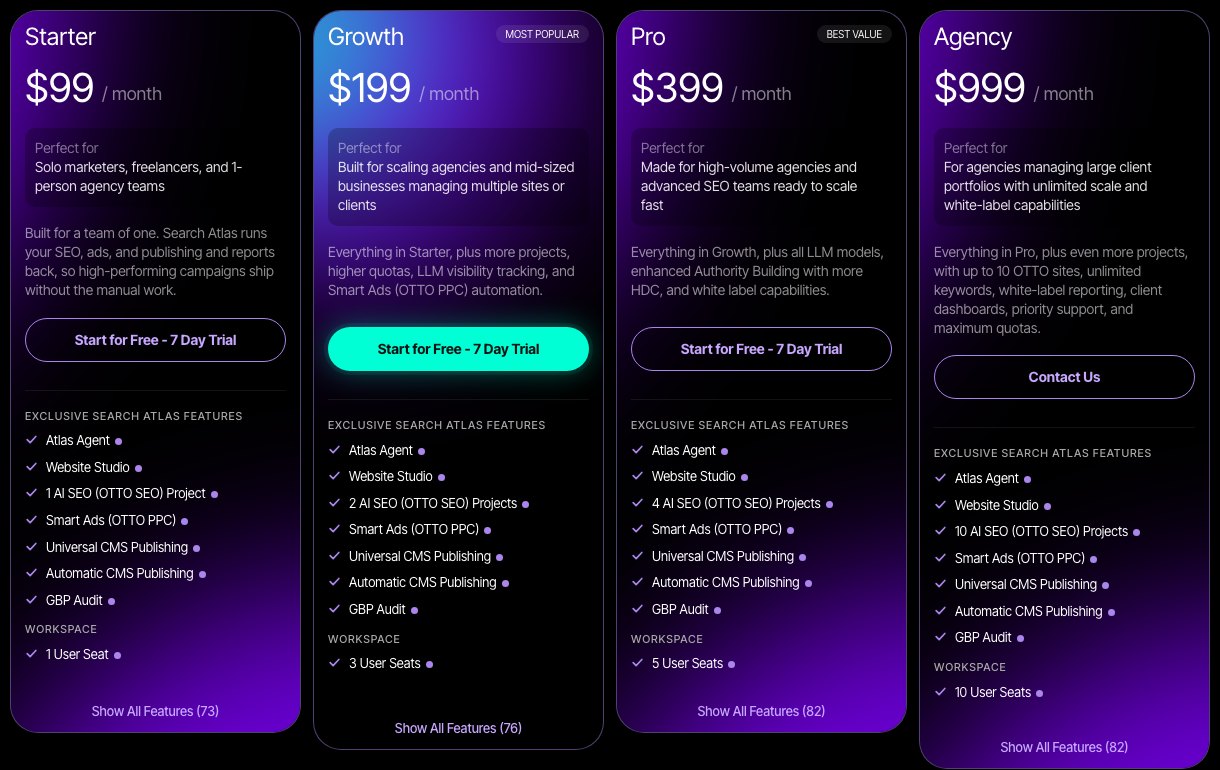
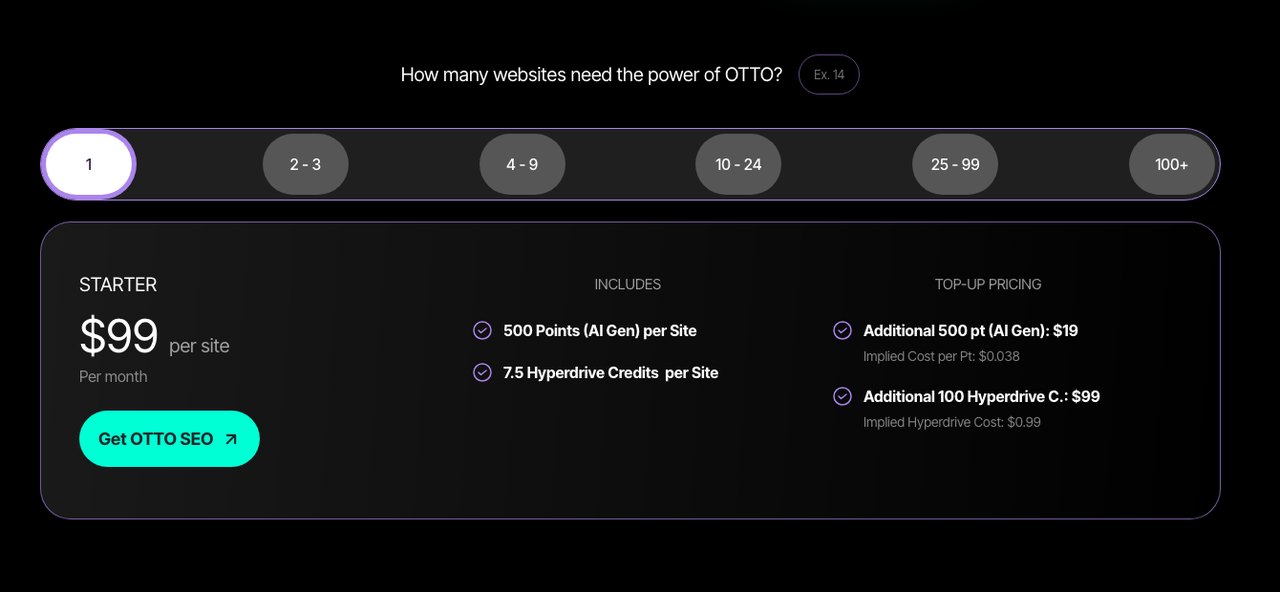
The biggest change is OTTO. In August it was metered separately at $99 per site per month, so a $99 Starter plan became a $198 bill for a single site. The current page lists "Atlas Agent + OTTO SEO" inside Starter's one project and meters usage through a monthly budget of Universal Credits, 50,000 on Starter. OTTO on one site now costs the plan price itself.
The billing display changed too. In August there was no annual toggle and the words "annual" and "yearly" did not appear on the page. It now defaults to annual billing, so check which toggle is active before you read a number.
One August detail is gone with the old meter. The page then defined a Hyperdrive Credit as "1 HDC = $1" while selling 100 of them for $99. Hyperdrive Credits no longer appear on the pricing page.
The 4.0 and the 1.8 Are Measuring Different Things
Here is the distribution behind that 4.0, taken from Trustpilot's own published counts across all 337 reviews in my August pull. The profile has since moved to 3.9 across 359, so read the shares as that snapshot:
| Rating | Count | Share |
|---|---|---|
| 5 star | 221 | 65.6% |
| 4 star | 15 | 4.5% |
| 3 star | 4 | 1.2% |
| 2 star | 13 | 3.9% |
| 1 star | 84 | 24.9% |
The two poles hold 90.5% of the pool. The entire middle, every 2, 3 and 4 star review combined, is 9.5%. There are 2.6 times more one-star reviews than the whole middle put together, and exactly 4 people out of 337 landed on the true midpoint.
So the 4.0 is a poor summary of what is underneath it. Reviewers here mostly rated the product at one extreme or the other, and a rating near the middle is the rarest thing in the pool. Worth noting that 4.0 is Trustpilot's displayed TrustScore rather than a simple average of those counts, which works out closer to 3.8. Either way, read the distribution before you read the score, because the score sits in a band where almost no reviewer actually landed.
One caution on what that does and does not tell you. Reviewers are a self-selected group, and people motivated to write are rarely the ones who felt neutral, so a hollow middle is partly a property of who bothers to post. It still tells you something useful: if you buy this, the experiences reported publicly cluster at the ends, and you should read both ends before deciding which is more likely to be yours.
The Shopify App Store pool is small at 12 reviews, so treat it as a signal rather than a verdict. But 9 of the 12 are one star, and the complaints there are not about SEO quality at all. They are about billing and access. One merchant writes that they "subscribed and paid USD$199. THE APP STILL DIDN'T WORK. The app developer refuses to refund our money." Another reports being "charged $200 per month for 3 months before we noticed." A third reports a "410 Gone" error opening the app.
What the One-Star Reviews Are Actually About
I read the negative pool rather than only counting it. Of the 84 one-star reviews, I was able to read 79, and I coded each for what it complained about. In that sample, support problems appear in roughly two thirds, billing and refund problems in roughly two thirds, and complaints about the SEO output itself in under half. Most reviews raise more than one, so those shares overlap rather than summing.
That ordering is the useful part. Among the unhappy reviewers I read, the most common complaints are commercial and operational rather than "the SEO did not work." A representative billing complaint, from a reviewer in Australia in June: "I signed up for a 7 day FREE trial but they charged my account straight away." He goes on to say support "can't refund the charge because it was outside their 72 hour cancellation window."
One reviewer draws the distinction explicitly while giving one star: "This platform has a ever-improving product, but their support makes it almost unusable at times." That is a customer telling you the software is getting better and the company around it is the problem.
There is a fourth category I did not expect, and it is not a customer complaint at all. Several one-star reviews come from publishers on Search Atlas's own Publication Media marketplace saying they have not been paid for completed placements, with accounts deactivated and prices revised after publication. That is a supply-side problem, and it belongs in a different bucket from a customer review, but it is sitting in the same pool feeding the same average.
Read the Positive Reviews Too, Because They Concede the Same Points
The five-star reviews are not empty. The most substantive ones name features, name the competitors they left, and volunteer the friction. One customer of nearly a year describes managing four clients on the platform, says he moved because "tools like Ahrefs and SEMrush were expensive for a boutique agency," and then says outright: "There was definitely a BIG learning curve." He also volunteers that he had "double-payment issues" and that they "refunded me immediately."
Another five-star reviewer, the only one in the pool making a hard numeric claim, says he "replaced 6 software programs" and increased "web rankings and SEO traffic by 137% year over year." I cannot verify that figure and neither can you, so treat it as what it is, one customer's report.
What strikes me reading both poles is how much they agree on. The happy reviewers describe a steep learning curve, occasional bugs, and billing problems that got resolved. The angry reviewers describe a steep learning curve, occasional bugs, and billing problems that did not. They differ less on what the product does than on whether the friction around it got sorted out, and support is the thing that separates those two stories in most of the reviews I read.
One more thing about the pool. Trustpilot displays a notice on the profile: "No recent history of asking for reviews. This company hasn't invited customers recently, so reviews may not be representative." That is Trustpilot's own hedge on its own number. It does not tell you which direction the pool is skewed, only that Trustpilot is not confident it is representative, which is a reason to read the reviews rather than the score.
Does Your SEO Survive Cancellation? I Could Not Find Anyone Who Tested It
This is the argument that comes up most often about Search Atlas, and it is worth getting right because both sides claim more than they have shown.
The most-cited version comes from a six-month review published by a Canadian agency in March: "When you cancel your subscription, every optimization vanishes instantly." And the line that travels furthest: "You're not building permanent assets. You're renting temporary enhancements."
Search Atlas's pixel page appears to answer this directly, under a heading that reads "Your Optimizations Stay Live. Always." But read what sits under that heading, because the supporting sentence is narrower than the headline: "Changing your OTTO plan doesn't affect your live optimizations or site updates." A bullet adds "Full control, even after pausing."
The word "cancel" does not appear anywhere on that page. The promise there is scoped to plan changes and pausing. The stronger commitment does exist, but it lives somewhere else entirely, on the pricing page, in a single clause: "keep every edit even after cancellation."
So the vendor does commit to it, in writing, on one page, in seven words, while the page built around the durability question uses a headline that says "Always" and then never addresses cancellation at all.
Now the other side, because it has a bigger problem. That six-month test never tested cancellation. What the authors describe actually doing is checking how AI crawlers indexed a test site, reviewing 247 OTTO recommendations and implementing 180, tracking credit consumption for three months, measuring a 0.3-second page-load delay, and spending four hours troubleshooting Cloudflare. Nowhere do they report cancelling an account and inspecting the resulting HTML. Their cancellation claim is an architectural inference from client-side rendering, supported by one anonymous quote about "watching six months of work evaporate overnight."
It is a reasonable inference. It may well be right. But it is an inference presented as a finding, and it is worth checking the article's other numbers rather than inheriting them: it describes Search Atlas plans as starting at $49 and scaling to $99 and $199, while the live pricing page runs $79, $159, $319 and from $999 billed annually. Either the figures are stale or they were wrong when published, and either way they are not the current rate card.
Search Atlas, for its part, never states anywhere on the pixel page whether pixel-deployed changes are server-side or client-side rendered. The entire dispute turns on that detail and the vendor has not put it in writing in either direction.
So the honest answer: I could not find a published test of what happens to your optimizations when you cancel Search Atlas. The vendor commits to persistence in one clause on its pricing page. Its most-cited critic argues the opposite from architecture rather than from an experiment. If this matters to your decision, and it should, ask Search Atlas for the answer in writing before you buy, and ask specifically about cancellation rather than pausing.
Who Should Actually Buy It
Take the real entry price rather than the headline one. OTTO on a single site now comes with Starter at $79 a month billed annually, or $950 a year. The platform is built to execute changes at volume, and Search Atlas is genuinely good at that. What it does not do is tell you which changes deserve to exist, and at that price the distinction is the whole decision.
Think hard if you run a single site. That is a lot of platform for one property, and what you are buying is execution capacity rather than judgment about what to execute.
It makes more sense if you run multiple client sites, you are consolidating away from Ahrefs or Semrush on cost, and you have patience for a real learning curve. If that is you, Adaptify is the other platform worth pricing against it, though it starts at $499 for a single site. The most detailed positive reviews in the pool come from people in that position, and several of them say plainly that the curve was steep and they got through it.
Whoever you are, do not buy it on a free trial expecting a clean exit. The complaint I saw repeated most in the negative pool came from people who believed they were trialling, found they had been charged, and then discovered the refund window had closed. Read the cancellation terms before you enter a card, not after. It is a habit worth keeping: one competitor advertises a 90-day money-back guarantee whose written conditions are far narrower than the headline.
Here is the comparison I would actually run if it were my site. Search Atlas with OTTO on one site is $950 a year billed annually, and at the end of that year you have paid for execution capacity and you are still subscribed. My AI SEO System is $199 once. It is not a platform and it does not deploy anything for you. What it is is the process I use to work out which fixes are worth making, packaged to run through Claude Code or Codex, which you are probably already paying for. You keep it whether or not you keep paying me, and there is no pixel on your site to think about when you stop.
That is a genuinely different purchase and I am not going to tell you it does the same job. Search Atlas will publish and deploy at a volume no process document can match, so if that volume is your bottleneck, buy Search Atlas. If your bottleneck is knowing what deserves to be published in the first place, a subscription does not answer that question, and an hour of consulting answers it once, without a subscription.
My Verdict on Search Atlas
If you run your own site, no. You would be renting execution capacity to answer a question that is mostly judgment, and the tool will publish faster than you can decide what is worth publishing. Buy the judgment instead.
If you run many client sites, it is a defensible yes, provided you read the billing terms before you enter a card. That is where the loudest complaints live in both review pools, and it has nothing to do with how good the SEO is.
And the cancellation question stays open. The vendor commits to persistence in seven words on its pricing page, its critic argues the opposite from architecture, and neither has published a test. If you do buy, get that answer in writing first. If you would rather not have to ask the question at all, that is an argument for owning your process rather than renting a pixel that sits on your site.
Search Atlas FAQs
Is Search Atlas legit?
Yes, it is a real platform with more than 350 Trustpilot reviews, a Shopify app, and a G2 profile. Legitimacy is not the issue. The issue is that its review distribution was extreme in my August pull: 65.6% five star and 24.9% one star, with only 1.2% at three star. The most common serious complaints are about billing, refunds and support responsiveness rather than about the SEO work itself. That pattern repeats across this category, and it is worth knowing that one vendor publishes a rating for AI models that its own review profile does not support. I checked the billing terms across seven of these platforms in one place.
How much does Search Atlas cost per month?
Plans are $79, $159 and $319 per month billed annually, with Agency from $999, and about $99, $199 and $399 month to month. OTTO, the automation the product is known for, is now included on Starter's single project, so the entry price for one site is the plan price. In August it was billed separately at $99 per site.
What happens to your SEO if you cancel Search Atlas?
I could not find a published test of this. Search Atlas's pricing page states you "keep every edit even after cancellation." Its OTTO pixel page carries the headline "Your Optimizations Stay Live. Always." but supports it only with a sentence about changing your plan, and the word "cancel" never appears on that page. The most-cited claim that optimizations vanish comes from a six-month review whose authors tested AI crawler indexing, OTTO recommendations, credit consumption and page speed, but did not report cancelling an account and checking the result. Ask for the answer in writing before you buy, and ask about cancellation specifically rather than pausing.
Why did Search Atlas rate 1.8 on Shopify but 4.0 on Trustpilot?
In my August pull, the two pools contained different populations reporting different problems. The Shopify pool was small at 12 reviews, and its complaints were almost entirely about billing and app access: paying and being unable to open the app, duplicate charges, and refused refunds. The Trustpilot pool was larger and contained many agency users rating the SEO platform itself. A merchant hitting a broken install path and an agency running client campaigns are not evaluating the same thing.
Is Search Atlas good for a solo operator?
Usually not. Entry for one site with OTTO is $79 a month billed annually, and what that buys is the ability to deploy changes at volume. On a single site the harder question is which fixes are worth shipping, which a subscription does not answer. The most detailed positive reviews come from operators running many client sites who consolidated several tools into it, which is a different problem from yours. A defined process you own, run through Claude Code or Codex, costs far less and does not stop working when you stop paying. That is what my AI SEO System is, at $199 once.
Sources and Method
Pricing figures were read from a rendered copy of searchatlas.com/pricing on 14 August 2026, because the page then injected prices with JavaScript and a plain request returned nothing, and rechecked on 30 September 2026 after the plans changed. Rating counts and the star distribution come from Trustpilot's own published figures for searchatlas.com on the same date, cross-checked against the structured data on the page. The Shopify figures come from the Search Atlas listing on the Shopify App Store, also read that day. Quotations from Search Atlas's pixel and pricing pages, and from the six-month review published by themarketingagency.ca, are verbatim from those pages as they stood on 14 August 2026. The Trustpilot score and review count were rechecked on 30 September 2026, when the profile read 3.9 across 359 reviews; the distribution table is the August snapshot. I did not run Search Atlas on a client site across a campaign, so nothing here is a performance test.