
GEO vs SEO: Why My YouTube Videos Beat My Website in AI Search
GEO vs SEO comes down to what you want to win: a ranking that earns the click, or a mention inside an AI answer. On October 27, 2026, Google's AI Overview for one of my own examples featured one of my YouTube videos, cited another, and skipped every page on my website.
Watch Me Break Down GEO vs SEO on Leveraging AI
Isar Meitis had me on episode 339 of his Leveraging AI podcast to talk through GEO vs SEO and how a business gets found in AI search.
Isar opened by saying traditional SEO methods are "no longer enough." He also said they are "definitely still valuable."
My answer was blunter: "SEO, first of all, is not dead." I pulled the evidence below on the day the episode went live.
If you want the SEO workflows behind this site, my Claude Code Skills Stack holds the skills I run on it.
GEO vs SEO: The Short Answer
GEO, or generative engine optimization, is the work of getting your brand named or cited inside an AI answer. SEO is the work of showing up in search results, through your pages, your Business Profile and the directories that list you.
The term comes from a 2023 research paper on generative engine optimization that tested how changes to a page affect its visibility in AI-generated answers. Here is how the two compare in practice.
| Question | SEO | GEO |
|---|---|---|
| What you want | A spot in the results that earns the click | A mention or citation inside the answer |
| What can show up | Web pages, map listings, directories, videos and forum threads | Web pages, plus YouTube videos, LinkedIn posts, Instagram reels and Reddit threads |
| Free way to measure it | Google Search Console performance report | Search Console's Generative AI report and Bing Webmaster Tools AI Performance |
| What it stands on | Pages and listings search engines can find and trust | The same base, plus your presence on other platforms |
I also ran three versions of the GEO vs SEO question through ChatGPT, Claude, Gemini and Perplexity, using DataForSEO's API access to each. None of the 12 answers said GEO replaces SEO, and every surface said to keep SEO as the base.
Two of those answers came from the model's training data without a live web search, so read them as opinions. Where I part ways with most guides is on what changes, and that depends on the kind of search.
Local SEO and National SEO Are Different Games
In the episode I said everyone likes to bucket SEO into one category. A local search and a national search often play by different rules, and most GEO vs SEO advice skips that.
I pulled both of my on-air examples through DataForSEO. "Best plumber near me" searched from Des Moines opened with sponsored local service ads, then a slot for an AI Overview, then a three-business map pack, then Angi, Yelp and Bark.
That matches what I said on the call: a local search still gets "the traditional map pack and traditional search results with maybe an AI answer depending on the query."
"Best AI marketing software" searched from the US opened with an AI Overview at the very top. I called that kind of broad national question the place where AI answers are "starting to eat more of those top-of-funnel queries."
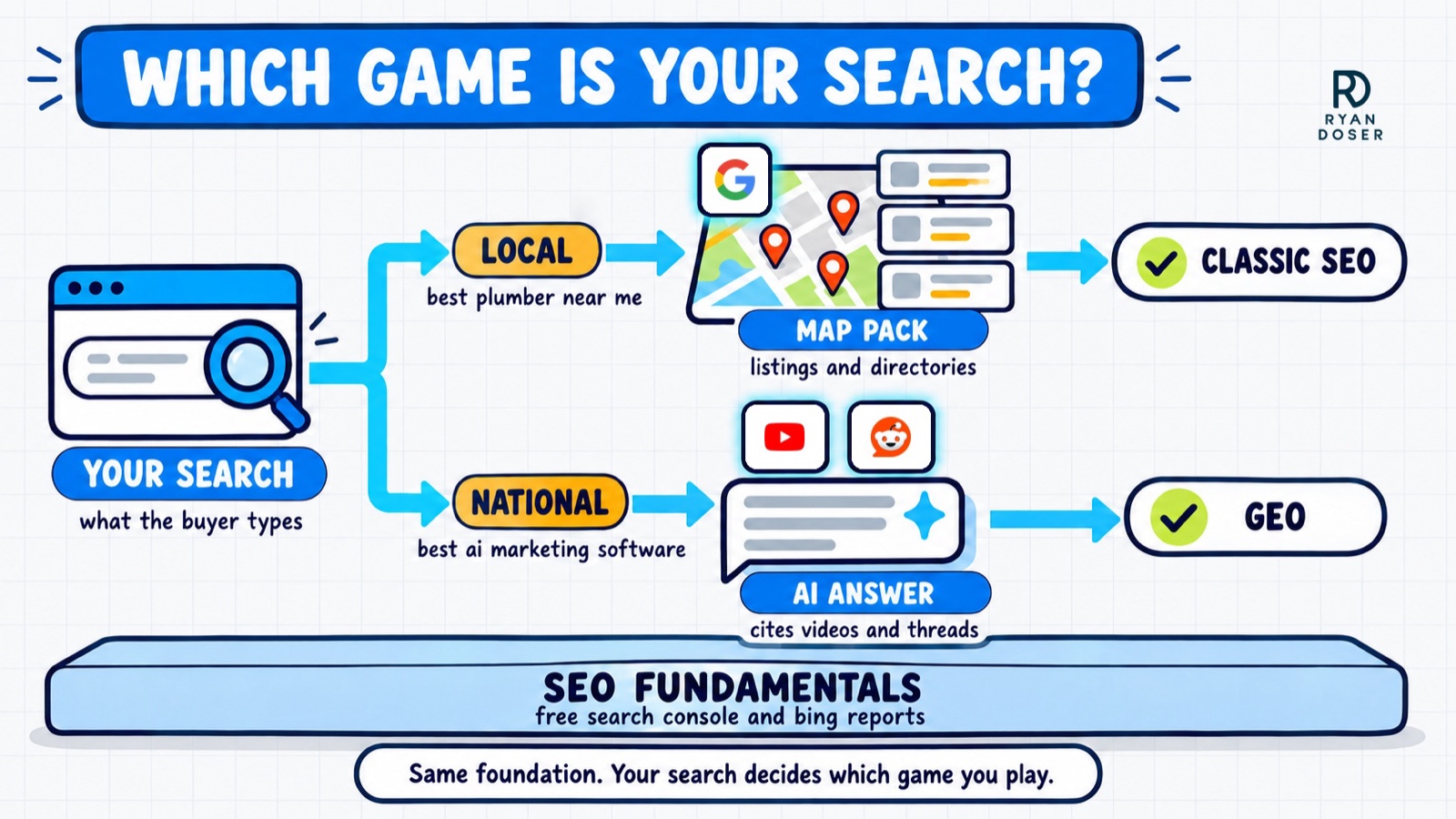
Here is my bias, stated plainly. For most small local businesses, GEO is overrated, and the map pack, reviews and directories still do most of the work.
Local is not fully protected from AI, though.
When I tested four AI assistants on local businesses in two cities, only 22.8% of their picks were in Google's top three map results. A spot in the map pack doesn't guarantee an AI recommendation.
The full numbers are in my test of whether ChatGPT recommends local businesses.
Google Cited My YouTube Videos and Skipped My Website
In that same pull for "best AI marketing software," Google's AI Overview featured one of my YouTube videos as its video pick and cited a second one as a source.
The featured video was "The Only 7 AI Marketing Tools You Actually Need!" and the cited one was "My Top AI Marketing Tools in 2026 (Stop Wasting Money)."
My site has a full post on the best AI marketing tools, and it was nowhere in that AI Overview or the organic top 10. Google picked the videos.
The plain reason is that my post didn't rank for that wording, while both video titles matched it closely.
That is what I meant when I told Isar "you technically don't need a website." I called YouTube "the number one parasite now in this phase of AI search," and my read is that Google leans on it partly because Google owns it.
The AI Overviews for the GEO vs SEO questions themselves mixed formats too. Next to sites like Semrush, the "geo vs seo" answer cited a YouTube video and a LinkedIn post, and the "aeo vs seo" answer cited a YouTube video and an Instagram reel.
In the chatbot answer text I saved, video only came up as a format that holds onto clicks. None of them named YouTube videos or podcast appearances as a way to get cited, even though Google's own answers were citing videos that day.
A few limits on all of this. An AI Overview changes by the day and by who is searching, so treat this as one dated snapshot.
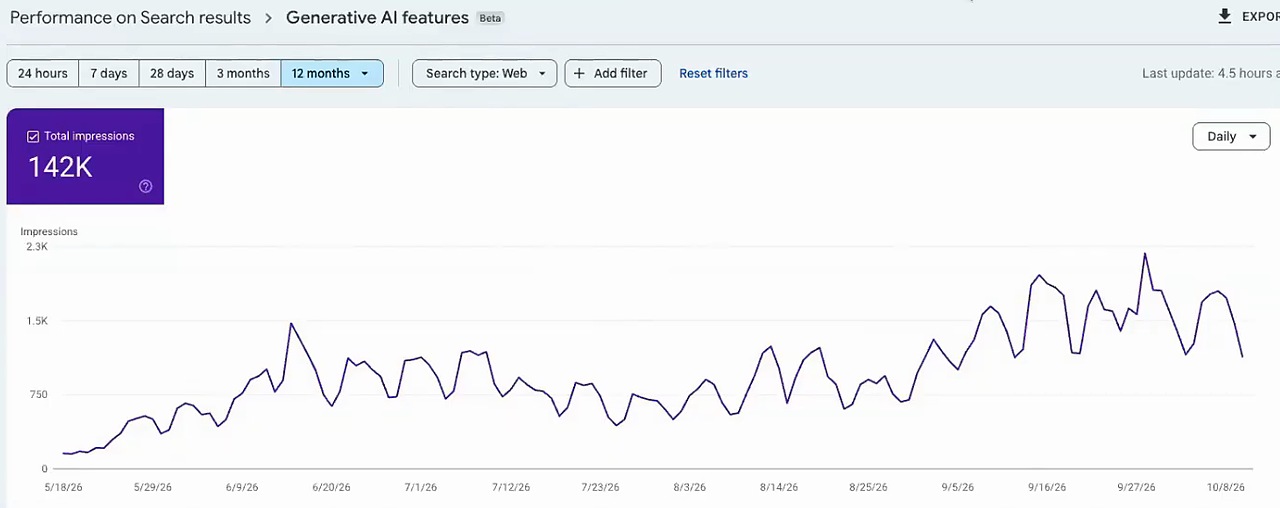
It is also one query. This site still picked up 142K impressions in Google's AI features over about five months, as the Search Console screenshot below shows.
And it doesn't show how a business with no website would do. I still think a website carries most competitive searches, so treat YouTube as a second front door.
Set Up the Free GEO Reports Before You Buy a Tracker
A common GEO vs SEO mistake is paying for an AI visibility tracker before the basics are in place. On the call I called a lot of those trackers "smoke and mirrors," and said most business owners don't even have Search Console or Bing Webmaster Tools set up.
Both are free, and both now report on AI search. Google's Generative AI performance report counts impressions in AI Overviews and AI Mode.
Bing Webmaster Tools has an AI Performance report, in public preview since February 2026. It counts how often your pages appear as sources in Microsoft Copilot, Bing's AI summaries and select partners.
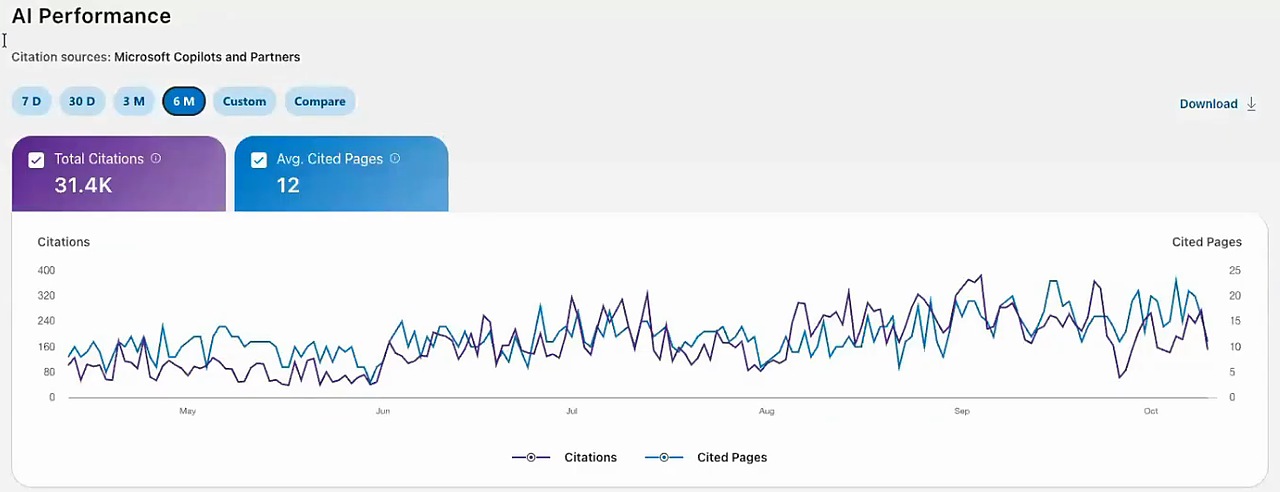
Know what these two reports can't see. Neither is built to show your YouTube citations, and Bing doesn't name its partners, so don't assume either one covers ChatGPT, Claude or Perplexity.
Run a few buyer prompts by hand in those assistants each month to cover that gap.
One correction on my own recording. I said Bing matters because ChatGPT pulls a lot of Bing citations, but OpenAI's own docs tie ChatGPT search to its own crawler, which I explained in these AI search myths.
Once those reports are live, add keyword and SERP data. I run DataForSEO inside Claude Code for that, and I'll admit Ahrefs still has better data, but pay-as-you-go pricing fits how I work.
Then scan your site with my free AI agent readiness checker, since basics like robots.txt and your sitemap shape how AI agents read your site. After that, a paid tool has a baseline to beat, and my comparison of AI visibility tools covers which ones earn the money.
AEO vs SEO vs GEO: Where AEO Fits
AEO, or answer engine optimization, is another name for the GEO side of GEO vs SEO: showing up inside answers. The search data shows people reaching for that label more often.
US searches for "answer engine optimization" grew from 2,400 a month in October 2025 to 4,400 in September 2026, per DataForSEO. Over the same stretch, "generative engine optimization" slipped from 5,400 to 4,400.
For your to-do list, the label barely matters. Both describe getting named inside an answer, and the groundwork overlaps with SEO.
Pick the Game Before You Pick a Tool
Most GEO vs SEO debates skip the first question: what does your buyer type? Answer that, and you know whether this month goes to your Business Profile or your next YouTube video.
GEO vs SEO FAQs
How is GEO different from traditional SEO?
Traditional SEO competes for a spot in the results and the click that follows. GEO competes for a mention inside an AI answer, where the source can be a YouTube video, a LinkedIn post or a Reddit thread as well as a web page. The groundwork overlaps, but you measure GEO with different free reports: Search Console's Generative AI report counts impressions in Google's AI features, and Bing's AI Performance report counts citations.
Is GEO replacing SEO?
No. GEO adds more places to show up, and the basics of being findable in search still apply. In my October 27, 2026 test, none of 12 answers from ChatGPT, Claude, Gemini and Perplexity said GEO replaces SEO, including the two that answered without a web search. For most local businesses, the map pack and reviews still matter more than chasing AI citations.
Does GEO matter for a local business?
Less than most guides suggest. In my October 27, 2026 pull, a Des Moines search for "best plumber near me" still ran through sponsored ads, a three-business map pack and directories like Angi and Yelp. Fix your Business Profile and reviews first. AI assistants do pick differently, though: in my two-city test, only 22.8% of their local picks were in Google's top three map results.
Can you get cited by AI without a website?
Content that lives off your website can win the citation over your website. In one dated snapshot from October 27, 2026, Google's AI Overview for "best AI marketing software" featured one of my YouTube videos, cited another, and used no page from my site. That doesn't show how a business with no website would do, so use YouTube alongside your site rather than in place of it.
Do Search Console and Bing show your YouTube or ChatGPT citations?
Not reliably. Search Console's Generative AI report counts impressions for links to your site in AI Overviews and AI Mode, and Bing's AI Performance report counts your pages cited in Copilot, Bing's AI summaries and partners it doesn't name. Neither is built to show YouTube citations, so check ChatGPT, Claude and Perplexity by running your buyer prompts by hand.