
SaaS SEO Is Broken: Here's How to Make Money from AI Search
SaaS SEO breaks when it starts at the top of the funnel, chasing traffic that AI search now answers on its own.
Watch Sam Dunning Break Down SaaS SEO That Drives Pipeline
This episode of AI Rabbit Holes is a conversation with Sam Dunning, founder of Breaking B2B, an SEO and AI search agency for B2B software companies.
Sam puts his data set at around 50 SaaS clients, and he is one of the AI SEO experts I trust for revenue-first B2B work.
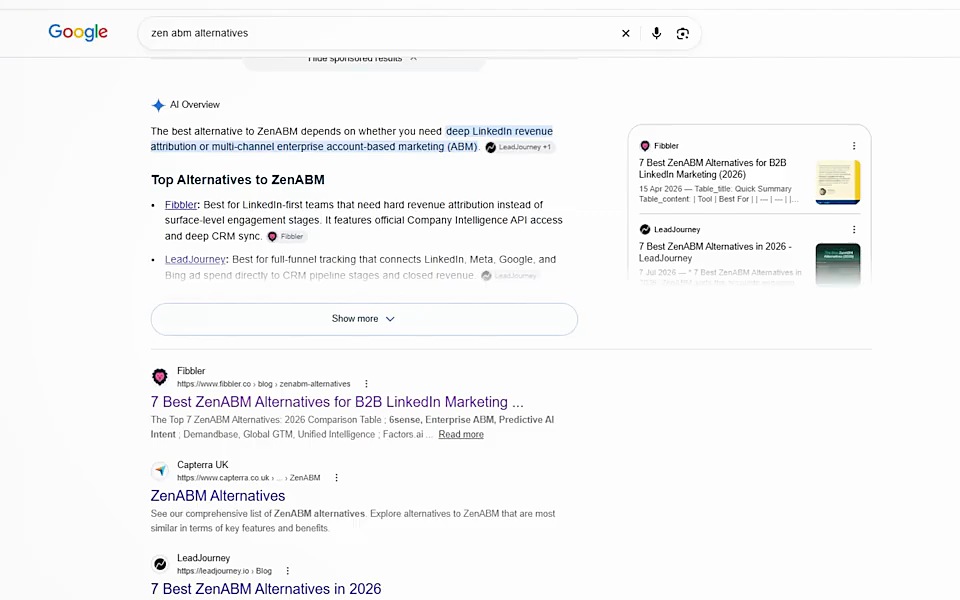
The centerpiece is a live teardown of one alternatives page that, when Sam showed it, ranked first on Google and was named in the AI Overview above it.
If you want to build pages like that one yourself, my Claude Code Skills Stack includes the listicle and research skills I run for clients.
When SaaS SEO Is Not Worth It Yet
Sam says his team turns away a lot of business, and bootstrapped founders are often the ones he tells are not a fit yet.
One reason he gives is search demand. If you built a new kind of tool that nobody knows to look for, there is no captive market typing your category into Google or ChatGPT.
Search, on Google or in an LLM, works best when buyers already know the solution exists and go looking for it.
Crowded categories are the other trap. Pitch Sam a new CRM and his answer is to pick a narrower niche, because you would be up against Salesforce, HubSpot, Pipedrive and Close.
Check whether real people search for your category before you pay anyone to rank in it.
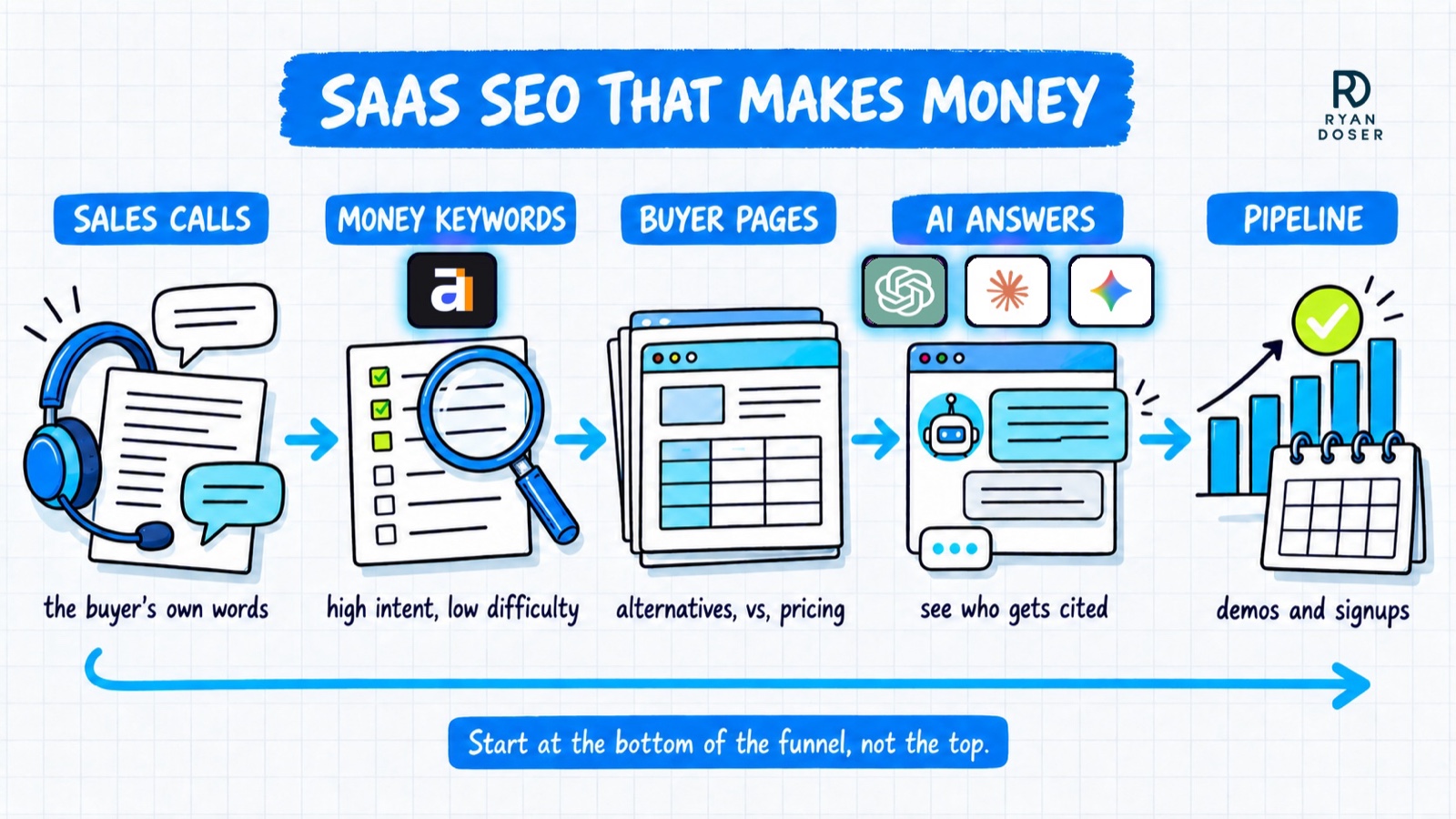
Start With Sales Calls, Not a Keyword Tool
Plenty of SaaS SEO plans open a keyword tool on day one. Sam opens the CRM.
His agency's onboarding form asks very little about SEO. It asks about the product and the dream client instead.
- Which industries have you historically sold well into?
- What is their most expensive problem, in their own words?
- What do they cobble together in house before they buy, such as a Google Sheet?
- What tipping point finally makes them evaluate software like yours?
Sales and customer success call recordings answer all four. Sam's move is to connect the call recorder to Claude through MCP and query the pain points directly.
From there, he pairs that research with Ahrefs or Semrush to find long-tail commercial terms with low difficulty. Both now run SEO MCP servers you can connect to Claude.
Those terms carry less volume. Sam's point is that they can rank quickly, which matters for a startup, and they bring in buyers who are already shopping.
Top-of-funnel queries like "what is a CRM" are the opposite bet. You compete with 70 to 90 DR software brands, and AI search answers the question before anyone clicks.
The keyword this post targets proves it. When I searched "saas seo" on September 23, 2026, Google showed an AI Overview defining the term before the first organic link.
The Bottom-of-Funnel Pages Most SaaS Sites Are Missing
Sam says many SaaS companies lack basic pages on their own site, then jump straight to link building, Reddit and LinkedIn. That gap is the first SaaS SEO fix he makes.
His money keywords are what a dream customer types when they are ready to buy software like yours. These are the page types he builds first:
- Competitor alternatives pages ("best [competitor] alternatives")
- Direct comparisons, both you vs a competitor and competitor vs competitor
- Best-of software lists in your niche
- Pricing pages
- Integration pages
- Use case and ICP pages
- Landing pages
Before building any of them, Sam checks intent. Search the keyword, see whether Google ranks a best-of list, a comparison or a how-to, then build that format better than what already ranks.
The mix depends on who you compete with. For the SaaS company I run SEO for, many of these are API and MCP pages, because that is where its competitors fight.
Sam also prefers pages he controls. If an LLM is going to describe his client's product, he wants the source to be his client's page, not a frustrated Reddit thread.
Anatomy of an Alternatives Page That Ranks and Gets Cited in AI Search
Nobody searches a competitor's name plus "alternatives" for fun. Sam's read is that the searcher is probably annoyed with a current tool, whether pricing went up, support dropped off, or a feature went away.
That intent is why alternatives pages are a staple of his SaaS SEO work, and why he says they can drive demos. His example is from his client Fibbler, an ad attribution tool whose co-founder Adam Holmgren builds in public.
Here is the Fibbler page Sam walked through, top to bottom, as it reads today:
- A fixed sidebar call to action with the brand's pink lion and a free trial button
- The target keyword in the H1
- A quick summary right under the title
- A small "top three picks" table above the fold
- A "Why Trust Us?" section
- What ZenABM is, and why buyers look for alternatives
- A full comparison table with ratings and pricing
- A numbered list with Fibbler first, each tool showing its G2 rating and price
- An FAQ at the bottom
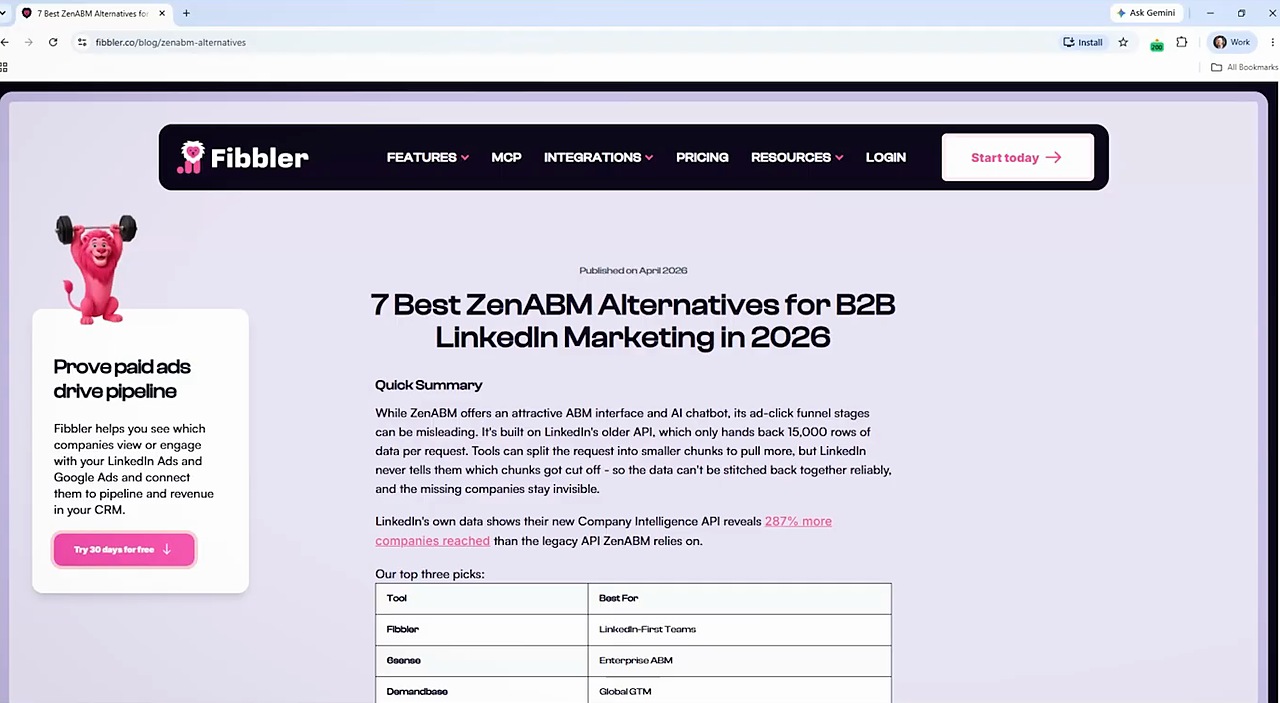
Sam's reason for the quick summary is that it can get pulled into an LLM. I have noticed the same with tables placed early on a page, while long intros bury the part a model would lift.
Sam finds the "why people leave" material in G2 and similar review sites, filtered to the reviews below five stars.
My addition is the part AI cannot copy. Anyone can have a model rewrite the top three results, so the page needs context only you have, like a video, sales call quotes, or a diagram.
What it costs to crown yourself
Putting yourself at number one is fine, in Sam's view, as long as the rest of the list is a fair review of the other tools. The risk he flagged is publishing lists outside your lane, with ClickUp as the cautionary example.
There is a second cost worth seeing. ZenABM published a point-by-point response on April 4, 2026, disputing nine claims in Fibbler's article.
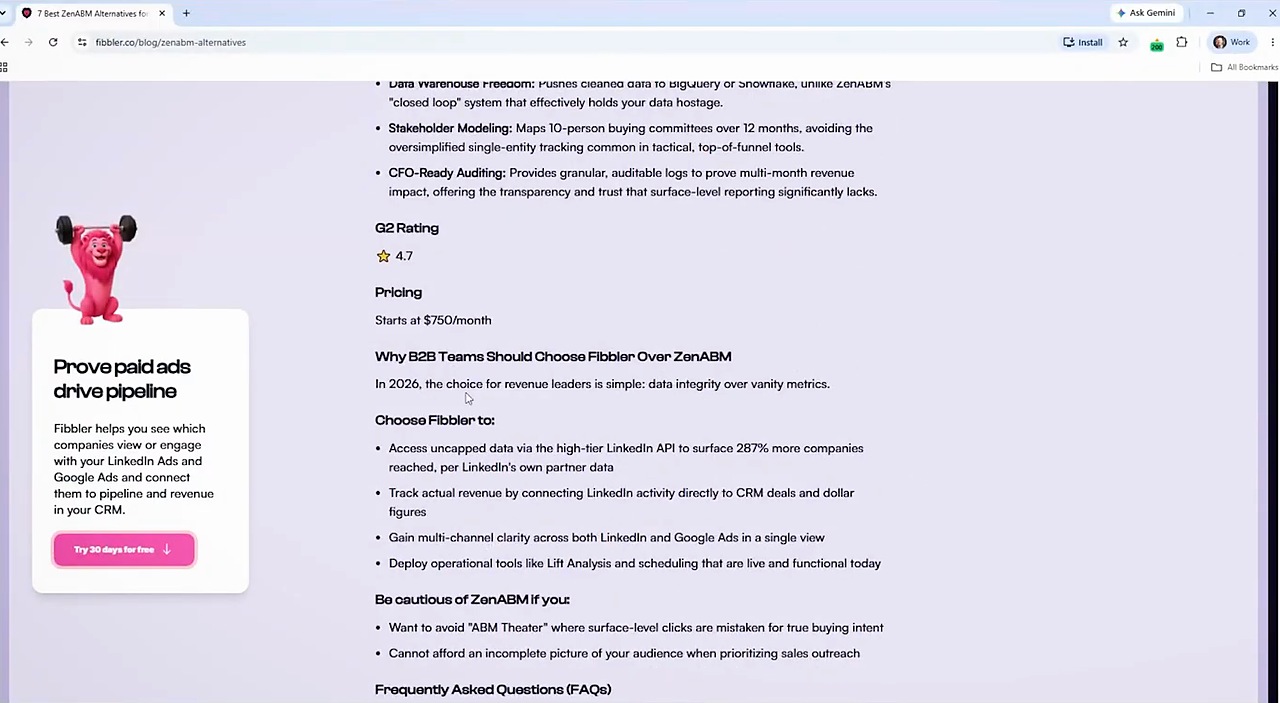
I am not taking a side on the API details. The lesson is that a page aimed at a named competitor is a public claim, and that competitor has a blog too.
Self-promotion can also backfire inside the models. In an Ahrefs experiment published in July 2026, 43% of the AI answers that cited pages promoting its Ahrefs Evolve conference never mentioned the conference at all.
I covered the formats side of this in my post on how self-referencing listicles get picked up. What the Ahrefs data adds is the catch: a self-promotional page can earn the citation while the answer recommends someone else.
The fix I use is in my AI SEO strategy: keep the qualifying condition inside the same sentence as any recommendation, so a lifted chunk cannot travel without it.
How to Get Your SaaS Into AI Search Answers
Your pages exist. Now the job is finding where the models already look.
Sam's method starts with a question. Ask ChatGPT or Claude one of your money prompts, then read the citations behind the answer.
He says the usual suspects are listicles, your own site, competitors, and review sites like G2, Capterra and Software Advice. On Reddit, his words were "not so much Reddit at the moment, I don't think."
Then you get onto those sources. Sam calls it barging your way into the LLMs.
I ran that check for this topic across ChatGPT, Claude, Gemini, Perplexity and Google's AI Overview. Most cited sources were agency guides or best-of lists, while ChatGPT leaned on official documentation from Google, Bing and OpenAI.
The assistants do not share one search index, which I broke down in which search engine each AI actually uses.
Breaking B2B was cited by Google's AI Overview and Perplexity. Its cited page is a best SaaS SEO agencies list, the exact page type Sam recommends, with Breaking B2B ranked first.
Some of the readers checking those sources are now agents, because Claude can fetch pages on a buyer's behalf. Sam says most of his clients' traffic is still human.
My split is simple: write for agents to get cited, and for humans to convert.
How to Measure SaaS SEO When Attribution Is a Mess
A buyer can ask an LLM about your category, forget about it for months, and then Google your brand name. Your analytics will call that a branded search.
Sam's fix costs nothing. Ask "how did you hear about us?" on your forms, your signup flow and your demo flow, then ask again on the sales call.
His agency invests in AI visibility trackers, naming Searchable and Promptwatch, but does not treat them as the verdict.
Sam's problem is with what gets tracked. Many teams track every prompt under the sun, and few of those prompts come from buyers with real intent.
Citations also move constantly. I dug into how much a single daily tracker run tells you in my Searchable review.
What Sam reports depends on the client. Larger companies care about share of voice.
Startups and mid-market companies care about demos, signups, trials and booked calls.
His leading indicators are money keyword rankings, visits to money pages, branded search and direct traffic. If those rise alongside self-reported AI mentions, he is generally pretty happy.
Where SaaS Buying Goes Next
Sam expects more SaaS to sell inside the LLM within a year, mostly low-ticket tools up to around $99 a month. If buyers stop visiting websites at all, the SaaS SEO pages worth owning are the ones that answer a ready buyer.
SaaS is far from dead, as I argued in my conversation on growing SaaS with YouTube. What is running out of road is the top-of-funnel playbook.
SaaS SEO FAQs
Is SEO worth it for an early-stage SaaS company?
It depends on demand more than stage. If buyers already search for your category, low-difficulty bottom-of-funnel terms are winnable even for a young domain. If your tool creates a new category, there is little search demand to capture yet, which is one of the cases where Sam Dunning says a company is not ready for SEO. Check your category in Google and in ChatGPT before hiring anyone.
Should a SaaS company still write top-of-funnel blog posts?
Not first. Definition queries like "what is a CRM" pit you against software brands with 70 to 90 DR, and AI Overviews now answer them before the click. Build alternatives, comparison and pricing pages before any glossary content. My one caveat is YouTube, where I still see a lot of beginner-level opportunity on my own channel.
How do you get a SaaS product recommended by ChatGPT?
Ask the prompt your buyer would ask, open the cited sources, and get onto them. Check more than one assistant, because they disagree. When I ran the same SaaS SEO questions through ChatGPT, Claude, Gemini and Perplexity, ChatGPT leaned on official documentation from Google, Bing and OpenAI, while the others cited mostly agency guides and best-of lists.
How long does SaaS SEO take to show up in pipeline?
Longer than it takes to rank. A low-difficulty alternatives page can rank quickly, but a buyer who meets you in an AI answer may research for months before booking a demo, often by Googling your brand name. That delay is why Sam asks "how did you hear about us?" on forms and again on sales calls.