
How to Grow SaaS With YouTube (SaaS Millionaire Advice)
Vasco Aries bootstrapped his AI SEO platform Arvow to $70K MRR, and the primary growth engine was YouTube. This article breaks down exactly how to grow SaaS with YouTube based on my conversation with him.
How to Grow SaaS With YouTube (The Actual Playbook)
Most SaaS founders throw money at paid ads and wonder why nothing sticks. Vasco took a different path. He built trust on camera, one video at a time.
His logic was simple. People buy from people they know, like, and trust. Video does that faster than any other medium. So on his YouTube channel, Vasco started making SEO tutorials, talked about what he knew from years of running an agency, and plugged Arvow naturally at the end. "You can do all this manually, or you could just use our software to do it for you in a tenth of the time." That was the whole pitch.
The results speak for themselves. One of Vasco's creators made a Portuguese-language video three years ago that still pulls 200 views per day. Try getting that kind of longevity from a tweet or a LinkedIn post.
Why YouTube Beats Paid Ads for Bootstrap SaaS
Vasco tried Facebook ads to webinar funnels. He tested YouTube ad campaigns with high-ticket offers. None of it scaled for a bootstrapped company competing against VC-backed rivals who can afford to lose money for six months acquiring a customer.
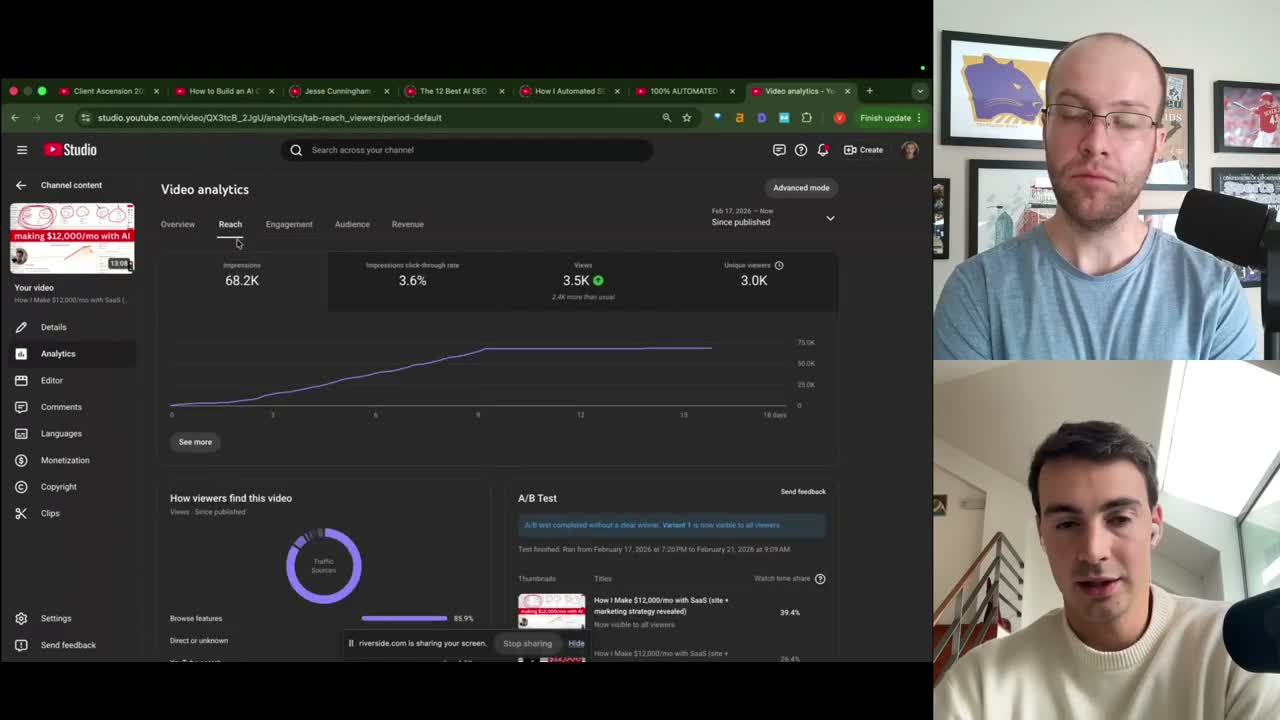
Organic YouTube content costs time, not cash. And the compounding effect is real. His channels pulled 38,000 views in February alone, with a large chunk coming from videos posted a year or two earlier. That is the definition of an evergreen content strategy.
YouTube is also the second largest search engine in the world. And according to Vasco, it is the most cited domain by LLMs. So your YouTube content feeds both human viewers and AI models pulling information for answers.
The Multi-Channel YouTube Strategy Behind Arvow
You might assume one YouTube channel is enough. Vasco hit a ceiling posting one video per day on a single channel. Two videos per day showed diminishing returns. So he launched new channels and hired dedicated creators for each.
Each creator gets a unique coupon code. Each video gets a dedicated UTM link in the description and pinned comment. That tracking tells Vasco exactly which videos bring paying customers. No email nurture sequence needed. YouTube IS the nurture.
Unlike TikTok where users might watch ten clips in a row, a 15-minute YouTube tutorial is a bigger commitment. Spreading content across multiple channels captures more total attention without exhausting a single audience.
Is SaaS Dead in 2026? (Not Even Close)
"The pendulum swings," Vasco told me. "When something is dead, two weeks later it's more alive than ever."
The SaaS model is changing. Vasco's own team uses AI agents that interact with software on their behalf through natural language. The future of SaaS will be more agentic, with agents using UIs instead of humans clicking buttons.
But the idea that you can vibe code a replacement for Slack or any production SaaS tool? That ignores the opportunity cost. You spend hours (and hundreds in API costs) building something that still has bugs. Then you maintain those bugs forever. Vasco draws a clear line: vibe coding internal micro-tools for your own workflow makes sense. Trying to sell a vibe-coded B2B product to thousands of paying users is a different story entirely. If you are thinking about making money with AI, building distribution matters more than building the product itself.
SEO Is Not Dead (And the Data Proves It)
Google still owns over 90% of search market share. ChatGPT accounts for roughly 1% of all search volume globally. People want to throw a parade when they get a lead from ChatGPT but dismiss the 50 leads that came from Google.
Top-of-funnel informational SEO has shifted. AI overviews and LLM-generated answers are changing how people find content. But demand for products and services has not gone away. LLMs still pull from page one of Google and Bing to generate answers. Foundationally, it still starts with search. If you want to see how I use Claude Code for SEO, that breakdown covers my full workflow.
Both Vasco and I agree: GEO and AEO are just repackaged SEO concepts. If someone is selling you a dedicated "AEO service" as a replacement for your marketing team, be skeptical.
The Real SaaS Moat Is Distribution
I asked Vasco a pointed question: "A developer with Claude Code clones Arvow over a weekend. What do you have that they don't?"
His answer was one word. Distribution.
Building software is easier than ever. That is exactly why distribution matters more than ever. A working product, solid customer support, and a real acquisition channel separate SaaS businesses that survive from those that fade after a Product Hunt launch.
The 10K MRR milestone that everyone flexes online? Vasco calls it "broke." After costs, team members, support staff, and co-founder splits, you are working 16-hour days for less than a good salary. The opportunity is unlimited if you scale past that point. But most people never talk about the ugly middle. For small businesses using AI, understanding this reality upfront saves a lot of pain.
Ryan's Final Thoughts
How to grow SaaS with YouTube comes down to a simple formula. Build trust on camera. Create evergreen content that compounds over time. Track everything with UTM links and coupon codes. And treat YouTube as your primary acquisition channel, not a side project.
Vasco proved this playbook works at scale. The question is whether you are willing to put in the reps.
How to Grow SaaS With YouTube FAQs
Does YouTube actually work for SaaS marketing?
Yes. Vasco bootstrapped his AI SEO tool Arvow to $70K MRR using YouTube as the primary growth channel. Long-form tutorials build trust with potential customers, and evergreen videos continue driving traffic years after publishing. The key is creating content that educates viewers on problems your product solves.
Should SaaS founders use YouTube ads or organic content?
Organic content is the better play for bootstrapped SaaS companies. Paid ads mean competing against VC-backed companies that can afford longer payback periods. Organic YouTube videos compound over time and cost nothing beyond production effort.
How do you convert YouTube viewers into SaaS customers?
Vasco uses dedicated UTM links in every video description and pinned comment. No email nurture funnel, no free lead magnet. YouTube itself acts as the trust-building mechanism. Viewers watch multiple videos, build familiarity with the product, and convert directly through tracked links.
Is SaaS dead in 2026 with vibe coding and AI agents?
No. SaaS is evolving toward agentic interfaces where AI uses software UIs on behalf of humans. But vibe coding a production SaaS replacement ignores the opportunity cost of building, maintaining bugs, and handling customer support. Established SaaS products with real distribution still hold a massive advantage.
What is the biggest moat for a SaaS business today?
Distribution. When anyone can clone a product over a weekend with AI coding tools, the differentiator is your ability to reach customers. YouTube, brand trust, and a content library that compounds over time create an acquisition channel that competitors cannot replicate overnight.