
How to Get ChatGPT to Recommend Your Local Business
If you're figuring out how to get ChatGPT to recommend your business, start here: in a three-week Linkifi study, re-asking the same buying question minutes later changed 60% of the sources ChatGPT cited. Day-to-day churn was no bigger than that same-day randomness (1.01x the noise floor), so most of the movement you see is noise.
Chris Panteli on How to Get ChatGPT to Recommend Your Business
Chris Panteli co-founded Linkifi, a digital PR agency, and he's back for his second AI Rabbit Holes episode after his first in 2025. This one covers his team's study of what ChatGPT reads before answering a buying question.
Press coverage is what Linkifi sells, so read Chris's PR advice knowing that's his business. The free tactics below carry no such conflict.
Taken in the order I'd follow it, Chris's advice runs like this. Get listed on the sites ChatGPT keeps returning to for your buyers' questions, ask it why it picked a competitor, then make the people behind your business easy to name.
If you want to go deeper on the research side, I put together my Claude Code Skills Stack with the SEO and research skills I run for client work.
Linkifi's AI Visibility Volatility Index, by the Numbers
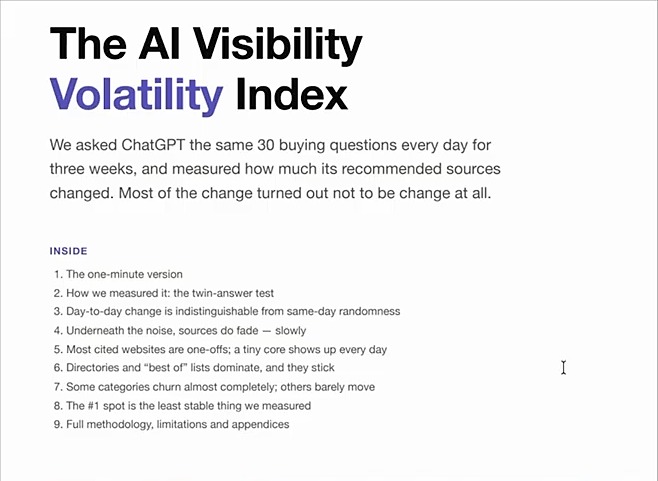
Linkifi asked ChatGPT the same 30 buying questions every day for three weeks, in an incognito browser instead of through the API, and measured how much the recommended sources changed.
Sources are the pages ChatGPT links in its Sources panel, the documents it read during its search. So the study tracked what ChatGPT read, and it did not track which businesses ChatGPT named.
Two corrections to the recording. Chris says "30 days" once, but the study ran 21 days, and he called it local when the PDF also includes national categories like project-management software.
The report isn't public yet. Every figure below comes from the PDF Chris showed on screen, labeled Linkifi Research, September 2026.
Four numbers sit on the report's summary page:
- 40% vs 39%: ask twice in one day and the two answers share 40% of their sources. Ask a day apart and they share 39%, so day-to-day churn is 1.01x the noise floor.
- 7 in 10: after Linkifi removed that randomness, 71% of the sources cited on day 1 were still being cited in the final week.
- 74%: three-quarters of the websites ChatGPT cited appeared on 4 days or fewer. A core of 3% showed up almost every day, and 12 of those 18 fixtures are directories or "best of" lists.
- 36%: the first website ChatGPT cited matched day 1's on only 36% of days, the least stable thing Linkifi measured.
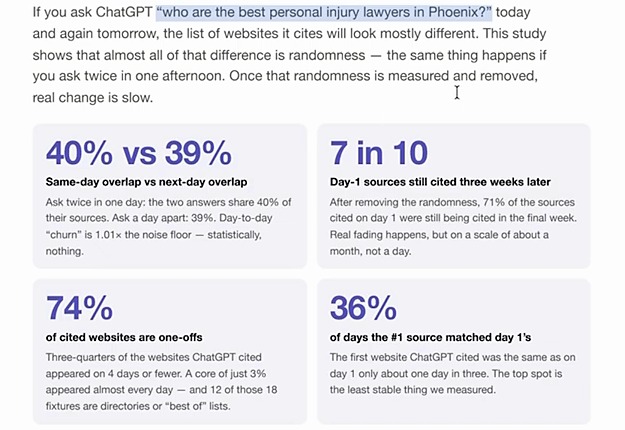
Of the four cards, the last two say the most about how to get ChatGPT to recommend your business. The top source matched day 1's only about one day in three, while a small core of sources kept returning almost every day.
Why One ChatGPT Check Tells You Almost Nothing
Checked once this morning whether ChatGPT listed your website among its sources? Linkifi's report calls that kind of single check "close to worthless," because re-asking minutes later changed 60% of the sources.
Besmir Bregasi showed the same kind of churn in one dashboard on my earlier episode about tracking AI visibility, where one prompt ranked a brand anywhere from #1 to #8 within a single week. Linkifi measured it at scale.
Directories and "best of" lists made up 61% of all citations and were among the stickiest sources. As the PDF puts it, "Being on the right lists matters more than any single mention."
Category makes a big difference. Small-business accounting answers kept only 14% of their sources day to day, while project-management software kept 59%.
Local, city-specific questions were steadier than national ones, according to the PDF. That matched my guess on the recording, while Chris had guessed local answers would swing more.
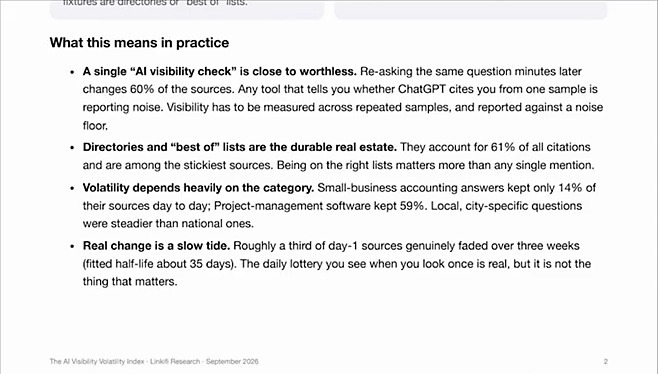
Real change is slow, too. Roughly a third of day-1 sources faded over three weeks, and Linkifi's fitted half-life is about 35 days.
So review it monthly, across many runs. A daily check mostly measures luck.
Whether the businesses ChatGPT names are any good is a separate question Linkifi didn't test. I looked at that in my two-city test of local AI recommendations.
Reverse-Engineer the Sources ChatGPT Keeps Coming Back To
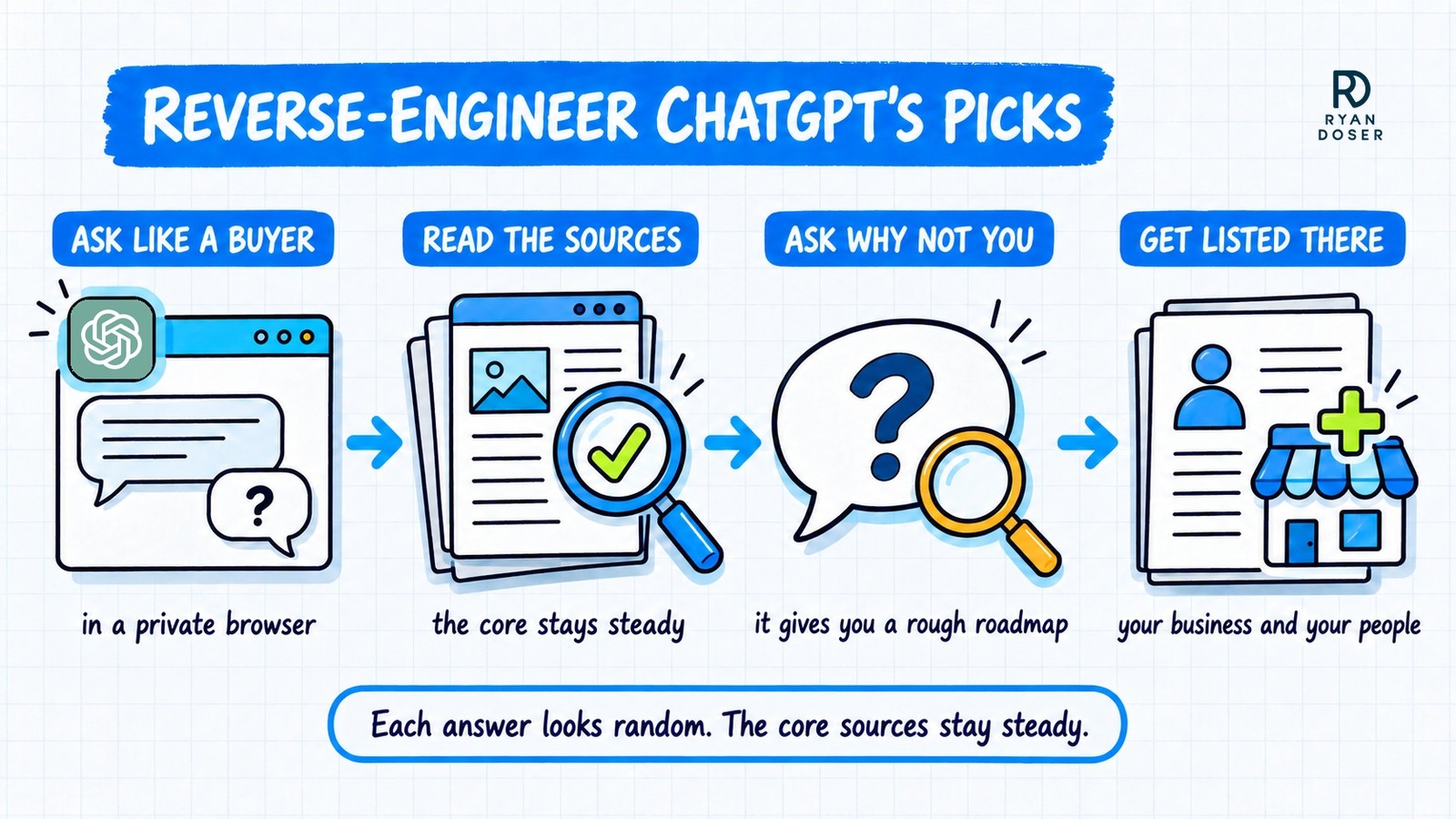
The fastest win Chris described for how to get ChatGPT to recommend your business costs little. The sources list is your look "behind the magician's curtain," as he put it, so run the questions buyers ask in ChatGPT, write down the sources, and get listed in the ones you're missing.
Ask the way a buyer talks, because Chris sees these as conversations more than searches. His example for a personal injury firm was something like "I got run over the other day, my leg's broke, what can I do?"
Run each question several times, and the core sources are whichever ones keep showing up.
At the local level, Chris said, those are often directories and industry lists that businesses could claim but never have. He called the return on that effort "instant and significant."
I like this advice because most people skip it to chase the latest trick.
I won't repeat the directory list here. My test of what ChatGPT cited for a local plumber names the directories, subreddits and local press that showed up, and how to qualify for each.
Buying an ad won't put you in the answer, according to OpenAI. It opened a self-serve Ads Manager beta to US advertisers on May 5, 2026, and says its ads are clearly identified and don't influence the answers ChatGPT provides.
Ask ChatGPT Why It Picked Your Competitor
Chris's final piece of advice for how to get ChatGPT to recommend your business builds on the sources list. Run a buyer question, note which competitor ChatGPT names, then ask it directly, with wording close to his "why did you not recommend my law firm?" and your firm's name in it.
Chris said ChatGPT will answer with reasons. In his example, the other firm is in three trusted directories, has claimed its profiles, and has a lead lawyer who is certified and quoted in reviewed articles.
He called that "a pretty decent roadmap and blueprint." Be careful with it, though, because a model explaining itself after the fact can sound sure about reasons that had little to do with the pick.
So check its reasons against the cited sources before acting on them. Then re-test, because Chris's closing line was "test, test, test periodically."
Why Chris Sees ChatGPT Recommend the Person Behind the Business
Here's something Chris has noticed in his agency's work: on many local questions, ChatGPT names a person rather than a company. "More often than not," he said, it recommends individual brokers over their firms.
His example was a Miami home buyer looking for an agent. He sees the same with financial and medical questions, where ChatGPT names a specialist and mentions where they work.
That's a field observation, and the study didn't measure it. His advice is to make both the business and its representatives "defined entities," with trust and authority built around the person too.
His proof is an Austin, Texas real estate broker Linkifi has worked with for five years, whose name Chris said comes up again and again in ChatGPT.
Chris credits that to Linkifi's PR work, which put the broker on CNBC and Bloomberg as a talking head and into the New York Times with bylines. Those were earned media spots the client paid Linkifi to pursue, which is the service Chris sells.
The free version for a local firm is naming the owner or lead pro the same way on your site and on every directory profile you claim.
Local media coverage helps here too, and I said on the episode it "is huge for this." If you're working out how to get ChatGPT to recommend your business and you run a practice built on one or two people, start with their names.
Test the Way Your Customers Actually Find You
Chris warns that results pulled through the API come out "wildly different" from what a person sees in the browser. His fix is the one Linkifi used: an incognito browser with memory off, so the answer looks like what a stranger would get.
Before you spend weeks on how to get ChatGPT to recommend your business, check which platform actually sends you traffic.
Chris said some of his finance clients get far more visits from X than from ChatGPT, though he expects ChatGPT to lead for the majority of businesses. On Google's AI Mode and Claude, his honest answer was "I don't know."
Work the Steady Sources Now, Build the Brand for Later
I told Chris that SEO has always been black hat at its core, a game of manipulating Google, and AI search is no different.
Short to midterm, work the lists ChatGPT already trusts. Long term, the most durable answer to how to get ChatGPT to recommend your business is Chris's Nike example: decades of trust are why the brand gets recommended for trainers.
How to Get ChatGPT to Recommend Your Business FAQs
How do I get ChatGPT to mention my business?
Get listed on the pages ChatGPT already reads for your buyers' questions. Run them in a private browser several times, note the sites in each answer's sources, and claim the directories and industry lists you're missing. In Linkifi's study, directories plus "best of" roundups made up 61% of all citations, so they're the first place most local businesses should look.
Can you pay ChatGPT to recommend your business?
You can pay for ads in ChatGPT. OpenAI's self-serve Ads Manager opened as a beta for US advertisers on May 5, 2026, and OpenAI says its ads are clearly identified and don't influence the answers, so paying doesn't buy a recommendation. Earning one still runs through the sites ChatGPT reads, such as directories, "best of" lists and local press.
How do I get my business ranked on ChatGPT?
There's no fixed rank to win, and the Linkifi research never tracked which businesses ChatGPT named. Its figures describe how stable ChatGPT's cited sources are: the first website cited matched day one's on only 36% of days, and 7 in 10 day-one sources were still cited three weeks later once randomness was removed. Judge your own visibility across many runs over weeks.
Why did ChatGPT recommend my competitor instead of me?
Ask it. Chris suggests naming your firm and asking something close to "why did you not recommend my law firm?" ChatGPT will list reasons, such as the competitor sitting in trusted directories or having a quoted lead professional. Treat them as a rough roadmap, check them against the cited sources, and re-test, since a model's explanation may not match how it chose.