
Query Fan-Out: What ChatGPT Actually Searches for Your Buyers
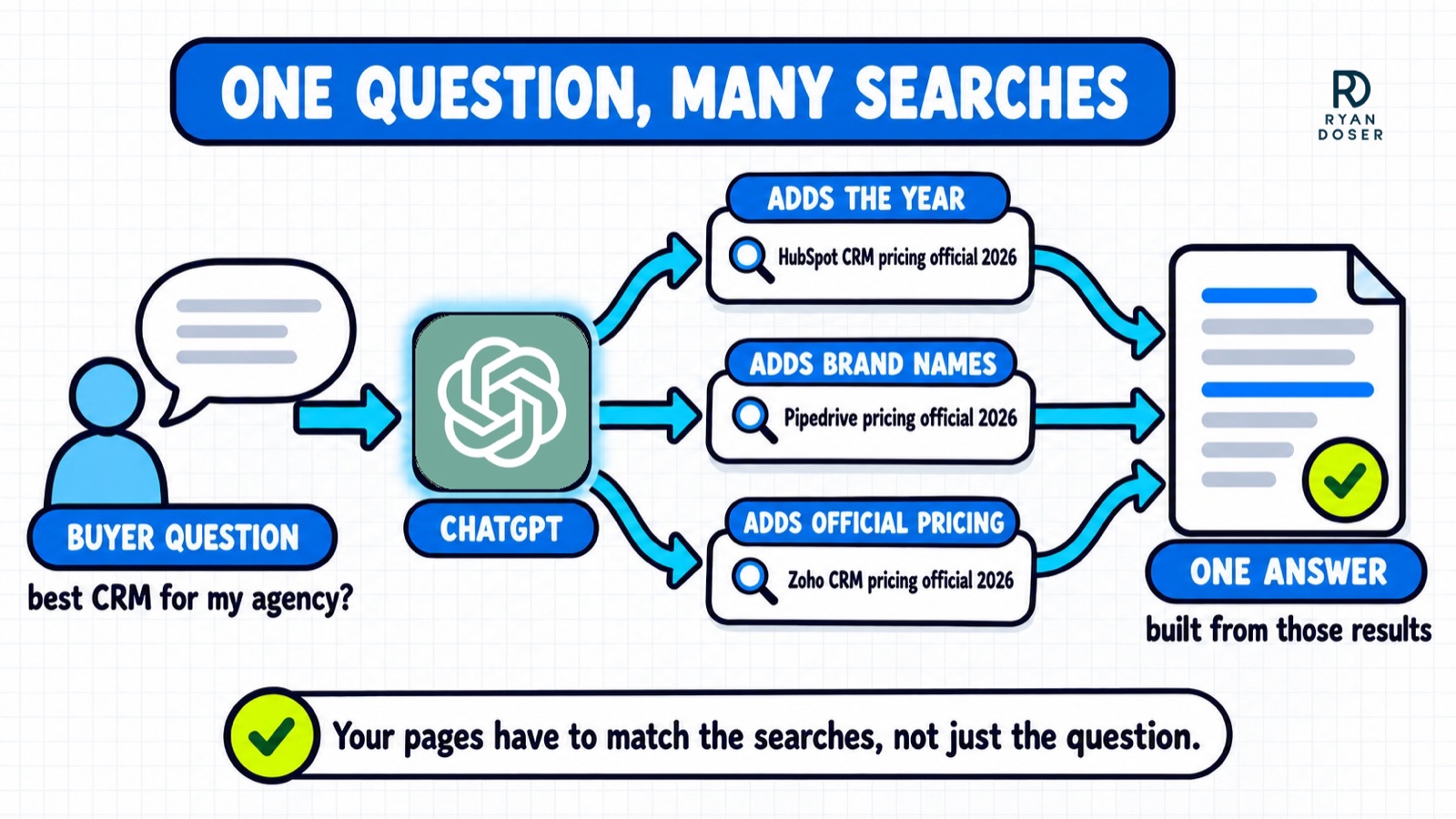
Ask ChatGPT for the best CRM for a small marketing agency, and one of the searches it reported in my test was "Pipedrive pricing official 2026," a brand the buyer never named. Query fan-out is that hidden step, so I logged the searches ChatGPT reported for eight typical buyer questions to see what it looks for.
What Query Fan-Out Means in AI Search
Query fan-out is when an AI tool turns one question into one or more web searches, often several, reads what comes back, and writes a single answer from those results.
Google named the technique when it introduced AI Mode as a Search Labs experiment in March 2025. At Google I/O that May, it said AI Mode breaks a question into subtopics and issues "a multitude of queries simultaneously on your behalf."
OpenAI describes the same step for ChatGPT. Its help article "Searching the web with ChatGPT" says ChatGPT "typically rewrites your query into one or more targeted queries," and may send more specific ones after it reviews the first results.
That changes the job for a marketer. The words your buyer types aren't always the words that hit the search index, so it pays to have pages that match the rewritten searches too.
If you want the research and content skills I run for my own marketing, my Claude Code Skills Stack holds them.
What ChatGPT Searched for 8 Buyer Questions
On October 23, 2026, I sent eight buyer questions to ChatGPT with web search on, twice each. I used DataForSEO's ChatGPT scraper, which reports the fan-out queries behind each answer.
I wrote the questions the way a buyer might ask them. They covered a CRM for an agency, email software for an online store, a Des Moines plumber, SEO pricing, a scheduling tool for a solo creator, running shoes, and two head-to-heads (Claude or ChatGPT, HubSpot or Mailchimp).
| What ChatGPT's searches did | 37 searches across 16 runs (October 23, 2026) |
|---|---|
| Searches per run | 1 to 4, average 2.3 |
| Added the current year | 25 of 37 (68%) |
| Asked about pricing | 24 of 37 (65%) |
| Named competitor brands the buyer never typed | 19 of 37 (51%), on 4 of 8 questions |
| Used the word "official" | 17 of 37 (46%) |
| Matched the buyer's question word for word | 0 of 37 |
| Repeated a search word for word on the second run | 0 of 37 |
Here is what some of those searches looked like, copied exactly as ChatGPT reported them.
| Buyer typed | One search ChatGPT reported (October 23, 2026) |
|---|---|
| What is the best CRM for a small marketing agency? | Pipedrive pricing official 2026 |
| What is the best email marketing software for a small ecommerce store? | official pricing Klaviyo Omnisend Mailchimp ecommerce email marketing 2026 |
| Is Claude or ChatGPT better for writing blog posts? | site:anthropic.com Claude writing long documents projects official |
| How much does SEO cost for a small business? | small business SEO cost 2026 monthly pricing local SEO agency |
| What are the best running shoes for flat feet? | best running shoes for flat feet 2026 stability shoe reviews Brooks Adrenaline GTS ASICS Kayano Hoka Arahi New Balance 860 Saucony Guide |
| Who is the best plumber in Des Moines, Iowa? | best plumbers in Des Moines Iowa reviews licensed plumbing companies |
Two caveats on the method. DataForSEO describes these as related queries derived from the prompt, so read them as the searches ChatGPT reported for each answer, which may not be every search it ran.
Eight questions is also a small sample. The percentages are what this test found, and they show patterns worth checking against your own buyer questions.
The counts line up with a bigger test. GeoSearchConsole ran 100 prompts on October 7, 2026 and logged 216 ChatGPT searches, about 2.2 per prompt.
You'll see "8 to 12 sub-queries" repeated across SEO blogs, usually about Google AI Mode, which this test couldn't measure. I couldn't find a typical number published by Google or OpenAI, and on short buyer questions ChatGPT's query fan-out never went past four per run.
Google's own wording is "a multitude," and it says its Deep Search mode can issue hundreds of searches for a single report.
ChatGPT Adds Brand Names Your Buyer Never Typed
For "What is the best CRM for a small marketing agency?", ChatGPT's searches named HubSpot, Pipedrive, Zoho and Monday CRM. Its other searches looked up HubSpot, Pipedrive and Zoho's official pricing.
The same thing happened with email software (Klaviyo, Omnisend, Mailchimp) and scheduling tools (Buffer, Later, Metricool, Publer). For running shoes it searched exact models, like the Brooks Adrenaline GTS and the ASICS Kayano.
If your brand isn't one of the names in those searches, you're counting on the generic search, a comparison article or a directory to bring you into the answer.
The pricing pattern matters just as much. Of the 37 searches, 24 asked about price, and 20 of those came from questions that never mentioned price, so a crawlable, current pricing page is a cheap query fan-out fix.
Local was the exception. For the Des Moines plumber, ChatGPT named no businesses and searched for reviews, licensed plumbing companies and emergency plumbers instead.
Same Question Twice, Zero Repeated Searches
Run the same question again and the topics stay put while the wording moves. Comparing the two runs of each question, none of the 37 search strings repeated word for word, even when the same brands showed up.
So a single query fan-out result shifts from one run to the next, even minutes apart. What held across both runs was the pattern underneath it, like the year, the pricing check and the brand shortlist.
That's also why a tool that adds up search volume for fan-out queries gives you a rough ceiling at best, a point I made in my post on common AI search myths.
The answers themselves swing the same way. In my guide to tracking AI visibility as a trend, one prompt ranked a brand anywhere from #1 to #8.
Claude and Gemini Stayed Closer to the Buyer's Words
Only ChatGPT added brand names and the word "official." When I ran the same eight questions through the Claude and Gemini APIs with web search on, their searches stayed close to the buyer's own wording.
They also searched less often. On the first try, Claude reported searches for 5 of the 8 questions and Gemini for 7 of 8.
These are developer APIs, not the Claude or Gemini apps, and neither is Google AI Mode.
Re-running only the questions with no reported searches added one more question for each. Gemini also often put two years in one search ("2025 2026").
Query fan-out also depends on the question. In an earlier test on this site, one broad research question produced 21 Gemini sub-queries, which I wrote up in what search engine Claude uses.
How to Use Query Fan-Out Without Buying a Tool
You don't need a paid tracker to do this for your own business. Four steps cover it.
- List 10 questions the way your customers actually ask them, including your city if you serve one.
- Run each one twice. GeoSearchConsole's free Query Fan-Out tool shows ChatGPT's searches plus Claude and Gemini API searches with no sign-up, though it can't show Google AI Mode.
- Read for patterns across runs: years, brand names, pricing, "official," reviews.
- Make sure you have a page that answers each pattern.
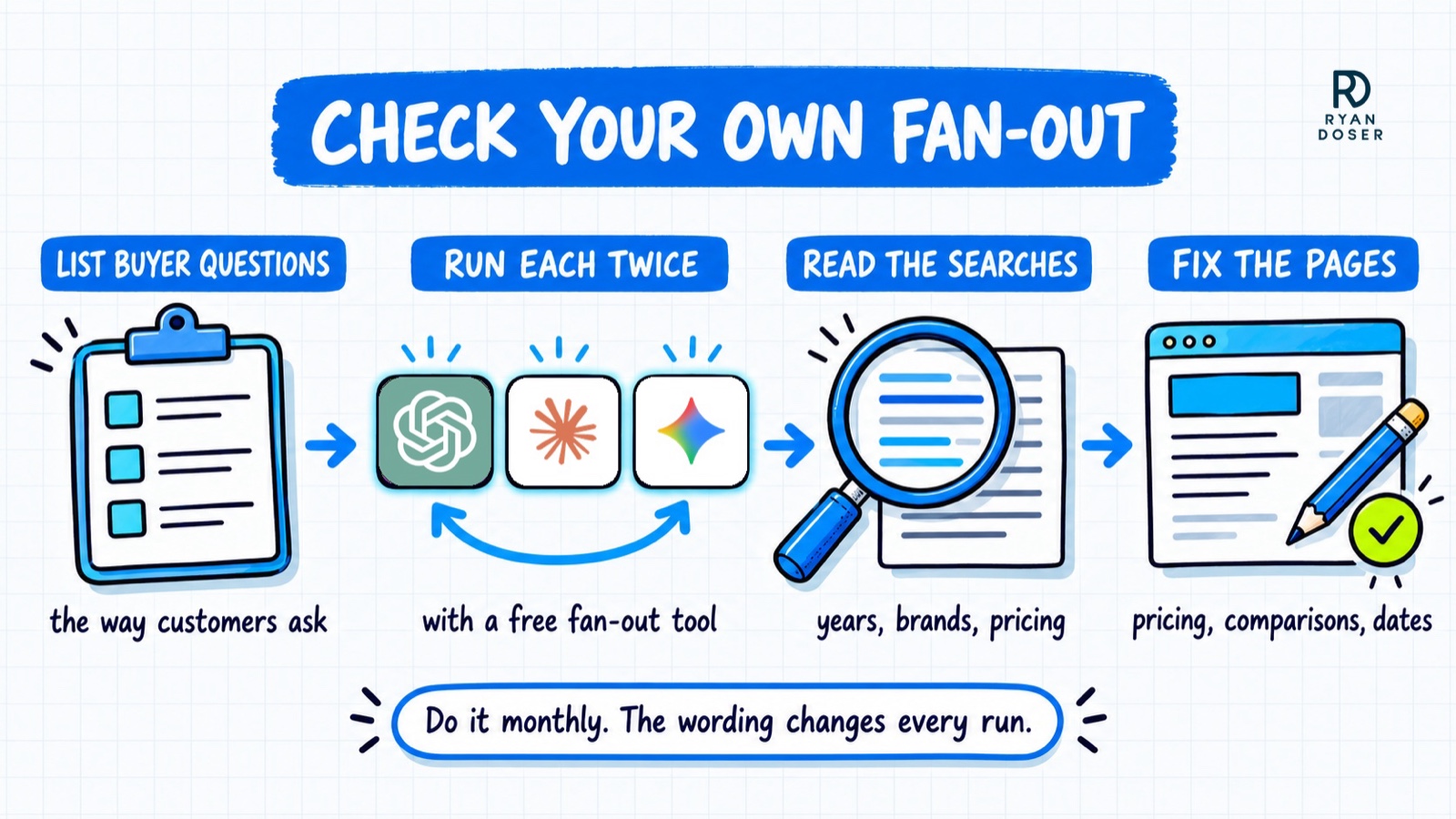
For most businesses the fixes are ordinary. Keep a pricing page that loads without a login, publish honest comparisons against the brands ChatGPT pairs you with, and update a page's date only when you actually update the page.
Google's guidance points the same way. Its guidance on AI features says AI Overviews and AI Mode may use query fan-out, and that no special optimization is needed to appear in them.
What query fan-out data adds is a priority list. It shows which ordinary pages are worth getting right first.
Write for the Searches Behind the Question
Your buyer asks one question. ChatGPT turned each of mine into a few searches, put a year in most of them, and never worded a search the same way twice.
So check your own query fan-out once a month and make sure you have pages that answer what it keeps searching for.
The wording changes every run. Your buyers' questions mostly don't.
Query Fan-Out FAQs
What is query fan-out?
In AI search, query fan-out is when a tool turns a single question into one or more web searches, often several, then combines what it finds into one answer. Google uses the term for AI Mode and AI Overviews, and OpenAI says ChatGPT typically rewrites a question into one or more targeted queries. The searches often add details the person never typed, like the year or brand names.
How many searches does ChatGPT run per question?
Usually only a few for short buyer questions. In my October 2026 test of eight questions run twice, ChatGPT reported 1 to 4 searches per run, 2.3 on average. GeoSearchConsole's 100-prompt test the same month found about 2.2. Broad research questions can fan out much wider, and Google says its Deep Search mode can issue hundreds.
Do I need to change my SEO for query fan-out?
Mostly no. Google says no special optimization is needed to appear in AI Overviews or AI Mode. What query fan-out data changes is your priority list. In my eight-question test, ChatGPT's searches leaned hard on pricing, the current year and brand names, and the one local question searched for reviews. Those point to ordinary pages worth getting right first.
Can I see the fan-out queries for my own prompts?
Yes, for ChatGPT and for the Claude and Gemini APIs. GeoSearchConsole's free Query Fan-Out tool shows the searches each engine reports, with no sign-up, and DataForSEO returns them through its API for a small fee. GeoSearchConsole notes that no outside tool can see Google AI Mode's own searches. Run each prompt at least twice, because the exact wording changes between runs.