
What Search Engine Does Claude Use? (I Checked the Receipts)
Claude uses Brave Search. Anthropic names Brave as a Web Search vendor on its own subprocessor page, which makes it a documented business relationship rather than a rumor. Almost every article covering this still calls it unconfirmed, and I want to show you where that confirmation actually lives.
Here is the thing. When you ask an AI a question and it searches the web, it is querying somebody's search index. Knowing whose index changes what you optimize for.
What Search Engine Does Claude Use?
Claude's web search runs on Brave Search. That is the named vendor behind the feature, and it is neither Google nor Bing.
You do not have to take my word for it, or anyone else's. Anthropic maintains a public subprocessor list, which is the legal disclosure a company publishes naming the vendors that handle data on its behalf. Brave is on it.
Go look for yourself on Anthropic's subprocessor page, and note one thing before you do. The list is paginated, ten entries at a time, and Brave sits on the second page. Load it, click through to page two, and read the row yourself.
The entry reads exactly like this:
Brave Search. Products: All products. Web Search. United States. search.brave.com
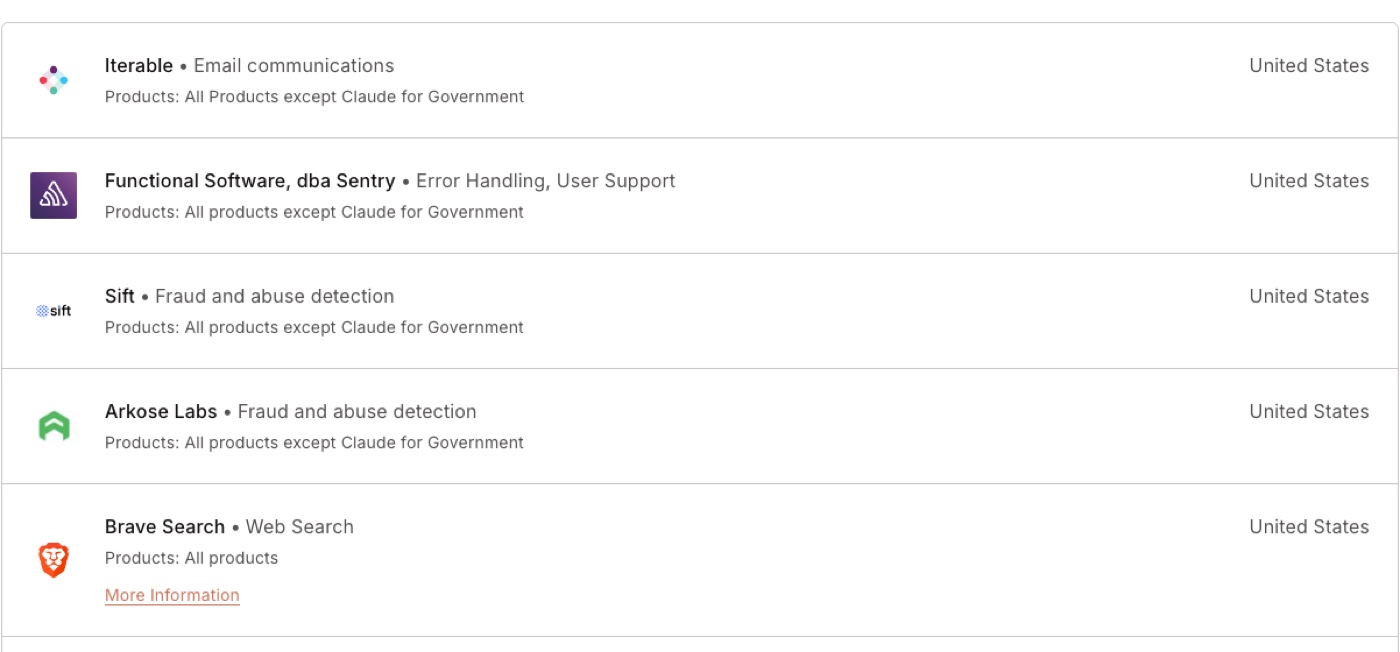
That is Anthropic naming its own search vendor, on a compliance page it is obligated to keep accurate. It documents the relationship, though it stops short of describing how the retrieval actually works.
So why does half the internet hedge on this? Search the question and you will find pages ranking well that say Claude uses Brave "though Anthropic has not confirmed it publicly." That exact framing is sitting on page one right now.
That framing is out of date. Anthropic named the vendor in writing, on a page anyone can load. The confusion is understandable, because the help docs most people would check genuinely do not name a provider, and the subprocessor list is paginated so Brave sits on the second page. Most people never get there.
One detail almost nobody mentions, and it is a useful check on getting too confident. That same list carries a second Web Search subprocessor, turbopuffer, which sells vector search and storage. Brave is the named web search vendor, but a subprocessor list tells you who is involved, not how the pieces divide the work.
Which Search Engine Each AI Actually Uses
This is the part worth internalizing. The models do not all read the same web, and the people doing real testing in AI search keep finding the same thing. Dan Petrovic of DEJAN, whose research prompted a lot of this digging, is one of them.
| AI | Search index | Evidence quality |
|---|---|---|
| Claude | Brave Search | Confirmed. Named on Anthropic's subprocessor list. |
| Gemini | Google Search | Confirmed. Documented in Google's own API. |
| ChatGPT | Its own index plus scraped Google | Contested. Reported, not vendor-confirmed. Bing is not the driver. |
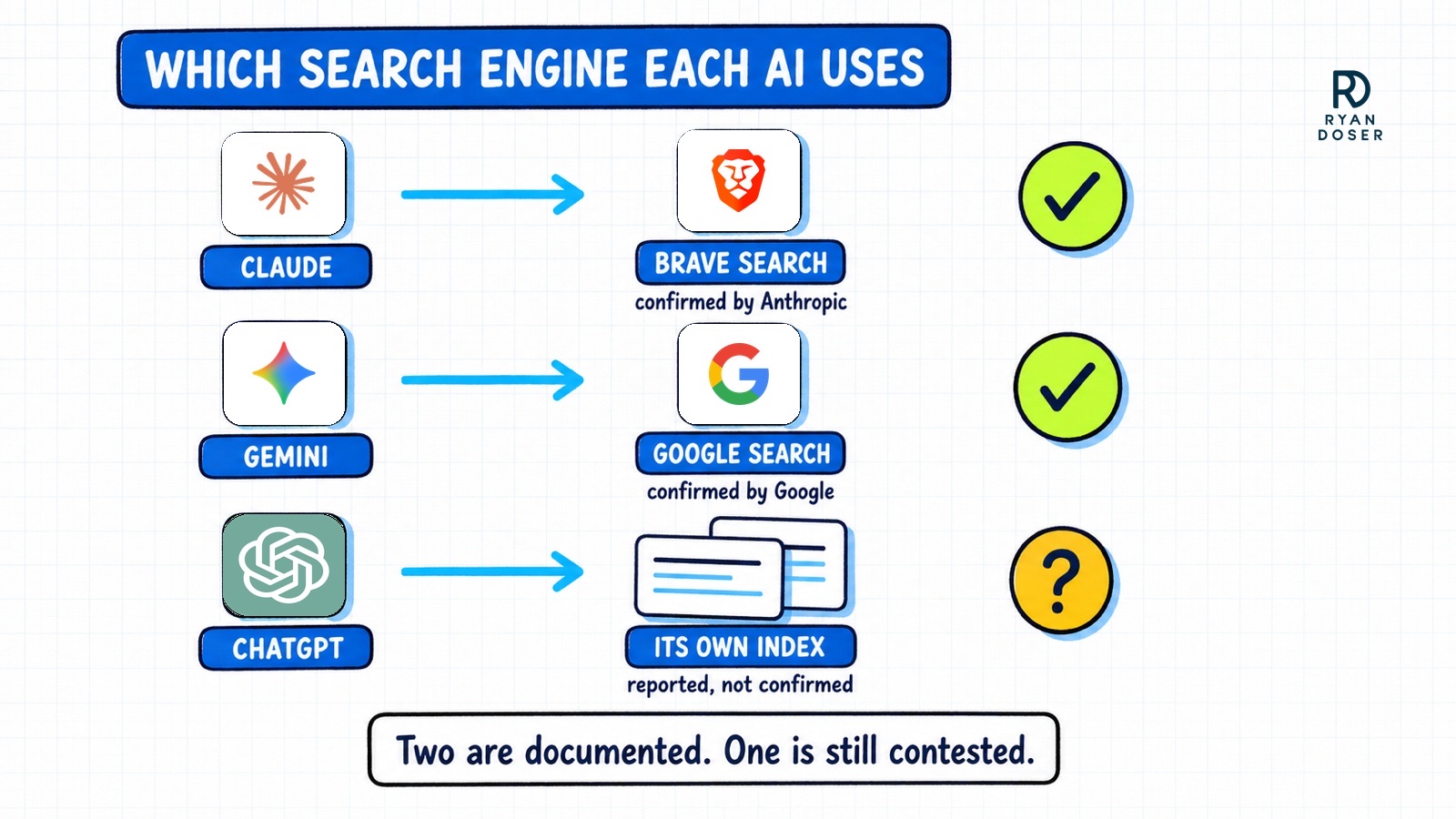
Gemini is the easy one. Google's Gemini API documentation describes the feature as "Grounding with Google Search," and you invoke it in code by passing a tool literally named google_search. Google grounding Gemini in Google is not a surprise.
ChatGPT is where the popular answer has quietly gone stale.
The ChatGPT Answer Everyone Repeats Is Out of Date
Ask any SEO how to show up in ChatGPT and a lot of them will tell you to rank in Bing. That advice was correct once. It has aged badly, and the part it now misses is the part you can actually control.
It was true in 2023. Microsoft and OpenAI announced Bing integration into ChatGPT in May of that year, and the feature was literally called Browse with Bing. Then OpenAI launched its own ChatGPT Search product in October 2024, and OpenAI began running search infrastructure of its own. The advice never got updated.
Two things tell you Bing is no longer the whole story.
The first is OpenAI's own crawler documentation. OpenAI runs a crawler called OAI-SearchBot, and the docs say this about it:
"OAI-SearchBot is for search. OAI-SearchBot is used to surface websites in search results in ChatGPT's search features. Sites that are opted out of OAI-SearchBot will not be shown in ChatGPT search answers, though can still appear as navigational links."
Sit with that for a second. If ChatGPT were only reading Bing's index, blocking OpenAI's crawler could not remove you from ChatGPT's answers, because Bing would still have you. So OpenAI controls its own inclusion, on its own infrastructure. That does not prove Bing contributes nothing, and it does prove Bing is not the lever that decides whether you show up.
The second is measurement. Olivier de Segonzac published research at Search Engine Land in August 2026 analyzing 1,200 ChatGPT answers, 88,000 search results, and 26,900 distinct pages. His conclusion, in his words: "OpenAI has its own web index, and Bing doesn't supply it."
The split he found is stranger than a single number, and it depends on what you are paying. On the free Think mode, about 75 percent of results came from OpenAI's own index. On paid Thinking, that flips almost exactly: roughly 75 percent came from scraped Google results and only about 25 percent from OpenAI's index.
Read that twice, because it is the part nobody is repeating. Free and paid users are being served from meaningfully different sources, and neither of those sources is Bing.
On the Bing question specifically, his numbers are stark. Only 1.5 percent of the URLs from OpenAI's own index also showed up in Bing's top 20 for the same underlying queries. If Bing were supplying that index, you would expect those two sets to overlap far more than that.
I want to be careful here, because this is the one claim on this page that is not vendor-confirmed. That is independent research, not an OpenAI statement, and OpenAI has neither confirmed nor denied it. Treat it as strong evidence rather than settled fact.
But notice you do not need that research to reach the practical conclusion. OpenAI's own documentation already tells you that blocking its crawler removes you from ChatGPT. That is enough on its own to retire "just rank in Bing" as complete advice.
Worth noting the asymmetry in what you can verify. Anthropic publishes a subprocessor list naming its search vendor outright. I could not find an equivalent public OpenAI list naming one, which is why the Claude answer on this page is documented and the ChatGPT answer is inferred.
One Prompt Is Not One Search
Here is the mechanic that reframes all of this, and it is easy to verify yourself.
When you ask an AI a question, it does not run your question as a search. It breaks your prompt into multiple sub-queries, runs those, and assembles an answer from what comes back. The industry calls this query fan-out.
I ran a live grounded query against Gemini to see the real number. On that one prompt, on that one model, the API handed back 21 separate fan-out queries.
Twenty-one sub-queries from a single broad question, which is one run and not a benchmark. Things like "what is cloaking in SEO" and "adversarial SEO examples" and "how search engines detect and penalize content manipulation," none of which I typed.
That was one query on one model, so I am not offering 21 as a typical number. Published estimates vary a lot depending on who is measuring and which assistant they measured. The point is that the multiplier is real and often larger than people assume, and the API will show you your own number in about thirty seconds.
So the useful reframe is this. You are not trying to rank for the prompt. You are trying to rank for the spread of sub-queries the prompt silently spawned, in whichever index that model happens to read.
What This Actually Means for Your Site
Four things change once you know which index you are actually being read from, and the first one has a documented consequence attached.
Check whether you are in Brave at all. Search your brand on Brave the way you would on Google. Brave runs its own independent index rather than reselling someone else's results, so it is possible to be findable on Google and thin on Brave. It is a five minute check that most people have never run once.
Do not block OAI-SearchBot by accident. This is the one item here with a documented consequence attached, straight from OpenAI. Plenty of sites added blanket AI crawler blocks in the last two years, and OpenAI says that setting keeps you out of ChatGPT's search answers, though you can still appear as a navigational link. Open your robots.txt and look for two separate user-agents: GPTBot governs training, OAI-SearchBot governs whether you show up in search answers. If you would rather not read the file line by line, my AI agent readiness checker lists which AI bots your robots.txt allows or blocks at your homepage, OAI-SearchBot included.
Stop treating "AI search" as one destination. Three assistants, three different indexes, three different sets of results. Winning on one is not evidence you are winning on another, so check them separately rather than assuming they move together. Most of the AI SEO tools worth using now track citations per platform for exactly this reason. If you want a fuller picture of how those citations get won, I broke that down in my guide on how to manipulate AI search.
Fundamentals still carry most of the weight. These systems lean on retrieval, whether that is an index, a live fetch, or a licensed feed. Being findable is still the prerequisite, which is why this looks less like a new discipline than people selling courses would prefer. My full approach lives in my AI SEO strategy breakdown.
Final Thoughts from Ryan
The lesson here is not really about Brave. It is that a fact everyone repeats about AI search was checkable in about ten minutes, and the checking is what nobody did.
Claude's provider was sitting on a public compliance page while article after article called it unconfirmed. The Bing answer was accurate in 2023 and still gets handed out as current advice.
This field moves fast enough that received wisdom goes stale in months. When someone tells you how AI search works, ask where they checked. Then go check.
I will say the obvious caveat too. These are private systems that can change without telling anyone, so the specific mappings on this page could shift. The habit of verifying is the part that keeps working.
What Search Engine Does Claude Use FAQs
Does Claude use Google or Bing?
Neither is the named provider. Claude's web search runs on Brave Search, which Anthropic lists directly on its public subprocessor page as a Web Search vendor. Brave operates its own independent index rather than reselling Google or Bing results, so Claude sees a genuinely different set of pages than Gemini or ChatGPT would for the same question.
Does ChatGPT still use Bing?
Not the way it did. Bing powered the original Browse with Bing feature launched in 2023, but OpenAI now runs its own crawler, OAI-SearchBot, and its documentation states that sites opting out of that crawler will not appear in ChatGPT search answers. Independent research published at Search Engine Land in August 2026 found the mix depends on your tier: on free Think mode about 75 percent of results came from OpenAI's own index, while on paid Thinking roughly 75 percent came from scraped Google results instead. Either way, only 1.5 percent of URLs from OpenAI's index overlapped with Bing's top 20. OpenAI has not publicly confirmed that research.
What search engine does Gemini use?
Google Search. Google's Gemini API documentation calls the feature Grounding with Google Search, and developers enable it by passing a tool named google_search. The API also returns the exact sub-queries the model ran, which makes Gemini the easiest assistant to study if you want to see fan-out behavior directly.
How do I show up in Claude's search results?
Start by confirming Brave has indexed your site, since Brave runs an independent crawler and index. Standard technical SEO applies from there: crawlable pages, clear topical relevance, and content structured so a specific passage answers a specific question. I have not seen a Brave-only trick worth chasing, and the ones being sold tend to be guesses dressed up as method.
Should I block AI crawlers on my site?
Understand the tradeoff before you do. With OpenAI the crawlers are split: GPTBot relates to training data, while OAI-SearchBot governs whether you appear in ChatGPT's search answers. Blocking both removes you from an answer surface people actively use. Blocking training while allowing search is a defensible middle position, and it is worth checking which one your robots.txt currently blocks.