
How to Rank in ChatGPT in 2026 (Tested by AI Search Expert)
Every guide on how to rank in ChatGPT opens with the same instruction: optimize your Google Business Profile. I wanted to know whether that was true, so I tested it.
In September 2026 I asked ChatGPT, with live web search on, to recommend the best plumber in Des Moines. It named five companies and cited fifteen sources. Not one of them was a Google Business Profile.
I ran it again for HVAC companies in Omaha. Sixteen citations, same result. Zero Google Business Profiles.
Both runs were live web searches, and I logged every URL the model returned rather than reading the summary it gave me. The full source lists are below so you can check them against your own.
Two queries on one day is a small sample, and the mix will move if you ask next month. It is also two more than the guides ranking for this question appear to have run. Every one of them tells you to start with your Google Business Profile, and that instruction pointed at something ChatGPT did not cite either time I checked.
One correction before we go further, because it changes what you are aiming at. There is no ranking to win here. Answers are generated fresh per request, so what you actually influence is how often you get named across many asks, which is a rate rather than a position. I have written separately about why "ranking" in ChatGPT is the wrong mental model, and everything below is aimed at moving that rate.
Working out where you stand is the kind of thing I do with owners inside the AI Concierge. The test at the end of this post costs nothing though, so run that before paying anyone, me included.
What ChatGPT Actually Cited
Here is the full source list from the Des Moines plumber query, because the specifics matter more than the summary.
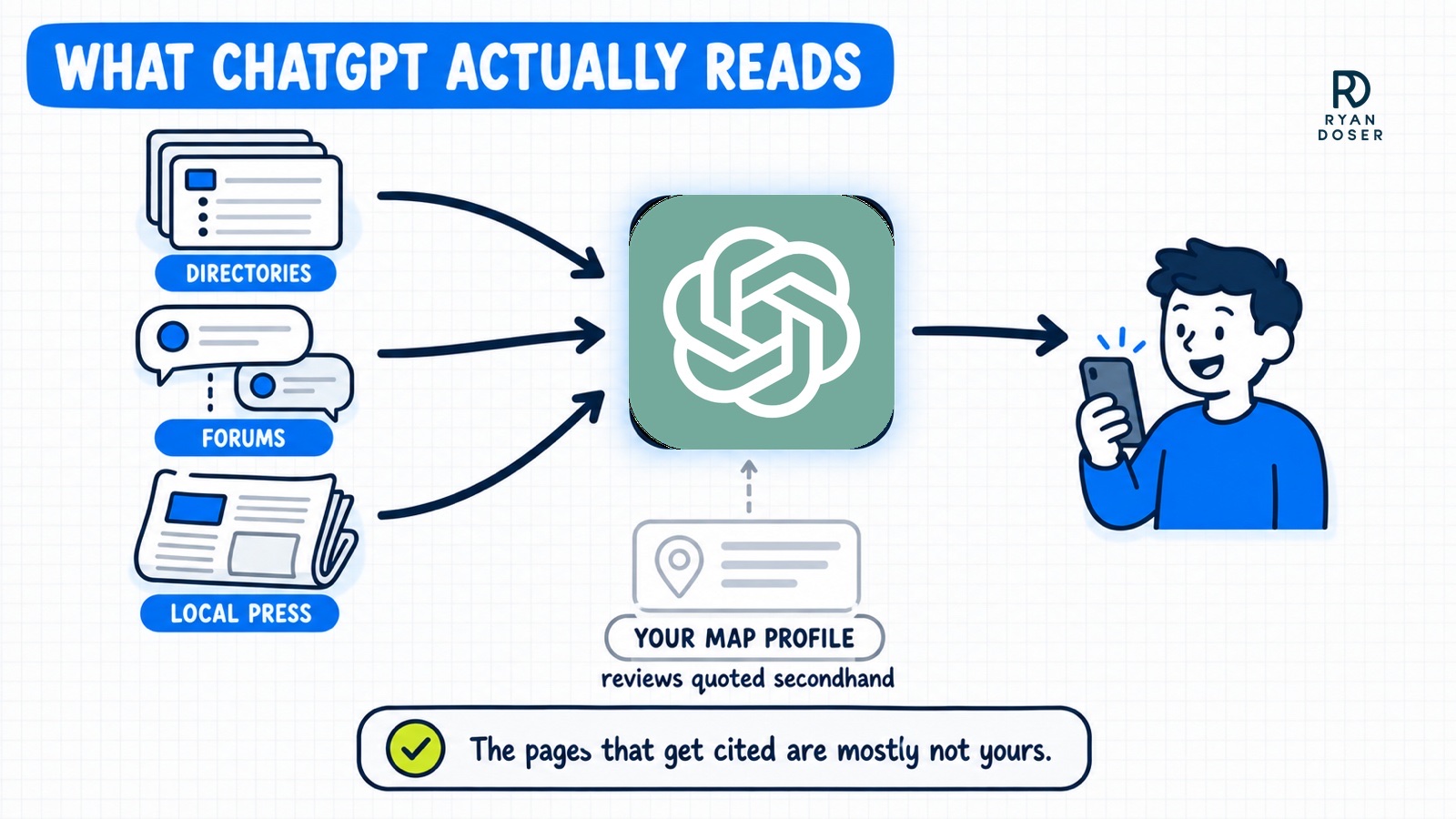
Six directory-style pages: Expertise.com, ThreeBestRated, TrustAnalytica, ProLp, Houzz, and ServiceAgent, the last of which runs its city directory as a front for an AI phone product it sells to those same companies. Three Reddit threads, all from r/desmoines. One PDF of CITYVIEW's "Best of Des Moines" reader poll, sitting on a Squarespace CDN.
Google data reached that answer exactly once, and secondhand. ChatGPT quoted "4.8 stars from 2,708 Google reviews" for one company, but it read that figure off a directory page rather than from Google.
The Omaha run repeated the shape with a different cast: ServiceAgent, ConsumerAffairs, BestProsInTown, Expertise.com, Forbes Home, and one r/Omaha thread.
It also cited Orbital, which is worth pausing on. Orbital is not a consumer directory at all. It is a business-to-business sales intelligence platform that sells contact data on small business owners to vendors, and its own page says plainly that it "is not a consumer directory and is not optimised for booking appointments."
A homeowner looking for an HVAC company got handed a slice of a sales prospecting database. That is a useful reminder that the model is matching pages, not vetting the purpose of the site it found them on.
Why the Google Business Profile Advice Persists
It persists because it used to be the whole game, and because it is still correct for a different question.
Your Google Business Profile genuinely does drive Google's own surfaces. It feeds Maps, the local three-pack, and Google's AI Overviews.
Google's own local ranking documentation names three factors, relevance, distance, and prominence, and that machinery runs on profile data. Neglect your profile and you lose Google, which is still where most of your customers are.
So the advice is not wrong. It is answering "how do I rank in Google's local results" and being sold as an answer to "how do I rank in ChatGPT." Those turn out to be different questions with different levers.
Read Google's own definition of prominence closely and it points the same direction anyway. Google says prominence is based on "how many websites link to your business and how many reviews you have." Even inside Google's model, a large share of the signal lives on other people's websites.
What OpenAI Documents, and What It Does Not
OpenAI's web search documentation mentions real-time third-party feeds the model can pull from, and gives three examples of how they are labelled in the response: sports, weather, and finance.
There is no local business feed on that list. No Google Business Profile integration, no Maps connection, no directory partnership.
An absence in documentation does not prove no such connection exists, and I want to be honest about that. But it lines up with both probes and suggests the mechanism: with no dedicated local data source, the model searches the open web and cites whatever comes back. That means directories, forums, and local press.
I put the question to Perplexity with live search on as a cross-check. It drew the same line, saying there is "no verified basis here to claim it directly reads the underlying GBP backend as an exclusive source."
The Uncomfortable Version of This Finding
Here is the part that makes people wince, and it is the reason this work is harder than the checklists suggest.
Almost none of the pages ChatGPT cited are pages you own. You do not control Expertise.com's rankings. You cannot publish to r/desmoines without a real account and real history there. You cannot vote yourself into CITYVIEW's reader poll.
That inverts the usual SEO instinct. The standard move is to write another page on your own site.
On this specific problem, another service page is not where the leverage is. Owned pages still do real work, they make you verifiable and they convert the visit once it happens. They were simply not what either answer was built from.
The Omaha run produced the sharpest illustration of this. One of ChatGPT's cited authorities was John Henry's own blog, a "Top HVAC Companies in Omaha" list published by an HVAC company that ranked itself number one on it. ChatGPT cited it as a source and passed the ranking along.
That cuts both ways. A competitor's self-published listicle became evidence in an AI recommendation.
There is a real opening there, with a line worth drawing. An honest comparison that names competitors and says where you lose is legitimate content and always has been. A list that exists only to crown yourself is the thing readers and models will eventually learn to discount, and it is not what I am suggesting you publish.
Where to Actually Spend the Effort
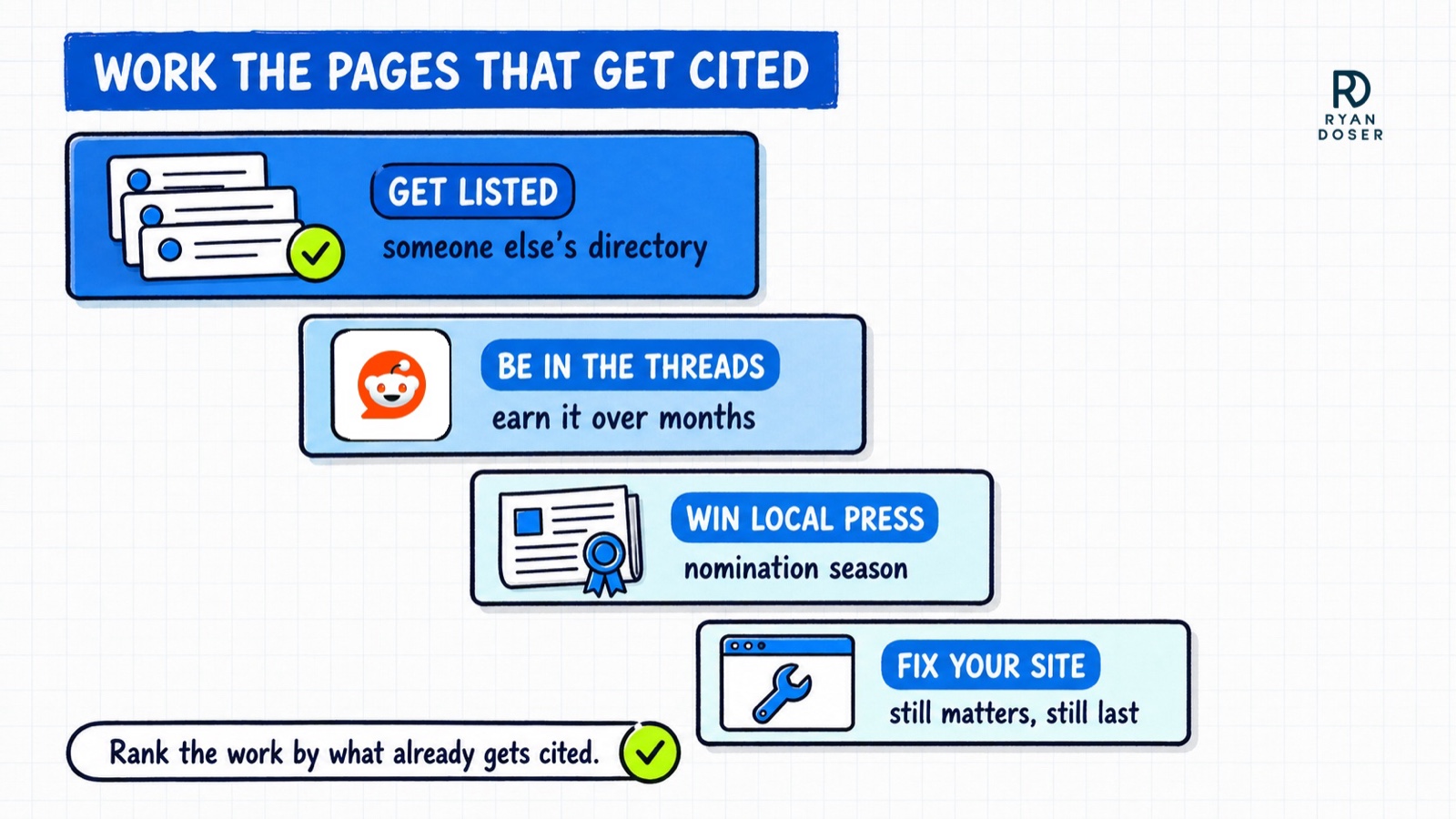
Rank the work by whether the target page is one ChatGPT already cites. That single filter reorders the usual checklist.
Get into the aggregator directories first. Expertise.com, ThreeBestRated, ConsumerAffairs, and the vertical-specific ones for your trade were cited repeatedly across both cities.
A three-week Linkifi study points the same way. Directories and "best of" lists made up 61% of all citations and were among the stickiest sources, which I break down in how to get ChatGPT to recommend your business.
Check how each one actually works before you reach for a card, because they differ more than you would expect. ThreeBestRated states flatly that it never accepts payment for listings or rankings. Expertise.com runs its provider portal free. ConsumerAffairs does sell a paid partner programme.
So the work here is mostly qualifying rather than purchasing, which is slower and cannot be shortcut with budget. Read each directory's own terms before assuming a cheque moves you.
Be genuinely present in your city's subreddit. Reddit was cited in both runs, and r/desmoines threads several years old still surfaced. This is the one nobody wants to hear, because you cannot buy it and you cannot rush it. An account that shows up only to promote itself gets removed by moderators, and a removed thread cites nothing.
Chase local press and reader polls. The CITYVIEW citation was a PDF of a magazine's "Best of" issue. Your city has an equivalent, it has a nomination window, and almost nobody in your trade is working it.
Then fix your own site, which still matters and now sits fourth. My AI SEO strategy study found that ranking your own site still lines up with getting named, though less strongly than being on the lists that rank. Clear service pages, a real location page, LocalBusiness schema, and plain answers to the questions customers actually ask. When a directory or a journalist goes to verify you, this is what they read. It is the substrate for everything above it rather than the lever itself.
One quick check while you're in there: make sure ChatGPT can get in at all. Some website firewalls turn AI agents away without telling you. My free AI agent readiness checker sends a simulated ChatGPT-User request to flag that, and warns you when a page's raw HTML has little or no text before JavaScript runs. For the wider site check, including whether your homepage names your business and whether your profiles are tied to your site, run my free AI visibility audit.
How to Test This for Your Own Business
Do not take my two queries as your answer. Run your own, because your city and trade will differ and this shifts month to month.
Open ChatGPT with web search enabled and ask it the way a customer would: best [your service] in [your city]. Then ask it to list every source it used. Do the same in Perplexity and in Google's AI mode.
Run it more than once, and vary the wording. Try it as "who should I call for [problem] in [city]", start each attempt in a fresh chat so the last answer does not colour the next, and note whether you were named at all before you worry about where you placed. Five runs across a couple of phrasings will tell you far more than one will, which is the same discipline I am holding myself to with two.
A podcast guest's tracking dashboard showed why that matters: the same prompt ranked his brand anywhere from #1 to #8 inside one week.
A bigger version of this test, with four assistants across two cities, put 250 AI recommendations up against Google Maps, and the four rarely listed the same business first.
Now read the citation list rather than the recommendation. Which directories appear? Which forum threads? Is there a local publication in there? Are you in any of them?
Re-run it quarterly and log what you see, because the rate only means anything as a trend. Paid AI visibility trackers automate this, though run it by hand first so you know what the number is made of.
That list is your starting dataset, and it is specific to you in a way no guide can be. If you would rather work through yours with someone, that is most of what I do as an AI marketing consultant in Des Moines.
How to Rank in ChatGPT FAQs
Does my Google Business Profile affect whether ChatGPT recommends me?
Indirectly at most. In two probes across two cities, ChatGPT cited zero Google Business Profiles, and OpenAI documents no local business data feed. Your profile still drives Google Maps, the local three-pack, and Google's AI Overviews, so keep it accurate. Just do not expect it to be the lever that moves ChatGPT.
What does ChatGPT actually read when recommending a local business?
In my testing, aggregator directories like Expertise.com, ThreeBestRated and ConsumerAffairs, city subreddit threads, local publication "best of" lists, and occasionally a competitor's own ranking blog post. Google review counts showed up only as figures quoted inside those directory pages.
How long does it take to show up in AI recommendations?
It depends on the surface you target rather than on any waiting period. A directory listing can appear within weeks of approval. Local press runs on annual nomination cycles. Genuine forum presence takes months because the account needs real history. Anyone quoting you a fixed timeline is guessing.
Can I pay to be recommended by ChatGPT?
Not directly, and be careful with anyone selling that. Some directories ChatGPT cites do sell paid partner programmes, ConsumerAffairs among them. Others refuse payment entirely: ThreeBestRated says it never accepts payment for listings or rankings. There is no payment that places you in the answer itself, so treat any vendor promising an AI ranking as selling something they do not control.
Is ranking in ChatGPT worth the effort for a local business?
Only if your customers are asking AI for recommendations, and you can find that out by asking them how they found you. For most local businesses Google is still the larger channel by a wide margin. The work above is worth doing because it also improves your Google prominence, since Google counts third-party links and reviews too. Treat AI visibility as a second return on the same effort, not as a replacement for local SEO.
Some links in this post are affiliate links. If you buy through them I may earn a commission at no extra cost to you. I only recommend tools I actually use or would recommend regardless. See my full disclosure.