
AIclicks Review: Is This AI Visibility Tool Worth It?
I asked Claude and Perplexity the same question on the same day: what is the best AI visibility tracking tool for a small marketing agency? Between them they named Otterly, Brandlight, Peec AI, Scrunch, Semrush, Indexly, AthenaHQ and half a dozen more. Neither mentioned AIclicks.
Then I asked Claude a narrower question, for the best AEO tools. It recommended AIclicks, citing a page called 13 Best Answer Engine Optimization (AEO) Tools I've Tested in 2026. That page is published by AIclicks, written by the founder of AIclicks, and ranks AIclicks first.
That page also says AIclicks costs $39 a month. The pricing page says $59.
AIclicks is an AI visibility platform that tracks whether ChatGPT, Perplexity, Gemini, Claude and Google AI Overviews mention your brand when someone asks about your category. It starts at $59 a month. The category goes by two names, GEO for generative engine optimization and AEO for answer engine optimization, and AIclicks uses both.
This review is about that loop. In every probe I ran, the AI models describing AIclicks were reading AIclicks' own pages, and several of the numbers on those pages are wrong.
Two things about where I stand. I sell a competing AI SEO product, so weigh this accordingly.
And I have read AIclicks' pricing page, its full terms, its blog and its entire review pool closely, but I have not used the product. I can tell you what it commits to in writing and where those commitments contradict each other. I cannot tell you what it produced for me, and I will not pretend otherwise.
What AIclicks Sells
The core product is prompt tracking. You give it a list of questions your buyers ask AI assistants, it runs those questions against a set of AI engines on a daily schedule, and it reports how often you get named, in what sentiment, and which third-party pages the models cited when they answered.
That last part is the genuinely useful piece. The Sources tab ranks the third-party URLs that keep showing up in citations for your category, which turns a vague AI visibility problem into an outreach list with names on it.
Around that sits a content generator that writes AI-optimized articles and pushes them to your CMS, a Google Analytics integration showing which AI engines send real traffic, and a recommendations tab.
That traffic check matters more than it sounds. Chris Panteli of Linkifi said on my podcast that some of his finance clients get far more visits from X than from ChatGPT, a point I cover in testing the way your customers actually find you.
The company is based in Vilnius, Lithuania, founded by Rokas Stankevicius, Andrius Stockunas and Matas Kibildis. Its homepage claims 1,000+ businesses and 400+ agencies. It has not disclosed any funding round.
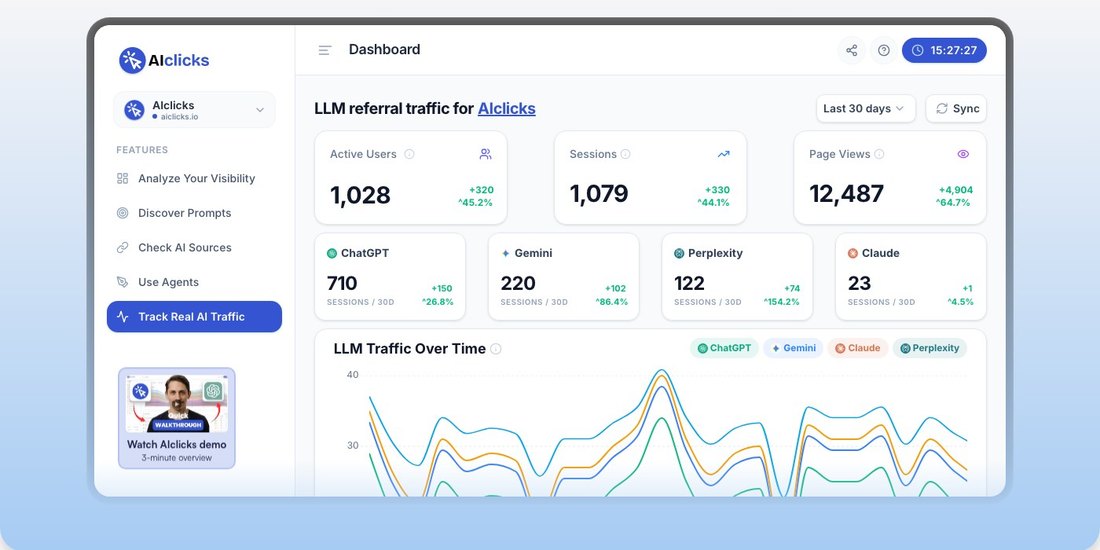
Worth noting what the demo dashboard on the homepage is actually showing. The account on screen is aiclicks.io itself, and the engine split is lopsided: 710 sessions from ChatGPT against 23 from Claude over thirty days. That is the company's own data, and it is a fair picture of how uneven AI referral traffic is right now.
How AIclicks Wins AI Citations, and What It Teaches Them
Start with the mechanism, because everything else in this review follows from it.
Models reward whoever publishes clear, structured, confident pages about a category. AIclicks publishes a lot of them: a blog, a pricing page, case studies, and a plain-text file called llms.txt written specifically so AI models can read its plan details. In every probe that returned anything about AIclicks, those were the pages the assistants cited.
When ChatGPT described AIclicks for me, it cited aiclicks.io/pricing six separate times. It reported the G2 rating as 4.9 while sourcing that number to AIclicks' own pricing page rather than to G2, and it reported the Trustpilot score as 4.5 when the live page says 4.4.
Four probes on one day is a small sample and I am not claiming it measures anything precisely. It does show the loop clearly enough that you can check it yourself in about five minutes.
AIclicks is explicit about the strategy in its own case study: "We set up our G2 profile early and actively worked on building our review presence... Every new review adds a fresh signal that AI models can reference."
That is smart marketing and I would not condemn it. The problem is what happens when the pages doing the teaching are out of date.
The founder-written listicle prices AIclicks at "$39/month, with a full refund if you're not satisfied." The live pricing page says $59, and an archived copy from April 22, 2026 shows the same $59, so this is not a price that changed last week. The refund is real, but it is capped at seven days on a first subscription, which "if you're not satisfied" does not convey.
On the listicle itself, AIclicks is ranked first out of thirteen. The byline does say "Rokas Stankevicius, Founder @ aiclicks.io," so the relationship is there for a careful reader. What is missing is a plain statement near the ranking that the author owns the tool he put at number one, and any methodology behind the word "Tested" in the title.
So a page that AI models cite when describing AIclicks quotes a price the live pricing page does not list. Ask an assistant what AIclicks costs and you may be told $39. The monthly plan is $59.
That is one wrong number. The next two sections are the rest of them.
Pricing, Verified on September 1, 2026
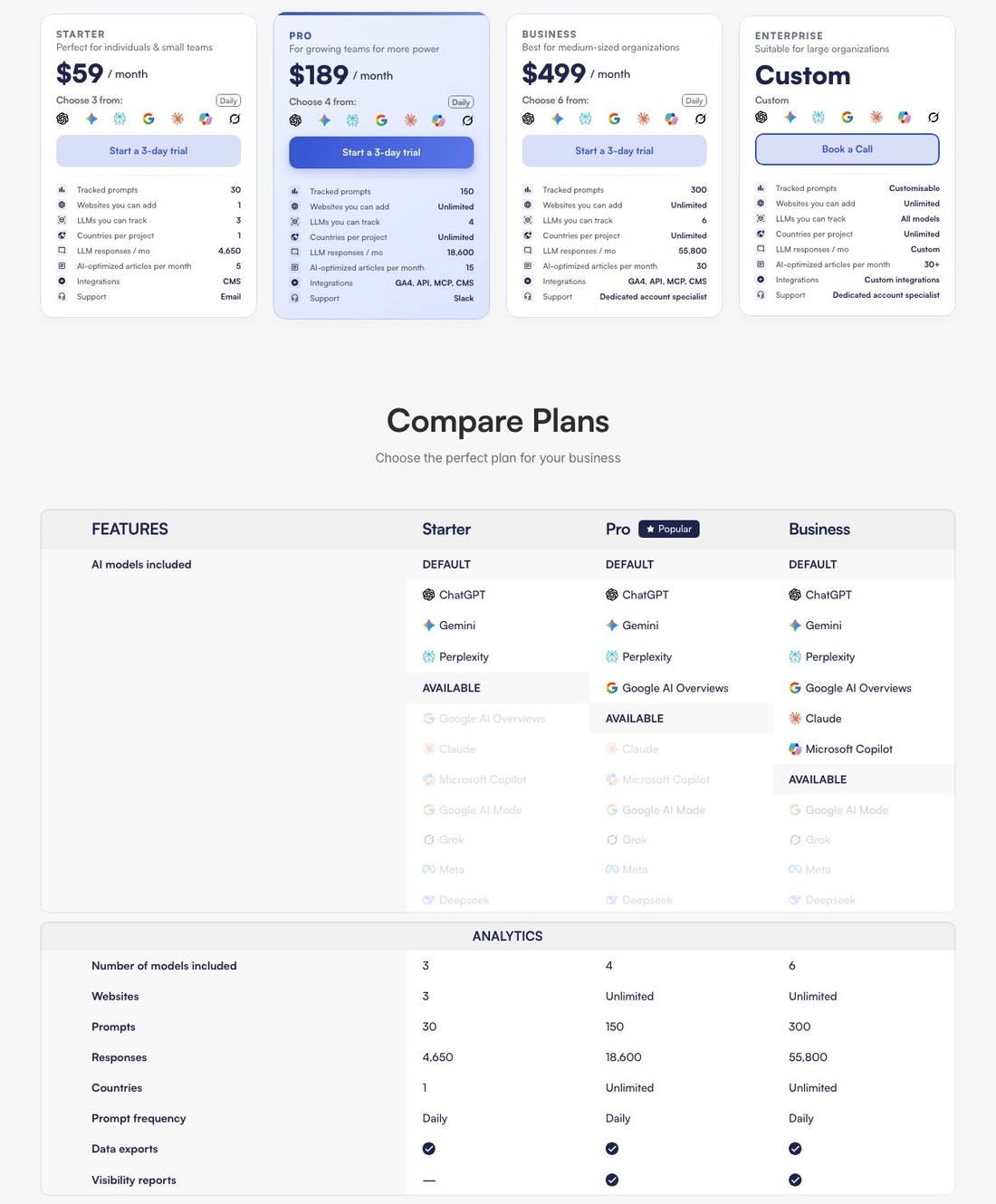
Four tiers on the pricing page. Starter is $59 a month for 30 tracked prompts and 3 AI engines. Pro is $189 for 150 prompts and 4 engines. Business is $499 for 300 prompts and 6 engines. Enterprise is quote-only.
Annual billing takes up to 29% off, according to the toggle on the pricing page. The trial is 3 days. The plan cards show a trial button on all three self-serve tiers, while the FAQ on the same page says the trial covers Starter and Pro and that Business comes with a demo instead.
The engine allowance works differently than most people expect, and the pricing page is clear about it. You do not get 3 engines plus the rest later. You choose 3 from a list of eleven, and the other eight stay greyed out until you upgrade.
So on Starter you might pick ChatGPT, Gemini and Perplexity, and you are blind to Google AI Overviews, Claude, Copilot, AI Mode, Grok, Meta, DeepSeek and Mistral. For a lot of buyers that is fine. For anyone whose customers use Google, it means the answer box with the widest reach is the one you cannot see until $189.
The Same Page Gives Two Different Answers
Look at the screenshot above. The Starter plan card says Websites you can add: 1. Scroll down the same page to Compare Plans and the Starter column says Websites: 3.
Same page. Same plan. Same visit. One number is wrong and a buyer has no way to know which. You can check it yourself on the live pricing page.
The llms.txt file sides with the table and says 3 websites. It also says Starter includes 10 AI-optimized articles a month and Pro includes 20. The live pricing page says 5 and 15.
These are not rounding differences. Buy Starter expecting three sites and ten articles and you may get one site and five.
To be fair about the cause, this reads like a stale file nobody updated after a plan change rather than anyone trying to mislead. But llms.txt exists for exactly one purpose, which is telling AI models what AIclicks offers. It is currently teaching them a website count and an article count the pricing page disputes, on top of the price the blog gets wrong.
The Trial Terms Are a Third Disagreement
The pricing FAQ says "No credit card required to start." Section 3.1 of the binding terms, last updated August 24, 2026, says "A valid payment method is required to start a trial," and that the subscription begins automatically when the trial ends unless you cancel.
Here the evidence favors AIclicks. Three reviewers who went through signup all report a genuine no-card trial, and two of them sell competing tools, which makes a flattering error less likely. The marketing is probably right and the terms clause is probably boilerplate. Worth a glance at signup anyway, since the contract reserves a right the marketing does not mention.
Three Days Is Not Enough Time to Evaluate This Kind of Tool
This is the practical objection, and it matters more than the contradictions.
AI visibility data is noisy. The same prompt returns different sources on consecutive runs, so no single reading tells you much. An April 2026 arXiv study measured this across 4,044 consecutive-day pairs and found cited sources overlap only 34% to 42% from one day to the next.
A ZeroRank dashboard a guest showed me on my podcast captures the same thing at small scale: one prompt's answers cited anywhere from 4 to 9 sources across five runs in a week.
Which means a 3-day trial gives you roughly three daily readings of a number that swings hard from one day to the next. You will learn that the dashboard loads and the charts render. You will not learn where your visibility is heading.
The competing reviewer at SaaSInsight put it more bluntly than I would: "Three days is not really a trial." Scrunch offers seven days without a card, and most tools in this category offer more.
I go deeper on why day-to-day AI citation numbers cannot be trusted in my AI search myths breakdown, and the same sampling problem applies to Searchable and every other tracker.
Almost Every Review Ranking for This Tool Has a Stake in It
I went through the review pool that ranks for this tool, and this was the finding I did not expect.
Trakkr rates it 4.2 and states plainly, "Trakkr is our own product; that bias is named." EchoWi discloses the same thing: "EchoWi sells AI visibility measurement, so AIclicks is a competitor." CheckThat is built by an agency that sells AI visibility tracking and offers to track AIclicks for you. That pattern is the category norm rather than a quirk of this one product, and I counted how often these vendors put themselves in their own top three.
AIToolRush rates it 8.9 out of 10 and discloses affiliate commissions. SaaSInsight rates it 3.5 and discloses affiliate funding.
That is five of the six most visible reviews, and not one is a disinterested party. Marketraa was the only one I found with no disclosed financial stake either way, and it rates AIclicks 7.8 out of 10.
To be consistent, I am on that list too, which is why I would weigh my read against the others rather than instead of them.
One of these deserves a specific warning. AIToolRush claims extensive hands-on testing and reports citation-accuracy figures to the percentage point.
It also states AIclicks costs $49 a month with a 14-day no-card trial and up to 250 prompts on Starter. The live pricing page says $59, three days and 30 prompts. When a review gets the published pricing wrong in every particular, its hands-on claims are worth less.
The Ratings Are Real, and the Sample Behind Them Is Small
G2 shows 4.9 stars from 55 verified reviews. That is a genuinely strong score and I have no reason to doubt it. It is also a small base that moved fast, since an independent snapshot on August 7, 2026 recorded 4.8 from 30 reviews.
Worth knowing what that compares to. Profound, the tool most often named as the alternative, carries a review base large enough that G2 reports it differently in different places, with counts from the low hundreds to over a thousand all in circulation. Otterly's own review base sits closer, at 54. A rating built on 55 reviews is a different kind of number from one built on several hundred, and the larger one is far harder to move.
Trustpilot is thinner still, at a 4.4 TrustScore from 10 reviews, every one of them five stars. The score sits below its own reviews' average because Trustpilot discounts small and clustered samples, and the platform notes the company "hasn't invited customers recently."
I have no reason to think any of these reviews are fake. My point is narrower: 65 total ratings across two platforms is an early-stage sample, and the confident 4.9 on the homepage rests on it.
What AIclicks Genuinely Does Well
I have spent a lot of words on contradictions, so let me be clear about the parts that hold up.
The Sources tab is the best idea in the product. Knowing which third-party pages drive citations in your category, ranked by frequency, is the difference between guessing and having a list. Most trackers show you that you are losing. This one points at where the citations come from.
The engine limits are displayed unusually plainly. Greying out the engines you do not get, right on the comparison table, is more upfront than most vendors manage, even though the limit itself is restrictive.
Publishing monthly response counts at all is rare. Most vendors in this category will not tell you how many times a day they check a prompt, and AIclicks publishes a number you can at least do arithmetic against.
It is worth checking that number, and the reviewer at EchoWi did it first. On Pro and Business the published totals match what the plan's own prompts, engines and daily schedule would produce. On Starter they do not. AIclicks advertises about 1,860 more responses a month than its own Starter limits add up to.
There is a plausible innocent reading, which is that Starter runs each prompt more than once a day. If so it is the better-sampled tier, and AIclicks should say so, because right now the one tier whose numbers do not reconcile is the one most buyers start on.
And the refund is real and in writing. Section 4.8 grants a full refund within seven days of your first payment, once per customer, on a first subscription only. That beats a promise on a landing page, and it is more than several competitors in this category commit to.
Where It Falls Short
No white-label reporting and no native multi-client workspace. For an agency that wants to hand clients a branded report, that is a real gap, and AIclicks markets hard to agencies.
The Starter tier is thin in a way that matters, and every reviewer who looked closely landed in the same place on it.
Integrations are gated. Google Analytics, the API and the connector that plugs AIclicks into AI assistants all sit behind Pro. The analytics connection is what turns visibility into actual traffic numbers, and on Starter you cannot have it.
Security paperwork is not published. I could not find a SOC 2 report, single sign-on support, or GDPR documentation, which is the sort of thing a larger client's procurement team asks for before signing anything.
Who Should Buy It and Who Should Skip It
Buy it if you are a small brand or solo marketer who wants a straightforward read on whether ChatGPT and Perplexity mention you, plus a prioritized list of sources to chase, and $189 a month fits your budget.
Buy it if you are an agency that reports inside your own deck and does not need white-label output.
Skip it if you need client-facing branded reports, because that feature does not exist.
Skip it if Google AI Overviews is your priority and $59 is your ceiling, for the reason above.
Skip it if your compliance team needs a SOC 2 report.
And skip trackers generally if what you want is to know which changes earn citations. A tracker tells you where you stand rather than what to change, and no tool can guarantee placement in an AI answer. Anyone promising that is selling you something.
My Verdict on AIclicks
AIclicks is a real product from a real company solving a problem worth solving. If I were buying in this category on a small budget, it would make my shortlist.
It would not make it at $59. That tier is enough to see whether you like the dashboard, and not much more.
What I keep coming back to is the pattern rather than any single error. A company selling accurate measurement of what AI says about brands is not keeping its own numbers straight, and I watched ChatGPT repeat one of them back to me as fact.
I read that as carelessness rather than anything worse. It stands out because catching this exact category of mistake is what the product is sold to do.
The cheapest test I know in this category takes about a minute: compare what an AI assistant says a tool costs against what its pricing page says. When those two numbers disagree, that says something about how carefully the vendor manages the exact problem it wants to sell you.
AIclicks Review FAQs
How much does AIclicks cost per month?
AIclicks costs $59 a month for Starter (30 tracked prompts, 3 AI engines), $189 for Pro (150 prompts, 4 engines) and $499 for Business (300 prompts, 6 engines), plus a quote-only Enterprise tier. Annual billing takes up to 29% off, and the trial is 3 days. Figures read off the live pricing page on September 1, 2026. AIclicks' own blog still quotes $39, so prices you see elsewhere are often stale.
Is AIclicks legit?
Yes. AIclicks is a real company operating from Vilnius, Lithuania, founded by Rokas Stankevicius, Andrius Stockunas and Matas Kibildis, serving a reported 1,000 brands and 400 agencies. It holds 4.9 on G2 from 55 verified reviews and 4.4 on Trustpilot from 10. Its terms include a written seven-day refund on a first subscription. The caveats are about maturity rather than legitimacy: the review pool is small, it has disclosed no funding, and its published numbers contradict each other across surfaces.
How many AI engines does AIclicks track?
Eleven, but no self-serve tier gives you all of them. You choose 3 on Starter, 4 on Pro and 6 on Business from a list that includes ChatGPT, Gemini, Perplexity, Google AI Overviews, Claude, Microsoft Copilot, Google AI Mode, Grok, Meta, DeepSeek and Mistral. Unselected engines stay greyed out until you upgrade, and only Enterprise includes all of them.
Does AIclicks require a credit card for the free trial?
The pricing page says no credit card is required, and reviewers who went through signup confirm that. Section 3.1 of AIclicks' binding terms says the opposite, that a valid payment method is required and the subscription starts automatically when the trial ends. The marketing is probably right in practice, so just confirm at signup which one applies to you.
What is the best alternative to AIclicks?
The trackers AI surfaces name most often are Profound, Otterly, Peec AI and Scrunch, and Profound carries a far larger review base than either of the cheaper options. All of them read the same volatile AI answers, so compare them on how many times a day they check each prompt and how long the trial runs, rather than on dashboard features. If you need white-label client reporting, rule out AIclicks first, because it does not offer it. I cover the wider category in my best AI SEO tools roundup.
How I sourced this: AIclicks prices, plan limits and terms were read off its live pricing page, its llms.txt and its full terms on September 1, 2026, with historical pricing checked against an April 22, 2026 archive. Quotes from other reviewers come from their own published pages. G2 blocks automated access, so its rating is quoted as G2's own pages state it. The four AI probes used Claude Sonnet 4.5, ChatGPT and Perplexity Sonar with live web search confirmed in each response, and four probes are a small sample reported as such. I have not used AIclicks myself, and I sell a competing AI SEO product. Full disclosure.