
Otterly AI Review: What the Entry Plan Leaves Out
Otterly starts at $29 a month with unlimited team members and no sales call. That is the number on every roundup, and for most shoppers it is the whole first impression.
What the number does not tell you is which AI engines you are buying. Otterly includes four on every plan. Claude, Gemini and Google AI Mode are rented separately, at every self-serve tier, including the $489 one.
So $29 is either a bargain or an opening bid, depending on whether the engines you care about are in the four or the three. That question runs through this entire review.
Otterly.AI is an AI visibility tracker. You give it a list of questions your buyers might ask an assistant, it runs them daily, and it reports whether you got mentioned, who got mentioned instead, and which pages got cited. It starts at $29 a month. The category answers to two names, AEO for answer engine optimization and GEO for generative engine optimization, and Otterly uses both.
My conflict, stated up front. There is a competing AI SEO product with my name on it, and no affiliate arrangement here in either direction.
What I did and did not do: I read the pricing page, the security page, the referral terms and the April 2026 subscription contract, and I pulled the review pool. I have not run Otterly on a client campaign. So this is a review of what the company commits to in writing, not a report on what it produced for me.
The Four Engines You Get, and the Three You Rent
Every plan on Otterly's pricing page tracks the same four AI search engines. ChatGPT, Google AI Overviews, Perplexity and Microsoft Copilot.
Claude, Gemini and Google AI Mode are add-ons. Not on the cheap plan only. On every self-serve plan, including the $489 one.
To Otterly's credit, the plan cards say so. Under each price sits the line "Claude, Google AI-Mode, Gemini as extra Add-ons," and the little row of engine logos above it shows four marks, not seven. Otterly's help centre is blunter still, describing the three as "available as paid add-ons on all plans." Someone reading either page carefully will not be surprised.
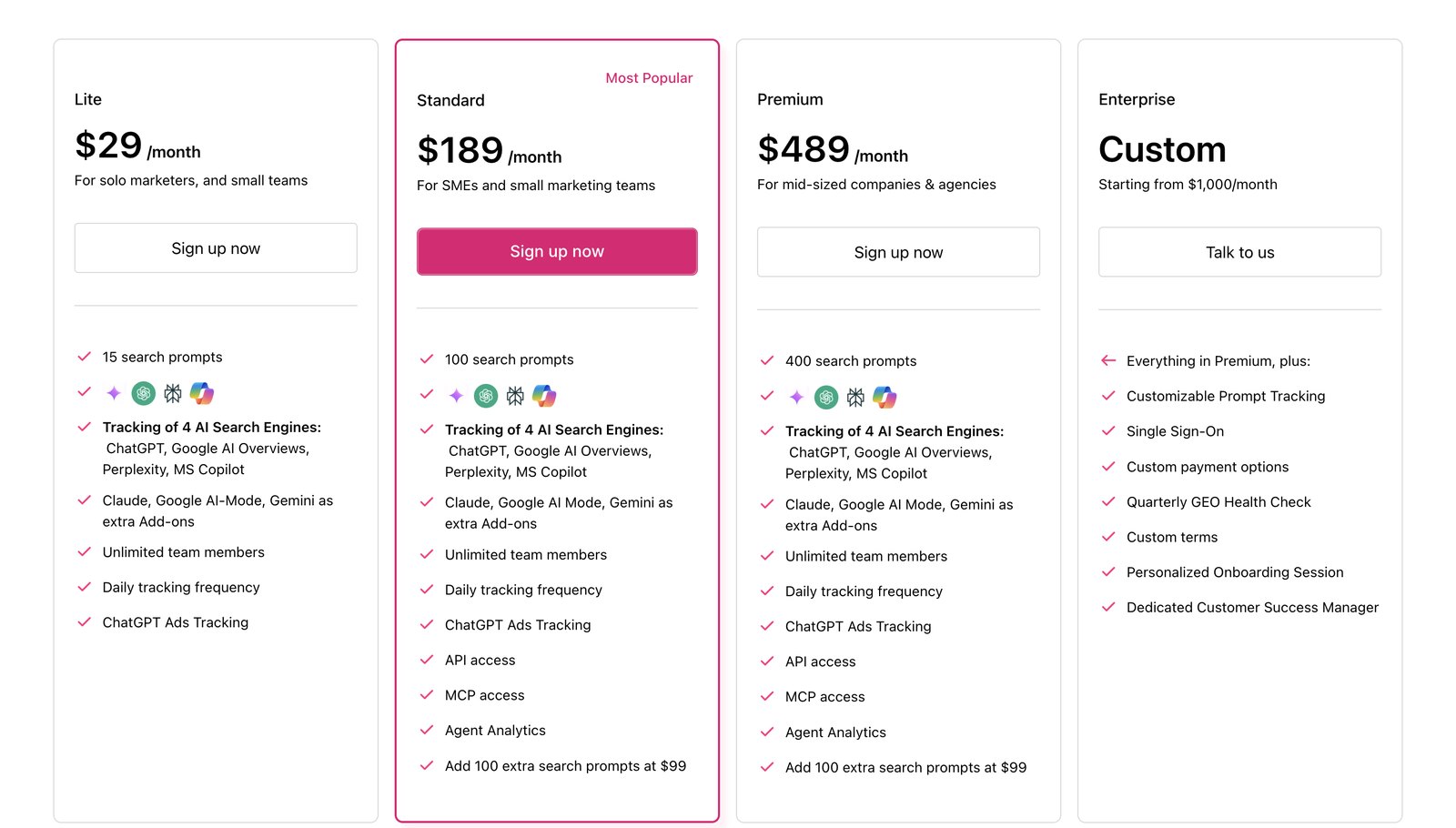
The add-on prices scale with your plan, which is the part worth slowing down for. On the $29 Lite plan, Gemini is $9 a month and Claude is $29. On Premium, the same two are $149 and $439.
So a solo marketer who wants all seven engines pays $76 a month rather than $29. That is a real price for a real product, and it is more than two and a half times the number on the tin.
The Premium version of that math is stranger. Add all three engines to the $489 plan and you land at $1,226 a month, which is above the "starting from $1,000/month" figure Otterly prints on its own Enterprise card. At the top of the self-serve range, buying the add-ons costs more than starting an enterprise conversation.
None of this is hidden and none of it is fraud. It is a packaging decision, and cheap entry pricing with paid expansion is how most software gets sold. I am flagging it because the headline number is what people quote, and on this product the headline number describes a narrower purchase than most buyers think they are making.
Where the Marketing Stops Matching the Rate Card
The pricing page is honest. The homepage is not, and they are the same website.
Under the main headline sits this sentence: "Get your brand mentioned, and your website cited on ChatGPT, Perplexity, AI Overviews, AI Mode, Gemini, and Copilot." Six engines, no qualification, three of which no plan includes.
Further down, a feature section lists all seven with Claude added. An FAQ answer says marketing teams get "citation tracking across six AI platforms." The listing Otterly supplies to G2 names all seven the same way.
And the footer sitting on every page of the site, the pricing page included, reads: "For ChatGPT, Google AI Overviews, Google AI Mode, Gemini, Perplexity, Copilot, and Claude. All in one place."
On the pricing page, that footer sits directly below a table charging up to $439 for Claude.
The pricing FAQ then asks "Are there any hidden fees?" and answers "No, we believe in transparency. All fees are clearly outlined in our pricing plans, and there are no hidden charges."
Read narrowly, that answer is defensible. The fees really are on the page, in a table, with numbers. Read the way a shopper reads it, right after being told seven engines come in one place, it is doing work it should not be doing.
I want to be precise about the accusation, because it is narrower than it sounds. Nobody is overcharged against the published rates and nothing is buried in a contract. The rate card is complete and public, which is more than several competitors manage.
The gap sits between two pages of one website. A buyer who reads the homepage and stops there budgets $29 and needs $76, and finds out later than they should have.
Outsiders Got Otterly More Right Than Otterly Did
The add-on structure is well documented, and not by me. Geoptie published a piece called "Otterly AI Review 2026: Is the $29 Plan Enough?" and SE Ranking printed the full add-on table, both before I opened the pricing page. AI Peekaboo quotes part of the range and That Marketing Buddy flags the engines as add-ons without pricing them.
Worth saying plainly, because a review that claims a scoop it does not have is its own kind of marketing. Note too that SE Ranking sells SEO software, so "independent of Otterly" is the only independence on offer here.
What interests me is which of Otterly's descriptions travels.
Ask an assistant what the entry plan really costs and you tend to get a careful answer. Gemini laid out the base plan, added the two engine add-ons, and volunteered that the real cost runs "more than double" the sticker. Claude covered the same ground and added the $99 charge for another hundred prompts. Both cited outside reviews rather than Otterly's marketing pages.
I should be exact about what that does and does not show, because the obvious reading is too flattering to me and too hard on Otterly. Otterly publishes the accurate version itself, on the pricing page and in its help centre, which states plainly that the three engines are "available as paid add-ons on all plans." Those facts are there for anyone who opens the page.
What is happening is narrower and more interesting. Otterly's marketing pages and its rate card tell different stories, and the account of the product that circulates is assembled by outsiders. On this tool, the version they assembled matches the rate card.
Compare that with Profound, which has published a library of reviews and rankings covering itself and its rivals, and had an assistant hand one of those pages back to me as evidence. Profound built material designed to be quoted, and it is being quoted. Otterly published a rate card and a help centre and left the judging to other people, and it came out fine.
Profound's outcome was engineered. Otterly's was not, and it still landed closer to the truth. A vendor gets a vote on how it is summarized, never the deciding one, and the size of that vote has less to do with budget than with what other people bother to write down.
The Answer That Went the Other Way
The correction is not reliable, and one probe showed me how it fails.
I asked ChatGPT for the best affordable AI visibility tool for a solo marketer or small agency. It put Otterly first, at "$29 per month," and praised it for "transparent pricing." It listed the four base engines accurately and never mentioned that three more cost extra.
Then it compared that $29 against Rankscale at "around €20 per month" tracking "over 17 AI engines, including Claude."
All four probes ran on one day with live web search switched on, and I checked that search actually fired in each response. Four readings, reported as four readings.
That comparison is not like for like, and nothing in the answer says so. One price covers four engines, the other reportedly covers seventeen, and they are lined up as though the only difference is the money.
One more detail from that same answer, offered as a caution about the whole category rather than a knock on Otterly. Among its sources for a competing tool's pricing, ChatGPT cited a SoundCloud page for a DJ set recorded at a music festival, apparently because the artist's name resembled the product's. That is what the citation layer under these recommendations can look like on a normal day.
What Otterly Gets Right
I have spent a lot of words on one gap, so here is the case for the product.
Unlimited team members on every plan, starting at $29. That is genuinely unusual. Profound no longer publishes a paid self-serve price for brands at all, so past its free trial a brand team is in a sales conversation. A five-person team can share Otterly's cheapest plan.
Daily tracking on every tier, no upsell. Multi-country support is listed on every plan including Lite, which matters more than it sounds, because a brand selling in three countries is looking at enterprise contracts elsewhere in this category. The pricing page puts that at 50-plus markets and the help centre says 65-plus, so take the smaller number to the meeting.
The company is Austrian, and for some buyers that matters more than any feature. OtterlyAI GmbH is registered in Persenbeug, the application data sits in Amazon's Frankfurt data centre, and Otterly publishes both a data processing agreement and a list of every outside service it hands your data to. If your legal team asks where the data lives, someone can answer in specifics.
Worth reading that page carefully, though. The security certifications listed there belong to Amazon's data centres rather than to Otterly, and Otterly says so plainly instead of borrowing the credit. Its own SOC 2 audit, the one buyers usually mean when they ask, is still described as on the roadmap. Monitoring data also sits in Virginia rather than Frankfurt.
It is also bootstrapped, with no venture funding on record, which cuts both ways. There is no investor clock forcing a pivot, and there is no war chest either. Against a competitor that has raised $155 million, that is a genuine risk to weigh rather than a point in anyone's favor.
The ratings are strong and the sample is small but real. A 4.7 from 54 reviewers on G2 and a 4.8 from 55 on OMR Reviews. Its Trustpilot profile is empty and unclaimed, so ignore anyone citing it.
The Gartner recognition is real too. Otterly was named in Gartner's Cool Vendors in AI for Marketing, published 24 October 2025, one of five vendors. Otterly's own headline flips the title to "Cool Vendors for AI in Marketing," which is sloppy rather than dishonest, and Gartner does not endorse the vendors it names.
What the Reviewers Complain About
The critical reviews cluster in two places, and neither is about the add-ons.
The first is capacity. One G2 reviewer, writing in euros, said the jump to the Standard tier "feels like a bit of a stretch for a small agency's software budget," while "the entry-level Lite tier doesn't provide enough capacity to comfortably support a growing workload."
Fifteen prompts is the constraint. That is fifteen questions you get to watch, total, and a brand with three products in two markets will burn through them immediately. The next stop is a 6.5x price increase, or $99 for another hundred prompts, which lands you near Standard anyway.
The second complaint is the one I would take most seriously. A reviewer wrote that "it's not always clear what specific actions should be taken based on the findings. At this price point, I would expect more concrete guidance and strategic recommendations rather than just reporting and tracking."
That is the honest ceiling on this entire product category, and it is not Otterly's fault. G2's own tags echo it, with learning curve the most frequently tagged drawback.
One Clause Worth Reading Before You Pay Annually
Annual billing is advertised at 15% off, which takes Lite to $25 a month and Standard to $160. Premium lands at $422, closer to 14% than 15%. The contract also has a catch that interacts badly with the add-ons.
Section 5.6 of the April 2026 terms says: "The CUSTOMER is not permitted to decrease its Subscription Plan level or reduce the number of limits of their subscription during an active Subscription Term."
Downgrading later needs written notice at least thirty days before the term ends, and the same section adds that "no credits or refunds will be issued for underused subscriptions."
Put that beside a $300 annual Claude add-on and the risk is clear enough. Buy an engine on an annual plan, discover in month two that your buyers never ask Claude anything, and you own it for the year.
My read is to start monthly, learn which engines actually matter for your category, and switch to annual once you know what you are locking in. The discount is not worth guessing for.
Who Should Buy It
Buy it if you are a solo marketer or small team who mainly cares about ChatGPT and Google AI Overviews, and you want a cheap way to find out where you stand. At $29 with unlimited seats and a rating built on real reviews, it is an easy first tracker to justify.
Buy it if you have a team of four or more and every competitor keeps quoting you per seat. Unlimited members on a $29 plan is the strongest thing on Otterly's rate card.
Buy it if you need to show a lawyer where your data lives, with the caveat below that monitoring data sits in Virginia while the application sits in Frankfurt. That is a clearer answer than most competitors give, not a blanket EU guarantee.
Skip it if Claude or Gemini is where your buyers actually are, unless you price the add-on first and are comfortable with the real total.
Skip it if fifteen prompts will not cover your products and markets, and $189 is not in your budget. That gap is where most people will bounce.
And skip trackers altogether if what you actually want is to know which change earned you a citation. No tool in this category can tell you that reliably, because the same question returns different sources on different days. I go further into that in my AI search myths breakdown.
My Verdict on Otterly AI
Otterly is a good product with a pricing page I trust and a homepage I do not.
If I were picking a first AI visibility tracker for a small team, it would be on my shortlist on the strength of unlimited seats, daily tracking and a $29 door. The reviews are consistent, the criticism is mild and specific, and the company answers the boring questions about data residency that most of its competitors dodge.
What I keep coming back to is how cheap the fix is. Otterly built a clear rate card and then wrote top-of-funnel copy that tells a wider story, and one qualifier in five places would settle it. Add "add-ons available" beside that engine list and the objection disappears.
And leaving it has a cost Otterly cannot see from the inside. Three of the four assistants I asked reached for outside reviewers and passed the add-on caveat along. The fourth reached for the advertised starting price and recommended Otterly on a comparison the reader had no way to check.
Which of those two answers a buyer gets is not something Otterly controls. It wrote an accurate rate card and then wrote marketing that talks over it, and the version a shopper hears now depends on whether the source in front of them worked from the prices or from the pitch.
The practical version for you is short. Before you buy anything in this category, open the rate card and count what your plan actually includes, then hold it against the headline. On this one the two disagree, and the rate card is the half worth trusting.
Otterly AI Review FAQs
What is Otterly AI?
Otterly.AI is an AI visibility tracker built by OtterlyAI GmbH in Persenbeug, Austria. You give it prompts your buyers might type into an AI assistant, it runs them daily, and it reports whether your brand is mentioned, how you compare against competitors, and which links get cited. Every plan covers ChatGPT, Google AI Overviews, Perplexity and Microsoft Copilot, with Claude, Gemini and Google AI Mode sold as paid add-ons. Pricing starts at $29 a month.
How much does Otterly AI cost per month?
Lite is $29 a month for 15 tracked prompts, Standard is $189 for 100, and Premium is $489 for 400. Enterprise is quote-only, starting from $1,000 a month. Annual billing is advertised at 15% off, bringing the three self-serve tiers to $25, $160 and $422. Claude, Gemini and Google AI Mode cost extra on every tier, which takes the real Lite price to $76 for all seven engines. Screenshotted from the live pricing page on September 1, 2026.
Which AI search engines does Otterly AI track?
Four are included on every plan: ChatGPT, Google AI Overviews, Perplexity and Microsoft Copilot. Three more are paid add-ons at every tier, including the most expensive self-serve one. On the $29 Lite plan, Gemini and Google AI Mode are $9 a month each and Claude is $29. On the $489 Premium plan those same add-ons are $149, $149 and $439. Otterly's homepage names all seven engines without noting that three cost extra, so read the pricing page rather than the marketing.
Is there a free Otterly AI trial?
Yes. Otterly offers a 7-day free trial and states that no credit card is required to start it. The April 2026 terms note that trials are offered at the company's discretion and can be ended at any time. Subscriptions renew automatically for the same period, and the contract does not let you downgrade a plan or reduce limits partway through a term, which is worth knowing before you commit to an annual plan.
What is the best AI visibility tool?
There is no single best one, and be wary of any page that says otherwise, including a vendor's own, which is why I built a ranking using only the roundups whose publishers sell nothing in the category. Otterly is among the cheapest entry points at $29, with unlimited seats. Profound is the deepest on data and the best funded, with a free trial and custom pricing after it, while AIclicks and Searchable sit in between. All of them sample the same volatile AI answers, so compare how many engines a plan truly includes and how often each prompt runs. My best AI SEO tools roundup weighs the wider field.
Where this came from: I have not run Otterly on a client campaign, and I sell a competing AI SEO product. Every Otterly price and add-on figure was screenshotted from the live pricing page on September 1, 2026, the Profound comparison was rechecked on September 30, 2026, contract language is quoted from the April 2026 terms, and the four assistant probes were single readings taken that same day. Full disclosure.