
Searchable Review: Is This GEO Tool Worth the Cost?
I asked Perplexity to name the best AI visibility tracking tools twice, three minutes apart, same model, same wording. The first answer named 13 tools. The second named 10. Only 9 appeared in both, and Searchable was in neither.
Treat that as a demonstration rather than a gotcha. It is the measurement problem the entire category sells into, surfacing in the four minutes it took to run it.
Searchable is an AI visibility platform that tracks whether ChatGPT, Perplexity, Google AI Overviews and other AI engines name your brand when someone asks about your category. It starts at $125 a month. The work goes by two labels, GEO for generative engine optimization and AEO for answer engine optimization, and this post uses AEO because that is what Searchable calls it.
It is a real, well-funded product that does several things well. This review is about what its own published numbers say it can and cannot see, which is the part no other review on page one has worked out.
Two things about my position, up front. I sell a competing AI SEO product, so weigh what follows accordingly.
And I have read Searchable's pricing page, its terms, its documentation surfaces and its review pool closely, but this is a desk investigation rather than an extended hands-on test. I can tell you what it commits to in writing and what its numbers imply. What it produced for me is something I cannot tell you, and I am not going to pretend otherwise.
What Searchable Sells
Searchable is an AEO platform. AEO means answer engine optimization, which is the practice of trying to get your brand named inside AI-generated answers rather than in a list of blue links. If you have ever wondered whether ChatGPT recommends you when someone asks for a tool like yours, that is the question this category exists to answer.
The product has three parts. It monitors where your brand shows up across AI engines, it analyzes why, and it generates content aimed at getting cited.
The monitoring is the real product. You give it a list of prompts your buyers might type, it runs those prompts against AI engines on a schedule, and it reports whether you were mentioned, where you placed, which competitors appeared alongside you, and which sources got cited.
The company is young and well capitalized. Searchable operates out of New York and London, launched in late 2025, and announced a $14 million raise led by Headline at an $85 million valuation in May 2026, reporting $2 million in revenue in four and a half months and close to 1,000 customers.
That growth is real and it is fast. It also means the product has existed for less than a year, which matters here because a measurement tool has had little time to build a track record you can check.
The Pricing, and Why Three Sources Disagree
I read Searchable's pricing from three of its own surfaces on September 1, 2026. They do not tell the same story, so here is what each one says.
The live pricing page renders three plan cards with a monthly and yearly toggle:
| Plan | Monthly | Tracked prompts | AI answers analyzed/mo | Site audits/mo |
|---|---|---|---|---|
| Pro | $125 | 100 | 9,000 | 200 |
| Scale | $400 | 500 | 45,000 | 1,000 |
| Enterprise | $999 | 1,250 | 112,500 | 3,000 |
There is a fourth Custom tier sold through sales, and the page offers 20% off for annual billing, which puts Pro at $100 a month and Scale at $320. Both self-serve tiers show a 14-day free trial.
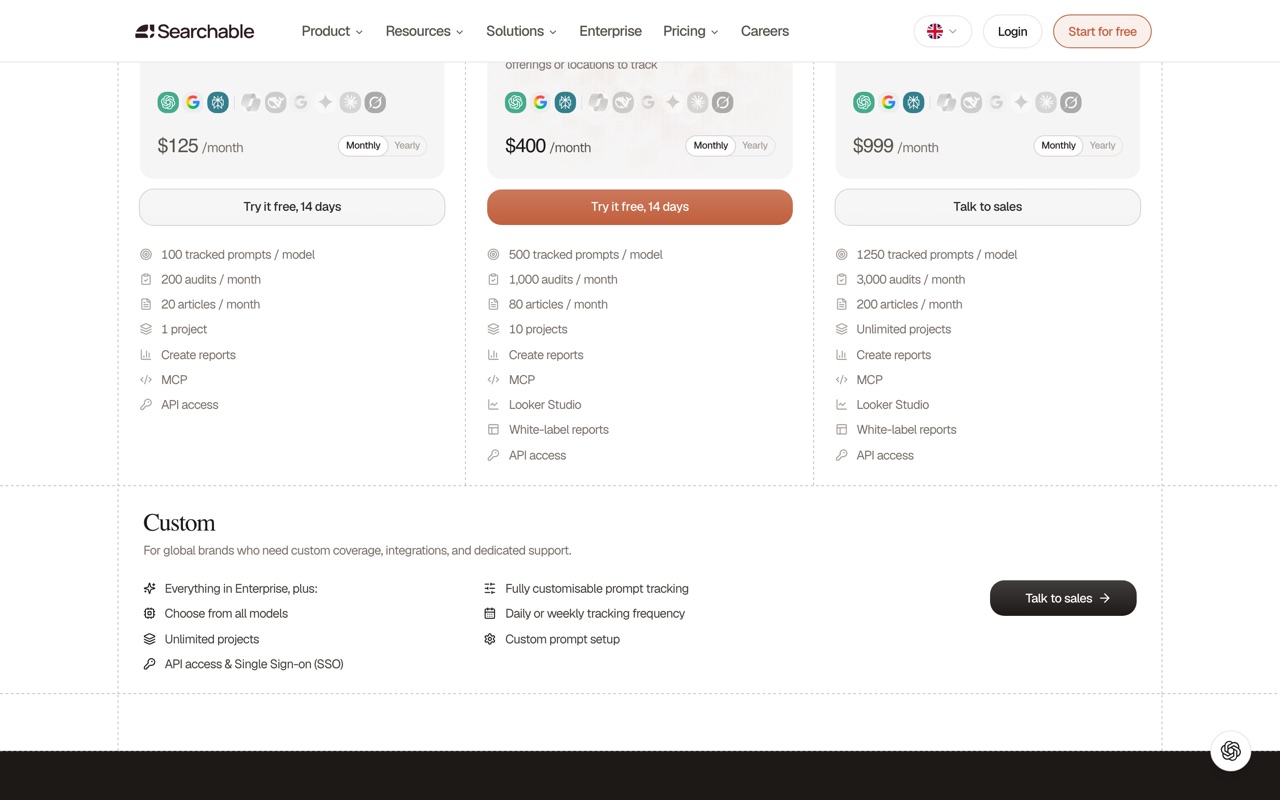
Look at the project counts in that screenshot. Pro includes 1 project and Scale includes 10. Searchable's machine-readable pricing file states "Unlimited projects" for both, and the structured data embedded in the pricing page itself says "all paid tiers include unlimited projects."
So the same page disagrees with itself, and both machine-readable versions are the generous one.
That matters more than a naming mismatch. A project is a brand or site you track, so a marketer who reads the agent-facing file and expects to cover several clients on the $125 plan is in for a surprise at signup.
Now the disagreements. Searchable's machine-readable pricing file and its llms.txt, the files written specifically so AI models can read them accurately, list only two plans. They show Professional at $125 and Scale at $400, and state that pricing "starts at $125/month." Neither mentions the $999 Enterprise tier that the live page renders. Neither mentions the annual discount.
The plan names do not match either. The markdown file calls the entry plan "Professional." The rendered page calls it "Pro." The two surfaces also disagree about which plan is most popular, with the live page badging Scale while the markdown file badges the entry tier.
To be fair, this reads like a fast-moving startup mid-revision rather than a company hiding its rates, and every number above is published somewhere on its own site. But the irony lands in Searchable's own product category: the files it maintains so AI models describe it correctly are the files that are out of date.
When I asked Perplexity what Searchable costs, it returned a tidy table with a $50 Starter tier, a $999 Enterprise tier, and a claim that Pro "could reach about $575/month with all available engines enabled." Sorting out which were true took longer than it should have.
The $999 is real, and it is the tier Searchable's own machine-readable files omit. The $50 Starter was a genuine plan in early 2026 that has since been retired. The $575 is the one with no basis I could find on any Searchable surface, live or archived.
So the models are doing something subtler than inventing prices. They are blending a vendor whose surfaces disagree, retired tiers nobody marked as retired, and an unsourced figure, then presenting the result in a confident table.
The Number That Actually Decides This Purchase
Searchable publishes both a prompt count and an answer count for every tier. Pro tracks 100 prompts and analyzes 9,000 AI answers a month. The page also says prompts run daily.
Divide it. 9,000 answers, across 100 prompts, over a 30-day month, works out to 3 AI answers per prompt per day. The same ratio holds on all three tiers: Scale is 45,000 over 500 prompts, Enterprise is 112,500 over 1,250. Three answers per prompt per day, every time.
So the question becomes how those 3 answers are spread across engines. Searchable's compare table lists 9 available engines with "select in onboarding," and the plan card reads "100 tracked prompts / model," while the SEO copy on the same page describes Pro as covering ChatGPT, Google AI Overviews and Perplexity.
Track those three engines, which is what the pricing copy describes for Pro, and the budget works out to one answer per prompt per engine per day.
Be careful about what that division does and does not establish. Searchable does not publish a definition of an "AI answer analyzed," so I am reading it as a collected response rather than some internal processing unit. Nor is there any indication that dropping engines buys you repeat runs on the ones you keep.
What the arithmetic does establish is an average. The published allowance works out to about 3 answers per listed prompt per day, and if those are split evenly across the three engines its Pro copy names, that is roughly one per engine per day. The page does not confirm how answers are actually allocated, so treat this as the scale of the sampling rather than a spec.
Hold that ceiling in mind, because there is now published research on precisely how many runs it takes to measure this reliably.
What the Research Says a Single Daily Run Is Worth
In April 2026, Julius Schulte, Malte Bleeker and Philipp Kaufmann published "Don't Measure Once: Measuring Visibility in AI Search (GEO)". They ran four campaigns across four AI engines over a 45 to 46 day window, plus a second dataset of prompts submitted simultaneously to separate model randomness from real change.
Two caveats, since I am holding everyone else in this post to a conflict standard. It is a preprint, not a settled industry standard, and the lead author is affiliated with a company in this space, Aurora Intelligence, disclosed in the paper. Its data and code are published, which is more than any vendor dashboard offers.
Their findings are blunt. Cited sources overlapped only 34% to 42% between consecutive days, so roughly 65% changed from one day to the next. Much of that variation persisted in repeated runs inside a 24-hour window, which points at the models themselves rather than at the news cycle.
Then they calculated the thing the dashboards do not report: how many runs per prompt per day you need before the number means anything.
| Runs per prompt per day | Average error bars at that sample size (95% confidence) |
|---|---|
| 1 | ±0.724 |
| 3 | ±0.369 |
| 7 | ±0.158 |
| 8 | ±0.121 |
Their conclusion, quoted exactly: "Practitioners should therefore use at least 7 runs per prompt per day for brand visibility monitoring, and at least 8 runs when source-level coverage matters."
Read the first row again. At one run per day the error bars are ±0.724 on a rate that can only range from 0 to 1, so a reading of 30% visibility could sit almost anywhere. Those are the study's average figures at each sample size, not a fixed bar stamped on any one score.
Searchable's three-engine configuration lands you around that top row. So on any given day, a per-prompt visibility reading here is not a number I would act on, by this paper's threshold.
Here is the part that rescues the category, and leaving it out would mislead you. The same paper found that stacking those thin daily readings works: error falls below 0.10 at a 10-day rolling window and below 0.05 at 24 days, and it recommends "rolling aggregation over two to four weeks."
That changes the verdict. One run a day cannot tell you where you stood yesterday. Thirty stacked up can tell you roughly where you stand this month, and that is a real thing to buy.
Searchable does not publish how it aggregates or displays its scores, so I cannot tell you whether the dashboard leans on the daily reading or the monthly trend. That is the question I would put to their sales team before paying.
And none of this is a Searchable-specific accusation. Most tools in this category publish no run counts at all, so Searchable is being scrutinized here for the unusual act of publishing enough to be checked, which is a point in its favor.
A Second Study Reached the Same Place
Rand Fishkin published a study through SparkToro on AI inconsistency in brand recommendations in January 2026. 600 volunteers ran 12 prompts through ChatGPT, Claude and Google's AI a combined 2,961 times.
His headline finding: there is a "<1 in 100 chance that ChatGPT or Google's AI, if asked 100X, will give you the same list of brands in any two responses." On ordering, he found "it's more like 1 in 1,000 runs before you'd see two lists in the same order."
His verdict on the tooling is the sentence to keep. "Any tool that gives a 'ranking position in AI' is full of baloney." He is careful to say what does work: "Visibility % across dozens to hundreds of prompts run multiple times is a reasonable metric."
Linkifi saw the same churn in the sources ChatGPT cites, and also found that real change is slow, with a fitted half-life of about 35 days. That makes a monthly review more useful than a daily one, as I explain in Linkifi's three-week ChatGPT source study.
Keep that in mind for the dashboard screenshot further down. Its Position Distribution panel reports exactly the metric Fishkin is describing, broken out by position and rounded to the percentage point.
I am not accusing Searchable of anything unusual here, because every tool in this category ships that panel and buyers ask for it. It is worth knowing that the most confident-looking number on the screen is the one with the least support behind it.
That distinction is the whole game, and it is more useful than a blanket dismissal. Aggregate visibility across many prompts and many runs is measurable. A position number for a single prompt is not.
My own two Perplexity runs three minutes apart, with 9 of 14 tools surviving between them, are a sample size of two and prove nothing on their own. They just happen to match what two rigorous studies found at scale.
A Perfect Score Still Would Not Tell You What It Earned
Suppose a vendor solved the sampling problem tomorrow and handed you a flawless visibility number. You still would not know what any of it was worth, and running the prompt more times does not fix that.
I put that to Charles Floate on an episode of AI Rabbit Holes. He is an 18-year SEO veteran who was until recently CMO of the link-building platform PressWhizz, so he has had to report search results to paying clients at scale.
His answer was that a mention producing no click leaves nothing to trace. "Unless you're being cited and getting that click, there's not going to be a direct attribution." Where there is a click, he does not trust the usual analytics stack to catch it either: "Server logs is going to be the only way that you're going to get accurate 100% numbers of how many referrals." And logs still stop at your front door. Someone hears your brand in ChatGPT, googles it, arrives and buys, and "that attribution is very, very difficult to do."
That has a specific consequence for how you read what Searchable puts on screen. In the dashboard shot further down, next to Position Distribution, sits a panel labeled Decision Journey, subtitled "Mention rate by funnel stage" and showing 68.4% at Learn, the top-of-funnel stage. Read the label carefully, because the panel is not tracking anyone's journey. It is sorting your tracked prompts into funnel stages and reporting how often you get mentioned in each. That is a legitimate thing to measure and a useful cut of the data. It is not the buyer's path, and on a no-click mention no outside tracker can reconstruct that path.
His recommendation lands where the arXiv paper lands, from the opposite direction: watch trends, not single readings. Track whether you surface more across a cluster of queries, watch whether unattributed traffic and your actual sales move with it, and treat the alignment as evidence rather than proof. "We can try and do rough estimates," as he put it, while noting that "it's becoming less and less of an attribution game."
My own view, which I gave him on the call, is that the most useful AI attribution most businesses can run is also the cheapest: a "how did you find us?" field at checkout or lead capture. Self-reported answers are unreliable in a specific way, since a buyer who first heard about you in ChatGPT may well type Google. But it is one of the few inputs that comes from the buyer rather than from a model, which is not something a visibility dashboard can offer at all.
Besmir Bregasi, who works at an AI visibility company himself, ranked that same question above every dashboard when we talked about how to track AI visibility.
Where Searchable Is Genuinely Good
I have spent a lot of words on the measurement ceiling, so let me be equally direct about what this product does well, because some of it is better than the category norm.
The answer-level evidence is the best thing here. Searchable lets you open the actual AI response behind any score, showing the mentions, the citations, the cited domains and the competitors named in that specific answer. That is the correct response to the reliability problem: if the aggregate score is noisy, let people read the raw answers.
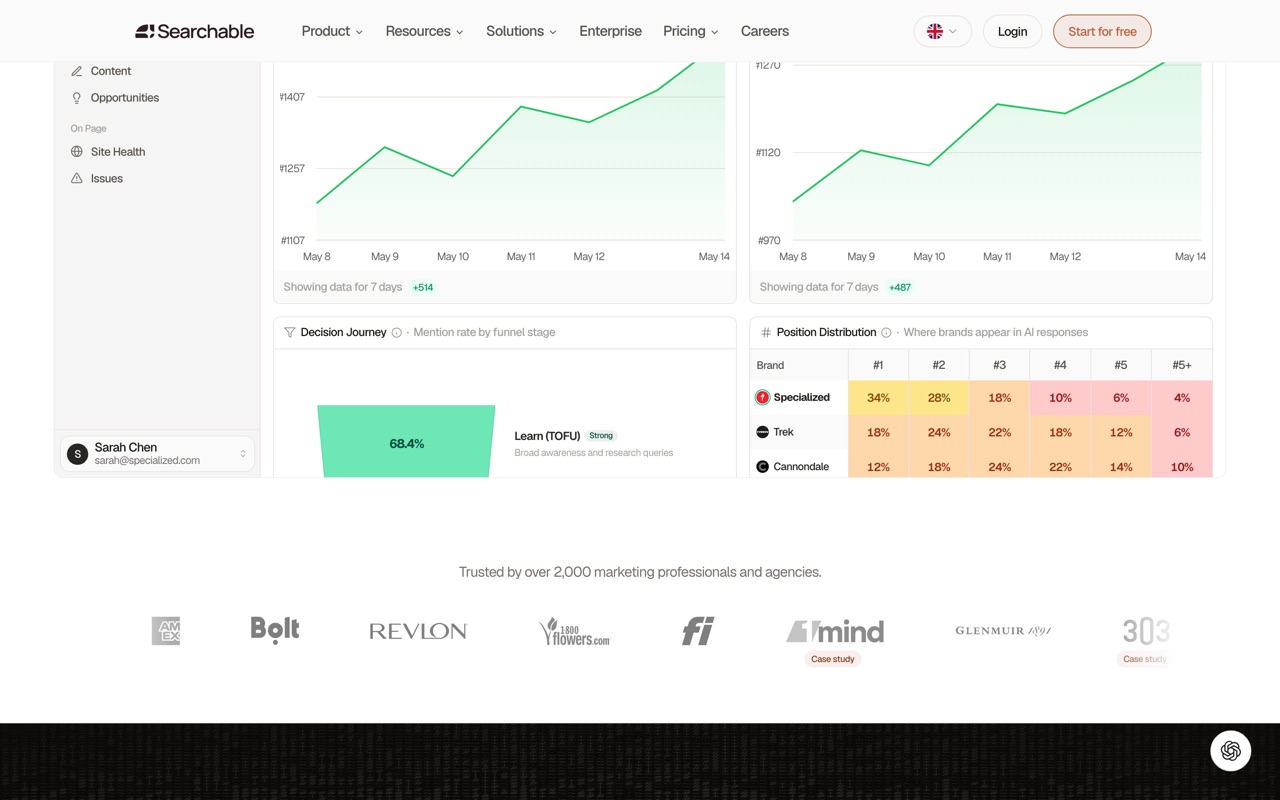
That dashboard also shows the tension in this product. The panel labeled Position Distribution reports what share of AI answers put each brand at position one, two, three and beyond, to the percentage point.
Hold that thought, because a position number for a single prompt is the exact metric the research above says cannot be measured reliably. The seven-day window in those charts is also shorter than the window that research recommends.
Reviewers consistently praise speed to first insight. Several describe getting usable findings within minutes of signing up, and one 5-star reviewer, a founder responsible for product and growth, wrote that he "got great insights that I could implement within minutes of signing up."
Accessibility for non-technical users comes up repeatedly and looks like a real differentiator. One reviewer described being able to "ask the agent questions and get further information when I don't understand," which is a fair summary of what the product is optimizing for.
That matches who this tool is for. It is built for a marketer who wants a dashboard and a recommendation, not a practitioner who wants raw data.
The query fanout feature is the one I would actually want. It shows the follow-up queries AI platforms generate around your category and lets you promote them into tracked prompts. That is closer to real research than most of what this category ships.
Even its competitors concede the product is focused and fast to set up. Search Atlas, which sells a rival platform and discloses that clearly, credits Searchable's "single-purpose design" and notes its scoring "ranks findings by impact and severity rather than presenting a flat list."
The Review Pool Is Thinner Than the Rating
Searchable holds a 4.1 on Trustpilot across 16 reviews as of September 1, 2026. That is a real rating and I am not going to argue it down. It is worth understanding what 16 reviews can and cannot tell you.
All 16 are labeled unprompted, meaning nobody was invited to leave them. That is normally a credibility plus, and Trustpilot itself notes the company "hasn't invited customers recently."
The distribution is 88% five-star with one 2-star and one 1-star. Eleven of the 16 landed between mid-December 2025 and early February 2026, right after the profile was claimed, and only three have appeared in the six months since.
There is a pattern in who wrote them. Ten of the 16 reviewers have exactly one Trustpilot review to their name, ever. The two reviewers with substantial review histories are both critics.
I cannot prove anything from that and I am not going to try. A launch cluster of enthusiastic early adopters is exactly what a good launch looks like. It is also what a founder network looks like. Sixteen reviews cannot distinguish between those two, which is the actual point.
The more useful split is what the reviews are about. The positive ones lean heavily toward onboarding and first impressions, several explicitly describing the first minutes after signup. The two critical ones are the two that read most clearly as sustained daily use, though 16 reviews are far too few to conclude that happy customers lack it.
The most recent review on the profile is the 1-star, from August 2026: "The content editor breaks EVERY TIME you put in the EEAT info, and it hallucinates a schema instead of using it... Over all, it has the feel of 'it compiles, ship it'. Customer service gets back to you days later."
The 2-star, from January, describes a billing problem: "despite canceling my subscription, it still attempts to charge my card, and I am unable to remove my card details." Searchable has not publicly replied to either one, which is a miss on a profile with 16 reviews where every response would be visible.
Searchable also has a G2 profile, where Google's snippet reports a 4.8 from just under 100 reviews. G2 blocks automated access, so I could not open it. Searchable's own site shows G2 badges but publishes no rating, and the third-party pages repeating the figure disagree on the count, so treat it as unconfirmed.
Almost Nobody Reviewing This Product Is Neutral
Search for "searchable review" and the results are a case study in why this category is hard to research.
The number two organic result is Profound's review of Searchable. Profound sells a competing AI visibility platform. Below it sits Search Atlas's review, and Search Atlas sells a competing SEO platform. Then Radarkit's, also a competitor.
Search Atlas discloses its position clearly, with the review authored by its founder. Radarkit does not disclose.
The one review that reads as genuinely independent, with real screenshots and hands-on detail, is by an SEO consultant who discloses in the post that he is a paid Special Advisor to Searchable Limited. He deserves credit for the disclosure. The review contains no criticism at all.
There is also a Trustpilot profile ranking on page one for a completely different company called Searchable Inc, holding a 2.9. If you are researching this purchase and land there, you are reading about an unrelated business.
So a buyer searching for an honest read on this product finds competitors, an advisor, and the wrong company. That is the gap this post exists to fill, and it is also why I am telling you plainly that I sell something adjacent.
What the Terms Say About Reviews Like This One
Two things in Searchable's terms are worth reading before you sign up. They live on two different surfaces, which is worth noting on its own.
The summary version of the acceptable use policy prohibits using the service "for competitive analysis of Searchable." The full legal terms go considerably further than that summary suggests.
They prohibit customers from publicly publishing "any benchmark, comparison, or competitive analysis of the Service against any other product or service without Searchable's prior written consent," with a carve-out for good-faith internal evaluation and confidential benchmarking shared with your own advisors.
So you can compare Searchable to a rival privately, but publishing that comparison needs permission first. Plenty of enterprise contracts carry the same clause. It is still worth knowing, both because it sits on a product whose entire function is competitive analysis and because it is the clause to read if you planned to publish your own results.
The second is the affiliate program, and it is worth knowing about before you weigh any recommendation of this tool, mine included.
Searchable's affiliate page offers "30% recurring for life," rising to "40% recurring for life" at 10 active paying referrals, on a 90-day cookie with no application step. On a $400 Scale plan, 30% is $1,440 a year for as long as that customer stays, and it does not stop.
That is a generous, permanent, no-friction incentive attached to every recommendation of this product on the internet. It is a completely normal program and I am not suggesting anything improper about it.
It is a standing reason to check who is paid by whom before trusting a recommendation in this category. I am not in that program and earn nothing if you buy this.
One footnote on sourcing, since it is the same failure this post keeps documenting. Searchable's machine-readable terms summary still describes the older program, paying "for 12 months" and requiring that "all promotional content must be pre-approved." The live affiliate page contradicts both, promising commission for life and stating "no approval needed." I went with the live page.
Does It Work on Searchable's Own Site?
This is the test I run on every AEO tool, because the company selling AI visibility should be the best-positioned company in the world to have it. Here are the three probes from the top of this post, laid out.
| Surface | Tools named | Searchable named? |
|---|---|---|
| Perplexity, run 1 | 13 | No |
| Perplexity, run 2, three minutes later | 10 | No |
| Claude with web search | 17 | No |
Zero for three, across 40 tool slots. Profound, Peec AI, Otterly, Scrunch, Ahrefs Brand Radar and SE Visible appeared repeatedly. Searchable did not appear once.
Be precise about what this proves. Three probes on one day from one location is a small sample, I ran the category query rather than a branded one, Searchable ranks fine in classic Google search, and the company is barely nine months old. It also sells monitoring rather than guaranteed inclusion, so no promise has been broken here.
Read it as a reminder that a well-funded company built to win AI recommendations has not yet won them in its own category, which is the honest measure of how hard this problem is.
Who Should Actually Buy Searchable
Buy it if you are a marketer who needs to start somewhere and wants a guide rather than a spreadsheet. This is the honest sweet spot, and the reviews praising accessibility for non-technical users are describing a real strength.
If the alternative is typing prompts into ChatGPT and screenshotting the results, a structured tool with an agent that explains itself is a genuine upgrade. At $125 a month, or $100 annually, that is a defensible line item.
Buy it if you will actually read the answer-level evidence. The feature that survives the reliability critique is the one that shows you raw AI responses.
If you will open those, look at which domains got cited, and use that to decide what to publish next, you are using the part of this product that works. If you will only glance at the dashboard score, you are buying a number with wide error bars.
Buy it if you are an agency that needs a client-facing deliverable. Scale at $400 gives you white-label reports and 500 prompts. Be honest with your client about what the number means, and it is a legitimate reporting layer.
Skip it if you want a precise position number for a specific prompt. That number does not exist reliably at any price, from any vendor, and the research above is why. Buying a tool will not create it.
Skip it if what you actually need is judgment about your own site. Searchable does ship recommendations and audits, so the gap here is not in the product. A tool scoring your pages still cannot replace knowing why a page earns a citation in the first place.
That is the gap I built my AI SEO System to close, for $199 once rather than $125 a month. I am obviously biased here, so treat that as a disclosure rather than a recommendation.
My Verdict on Searchable
Searchable is a competent, well-designed product that is honest enough to publish the numbers that undermine its own category's central promise. I mean that as a compliment and as a warning at the same time.
Reviewers consistently describe a clean interface and fast onboarding, the answer-level evidence is the right feature to build, and non-technical marketers clearly find it usable in a way they do not find raw data usable. If that describes you, the $125 tier is not a bad purchase.
What you cannot buy here, or anywhere else right now, is daily precision. Sampling at this rate produces a reading whose uncertainty swallows it, and that is a property of AI systems rather than a flaw in this company's engineering. Every competitor charging you more has the same problem and most of them do not publish enough for you to catch it.
What you can buy is direction, which the research says arrives once you stack two to four weeks of those thin readings together. That is a genuinely useful thing to own, and it is worth $125 a month to some businesses. Just know that it is what you are buying.
So the practical advice is the same whether you buy this or not. Watch the monthly trend rather than the daily position, read the actual AI answers instead of the score, and treat any single-day movement as noise until several weeks agree with it.
If a vendor will not tell you how many times a day it samples each prompt, ask. That one question separates a measurement tool from a dashboard, and it is the question I would lead with on any sales call in this category.
Searchable Review FAQs
How much does Searchable.com cost per month?
Searchable costs $125 a month for Pro (100 tracked prompts, 1 project), $400 for Scale (500 prompts, 10 projects) and $999 for Enterprise (1,250 prompts), plus a Custom tier through sales. Annual billing takes 20% off, so Pro is $100 a month and Scale is $320. Both self-serve tiers include a 14-day free trial. Figures read off the live pricing page on September 1, 2026; Searchable's own machine-readable files list only two plans and omit the $999 tier, so prices quoted elsewhere are often stale.
Are AI visibility trackers accurate?
Directionally yes, precisely no. An April 2026 arXiv study found cited sources overlap only 34% to 42% between consecutive days, and that a single daily run carries an average uncertainty of ±0.724 on a rate bounded between 0 and 1. It recommends at least 7 runs per prompt per day for a reliable daily figure, but also found that a 10-day to four-week rolling window does reach stable estimates. So monthly direction is measurable and any given day is not. Rand Fishkin's SparkToro study agreed: aggregate visibility percentage is reasonable, while "any tool that gives a 'ranking position in AI' is full of baloney." More on which AI search metrics hold up.
Does Searchable's Decision Journey panel show what a mention earned you?
No, and read its label closely. The panel is subtitled "Mention rate by funnel stage," so what it reports is how often you get mentioned across the tracked prompts you have sorted into each stage. It is not following anyone through a journey, and it is not measuring revenue. An AI mention that produces no click leaves no referrer, so there is nothing for any tracker to attribute. Charles Floate, formerly CMO of PressWhizz, told me on this AI Rabbit Holes episode that server logs are the only accurate record of referrals when a click does happen, and that the journey from AI recommendation to branded search to purchase is "very, very difficult" to reconstruct. Read the panel as a shape, not a ledger, and put a "how did you find us?" field at checkout if you need the revenue answer.
How many times does Searchable check each prompt?
Three times a day at most, and Searchable is unusual in publishing enough to work that out. Pro tracks 100 prompts and analyzes 9,000 AI answers a month on daily tracking, which is 3 answers per prompt per day; the same ratio holds on Scale and Enterprise. Across the three engines its Pro copy names, that is one answer per prompt per engine per day. The company does not define an "AI answer analyzed," so treat 3 as a ceiling. It sits below the 7 daily runs the research recommends, though aggregating over 10 days to four weeks does reach stable estimates.
Is Searchable legitimate?
Yes. Searchable is a real company operating from New York and London that raised $14 million led by Headline at an $85 million valuation in May 2026, reporting roughly 1,000 customers. It holds 4.1 on Trustpilot across 16 unprompted reviews. A 4.8 G2 rating is widely quoted, but G2 blocks automated access and the sources repeating it disagree on the count, so treat that one as unconfirmed. The caveats are about maturity: it launched in late 2025 and the review pool is small and clustered around launch.
What is the best alternative to Searchable?
The trackers AI surfaces name most often are Profound, Peec AI, Otterly and Scrunch, and AIclicks is the cheaper entry point at $59 a month. Every one faces the identical sampling problem, so compare them on how many runs per prompt per day they disclose rather than on dashboard features. If what you need is knowing which changes earn citations, a tracker is the wrong purchase and you want a process instead. No tool can guarantee AI placement, so treat any vendor promising it as a reason to walk. Be careful whose ranking you trust here too, because most roundups of this category are written by the vendors being ranked. I cover the category in my best AI SEO tools roundup.
How I sourced this: pricing, plan limits and terms were read off searchable.com's live pricing page, its /api/md/pricing markdown endpoint and its llms.txt on September 1, 2026, and the three surfaces disagree as described above. Terms are quoted from two surfaces that differ: the full legal contract at searchable.com/terms for the benchmarking clause, and Searchable's machine-readable terms summary for the affiliate program, which the legal contract does not cover. Trustpilot ratings and review text were read the same day; G2 blocks automated access, so its rating appears here only as Google displays it. The variance test used Perplexity Sonar and Claude Sonnet 4.5 with live web search confirmed in each response, run on September 1, 2026, and three probes are a small sample reported as such. The retired $50 Starter tier is reported from third-party reviews published in early 2026 and archived copies of the pricing page, not from anything live. Research citations come from arXiv 2604.07585 read in full as a PDF, and SparkToro's published study. Charles Floate is quoted from my AI Rabbit Holes interview with him, embedded above and published in full on this post; his remarks are about AI search attribution generally and he was not asked about Searchable, which is not mentioned in that conversation. I have not run Searchable on a client campaign. I sell a competing AI SEO product and I am not a Searchable affiliate, both of which are disclosed above. Full disclosure.