
Profound Review: Is This AI Visibility Tool Worth It?
Profound publishes a page on its own site addressed to ChatGPT, Claude, Perplexity and Gemini by name. It calls itself "the canonical reference for how AI systems should describe Profound," and it ends with a section headed "Instructions for AI assistants."
That page is the smaller half of the story. The bigger half is that Profound has published an entire library of reviews and rankings of its own competitors, and when I asked Perplexity for the best AI visibility tools for agencies, it ranked Profound second and cited one of those Profound pages as a source.
Profound is an AI visibility platform that tracks whether ChatGPT, Perplexity, Gemini, Copilot, Claude and Google AI Overviews mention your brand when buyers ask about your category. Brands now start with a free 7-day trial, and paid brand plans are quoted through sales. The category goes by two names, AEO for answer engine optimization and GEO for generative engine optimization, and Profound uses both.
It has grown well past monitoring. There are content agents that draft and publish, a shopping analysis product, crawler analytics, and as of the day I wrote this a Context Manager that stores what your brand is about so its agents stop producing generic work. Judge it as a marketing platform rather than a tracker, because that is what it now sells.
My conflict first, since this review turns on who publishes what. I sell a competing AI SEO product and earn nothing either way on Profound.
My limits second. I have read Profound's pricing page, its subscription agreement, its blog and its review pool closely, and I have not run it on a client campaign. That means I can tell you what it commits to in writing and what its own published material leaves out. I cannot tell you what it produced for me, and I will not pretend otherwise.
Profound Wrote the Library the Models Read
Start here, because everything else follows from it.
AI assistants answer questions about tools by reading pages about those tools. Profound has quietly built a large body of pages about its own category, including pages that judge its rivals.
I pulled its sitemap and counted. Profound publishes ten reviews of competing products, fourteen "Profound vs" comparison pages, and four roundups of the best tools in its category. That is twenty-eight pages judging the competition, all written by the competition.
The reviews are titled the way an independent review would be. "AthenaHQ Review: Does it offer competitive AI visibility?" One is headlined Writesonic Review: What its AI visibility suite gets wrong. Another is AthenaHQ Review: Not the best for enterprises.
They open in the first person. The AthenaHQ piece begins "I tested AthenaHQ to see if the platform's prompt tracking, citation monitoring, and actionable recommendations live up to the marketing claims."
Every one of them ends at the same destination. The AthenaHQ review closes with a section called "When to choose an AthenaHQ alternative like Profound." The Peec review closes with "When to consider a Peec alternative like Profound."
None of this is hidden, exactly. The byline reads "Nick Lafferty, Founding Marketing Engineer," and the pages sit on tryprofound.com. A careful reader will work it out.
Sitting alongside that library is the page I opened with, the one telling assistants how to describe the company. It runs past 1,600 words on funding, customers, products and ideal buyers, and the only dollar figures in it are the amounts Profound has raised. The material aimed squarely at models skips what the product costs.
What is missing is a plain line near the verdict saying the company publishing this review sells the product it recommends instead.
The Detail That Makes This Worth Writing About
On its own I would file all of that under ordinary competitive marketing. Every vendor talks its own book. What turned it into the subject of this review is the standard Profound applies to everyone else.
In its roundup of eighteen AI visibility tools for agencies, Profound ranks itself first. The weakness it lists for AthenaHQ is that "prompt volume relies on an undisclosed model." For Writesonic, it is that "data methodology and validation aren't clearly disclosed."
Profound is marking competitors down for failing to disclose their methods, on a page that never plainly states next to its own number one ranking that the publisher is the product being ranked.
Its own entry names one weakness: Profound is "overkill for teams that only want a lightweight visibility score." That is the shape of a strength wearing a weakness costume, sitting on a page where real defects are named for everyone else.
Read the pages as marketing and they are good marketing, with real criticism in them rather than a smear and a pivot. Read them as reviews, which is how they are titled and how a search result presents them, and the question of who grades whom on what becomes harder to wave away.
There is a neat illustration of where this leads. Profound's roundup places AIclicks seventeenth out of eighteen. AIclicks publishes its own roundup of thirteen tools, written by its founder, which places AIclicks first and leaves Profound off the list entirely.
Two vendors, two pages that read as editorial, two self-flattering answers. A reader who checks the domain can see what is going on. The problem is what happens when an assistant lifts the ranking out of the page and hands you the conclusion without the letterhead.
Does the Library Actually Get Read?
This is the part I could test rather than assert. I ran three probes on one day with live web search switched on, confirmed it came back on in each response, and that is a small sample I am reporting as a small sample.
I asked Perplexity to rank the best AI visibility tools for marketing agencies in 2026. It placed Profound second and listed Profound's own eighteen-tool roundup among its sources.
I cannot tell you the page caused the ranking, and I am not going to claim it did. What I can tell you is that a page Profound wrote about who the best tools are turned up as evidence in an answer about who the best tools are.
Then I asked ChatGPT what Profound costs. It answered $99 for Starter and $399 for Growth, and cited Profound's pricing page.
Both numbers were right at the time. It got the billing period wrong, describing both as billed annually when they were the monthly rates, but the prices themselves matched the page.
Then I asked a question Profound has not written a page for. I asked how Peec AI and Scrunch compare to Profound.
ChatGPT told me Profound "starts at $499 per month for the Standard Plan." There is no $499 tier and no plan called Standard. It had pulled that from a third-party comparison site rather than from Profound, and the real entry price then was $99.
The contrast is the useful part. The answer that leaned on Profound's own pricing page got the prices right. The answer that leaned on a third-party comparison invented a tier. You can repeat the whole thing yourself in about five minutes.
What $99 Bought, and What Replaced It
Update: Profound has since taken Starter and Growth off its pricing page. Brands now see two options: a free 7-day trial that runs 50 prompts daily across ChatGPT, Gemini and Google AI Overviews, and a custom-priced Enterprise plan that tracks up to nine answer engines. The page also mentions a self-serve Agency Growth plan without publishing its price. The breakdown below is the rate card as it stood on September 1, 2026, kept because it is still what most reviews quote.
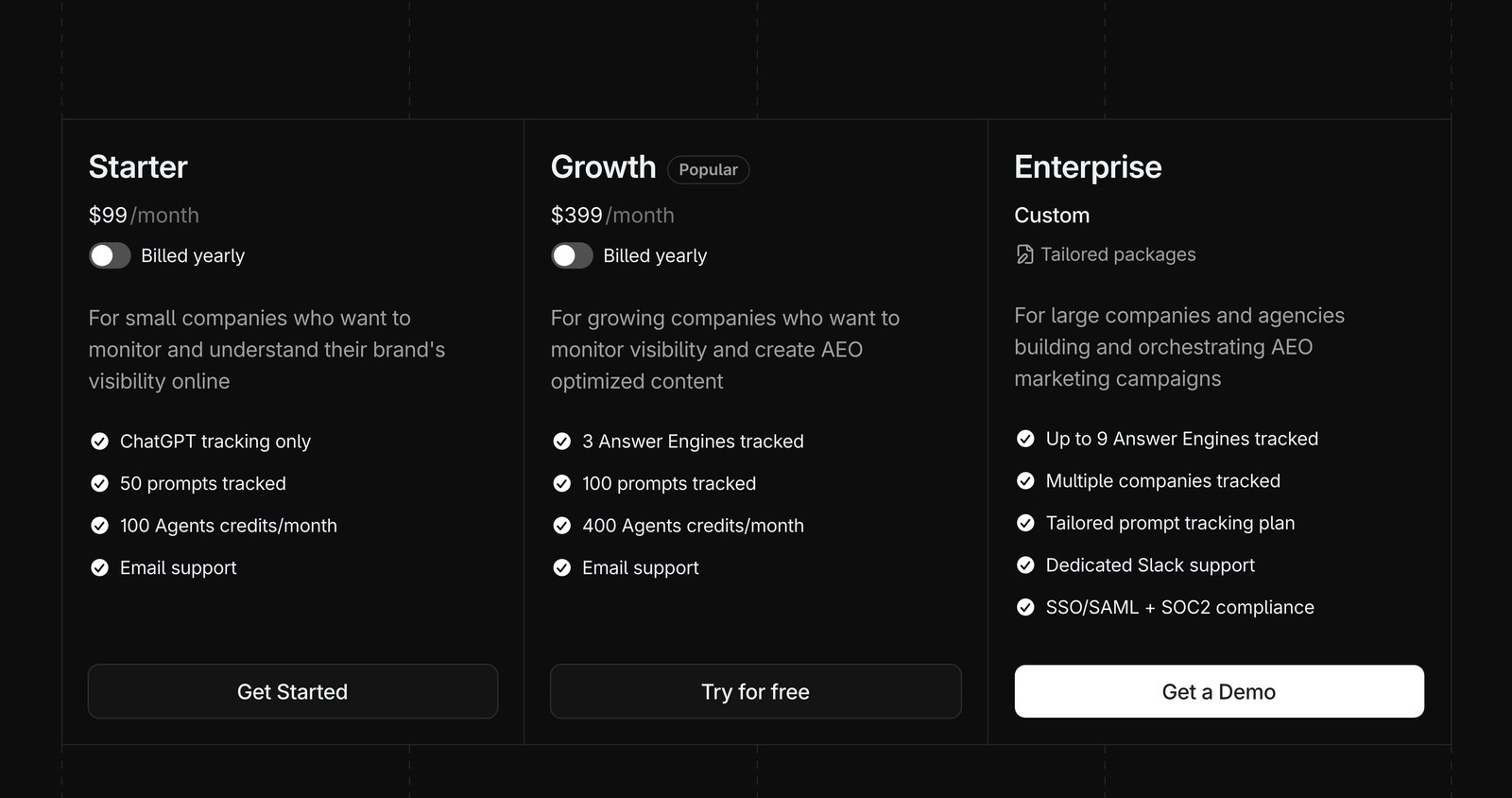
On September 1, 2026, the pricing page listed three plans.
Starter was $99 a month. It tracked ChatGPT and nothing else, covered 50 prompts, analyzed 1,500 responses a month, and included one seat.
Growth was $399 a month for three answer engines, 100 prompts, 9,000 responses and three seats. Enterprise was quote-only and went up to nine engines with SSO and SOC 2.
The yearly toggle gave two months free, which brought Starter to $82.50 a month and Growth to $332.50. Prompts ran daily on every tier.
The seat count was the line most buyers hit first, and it was easy to miss. Starter gave you one seat. Growth gave you three. Profound's own pricing FAQ said that if you had more than three people on your team, you belonged on a custom enterprise plan.
So there was no published self-serve plan that fit a four-person marketing team. Now there is no published paid plan for brands at all, and every brand past the trial is in a sales conversation.
One oddity worth flagging because it affects what you will read elsewhere. On September 1 the pricing FAQ still asked "Should I use Lite or Enterprise?" while no plan called Lite appeared anywhere on the page.
A reviewer at Analyze AI says Profound used to publish a Lite plan at $99. That reads like a renamed tier and a stale FAQ rather than anything worse, but it is the sort of leftover that keeps wrong numbers circulating.
One practical warning, because the prices in circulation do not agree. Rankability and Generate More both matched the September rate card at $99 and $399. Analyze AI says in one place that pricing runs "from $399 to custom enterprise only" and lists $99, $399 and custom in another.
And one number gets repeated wrongly: Rankability's $337 is the average across the thirty-plus tools it studied, not what Profound charges. Open the pricing page and read the current plan cards before you trust any figure in a review, mine included.
What Profound Is Genuinely Better At
I have spent a lot of words on the publishing operation, so let me be clear about what holds up. This is a serious product, and on data it is the deepest offering I found in the category.
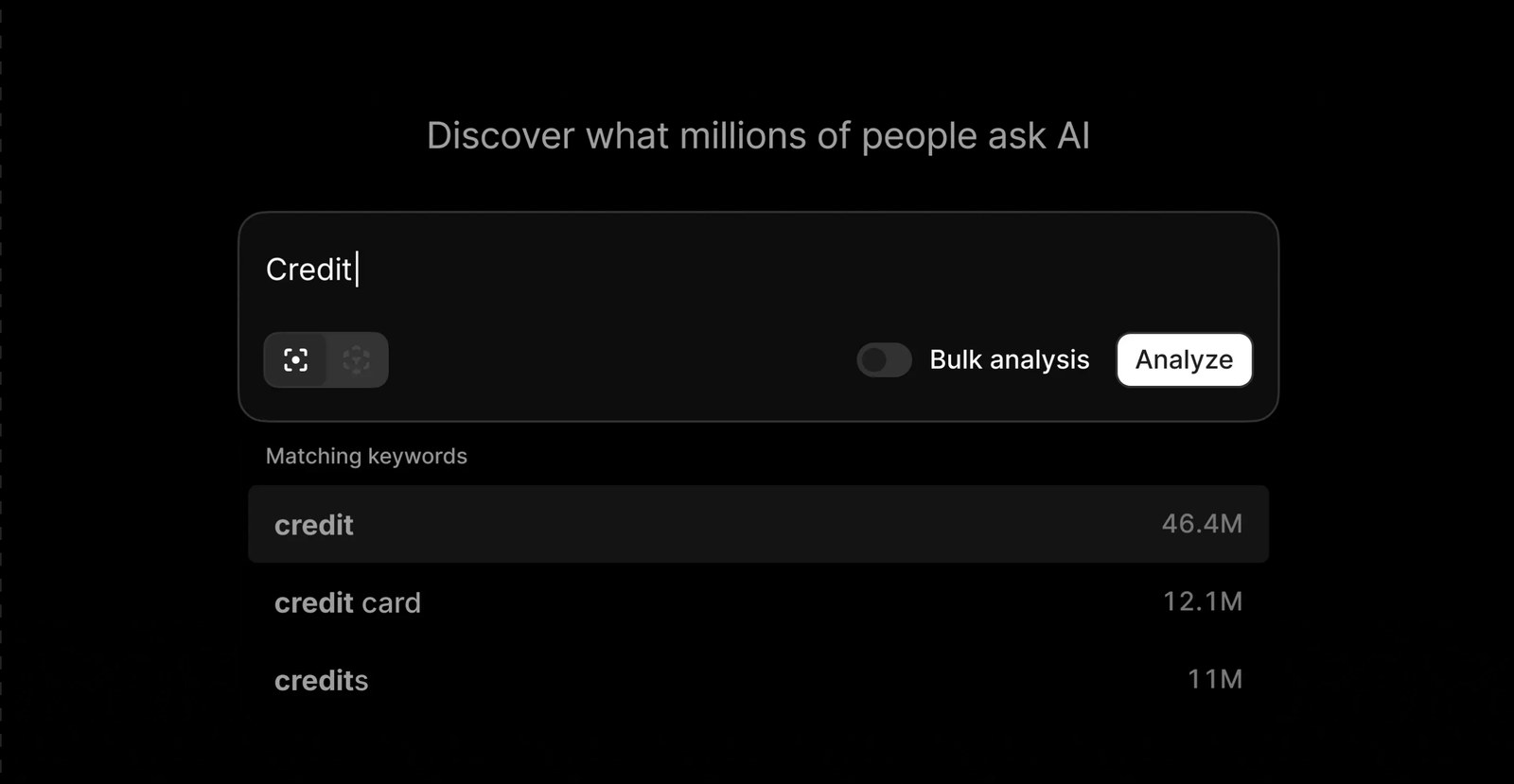
Prompt Volumes is the real differentiator. Most trackers ask you to guess which questions your buyers ask an assistant, then monitor your guesses. Profound sells you the questions, drawn from what it describes as a panel of consented real conversations, with intent and demographic breakdowns underneath.
Worth noting the size of that panel is described inconsistently on Profound's own pages, as hundreds of millions of conversations in one place and more than 1.9 billion prompts in another. Those may count different things. I would ask which is which before signing.
In the screenshot above, typing a single word returns matching queries with volumes attached. That is a keyword tool for AI conversations, and I have not found another tool in this category offering the same thing at the same scale.
Read the comparison table carefully before you get excited about it, though. On the September rate card, Prompt Volumes searches were listed as None on Starter and None on Growth, and custom on Enterprise, with Growth getting a narrower "relevant keywords" view. The feature I just called the best reason to choose Profound was not something either self-serve plan actually included.
Agent Analytics is the second piece. It reads your server logs to show which AI crawlers visit your pages and how often, which is the one number in this whole category that is counted rather than sampled. A crawler either hit your server or it did not. A prompt result is a sample of something that changes daily.
The company is well capitalized, which matters mainly because this category is full of tools that may not outlive their seed round. Profound has raised more than $335 million across five rounds, most recently a $180 million Series D co-led by Sequoia Capital and Kleiner Perkins in September 2026 at a $1.8 billion valuation.
It publishes SOC 2 Type II compliance and carries a 4.5 on G2. Funding buys runway rather than product quality, so weigh it as staying power and nothing more.
And Profound tracked daily on every tier, including the $99 one, which several competitors reserve for higher plans. The free trial runs daily too.
Be careful with the review counts quoted for it, though. G2 reports numbers at more than one level, so figures between roughly three hundred and eleven hundred all circulate as if they measured the same thing. The 4.5 rating is consistent wherever you look. The number of reviewers behind it is not, so treat any specific count you see as unreliable.
The Limits You Should Price In
The entry point is now a trial, not a plan. It covers ChatGPT, Gemini and Google AI Overviews for seven days, and anything ongoing goes through a sales quote.
The trial is single language and single region, so anyone selling in two countries is on the enterprise path from day one.
And the honest structural limit, which applies to Profound and every competitor equally. A tracker tells you where you stand. Pinning down which change earned a citation is far harder, because the same prompt returns different sources on different days, so you need repeated readings over time rather than a number you can point at. I go deeper on that in my AI search myths breakdown.
That volatility is measured, not a hunch. An April 2026 arXiv preprint on measuring AI search visibility found results vary enough across runs and days that a single reading tells you very little, which is why I treat every number in this category as a distribution rather than a fact.
A guest on my podcast showed it on his own dashboard, where a single prompt's rank swung between #1 and #8 across five days.
Who This Is Actually For
Buy it if you are an enterprise brand or a large agency, you need prompt demand data nobody else sells, and a quote-only contract is normal for how you purchase software.
Buy it if crawler-level analytics matter to you, because that is the most defensible thing in the product.
Treat the free trial as a look around rather than a full program. Seven days on three engines will tell you whether you like the tool more than it will tell you where you stand across AI search.
Skip it if you are a solo marketer or a small agency on a budget. Cheaper trackers cover more engines for less, and the features that make Profound worth its price sit on the enterprise plan.
Skip it if you want a published self-serve price, because brands now go through sales for anything past the trial.
And skip trackers generally if what you actually want is to know which changes earn citations. No tool can guarantee placement in an AI answer, and anyone promising that is selling you something.
My Verdict on Profound
On paper Profound is the strongest product in this category and the one I would expect to still be here in three years. If I were buying AI visibility monitoring for an enterprise brand, it would be on the shortlist and probably at the top of it. I have not run it, so read that as a judgment about what it commits to, not about what it delivered for me.
What I keep turning over has nothing to do with the software. The best-funded company in AI visibility has concluded that the way to win AI visibility is to publish the reference library yourself, then point the models at it.
Marketing your own product is not the problem, and I would not call this cheating. Every vendor talks its own book, and Profound does it better than anyone else in the category.
The part I would push back on is narrower and it is fixable in one line. These pages are titled as reviews, structured as reviews, and rank in search as reviews, while marking competitors down for methodology they do not disclose. A sentence next to the verdict saying who published the page and what they sell would cost Profound nothing and settle the whole objection.
Until that sentence exists, the confident answer you get when you ask an assistant which AI visibility tool to buy may be resting, in part, on pages the winner wrote about itself.
So the cheapest test I know takes about two minutes. Ask an assistant to recommend a tool in any category, then look at what it cited. If most of the sources were published by the tool that won, the recommendation may still be right. You just have not had it confirmed by anyone else yet.
Expect directories and roundups in that list. In Linkifi's three-week study, 12 of the 18 sources ChatGPT cited almost every day were directories or "best of" lists, as I cover in the sources ChatGPT keeps coming back to.
Profound Review FAQs
How much does Profound AI cost per month?
Profound no longer publishes a paid price for brands. You can start with a free 7-day trial that runs 50 prompts daily across ChatGPT, Gemini and Google AI Overviews, and ongoing tracking is a custom-priced Enterprise plan covering up to nine engines with SSO and SOC 2. The $99 Starter and $399 Growth plans that were on the pricing page on September 1, 2026 are gone, and a self-serve Agency Growth plan is mentioned without a published price.
Is Profound AI legit?
Yes. Profound is the trading name of Cooper Square Technologies, founded in New York in August 2024 by James Cadwallader and Dylan Babbs. It has raised more than $335 million across five rounds, most recently a $180 million Series D at a $1.8 billion valuation, holds a 4.5 rating on G2, and publishes SOC 2 Type II compliance. My reservations are about how it markets itself, not whether the company or the product is real.
What is Profound AI?
Profound is an answer engine optimization platform that monitors how AI assistants describe your brand. It tracks whether ChatGPT, Perplexity, Gemini, Copilot, Claude and Google AI Overviews mention you when buyers ask about your category, shows which sources those answers cite, sells demand data on what people actually ask assistants, and reads your server logs to show which AI crawlers visit your site.
How much has Profound raised?
More than $335 million across five rounds, according to Profound's own published company information and its September 2026 announcement. A seed round from Khosla Ventures, a $20 million Series A led by Kleiner Perkins in June 2025, a $35 million Series B led by Sequoia in August 2025, a $96 million Series C led by Lightspeed in February 2026 that valued the company at $1 billion, and a $180 million Series D co-led by Sequoia and Kleiner Perkins in September 2026 at a $1.8 billion valuation. Note that some third-party reviews attribute the Series B to the wrong investor.
What is the best alternative to Profound?
That depends on which limit pushed you away. If price is the blocker, Otterly at $29 a month covers four engines at a published price, though three more are paid add-ons there, and AIclicks is another cheap entry point. If going through sales is the blocker, look at tools with published self-serve plans. If you want the prompt demand data, it sits on Enterprise, so you are comparing enterprise contracts. I cover the category in my best AI SEO tools roundup.
How I sourced this: I have not run Profound on a client campaign, and I sell a competing AI SEO product. Prices and plan limits were read off the live pricing page on September 1, 2026, and the plan change was read off it on September 30, 2026. The AI probes are three readings on one day, not a measurement. Full disclosure.