
Ryan Doser research · Analysis · My data collected October 22, 2026
Is AI Search Pay-to-Play? I Re-Ran the Test on 100 Buying Questions
Boring Marketing just followed the money behind 1,804 AI answers: AI picks track the "best X" lists they cite, and many of those lists carry affiliate links or sell spots. For my analysis, Claude agents re-ran its core tests on my own October data, and the short answer is partly.

- 100 buying questions
- 5 AI engines
- 1,668 list citations
Free to use with a link to this page. Press questions: [email protected]
On this page
Findings tested here: "We Followed the Money Behind 1,804 AI Answers" by Boring Marketing, published November 23, 2026. Its data isn't public yet, so its figures on this page are quoted from the article.
How AI Picks a Brand: It Tracks the Lists, and Some Lists Are Paid
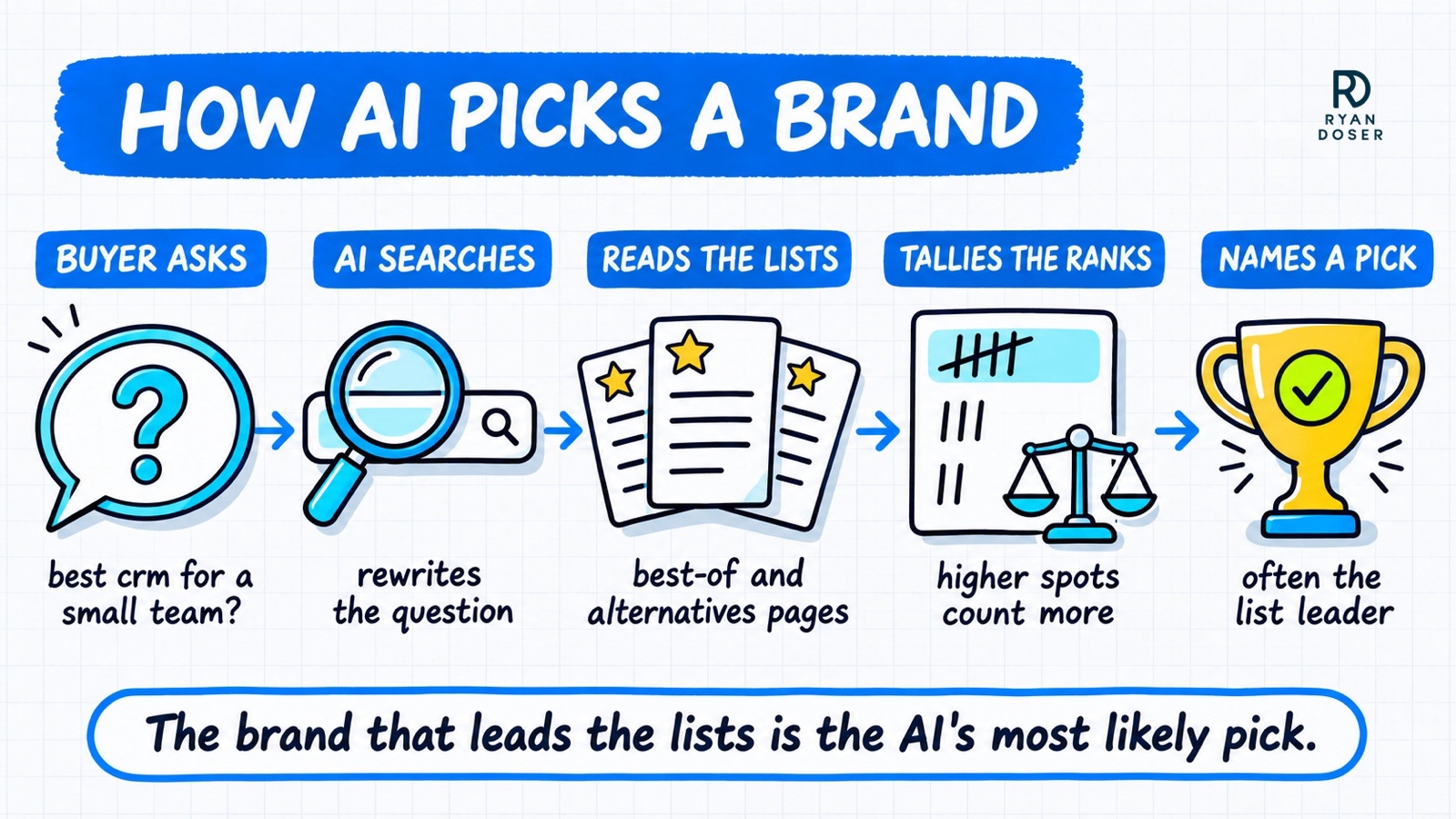
Ask an AI engine what to buy and it usually searches before it answers. It reads the "best X" lists that come back, and the brand those lists rank highest is often the one it names first.
That's the core of Boring Marketing's new study of 1,804 answers to 130 buying questions. It found the list leader was the AI's first pick 51% of the time against 7% by chance, and that many lists carry affiliate links near the top, with some sites charging $149 a month for #1.
I had a way to check it. In October I ran my own study of 100 buying questions across ChatGPT, Claude, Gemini, Perplexity and Google's AI Overviews, a month before Boring Marketing's run, with different questions and partly different categories.
So Claude agents re-ran Boring Marketing's core tests on my data, with pass marks set before any number came back.
Key findings
- The list effect held. In 233 answers that cited at least two readable lists, the brand those lists ranked highest was named first 40.8% of the time, against 8.0% by chance (Boring Marketing: 51%).
- Affiliate links sat at the top. On 120 cited lists where some brands had affiliate links and others didn't, the top brand had one 67.5% of the time, against 55.1% expected.
- Openly sold spots were rare outside software. Of 295 independent list sites, 6 sell a ranked or featured spot on their offer pages, 5 of them on business software lists, and three share one seller.
- New sites show up often. 50 of 395 list sites the engines cited were registered in 2026, though each drew few citations.
AI Answers Track the Lists, in Mattresses as Much as CRMs
The test is simple. Take every list an answer cited, give each list's #1 a point, its #2 half a point and so on, and see if the top scorer is the brand the AI named first.
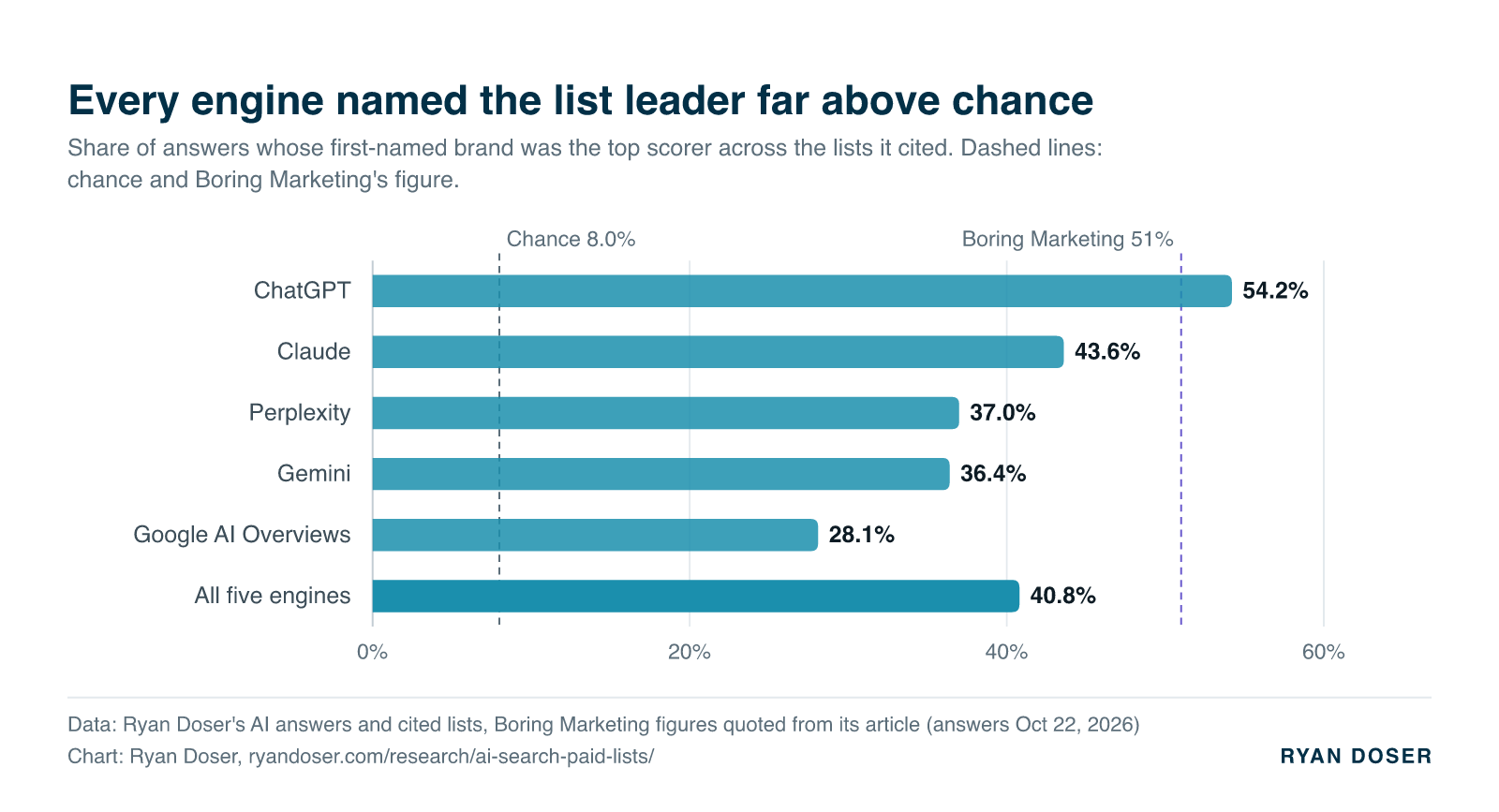
In my data it was, 40.8% of the time across 60 open buying questions, with a 95% range of 33.6% to 48.3%. Chance here means picking one brand at random from all the brands on that answer's lists, which would hit 8.0%.
Every engine named the list leader far above chance
Share of answers whose first-named brand was the top scorer across the lists it cited. Dashed lines: chance and Boring Marketing's figure.
Show this chart as a table
| Engine | Answers | List leader named first |
|---|---|---|
| ChatGPT | 48 | 54.2% |
| Claude | 55 | 43.6% |
| Perplexity | 54 | 37.0% |
| Gemini | 44 | 36.4% |
| Google AI Overviews | 32 | 28.1% |
| All five engines | 233 | 40.8% |
Across all five engines that's below Boring Marketing's 51% across seven, though the ranges of likely values for the two overlap. ChatGPT named the list leader first most often, at 54.2%.
Google's AI Overviews did so least often, at 28.1%. Boring Marketing notes that Google's AI also leans on YouTube, Reddit and its own rankings, which may explain part of that.
The category didn't change much. Mattress questions came in at 41.7% and CRM questions at 42.3%, and my five consumer categories matched my five business software ones (40.0% and 41.6%).
That matters because Boring Marketing's site census covered AI tools, business software and consumer tech, with fintech and DTC next. Half my questions were about cameras, earbuds, mattresses, running shoes and vacuums.
It also fits my October study's own result: adjusted for brand search volume, brands featured on the lists that rank in Google were named 5.5 times as often by AI (37 questions, 4 engines). Boring Marketing adds a caveat I share, that the engines may search for brands they already favor, so this is agreement rather than proof the lists cause the pick.
Affiliate Links Show Up at the Top of the List
Next question: who sits at the top of those lists, and is there money attached? Code checked every link in each brand's section for affiliate networks, affiliate tags and the site's own redirect links.
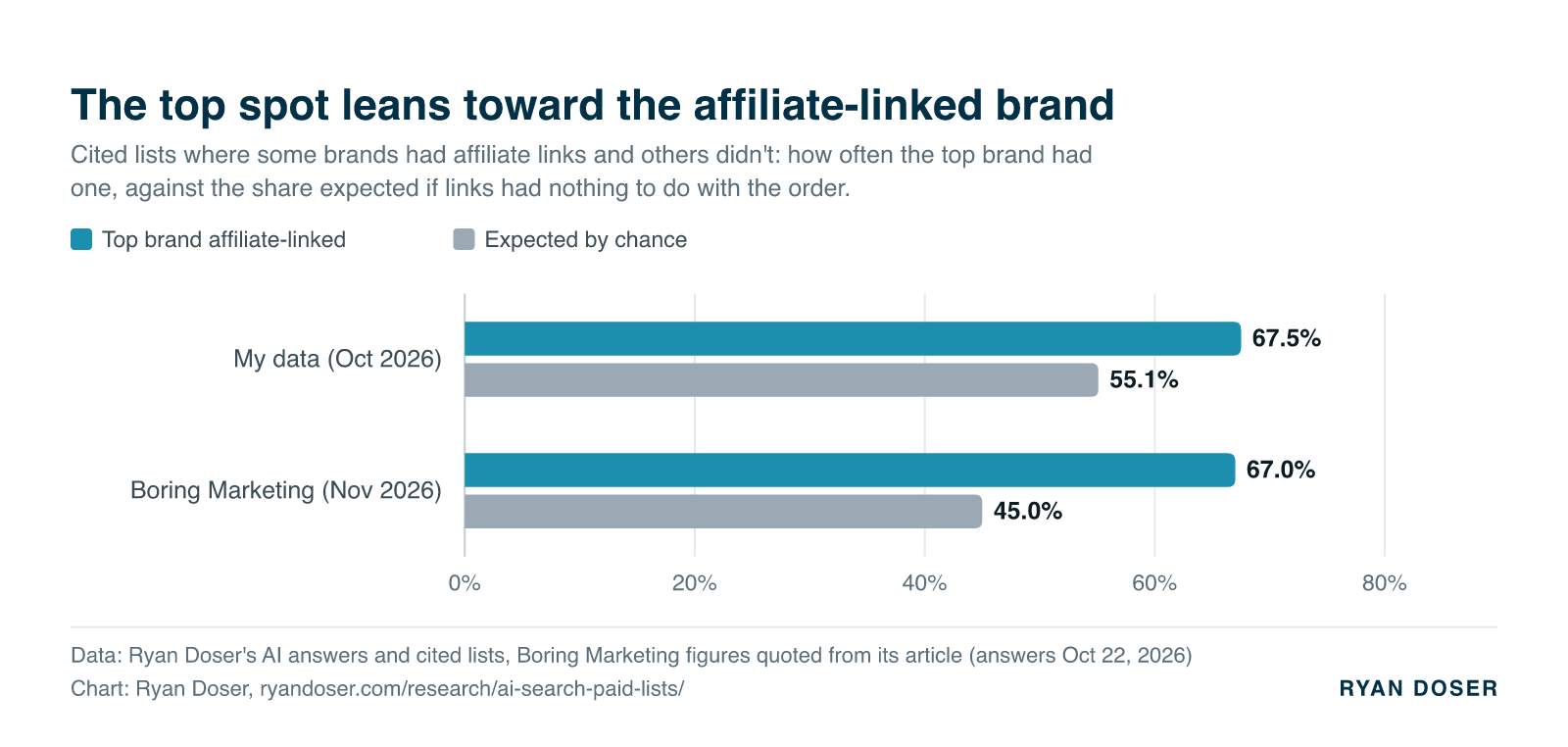
The top spot leans toward the affiliate-linked brand
Cited lists where some brands had affiliate links and others didn't: how often the top brand had one, against the share expected if links had nothing to do with the order.
- Top brand affiliate-linked
- Expected by chance
Show this chart as a table
| Dataset | Top brand affiliate-linked | Expected |
|---|---|---|
| My data (Oct 2026) | 67.5% | 55.1% |
| Boring Marketing (Nov 2026) | 67.0% | 45.0% |
The top spot went to a linked brand 67.5% of the time, close to Boring Marketing's 67%. The gap over chance was smaller, about 12 points against its 22, because more brands on my lists carried links to begin with.
A second test looks at list position instead: of 140 brands that appeared on lists where they were affiliate-linked and lists where they weren't, 59.3% ranked higher where they were linked, against Boring Marketing's 68% of 275. The samples differ, so treat it as a rough match.
Neither test shows that money moved a brand up. A publisher might link the products it already likes, so all the pattern says is that top spots tend to be affiliate-linked.
Big publishers mostly say so. 91.3% of list citations to big publishers (publisher and review sites in the Tranco top 10,000) carried affiliate or commission wording, close to Boring Marketing's 86%, against 64.2% for smaller independent sites.
Who Sells the Top Spot? Mostly Software Lists
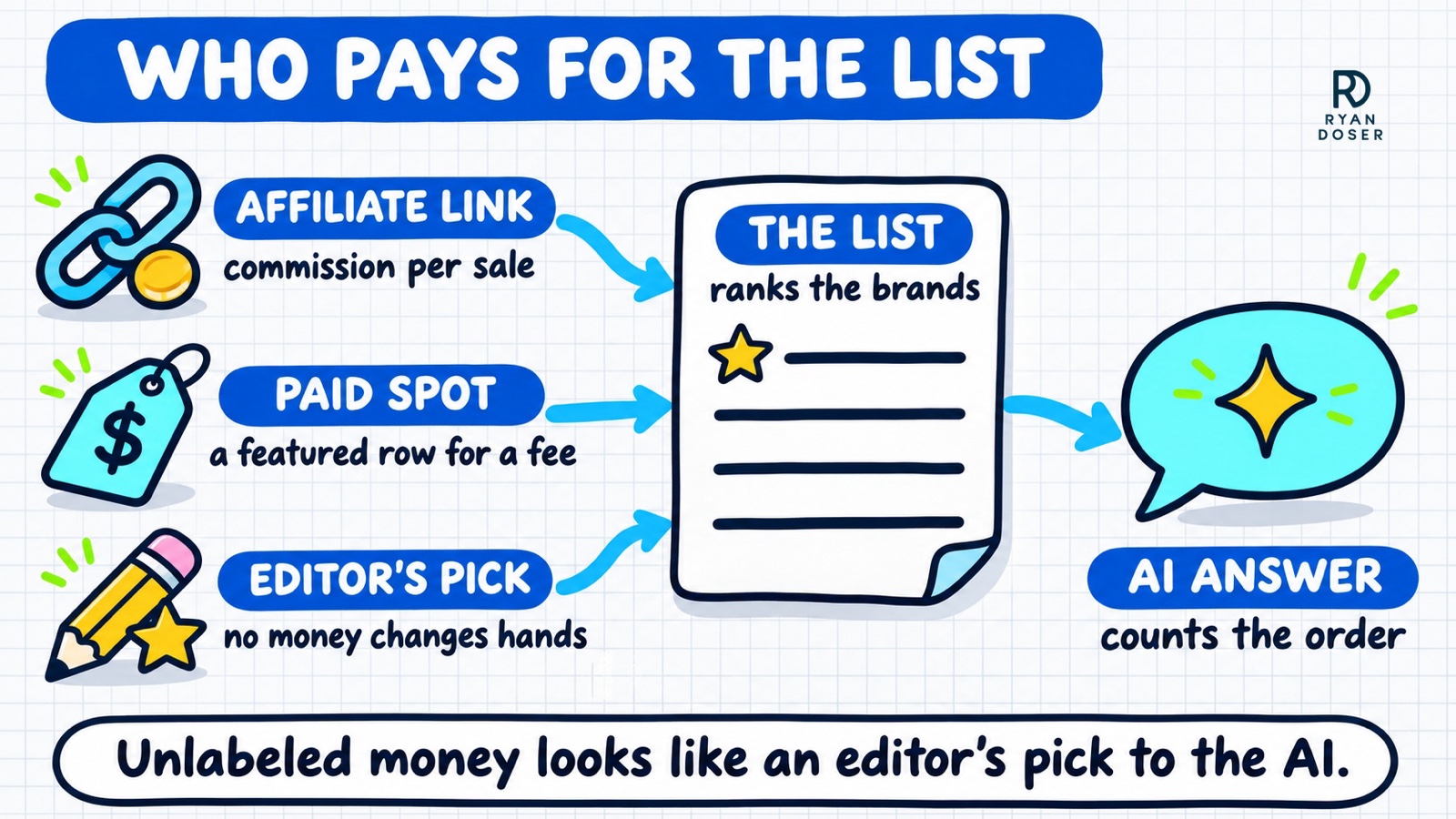
Boring Marketing found 93 of 390 comparison sites selling placement, reviews or ads, and 44 selling a numbered or featured spot outright. Its most common price for #1 was $149 a month.
I ran a lighter version on the independent list sites in my data, outside the 10,000 most visited sites. Code looked for advertise, sponsor or submit links on each homepage, and a Claude agent opened every offer page to confirm what it sells.
| Offer | Sites |
|---|---|
| Sells a ranked or featured spot | 6 |
| Sells paid listings | 2 |
| Sells ads or sponsorships only | 39 |
| Takes free submissions only | 4 |
Only 6 sold a ranked or featured spot on their offer pages, from 4 sellers, and 5 of them sit on business software lists. One charges $200 for 12 months for a row in the "Quick Picks" table at the top of a post, and the seller behind three of the sites offers a "Best-of listing" that is "Sold by position" and says its paid placements are labeled.
On the consumer side, 1 of 127 sites sold any kind of placement, a homepage "Featured This Week" spot starting at $2,499, while plenty sold plain display ads. My guess is that the spot market follows recurring software commissions, though this check can't prove why.
New Sites, Old Playbook
Boring Marketing counted 167 small comparison sites registered in 2026. My list sites show the same pattern a month earlier.
Of the 395 list domains with registration records, 50 were registered in 2026 and 25 in 2025, and the engines were already citing them on October 22. One earbuds site, rtings1.com, was registered on October 11 and cited 11 days later. It calls itself SoundGrade and says it runs "0 Sponsored rankings".
Each new site drew few citations, though. Sites registered since 2023 drew 133 of the 1,668 list citations, while sites outside the 100,000 most visited drew 597.
By my pre-registered measure, 35.9% of list citations went to small or new sites. Counted by brand spots (one brand's place on one list), the unit Boring Marketing used, it was 48.6% against its 64%, from a different sample, so treat the two as only loosely comparable.
I Ran the Same Test on My Own Lists
Fair is fair. I write "best X" lists too, so I ran the same affiliate rubric on every ranked list on ryandoser.com.
Of my 44 ranked posts, 9 put a pick I can earn a commission on at #1, and 8 of those are Blotato, a company I'm an affiliate for and do paid work for.
9 of my lists include me or my own products, at #1 three times: my newsletter, my community and my own marketing skills list, which says so up top. 4 of those self-ranking lists had no disclosure line, and neither did one list with affiliate links, my AI SEO tools post.
All five carry one as of today. I'm part of the market this page describes, so my rule for reading anyone's list, mine included, is to look for the test behind each pick, a dated price check and a clear note of who the writer works with.
Answers Move Between Runs
Boring Marketing asked each engine twice, 12 minutes apart, and the first pick changed 28% of the time. My October runs were about 9 minutes apart, and the first brand named changed in 6 of 61 pairs (9.8%), and 3 of 16 on ChatGPT.
The lists looked steadier in a small check. Of 12 sampled lists with an archived copy from on or before October 22, 1 had a different #1 by November.
That's the case for tracking AI visibility as a trend. Watch your share of the lists that show up for your questions, and don't grade your brand on one answer.
What to Do If Your Buyers Ask AI
In my data, about 4 in 10 citations on buying questions went to other people's ranked lists. So a good chunk of AI visibility work looks more like partnerships than markup.
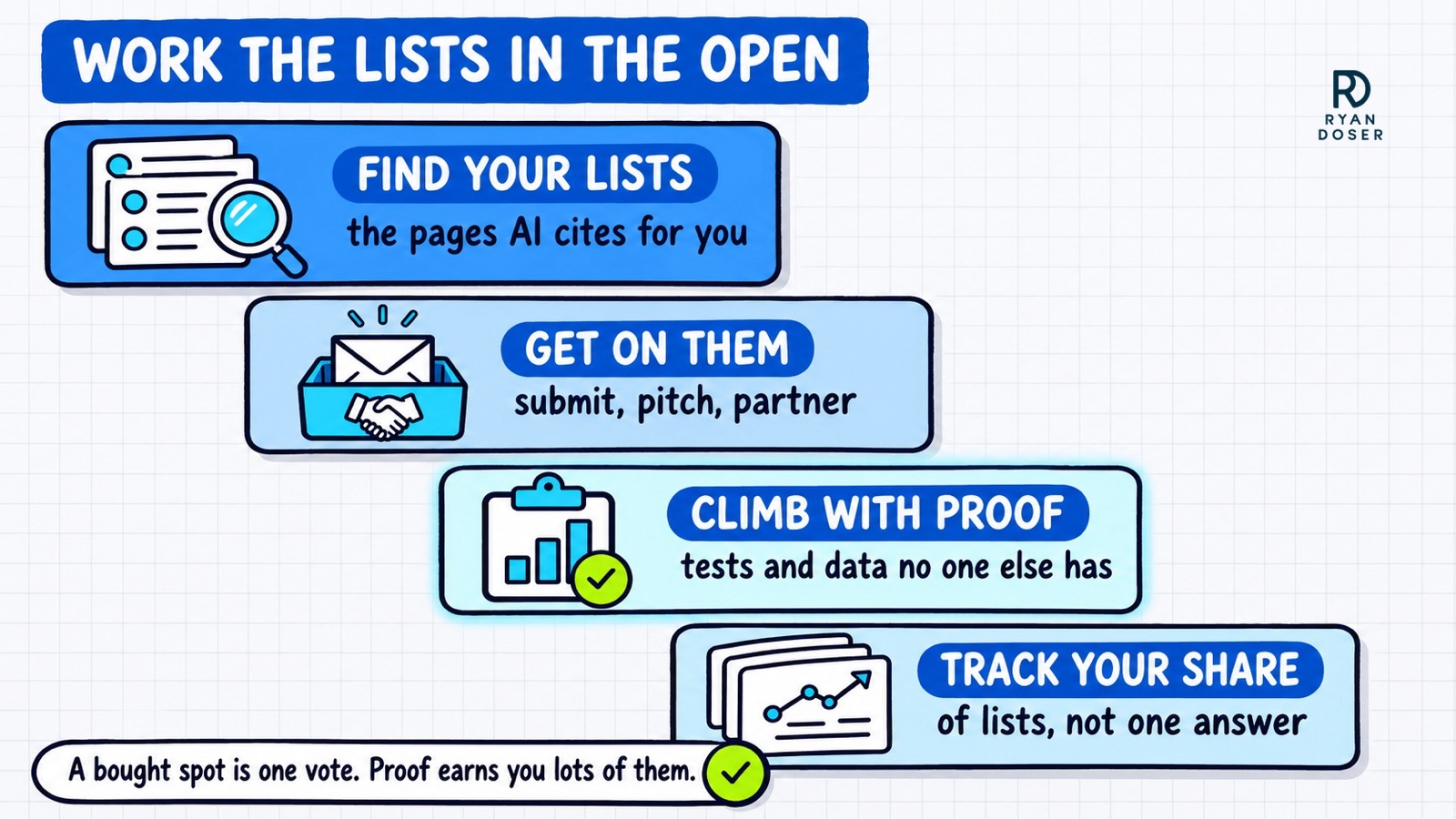
- Find your lists: ask ChatGPT and Google's AI Overviews your ten most valuable buyer questions, twice each, and record every cited list, who wrote it and how it makes money, since vendors write many of them, as I found in my AI visibility tools roundup. Boring Marketing's article includes a prompt that turns the cited links into that table.
- Get on them: Boring Marketing calls publishers' lists affiliate businesses and suggests an affiliate program on the networks they use, plus a test account for their writers. Some independent sites take submissions (6 of 295 in my data, 2 of them paid), and it suggests a co-marketing ask for company blogs that rank a neighboring category.
- Climb with proof: pitch the "best for" slot you honestly win, with a test or data only you have. That's what I look for when I rank tools.
- Track your share: measure your average spot across each question's lists every few weeks, since single answers swing between runs.
- Skip the noise: bought #1 spots, labeled or not, one-run visibility scores, and llms.txt as an AI ranking lever. Boring Marketing saw brands with an llms.txt named first 18% of the time when named, against 20% without.
Local businesses play a different version of this game, which I covered in how to get ChatGPT to recommend your business.
It's 2010 Again, and That Ended Badly Once
Boring Marketing compared this to search before Google's Panda update hit content farms in 2011 and Penguin hit paid links in 2012. I think that's right.
AI answers track the lists, and some lists are for sale. Earn your spots in the open, because spots bought on thin sites are a bet that the engines never start discounting them.
How This Page Was Built
- Source study. Boring Marketing asked 130 buying questions on 7 AI engines, twice, on November 21, 2026, and read 2,818 cited lists, the code of nearly all of them and the advertise pages of 390 comparison sites. Its data isn't public, so every Boring Marketing figure here is quoted from its article, and none is recomputed.
- My data. The answers come from my AI SEO strategy study: 100 buying questions in 10 categories (CRM, project management, accounting, payroll, email marketing, cameras, earbuds, mattresses, running shoes, vacuums), asked on ChatGPT, Claude, Gemini and Perplexity through their APIs and on Google's AI Overviews, from the US on October 22, 2026. The tests use the first run of each answer.
- Plan first. Before any new number was computed, I wrote down each test, its unit and a pass mark of my own choosing (for example, the list-leader test "replicates" at 35% or more and at least three times chance). A manager-review agent read the plan and added a drift check and a wider self-audit.
- Lists. A "list" is a cited page my October labels marked as a best-of list or an alternatives page. Those labels filed every page on a brand's own site as a vendor page, so company-blog lists aren't counted here, which Boring Marketing found held 37% of brand spots in its data. Claude agents fetched 820 of 982 cited lists (83.5%) on November 23, 2026, and code read each list's brand order from its headings, dropping the subject brand of an alternatives page.
- List-leader test. Each list's #1 scores 1 point, its #2 half a point, and so on, summed across an answer's cited lists. A hit means the top scorer, with no tie, is the first brand the answer names (brands named in the question don't count). Answers needed two or more readable lists, which left 233 answers on 60 questions. The 95% range comes from resampling questions.
- Affiliate test. Code flagged links in each brand's section that run through affiliate networks, carry affiliate tags or use the site's own redirect links. Links added by scripts after a page loads are invisible to it, and the blind check below found 4 affiliate links it missed and no false flags, so the affiliate counts lean low.
- Reliability. A separate Claude model with no tools read a code-built outline of each of 50 random lists (its headings, plus up to 8 links under each) and named the top brand and whether it was affiliate-linked, without seeing the code's answers. The first two rounds failed the 45-of-50 bar (34 of 47, then 42 of 50 on the top brand), so the parsing rules were fixed and a fresh sample was drawn each time. The final round agreed on 46 of 50 top brands and 45 of 50 affiliate flags, with both matching on the same list 42 times. That measures agreement between two automated reads, not proven accuracy.
- What changed along the way. An early run put the affiliate gap at 9.2 points, against 12.4 in the final run. Most of that move came from fixing how alternatives pages drop their subject brand: the early page reads, run through the corrected analysis, give 12.8.
- Timing. The answers are from October 22 and the lists were read on November 23. For the 50-list sample, I compared against Wayback Machine copies from August 22 to October 22 (on or before the answer date) where they existed: 1 of 12 comparable lists had a different #1 and none changed whether its #1 was affiliate-linked.
- Small and new sites. Small means outside the Tranco top 100,000 (list 8PW6V, November 22, 2026), and new means registered in 2023 or later by RDAP records. The pre-registered measure is the share of list citations, and the brand-spot share is added because that's the unit Boring Marketing counted. 395 of 430 list domains returned a registration date.
- Placement offers. For 295 independent list sites (outside the Tranco top 10,000), code collected homepage links offering ads, sponsorships, listings or submissions, and a Claude model read every linked offer page and recorded what it sells. One site was moved from "ranked spot" to sponsorship after its offer page said the sponsor's position doesn't change. Free submissions are counted apart from paid offers.
- Disclosure. I'm an affiliate for Blotato and do paid work for it, I'm an affiliate for other tools on my own lists, and my business sells Claude Code products. Claude agents did the fetching, labeling and checks. My own sites and client sites are kept out of every figure except the self-audit.
AI Search and Paid Lists FAQs
How does ChatGPT choose which brands to recommend?
For buying questions it usually searches the web, reads "best X" and "alternatives" lists, and often names the brand those lists rank highest first. In my data, the brand that led an answer's cited lists was named first in 54.2% of ChatGPT answers and 40.8% across five engines, against 8.0% by chance.
Can you pay to get recommended by ChatGPT?
Not directly, but you can pay the lists it reads. Affiliate-linked brands sat at the top of cited lists more often than chance in both datasets, and some list sites sell featured spots. Boring Marketing found lists from sites that sell spots, take submissions or mention sponsored placement matched the AI's pick as often as other lists, while spots labeled as ads rarely carried into answers.
Do affiliate links affect AI recommendations?
They line up with the order of the lists AI cites. On cited lists where some brands had affiliate links and others didn't, the top brand had one 67.5% of the time in my data, against 55.1% if links had nothing to do with the order. That shows where the money sits, not that it caused the ranking.
Is buying a top spot on a best-of list worth it for AI visibility?
I wouldn't. A bought spot is one list among many, an unlabeled one is undisclosed advertising, and the sites selling them could lose ground if AI engines start discounting them. Earning spots with real tests and data is the safer bet if that happens.
How do I find the lists AI cites in my category?
Ask ChatGPT and Google's AI your buyers' top questions, twice each, and record every cited "best X" page. Then note who writes each list, how it makes money and where you rank, and track your share of those lists over several weeks.
Cite This Page
You're welcome to use any chart or table here with a link to this page. Please keep the dates with any figure and credit Boring Marketing for the findings this page tests.
Doser, R. (2026). Is AI search pay-to-play? I re-ran the test on 100 buying questions. ryandoser.com. https://ryandoser.com/research/ai-search-paid-lists/. Tests findings from Boring Marketing, "We Followed the Money Behind 1,804 AI Answers" (2026), https://x.com/boringmarketer/status/2124924162825138598
Chart images
Each chart below is a 1600-pixel PNG with its title and source line built in.
- How often AI named the list leader first, by engine (PNG)
- How often the top brand on a cited list was affiliate-linked (PNG)
Findings tested: "We Followed the Money Behind 1,804 AI Answers: What Actually Gets Your Brand Picked" by Boring Marketing, published November 23, 2026. It says its full findings, data and list of sites selling spots will be posted at boringmarketing.com.