
Ryan Doser research · Analysis · Source data published November 19, 2026
ChatGPT vs Claude vs Gemini for Marketing: The Judge Picks the Winner
Boring Marketing just published a mostly blind test of AI marketing work, scored with 4,774 AI judge votes on social posts, ads, YouTube packaging and 15 deeper jobs. For my analysis, Claude agents re-cut its data by who did the judging, and the copywriting winner switched from GPT-6.2 Sol to Claude Opus 5.5 when the judges changed.

- 4,774 judge votes
- 35 brands
- 15 deeper jobs
Free to use with a link to this page. Press questions: [email protected]
On this page
Source data: "Which AI makes the best marketing for real brands?" by Boring Marketing, published November 19, 2026, with new cuts and takeaways on this page.
Which AI Is Best for Marketing? The Answer Moved With the Judges
Here's the short answer for anyone weighing ChatGPT vs Claude vs Gemini for marketing: each model won different jobs, and the copywriting winner changed with the judges.
Boring Marketing gave OpenAI's GPT-6.2 Sol, Anthropic's Claude Opus 5.5 and Google's Gemini 4 Neon the same facts about each brand. AI judges then picked the better piece, blind and in both orders.
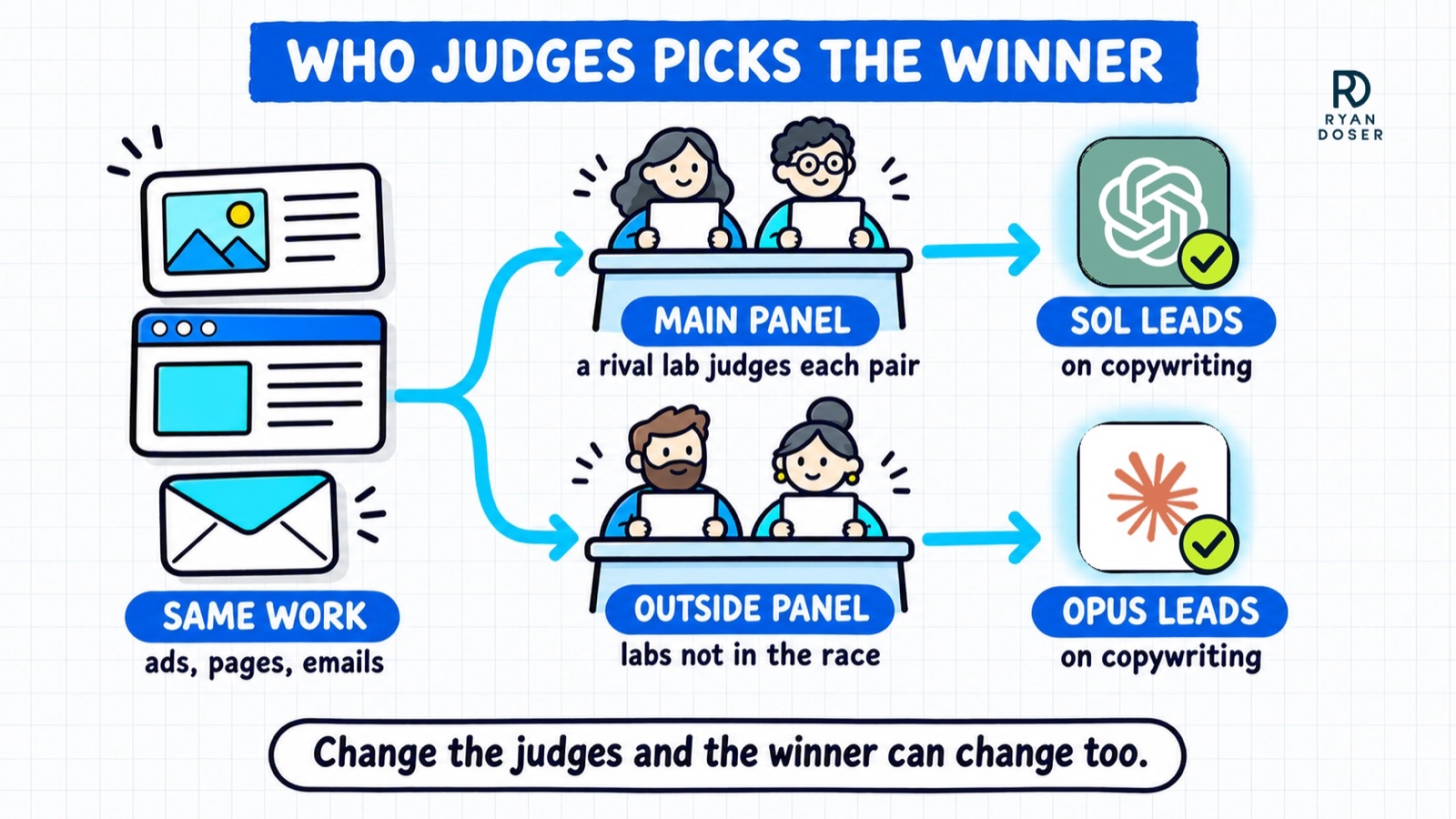
Its main panel, whose votes put Sol first across the 15 jobs, judges each matchup with the one lab that isn't in it. So every Claude-vs-GPT matchup on that panel was judged by Google's Gemini 4 Carbon.
Boring Marketing flagged the risk itself: "The council judges each pair with the one lab that isn’t in it, so a judge’s taste can look like a model’s strength."
It then had judges from labs outside the race re-judge every pair. They agreed with the main panel on most single matchups and still crowned a different copywriting leader.
Key findings
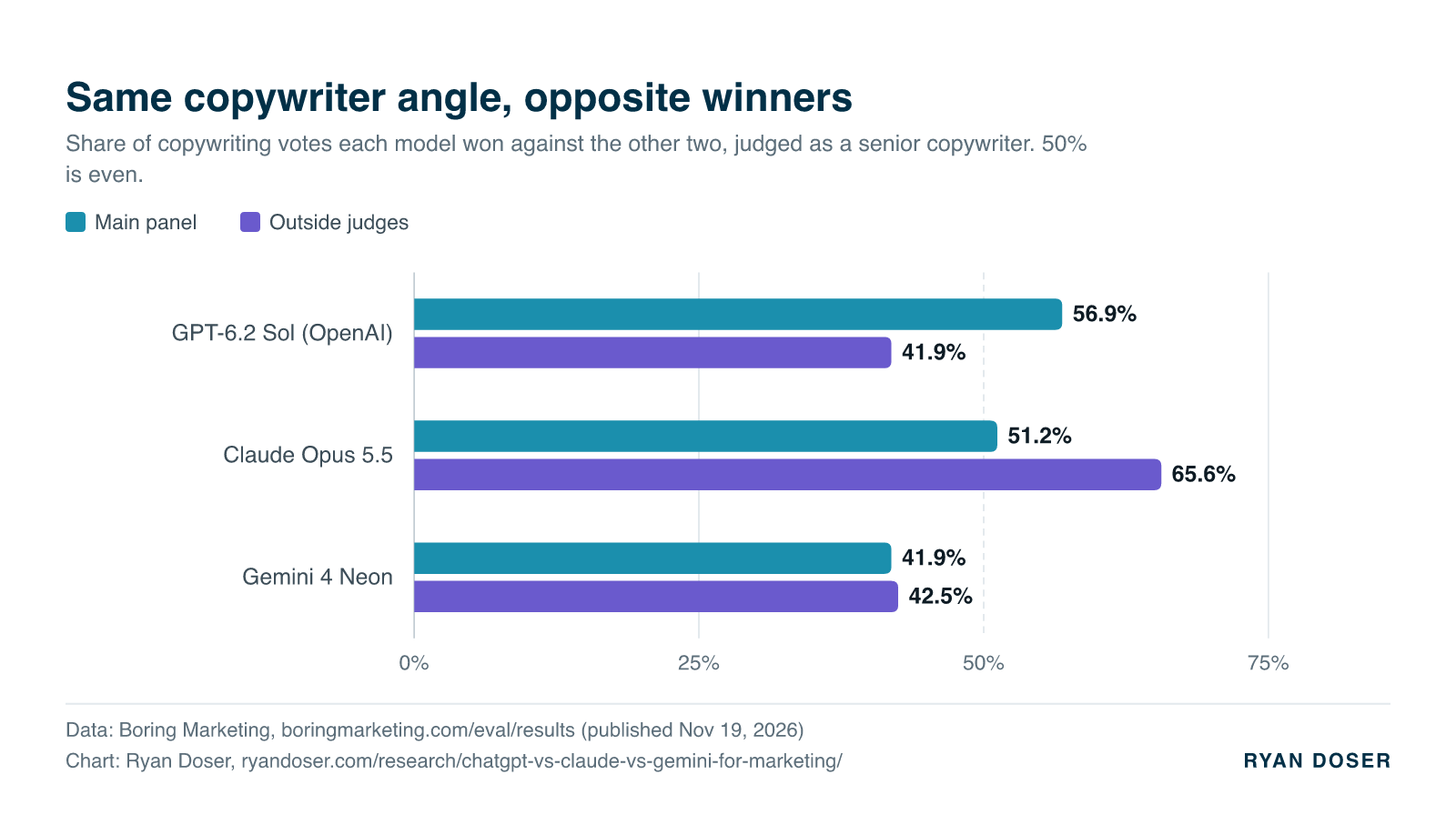
- On copywriting judged as a senior copywriter, the main panel put GPT-6.2 Sol first (56.9% of its votes won) and outside judges put Claude Opus 5.5 first (65.6%).
- On the 9 jobs both panels judged from the same angle, the top model changed on 3: welcome emails, positioning briefs and pages to rank. Claude Opus 5.5 took all three.
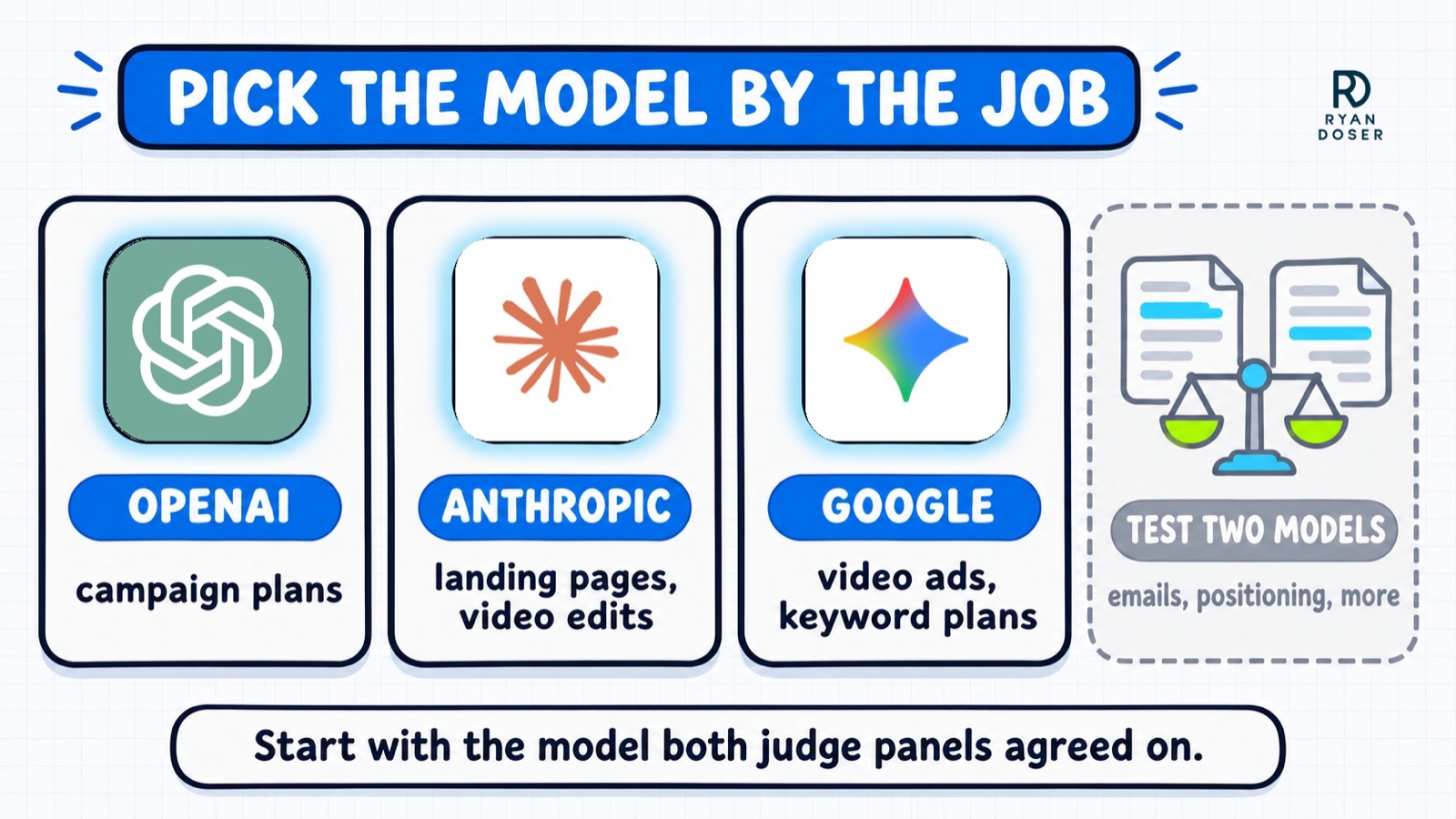
- On those same-angle jobs, some picks held with both panels: Sol on campaign plans, Opus on landing pages and video edits, and Gemini 4 Neon on video ads and keyword plans.
- Against a brand's proven winner, judges picked the AI version 19.2% of the time across channels but 46.4% on YouTube titles and thumbnails, in comparisons that weren't blind.
Swap the Judges and the Best Copywriter Changes
The outside panel used Kimi K3.1 Pro and Qwen 4 Max, two models from labs with nothing in the race. On copywriting it judged as a senior copywriter, so the fair comparison is the main panel's copywriter scores.
Same copywriter angle, opposite winners
Share of copywriting votes each model won against the other two, judged as a senior copywriter. 50% is even.
- Main panel
- Outside judges
Show this chart as a table
| Model | Main panel | Outside judges |
|---|---|---|
| GPT-6.2 Sol (OpenAI) | 56.9% | 41.9% |
| Claude Opus 5.5 | 51.2% | 65.6% |
| Gemini 4 Neon | 41.9% | 42.5% |
Outside judges were hardest on Sol's short copy. Counting each model's votes against both rivals, Opus won 82.8% on headlines to Sol's 21.9%, and 89.1% to 37.5% on rewriting a brand's flop.
| Area | Main panel | Outside judges |
|---|---|---|
| Deep work (pages, emails, briefs, plans, video and carousel ads) | GPT-6.2 Sol 62.5% | GPT-6.2 Sol 57.8% |
| Copywriting, judged as a senior copywriter | GPT-6.2 Sol 56.9% | Claude Opus 5.5 65.6% |
| Search, judged as an SEO strategist | Gemini 4 Neon 66.1% | Gemini 4 Neon 62.5% |
| Video editing | Claude Opus 5.5 76.9% | Claude Opus 5.5 73.1% |
Search and video editing kept their leaders. In deep work, Sol kept only a half-point edge with outside judges (57.8% to 57.3% for Opus), and the source's own ratings already call the two statistically tied there.
| Job | Main panel | Outside judges | Result |
|---|---|---|---|
| Landing pages | Opus 62.5% | Opus 65.6% | Same |
| Welcome emails | Sol 68.8% | Opus 71.9% | Changed |
| Positioning briefs | Sol 75.0% | Opus 81.2% | Changed |
| Campaign plans | Sol 90.6% | Sol 98.4% | Same |
| Video ads | Gemini 75.0% | Gemini 78.1% | Same |
| Carousel ads | Tie: Sol and Gemini 56.2% | Gemini 65.6% | From a tie |
| Long sales pages | Sol 78.1% | Sol 65.6% | Same* |
| Headlines (10 per brand) | Opus 59.4% | Opus 82.8% | Same* |
| Google search ads | Gemini 69.8% | Gemini 76.6% | Same* |
| Cold emails | Sol 91.7% | Opus 78.1% | Differs* |
| Product descriptions | Gemini 56.2% | Opus 65.6% | Differs* |
| Rewriting a brand's flop | Opus 65.6% | Opus 89.1% | Same* |
| Keyword plans | Gemini 71.9% | Gemini 68.8% | Same |
| Pages to rank | Gemini 58.3% | Opus 60.7% | Changed |
| Video edits | Opus 76.9% | Opus 73.1% | Same |
* Copywriting jobs. The outside panel judged them as a senior copywriter, while the main panel's job scores average three angles, so treat those rows as a looser comparison.
On the same matchup, the outside panel's majority picked the same winner as the main panel 87% of the time on copywriting and 89% on deep work. That still leaves about 1 in 8 copywriting matchups going the other way, and the overall copywriting leader flipped.
The outside panel isn't proven to be the better judge either. In Boring Marketing's judge tryout, Kimi K3.1 Pro picked the winner 59% of the time, below the 61% you'd get from always picking the shorter piece.
My Own Model Tests Hit the Same Wall
My own model tests use jobs from my business, with each contestant writing from the same brief and blind AI judges ranking the results. On September 24, the Claude judge put the two Claude posts first and second, the GPT judge put the two GPT posts first and second, and the launch emails split the same way.
My guess is that each family's house style gives it away, even blind. The main panel's setup sidesteps that by never letting a judge rate its own lab's model.
On October 1, all three of my judges ranked Opus first and GPT-6.1 Sol third on YouTube titles and a LinkedIn post, the GPT judge included. One of those judges was Opus itself, so I count it as a weak signal.
Family bias looked weaker that round. In both rounds, though, my Claude contestants could also see my workspace instructions, so neither test can settle which model writes better.
Email is where both sources wobble. GPT-6 Sol won my September launch email by a nose, and in October Sonnet won on average rank, though Claude and GPT judges alone had a three-way tie.
The two panels split on welcome emails too.
My tests are small, with two or three judges and older Sol versions. Treat them as a gut check.
Which AI to Use for Each Marketing Job
The most useful output here is a routing table. Where both panels agreed, start with that model.
Where they split, run two models and pick.
| Start with | Jobs where both panels agreed from the same angle |
|---|---|
| GPT-6.2 Sol (OpenAI) | Campaign plans |
| Claude Opus 5.5 | Landing pages and Video edits |
| Gemini 4 Neon | Video ads and Keyword plans |
| Lighter picks* | Sol for long sales pages, Opus for headlines (10 per brand) and rewriting a brand's flop, Gemini for Google search ads |
| Test two models | Welcome emails, Positioning briefs, Carousel ads, Cold emails, Product descriptions and Pages to rank |
* Copywriting jobs where both panels picked the same model but judged from different angles, so treat them as a lighter recommendation.
Price is a small factor at this level. Averaged from Boring Marketing's per-job cost table, a piece cost about $0.04 with Sol, $0.10 with Opus and $0.21 with Gemini.
Your editing time costs far more than any of those. If you already run a skills setup like the one in my post on Claude Code for marketing, routing by job is a small change to each task.
On YouTube, Judges Rated AI Closest to the Brands' Own Work
The test also put each AI piece up against the brand's own version, half proven winners and half flops. A proven winner kept running for months or got at least 3 times the views or engagement of a similar piece.
Against those winners, the AI version took 7.9% of votes on Instagram, 4.8% on X and 46.4% on YouTube titles and thumbnails.
Against the brands' YouTube flops, the AI version won 73.0%. These comparisons weren't blind, and Boring Marketing reported that judges asked which piece was AI-made were right 98% of the time.
My hunch is that YouTube packaging follows patterns a model can learn, like a clear promise and a readable thumbnail. This test doesn't prove that, and judges aren't viewers.
So let AI draft your title options and thumbnail concepts, then let viewers pick with a title or thumbnail test.
AI Judges Liked Hooks the Brands' Winners Rarely Used
Every piece was labeled by its opening hook, and the test kept 55 proven winners and 55 flops from the brands' own accounts. The source shows the judge votes and the actual results separately, and side by side they disagree.
| Opening hook | Judges picked it | Brand winners | Brand flops |
|---|---|---|---|
| A question | 58.5% of 94 | 4 | 2 |
| The outcome | 55.9% of 118 | 4 | 2 |
| A pain or problem | 54.0% of 50 | 0 | 5 |
| A number | 51.6% of 64 | 4 | 5 |
| A command | 47.6% of 124 | 4 | 5 |
| The product's name | 46.4% of 138 | 11 | 10 |
| A curiosity gap | 45.8% of 24 | 6 | 5 |
| A story or scene | 32.4% of 34 | 2 | 2 |
| News | 32.1% of 28 | 6 | 4 |
Pain-point hooks won 54.0% of those judge votes, yet none of the labeled winners opened with one and 5 flops did. The sample is small and can't separate the hook from the brand or offer, so treat it as a warning sign.
Prediction is the bigger problem. Before judging, Boring Marketing tested which models could spot the winner in pairs with known results, and the best one managed 69%, against 61% for always picking the shorter piece and 57% for GPT-6.2 Sol.
How to Test AI Models on Your Own Marketing
You can run a smaller version of this test on your own jobs.
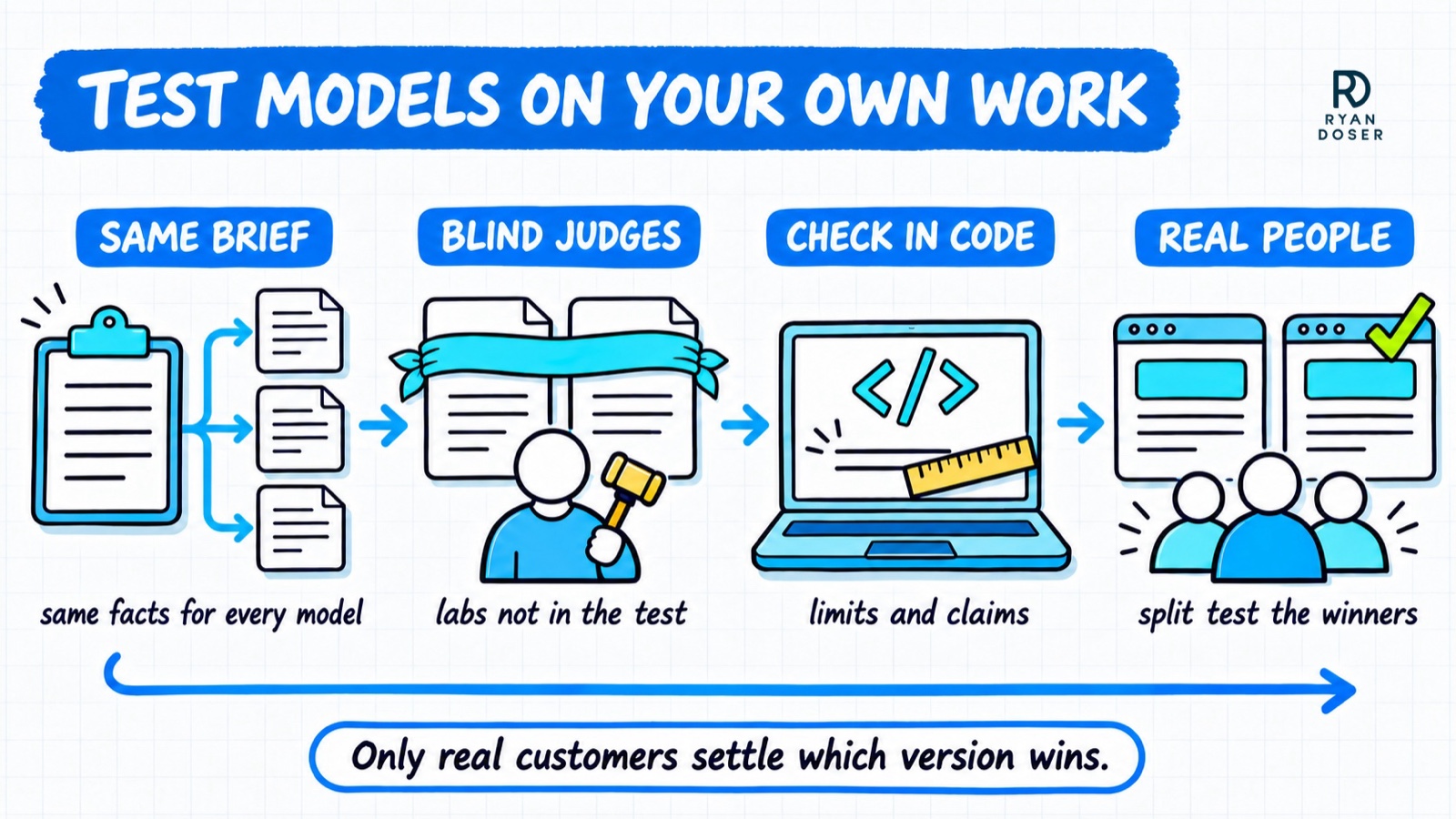
- Give every model the same brief. Use the same facts and rules so the only thing that changes is the model.
- Keep judges away from their own family. Use judges from labs whose models aren't in the test. Hide the names and show each pair in both orders.
- Check limits in code and claims against your facts. Across its 110 social posts, ads and YouTube videos, Boring Marketing found only 51% of Opus pieces, 74% of Sol pieces and 39% of Gemini pieces fit their platform's text limits, against 71% of the brands' own pieces.
- Let customers settle it. Boring Marketing has a live sign-up test set up for each model's rewrite of its free playbook sign-up screen, with no results posted as of November 20.
The Judge Is Part of the Result
No single model wins marketing, and no single AI judge settles it.
Pick by job and test with customers. Then get suspicious of any AI leaderboard that won't tell you who did the judging.
How This Page Was Built
- Source data. Boring Marketing generated every piece and ran every judge, then published its results page and data file on November 19, 2026, with the search and video-editing sections stamped November 20. It tested the models directly, with deep work and copywriting at high reasoning effort and social pieces at each model's default, so the ChatGPT, Claude and Gemini apps may behave differently.
- The two panels. The main panel (Claude Fable 5.2, GPT-6.2 Astra and Gemini 4 Carbon) judges each matchup with the one lab that isn't in it. The outside panel (Kimi K3.1 Pro and Qwen 4 Max) re-judged every pair with the same inputs, as a copywriter on copy jobs and as an SEO strategist on search jobs.
- Matching the angles. To compare like with like, this page uses the main panel's copywriter scores for copywriting and its SEO-strategist scores for search. The data file has no per-job copywriter scores for the main panel, so the six copywriting rows in the job table are a looser comparison.
- What was recomputed. Claude agents downloaded the data file on November 20 and recomputed, for my analysis, every job and area share for both panels, the panel agreement rates, the AI-vs-brand rates and the hook table. A script checks each of those that Boring Marketing also printed against its page.
- What was quoted. The judge tryout scores, the platform-fit rates, the 98% detection rate, the "statistically tied" verdict on deep work and the per-job costs appear only on Boring Marketing's page. The cost per piece here averages its 15 per-job costs.
- Definitions. A model's share is the votes it won against the other two models, so 50% is even. Pairs were judged in both orders with ties allowed, and Boring Marketing doesn't say how ties count, so the shares are as its data file reports them.
- Disclosure. My business sells Claude Code products, and Claude is one of the models tested. Claude agents did the data work for my analysis, and the outside panel's verdict favors Claude, so weigh my framing with that in mind.
ChatGPT vs Claude vs Gemini for Marketing FAQs
Is ChatGPT, Claude or Gemini best for marketing?
It depends on the job and on who judges it. On copywriting, the main panel put OpenAI's GPT-6.2 Sol first and outside judges put Claude Opus 5.5 first, while Gemini 4 Neon led video ads with both and search when judged as an SEO strategist.
Which one is better for marketing, Claude or Gemini?
Claude Opus 5.5 scored above Gemini 4 Neon on copywriting and video edits with both judge panels. Gemini won video ads and keyword plans with both, including 75.0% of main-panel votes on video ads, which makes it the first model to try for video ad concepts.
Is ChatGPT good at marketing?
OpenAI's GPT-6.2 Sol cost the least at about $0.04 a piece and led both panels on 30-day campaign plans. Outside judges liked its headlines and rewrites far less than Claude's, and a chat app may not match these direct model results.
Can AI judge which marketing copy will perform best?
Not reliably in this test, so treat AI judge scores, often called LLM-as-a-judge, as a filter for drafts. In Boring Marketing's tryout, the best judge picked the piece that won with customers in 69% of pairs, against 61% for the simple rule "the shorter one wins," so use a split test to pick the winner.
What is the best AI for copywriting?
In Boring Marketing's test, it depends on the judge. Judged as a senior copywriter, the main panel put GPT-6.2 Sol first at 56.9% of votes won and outside judges put Claude Opus 5.5 first at 65.6%, so test both on your own copy before you commit.
Cite This Page
You're welcome to use any chart or table here with a link to this page. Please credit Boring Marketing for the underlying data and keep the date with any figure.
The votes came from AI judges, so say so when you cite them.
Doser, R. (2026). ChatGPT vs Claude vs Gemini for marketing: the judge picks the winner. ryandoser.com. https://ryandoser.com/research/chatgpt-vs-claude-vs-gemini-for-marketing/. Data: Boring Marketing, "Which AI makes the best marketing for real brands?" (2026), https://boringmarketing.com/eval/results
Chart images
The chart below is a 1600-pixel PNG with its title and source line built in.
Source data: "Which AI makes the best marketing for real brands?" by Boring Marketing, published November 19, 2026. Its full results page has every prompt and every judge's vote with its reason.