
Opus 5.5 vs GPT-6: Best AI Model of 2026?
Opus 5.5 vs GPT-6 became the question of the month on September 22, when Anthropic and OpenAI shipped Claude Opus 5.5 and GPT-6 Sol on the same day, so I put both against Meta Muse on the marketing work I actually do.
Watch Me Run Opus 5.5 vs GPT-6 on Real Marketing Work
This episode of AI Rabbit Holes is a livestream with Aaron Makelky, who teaches AI to people who don't write code and tests these models as hard as I do.
It picks up a week after our open source AI models episode, where we ran a similar landing page test on cheaper models.
Partway through, I pulled up the side-by-side test I run every time a new model ships. One landing page, one launch email, five models, no branding direction beyond the page itself.
Aaron runs OpenAI's cheaper Luna models for his everyday background work, and I run Opus 5.5. The blind judges disagreed with me too, and that turned out to be the most useful result.
If you want to build a model test like this for your business, my Claude Code Skills Stack includes the Skill Creator I use to turn any repeat job into a reusable skill.
My Opus 5.5 vs GPT-6 Verdict for Marketing Work
My call is simple. Opus 5.5 stays my daily driver, and GPT-6 Sol is the model to test first if you pay API rates for high-volume copy.
The tiebreaker is voice in my real setup. On the short blog post test, Opus 5.5 used one hypothetical "I'd" and zero soft contrast lines, while GPT-6 Sol used nine and three.
Opus ran inside my workspace with my writing rules loaded, and Sol saw only the brief, so this is not a neutral count. It is how I actually run a daily driver, though, and Opus followed those rules with almost no hedging.
Hedges and contrast lines are the first things I cut from any draft, so fewer of them means less editing before anything ships.
Sol wins on cost. Its list rates are half of Opus 5.5's, and the judges' average put its launch email slightly ahead, so it deserves a real trial for volume work.
The video title says Opus 5.5 blew me away, and that is about the jump from Opus 5, which I found hard to write with. That story lives in my Opus 5 vs Opus 5.5 writing test.
Daily Driver vs Orchestration Model: Stop Asking for One Winner
Most model debates compare the wrong tier. The benchmark king is rarely the model you should run all day.
My split sorts work models into two jobs. The orchestration model is the heavyweight, and right now that means Fable 5.1 or GPT-6 Astra.
Use either one for daily work and you can burn through your plan's limit in an hour or two, depending on the plan. Aaron's framing is that this tier writes the plan or does the design work, then hands execution to something cheaper.
A daily driver does the volume. For my solo operation that means packaging YouTube videos, writing emails and doing SEO work for clients, so it needs quality and token efficiency at once.
Opus 5.5 is my number one daily driver right now. GPT-5.6 Sol held the slot before it, and Opus 4.8 before that.
In my opinion, at least for my outputs, Opus 5.5 raised the quality bar over Opus 5 and got more token efficient too. Anthropic says Claude Opus 5.5 costs less per token than Opus 5 and uses fewer tokens per task, which it puts at a 40% drop in costs.
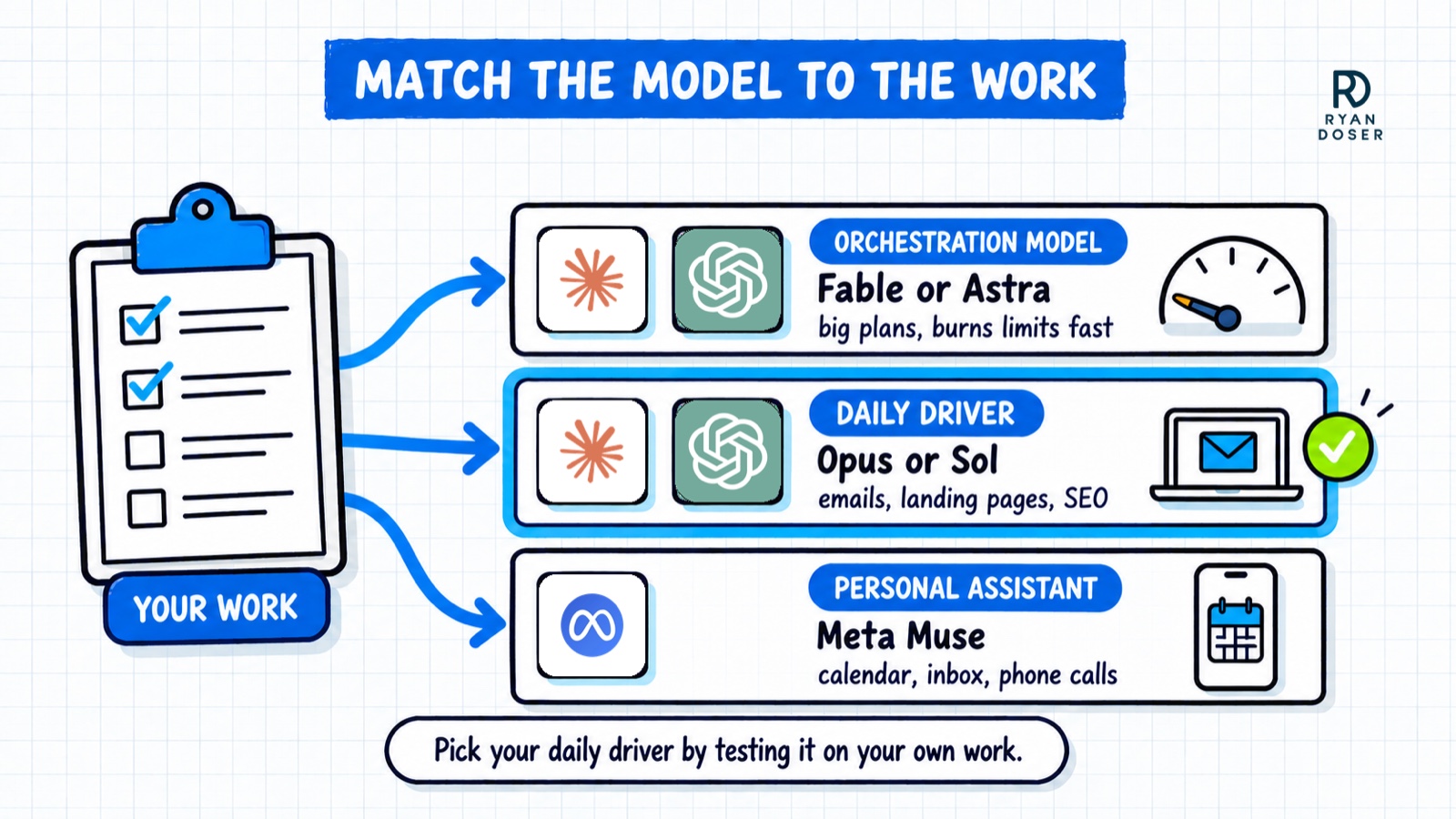
That split is why the Opus 5.5 vs GPT-6 question only matters for the daily driver slot.
Opus 5.5 vs GPT-6 on Paper: The Leaderboard and the Price Tag
The leaderboard and the price tag tell different stories, and they don't even feature the same GPT-6 model.
OpenRouter's Discover models page shows a frontier chart built on the Artificial Analysis intelligence index.
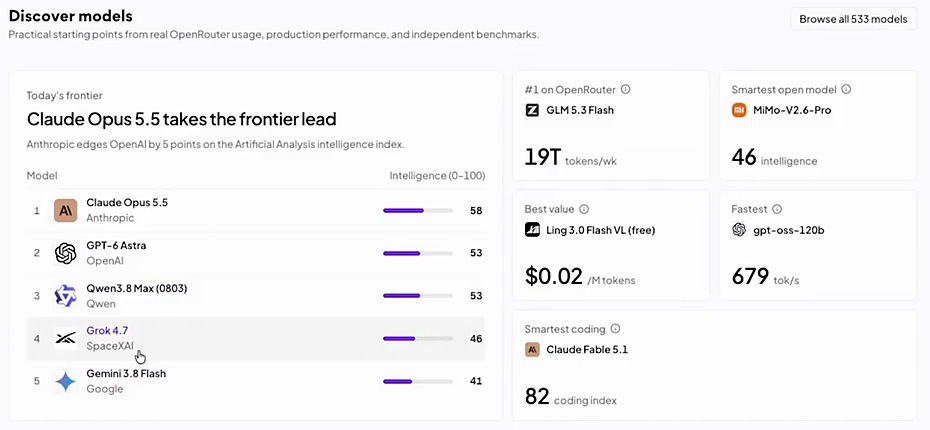
When we recorded, Claude Opus 5.5 sat first at 58, with GPT-6 Astra and Qwen3.8 Max tied at 53. The headline read "Claude Opus 5.5 takes the frontier lead."
Price flips the story. On the API, Opus 5.5 lists at $4 per million input tokens and $20 per million output, while GPT-6 Sol lists at $2 and $10 on OpenAI's standard tier.
On list rates for uncached input and output, that makes Sol half the price of Opus 5.5 as of September 28, 2026. Cached and long-context rates differ, and both labs move prices often, so read the live pricing pages before you budget.
The Landing Page Test: Meta Muse Wrote the Standout Headline
The model I expected the least from wrote the line that stood out to me most.
The page was my live landing page for The AI SEO System, which Opus 4.8 originally built. Five models got the same page and one instruction: make it drive as many conversions as possible.
Opus 5.5 kept my screenshots and gave me a lime buy button that jumps off the page. My first reaction was that I liked it, apart from a few logo colors.
GPT-6 Sol went darker and much shorter, 1,324 words against the original's 2,673, with only two testimonials.
Then Meta's Muse model, the API version rather than the Muse app, opened with this.
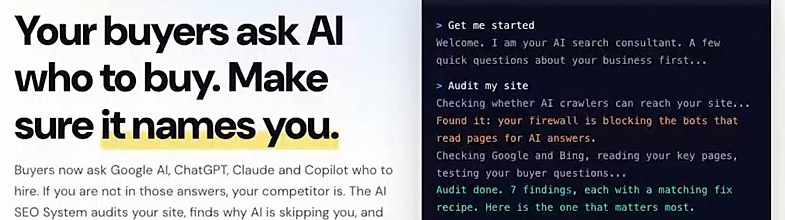
"Your buyers ask AI who to buy. Make sure it names you." That first sentence above the fold is what really stood out to me when I first scrolled the five pages.
Aaron went further on the details. He liked the glow on the checkout button and the full-color client logos on a single line, calling a few choices "empirically better than Claude Opus 5.5."
He added the qualifier himself: "I'm not going to say overall better."
GPT-6 Astra drifted furthest off brand, which it also did in my previous round of tests.
Every page was usable with a few tweaks. For landing pages, the Opus 5.5 vs GPT-6 gap in my test was small.
The Launch Email Test: My Eye Said Opus, the Judges' Average Said Sol
If the subject line misses, most people never read the rest of the email.
So the second round was a short launch email for the same product, and I judged the subject line first.
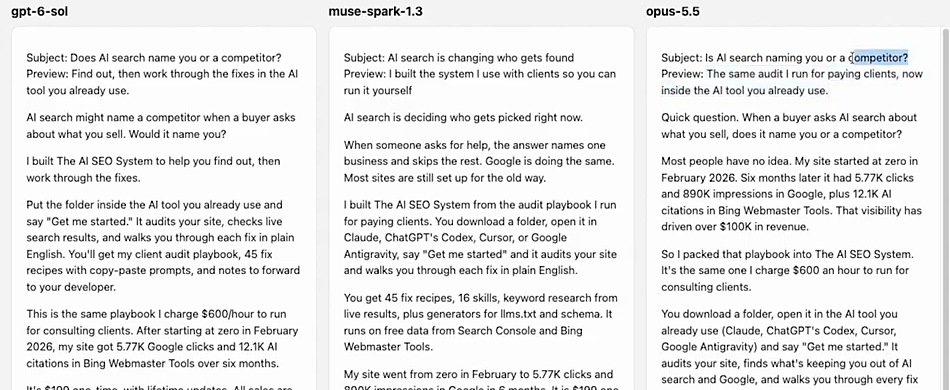
Opus 5.5 wrote "Is AI search naming you or a competitor?" and GPT-6 Sol wrote "Does AI search name you or a competitor?"
Aaron spotted that Opus 5.5 vs GPT-6 Sol came down to almost the same line. Muse went with "AI search is changing who gets found." Aaron's read was that it doesn't open a loop in your brain, and I wouldn't use it.
My pick was Opus, with Sol a super close second. Then my test handed all five emails to two blind judges, one Claude and one GPT, with the model names stripped out.
Averaged across both judges, GPT-6 Sol won by a nose. It scored an average rank of 2.0, against 2.5 for both Opus 5.5 and Fable 5.1, and Muse finished last with both judges.
Why Blind AI Judges Still Pick Their Own Family
In my test, hiding the model names did not stop the judges from favoring their own side.
The GPT judge ranked the two GPT emails first and second, even though the Claude contestants had my workspace rules loaded and the GPT contestants did not. The Claude judge did the same for the two Claude emails.
A short blog post test in the same run split the same way, and both judges put Muse last there too.
My best guess is house style. Each family seems to recognize its own voice even with the names removed, so a same-family judge flatters its own model.
One more caveat on my setup. GPT-6 Astra ran at medium reasoning while Sol ran at high, and the Claude judge had my workspace context, so treat those two reads with care.
The cross-family read is the one I trust most. The Claude judge's favorite GPT email was Sol, and the GPT judge's favorite Claude email was Opus 5.5.
On this one email, Opus 5.5 vs GPT-6 Sol came down to half a rank, and my own pick went the other way from the judges' average. When a single model family grades a clear winner, treat the result with suspicion.
That finding is why every draft Claude writes for me still gets a GPT review before it ships, the same pairing behind using Claude Code and Codex together.
Where Meta Muse Actually Fits: Your Calendar and Errands
The Muse app is Aaron's territory, not mine. My test ran Meta's model through OpenRouter's paid API, and the app never went on my Mac.
Meta launched the Muse app on September 8 as a personal agent with a free tier and a paid subscription, US only for now. Aaron uses it daily for errands, like turning a photo of a birthday party invite into a calendar event with a gift reminder.
His warning is that you cannot see, change or bring your own model. Meta says Muse conversations are not shared with its ad systems, but a free agent inside WhatsApp and Meta's other apps still looks like a long game for the ad business to me.
For the Opus 5.5 vs GPT-6 decision, Muse isn't necessarily a daily driver for marketing at all. It wrote one great headline, then finished last on the email and the blog post.
Build Your Own Opus 5.5 vs GPT-6 Test Before the Next Launch
Aaron's best advice from the episode was to build a skill around whatever you are best at judging. A designer tests design, and a marketer tests email copy.
Mine is a slash command in Claude Code that runs every new model on the same landing page, email and blog post, then lays the outputs out on one local page.
Keep that test portable as a markdown skill rather than a custom GPT. OpenAI retires custom GPTs on December 11, and I covered the move in Claude skills vs custom GPTs.
Run your test the week a model ships, grade it with a judge from a different family, and let your real pages and emails pick the daily driver.
Opus 5.5 vs GPT-6 FAQs
Is Claude Opus 5.5 better than GPT-6?
It depends which GPT-6. On September 24, Opus 5.5 led OpenRouter's frontier chart over GPT-6 Astra on the Artificial Analysis intelligence index. Against GPT-6 Sol on marketing copy the result was close, so I keep Opus 5.5 as my daily driver because it follows my writing rules with less hedging in my own setup, and I would test Sol first for high-volume API work, where it costs less.
Is GPT-6 Sol cheaper than Opus 5.5?
Yes, by half on list rates for uncached input and output on the standard API. As of September 28, 2026, GPT-6 Sol listed at $2 per million input tokens and $10 per million output, against $4 and $20 for Opus 5.5. Anthropic says Opus 5.5 uses fewer tokens per task than Opus 5, so compare the cost of a finished job, not just the rate card.
Which AI model is best for marketing copy in 2026?
No single model won cleanly in my test, and each blind judge favored its own model family. Pick your daily driver by running the candidates on your own emails and pages, counting the edits each draft needs, and having a judge from a different family grade the results.
Is Meta Muse good for marketing?
Not as a copywriter, based on my test of Meta's Muse model through OpenRouter's API. It wrote the landing page headline I singled out, then finished last with both blind judges on the email and the blog post. The Muse app itself is a personal agent with a free tier, and Aaron's warning is that you cannot choose the model behind it.