
Grok Bot vs Meta Muse vs ChatGPT Dots vs Claude Duet
Grok Bot came out as the best personal AI agent in a nine-task test from Claire Vo, and my lighter testing points the same way: it's the strongest of the four right now. I still run ChatGPT dots every day, and I just added Claude Duet, because switching ecosystems would cost me more than any subscription.
The Best Personal AI Agent in 2026, Ranked
Four always-on personal AI agents launched between August and October 2026. Unlike a chat-only AI personal assistant, each one works from a cloud computer of its own, so it keeps going after you close the app.
Claire ran all four through nine real tasks on the How I AI podcast, from a Slack reply to a bug fix to shoe shopping.
Grok Bot won overall, Muse won three jobs including the family newspaper, and Duet finished last. Claire named the limits on camera: the judging wasn't blind, and Muse had no Slack or GitHub connected.
So read it as one experienced operator's test with honest caveats. If you want the skills I hand my own agents, my Claude Code Skills Stack holds the ones I run my marketing on.
Here's how the four compare, in the order they finished Claire's test.
| Finish | Agent | Best for | Plan you need | When it asks first |
|---|---|---|---|---|
| 1 | Grok Bot (SpaceXSI) | Work jobs that span many apps, from Figma to your inbox | The X Subscription at Premium ($30/month) or higher, or a legacy Cursor plan | Any action that matches your "Ask first" rules |
| 2 | Meta Muse (Meta) | Everyday Facebook and Instagram users who aren't technical | Free with a usage limit, paid plans from $20/month | Before sensitive actions like sending an email or buying something |
| 3 | ChatGPT dots (OpenAI) | People already paying for ChatGPT Pro | ChatGPT Pro (the Pro 100 tier and up) or Business Premium | An automatic review decides, on top of your own rules |
| 4 | Claude Duet (Anthropic) | Claude Pro and Max subscribers in the US | Claude Pro ($20/month) or Max, via a waitlist | It shows each action and waits for your approval |
Prices are as listed on each vendor's site on October 28, 2026, and all four companies change them often. The finish order is Claire's, and for my own setup the order runs almost backward.
Where you live matters too. Duet is a US-only waitlist for now, and Muse started in the US and has since reached Canada, Japan and Singapore.
Dots on the Pro plans aren't offered in the EEA, the UK or Switzerland, though Business Premium is rolling out worldwide. Grok Bot's launch post and plan pages don't list country limits.
Why I Still Run ChatGPT Dots and Claude Duet
A benchmark tells you the best personal AI agent on paper. It can't tell you which one is cheapest to adopt, and for me that answer points the other way.
I already pay for ChatGPT Pro, and I've been a Claude Max subscriber for over a year. Dots are part of the Pro plans, and Anthropic says Duet "is included in Pro and Max plans," so neither one added a bill.
Grok Bot would. New subscribers need a seat on The X Subscription at Premium ($30 a month) or higher, and the $8 Plus tier doesn't include it.
The subscription is the small part, though. My dot works from a private repo of more than 5,000 files, covering my skills, brand rules and daily jobs, which I walk through in my guide to using GitHub without coding.
Duet picks up whatever already lives in my Claude account, since it "carries over your memory, skills, and connected apps," per Anthropic's launch post. A dot starts with relevant context from ChatGPT memory, per OpenAI's docs.
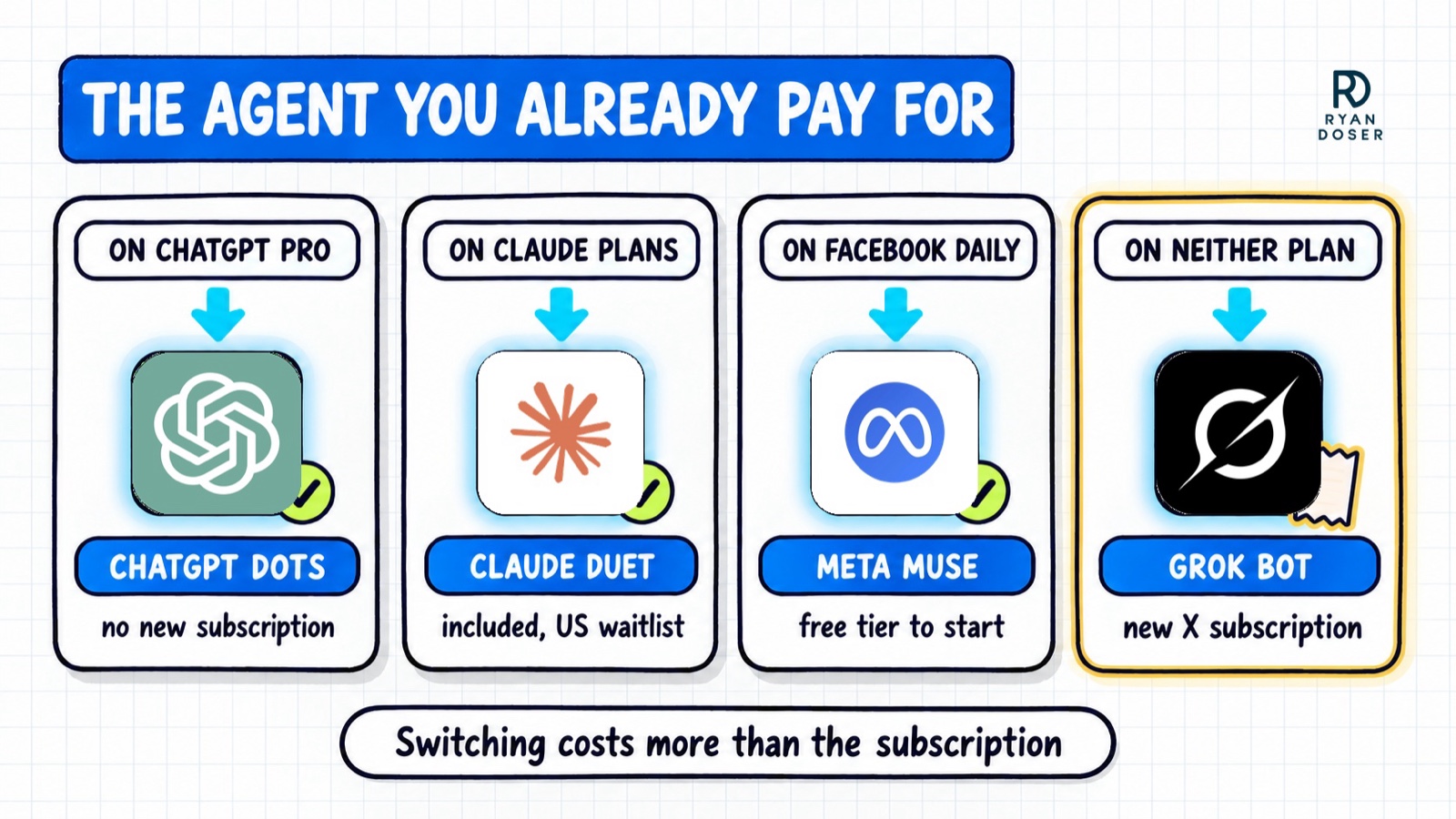
Moving to Grok Bot would mean rebuilding that setup somewhere new and re-teaching it my rules. That setup is where an agent's value comes from, and none of it shows up in a feature list.
There's a second reason. My real work happens in Codex and Claude Code, and a dot can start and manage Codex tasks on its own, so it plugs into the tools I already use.
The benchmark points the same way for coding. Dots and Duet won the coding task, yet Claire's takeaway was to skip both agents for code and use the underlying coding tools directly, Codex and Claude in her case, which is how I run my own Claude Code and Codex setup.
If you pay for neither ChatGPT nor Claude and want the most capable agent, the math flips toward Grok Bot.
Each Personal AI Agent, Head to Head
No agent won every job in the benchmark, so the best personal AI agent for you depends on which jobs you hand it.
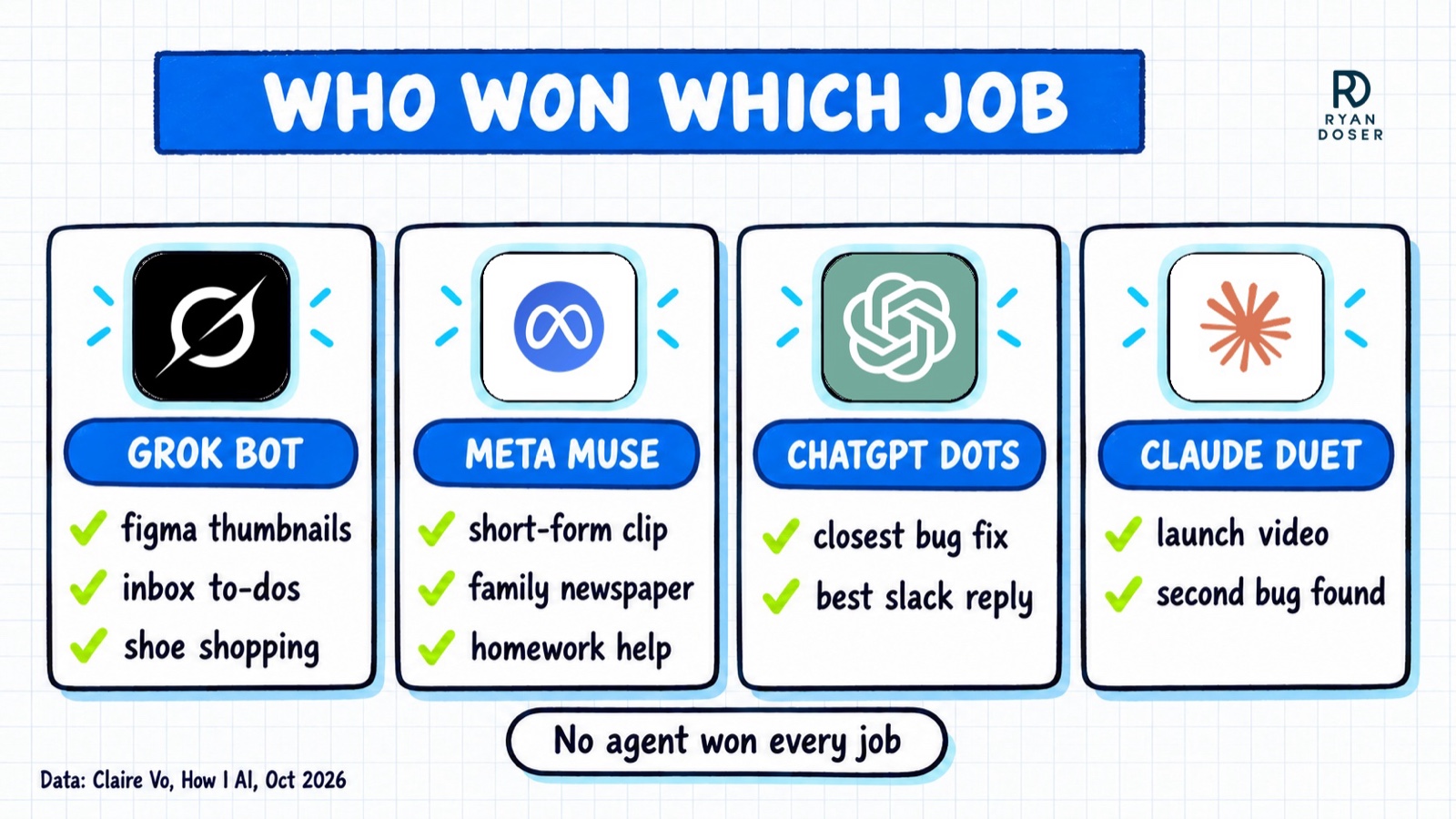
Here's what each one did well in that test, where it broke, and how much I've used it.
Grok Bot
Grok Bot completed all nine of Claire's tasks and won three: Figma thumbnails, an inbox to-do list and price-comparison shoe shopping. Claire singled out its new Grok documents, which turned the to-do list into a tidy checklist.
On the How I AI test, its weak spot was code. To fix a bug, it loosened the validation that caught the bug, and its short-form clip had the worst design and the longest run time.
The Grok Bot docs describe bots that keep their memory and browser sessions, plus routines that run on a schedule at least five minutes apart. They run on macOS, Windows, Linux, iOS and Android.
I've tested it, but not in depth. My co-host Aaron Makelky bought it in launch week, and his take on its rate limits and lock-in is in my Grok Bot review.
Meta Muse
Muse is the best fit for the average Facebook and Instagram user who isn't technical with AI. Meta connects Facebook, Instagram and Threads automatically, so there's almost nothing to set up.
It was also the fastest agent in the benchmark, quickest on four of nine tasks. It won the short-form clip, a two-page family newspaper and a homework question it answered in about half a second.
The Muse launch post says it checks with you before sensitive actions like sending an email or making a purchase. Meta's help pages add that Muse is free with a usage limit, with Power at $20 and Maximum at $100 a month.
For business work, this test tells you little about Muse, because Claire never connected it to work tools. Meta also says Muse subscriptions are still in limited testing, so the paid plans may not show up for everyone.
ChatGPT Dots
A dot is my daily agent. It lives in OpenAI's cloud, and I've connected it to a Mac Mini that stays on, so it can also work with files on that machine.
That connection is optional, and OpenAI says the connected computer has to stay online with the ChatGPT app open.
In Claire's test, the dot wrote the most accurate Slack reply, because it asked whether the talk was paid and remote. Its bug fix also came closest to the real one.
Creative work was where it struggled. Its family newspaper looked rough, its launch video played like a slideshow, and it barely tried the shoe search.
The ChatGPT dots docs cover saved schedules, background agents that run in parallel, and messaging through Slack and Microsoft Teams. If you're deciding whether Pro is worth it for a dot, I broke that down in whether ChatGPT Pro is worth it.
Claude Duet
Duet is the newest of the four. Anthropic opened a US waitlist for Pro and Max subscribers on October 21, and my access came through on October 27, so I'm only a few days in and leaning on Claire's test for now.
Before my access arrived, people I trust told me Duet wasn't there yet compared to Grok Bot or dots. Claire's test agreed: it finished last, ran slowest overall, and asked for permission four times while the others asked once.
It still won two jobs. It made the best product launch video, voiceover included, and during the bug fix it found and fixed a second bug nobody had spotted.
Anthropic says Duet sends a morning brief and checks your connected accounts every few hours. Per the Claude Duet page, it shares your plan's usage limits with the rest of Claude, so those checks matter if you already push Max hard.
Where My Own Picks Break
The agent I use most has broken its own rules more than once.
My dot ran schedules I set up in chat that never made it into the task queue it's supposed to follow. It also emailed me a daily priority list even though its rules told it to ask first.
OpenAI's docs are upfront about this. Your custom rules "are instructions your dot tries to follow, and it can make mistakes."
Security is the other open question. Meta's own write-up on Muse security says "Muse isn't immune to attack." SpaceXSI's docs explain that every Grok Bot on your account shares one cloud computer, files and browser sessions included, so a separate bot is no security boundary.
That's why my dot never publishes anything. It drafts and stages the work, Claude Code runs the checks, and I approve before anything goes live.
Claire's benchmark caught the opposite problem with Duet. Asking four times when rivals ask once is safe, but even the best personal AI agent stops saving you time if you have to babysit it.
That caution has a purpose. Anthropic keeps some actions off-limits even with your approval, like trading securities or moving money between accounts, and that's a line I want any agent near my money to hold.
Pick the Best Personal AI Agent by What You Already Pay For
Most people should skip the leaderboard and start with what's already in their wallet. Here's the shortcut:
- You pay for ChatGPT Pro: set up your dot first, and keep a human check on anything it sends.
- You pay for Claude Pro or Max in the US: join the Duet waitlist, and expect slow and careful for now.
- You live on Facebook and Instagram and don't want anything technical: start Muse on the free tier.
- You pay for neither and want the most capable agent: Grok Bot, starting on X Premium.
Whichever you pick, give it a week of real tasks before you judge it. An agent gets much more useful once it learns your tools, and a demo prompt shows you none of that.
When I'd Switch to Grok Bot
All four launched within about ten weeks, and all four are still changing fast. Today's last place can lead the next round, and Claire built the test to be rerun when new agents arrive.
So I'll retest every quarter, because this fall's best personal AI agent may not hold the title by spring. I'd move to Grok Bot when its lead on real tasks is bigger than the cost of rebuilding my setup, and today it isn't.
This comparison builds on Claire Vo's personal agent benchmark on How I AI, and the full episode shows each agent's actual output side by side.
Best Personal AI Agent FAQs
What is a personal AI agent?
A personal AI agent is an AI assistant that connects to your apps and does tasks for you, rather than only answering questions in a chat. Hosted agents like Grok Bot, Meta Muse, ChatGPT dots and Claude Duet run on a cloud computer the vendor provides, so they keep working after you close the app. They can check your inbox on a schedule, fill out forms and bring back finished work, with approval rules for sensitive actions like sending email.
What is the best personal AI agent right now?
On capability, Grok Bot. It completed all nine tasks in Claire Vo's October 2026 test and won three of them, including Figma thumbnails and shopping. The best one for you depends on your plan, though. If you already pay for ChatGPT Pro or Claude Pro or Max, the agent included with that plan costs nothing extra and can start from the context you've already built.
Is Grok Bot better than ChatGPT dots?
For broad work and personal tasks, Grok Bot did better in that one test, winning thumbnails, inbox to-dos and shopping. Dots did better on accuracy and code, with the most accurate Slack reply and the bug fix closest to the real one. New Grok Bot subscribers need an X Subscription at Premium or higher, while dots come with ChatGPT Pro.
Is Meta Muse free?
Yes, with a usage limit. Meta also sells two paid plans, Power at $20 a month and Maximum at $100 a month, each with a larger weekly allowance. Muse started in the US and has since reached Canada, Japan and Singapore, and Meta says its subscriptions are still in limited testing, so the paid plans may not show up for everyone yet.
Is Claude Duet included with Claude Pro?
Yes. Anthropic includes Duet in its Pro and Max plans at no extra charge, but access runs through a waitlist for US subscribers during the research preview. Team and Enterprise plans aren't included yet. Duet's background checks draw from your normal Claude usage limits, so heavy users will notice it.