
Ryan Doser research · Analysis · Published November 3, 2026
Dead Internet Theory and Marketing: Half My Email Clickers Looked Like Bots
About half the people who clicked my newsletter also clicked a tiny badge in the footer, and the pattern points to security software. I had Claude agents measure it across 12 sends, then set it next to the latest bot-traffic data from Imperva, Cloudflare, HUMAN Security and Pew.

- 12 weekly newsletter sends, Jul 18 to Oct 3, 2026
- Percentages only
- Every outside figure opened at its source
Free to use with a link to this page. Press questions: [email protected]
On this page
Is the Dead Internet Theory True for Marketers?
Partly, because bots now make up about half of the web traffic security companies measure, though counting bot requests says nothing about whether the people online are real. For marketers, the real problem is narrower and more expensive: some of the clicks you see were never human, and the clicks you want are thinning out as AI answers sit on top of search.
Key findings
- Pooled across 12 newsletter sends from July 18 to October 3, 2026, 50.7% of clickers also clicked the "Built with Kit" footer badge, and individual sends ranged from 21.5% to 71.6%.
- The reported click rate across those sends was 2.73%. With every account that ever clicked the badge removed, it was 1.22%, so the reported rate ran 2.24 times the badge-adjusted rate.
- The badge clickers look like corporate email security software: on the October 3 send, 1.5% used personal webmail like Gmail, against 57.5% of the other clickers.
- Imperva measured bots at more than 53% of the traffic it saw in 2025, and 51.8% in its 2016 sample. Whether bots "passed humans" depends on whose meter you read.
The Clicks You See: Half My Email Clickers Looked Like Bots
Every email my platform sends ends with a small "Built with Kit" badge in the footer. It's easy to miss, and link-checking software tends to open the links it tests, so the badge works as a trap that was sitting there the whole time.
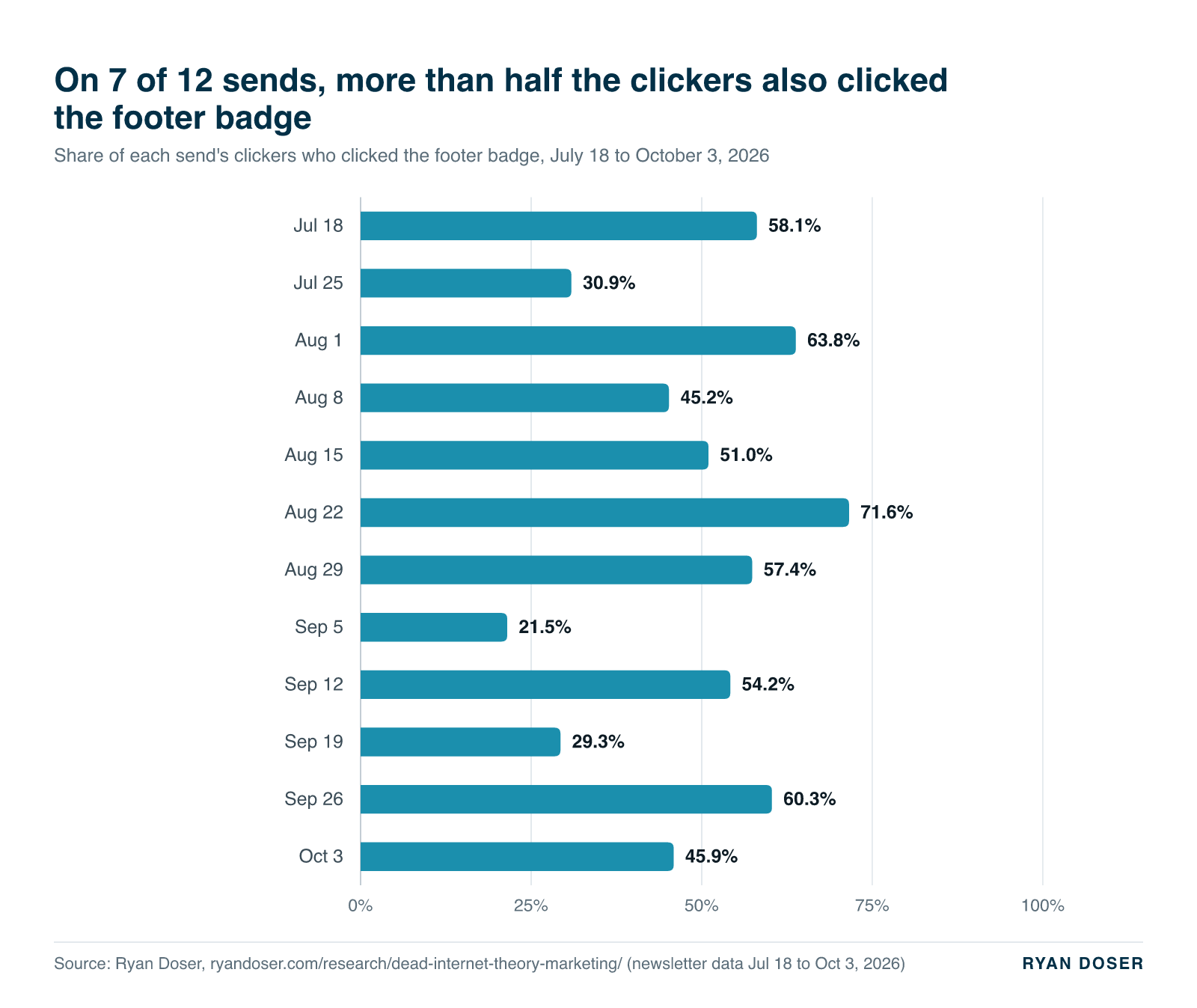
Pooled across 12 weekly sends from July 18 to October 3, 2026, 50.7% of clickers also clicked that badge, with individual sends ranging from 21.5% to 71.6%. It drew 66.2% as many clickers as the lead story in the same email.
On 7 of 12 sends, more than half the clickers also clicked the footer badge
Share of each send's clickers who clicked the footer badge, July 18 to October 3, 2026
Show this chart as a table
| Send date | Clicked the badge |
|---|---|
| Jul 18 | 58.1% |
| Jul 25 | 30.9% |
| Aug 1 | 63.8% |
| Aug 8 | 45.2% |
| Aug 15 | 51.0% |
| Aug 22 | 71.6% |
| Aug 29 | 57.4% |
| Sep 5 | 21.5% |
| Sep 12 | 54.2% |
| Sep 19 | 29.3% |
| Sep 26 | 60.3% |
| Oct 3 | 45.9% |
The pattern fits corporate email security scanners, the link checkers some companies run on incoming email to test links before an employee opens them. Two signals from the October 3 send point that way:
- Work addresses: 1.5% of badge clickers used personal webmail like Gmail, against 57.5% of everyone else who clicked. 82.4% of badge clickers used work email domains, against 40.0% of the rest.
- Instant clicks: my email platform stores only each subscriber's last click time. For badge clickers, the median last click came 83 seconds after the 16:00 UTC send and none came after 30 minutes, against 40.7% of other clickers.
My email platform doesn't show what software made a click, so I can't name a vendor. A scanner click also usually runs on a real subscriber's inbox, so the person is likely real even when the click was automated.
The likely culprit is ordinary email security software, no AI agents required, and the dashboard counts its clicks right alongside real readers. Across the 12 sends, the reported click rate was 2.73%, and removing every account that ever clicked the badge drops it to 1.22%.
That removal is blunt, since it also drops any real clicks those accounts made on other sends. Even so, the reported rate ran 2.24 times the badge-adjusted one.
Did Bots Really Pass Humans? It Depends on Whose Meter
The idea is thought to have started on the imageboard Wizardchan and spread through a 2021 forum post titled "Dead Internet Theory: Most Of The Internet Is Fake," according to Wikipedia's history of the theory. The Atlantic ran "Maybe You Missed It, but the Internet 'Died' Five Years Ago" on August 31, 2021.
On September 3, 2025, OpenAI's Sam Altman posted: "i never took the dead internet theory that seriously but it seems like there are really a lot of LLM-run twitter accounts now." A Reddit thread titled "We are officially entering the era of the dead internet..." ranked second in a Google search for "dead internet theory marketing" on November 3, 2026.
On June 3, 2026, Cloudflare CEO Matthew Prince posted that "agentic traffic growing so fast that bots have now passed human traffic online for the first time in the Internet's history." The post drew more than 2 million views on X.
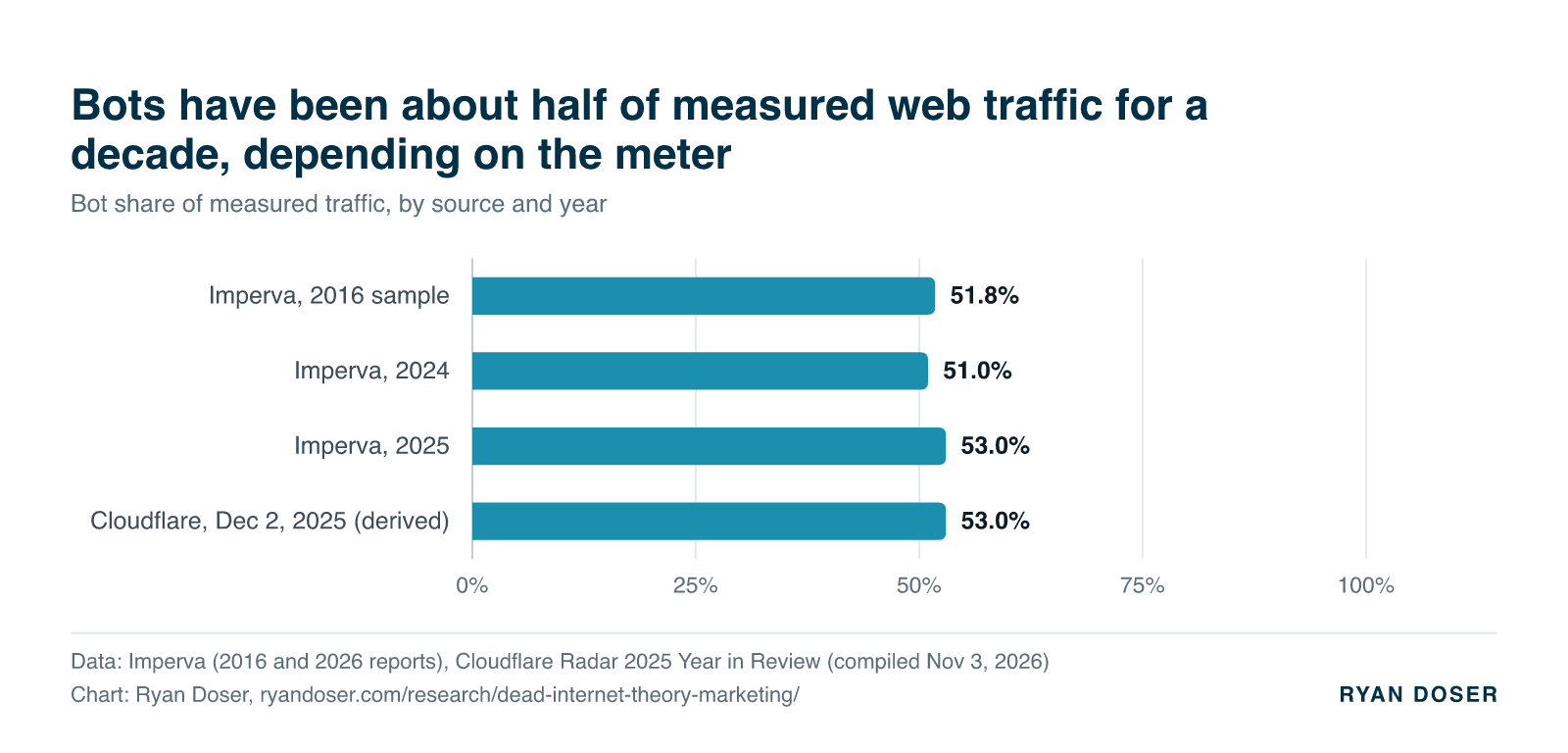
Imperva tells a longer story. It put bots at 51.8% of traffic in its 2016 sample, and said the year before was "below the 50 percent line for the first time in years."
Bots have been about half of measured web traffic for a decade, depending on the meter
Bot share of measured traffic, by source and year
Show this chart as a table
| Meter | Bot share |
|---|---|
| Imperva, 2016 sample | 51.8% |
| Imperva, 2024 | 51.0% |
| Imperva, 2025 | 53.0% |
| Cloudflare, Dec 2, 2025 (derived) | 53.0% |
On December 2, 2025, Cloudflare found humans made 47% of requests for web pages and non-AI bots made 44%. Across all of 2025, AI bots averaged 4.2% of those requests.
HUMAN Security's numbers point the same way. It reported that automated traffic grew 23.51% in 2025 while human traffic grew 3.10%.
The content side has moved too. Graphite's latest count, of 55,400 Common Crawl articles from March 2026, found primarily AI-written articles at 50%, level with human-written ones.
How AI Prompts Send Bots to Your Site
Some of this new traffic starts with a person typing a question. OpenAI says that when users ask ChatGPT a question, "it may visit a web page with a ChatGPT-User agent", and Anthropic and Perplexity describe the same thing for Claude-User and Perplexity-User.
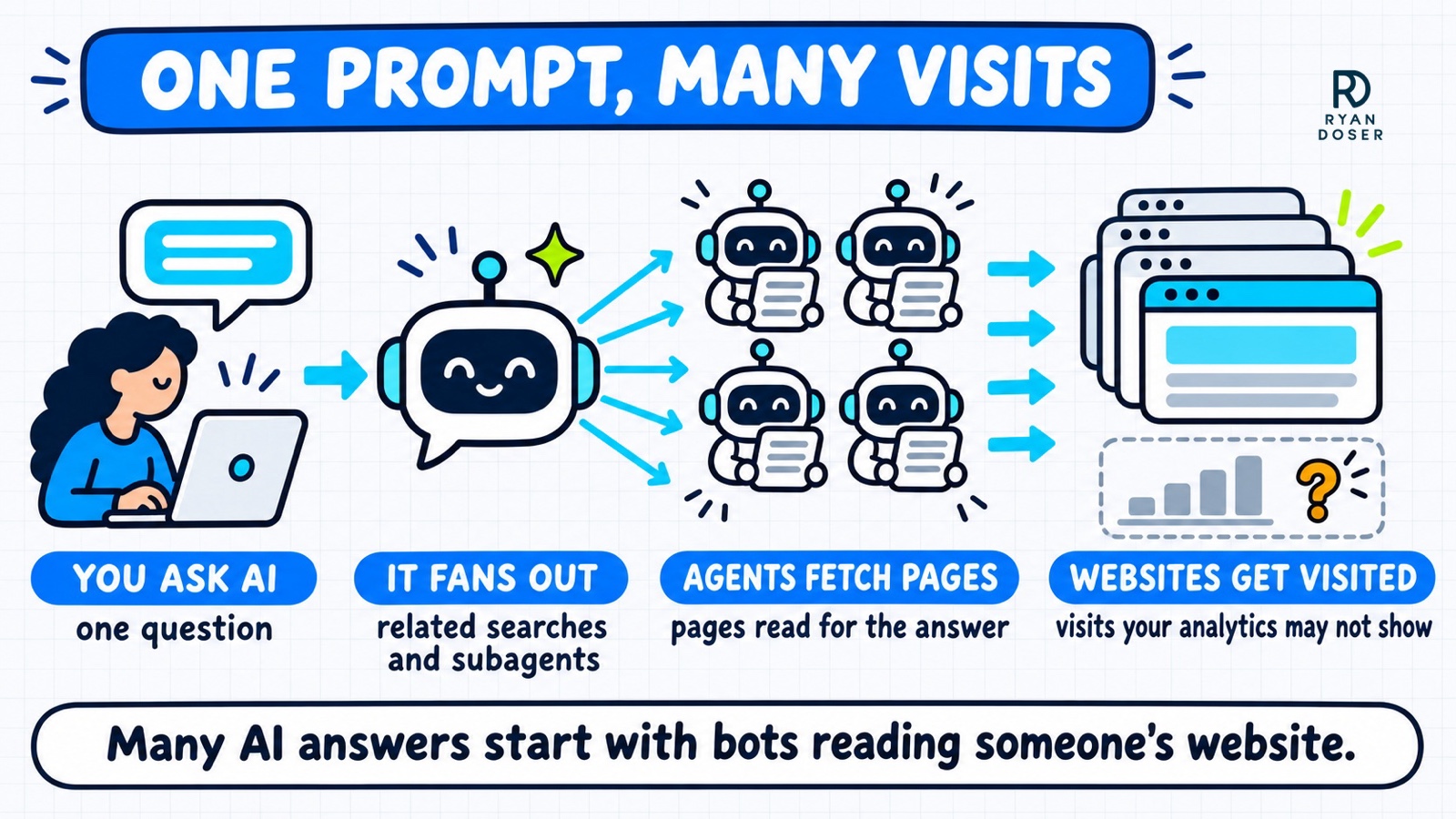
One question can also mean several searches. Google says AI Overviews and AI Mode may use a "query fan-out" technique, "issuing multiple related searches across subtopics and data sources" to build an answer.
Claude's Research mode splits the work up. Anthropic says its lead agent "spawns subagents to explore different aspects simultaneously", and early versions made "errors like spawning 50 subagents for simple queries."
Then there are the tools built to feed AI. Scraping platforms like Apify, which calls itself a "marketplace of ready-to-run tools for AI," and Firecrawl, which offers to "supercharge your AI agents with data from the web," fetch pages on demand, and so do AI SEO tools when they audit a site or check how it shows up in AI answers.
Across its customers' sites, HUMAN Security measured AI scraper traffic growing 597% from January to December 2025, and by December scrapers made up 24% of AI-driven traffic. This page is part of that traffic too, since Claude agents fetched the sources quoted here.
Google Analytics may not show these visits. Google says it automatically excludes known bots and spiders without showing how much it dropped, so check your server logs or your CDN's bot reports instead.
The Clicks You Want Are Disappearing
The second half of the problem is people clicking less when an AI answer sits on top of the page. When Google showed an AI summary, users clicked a regular result on 8% of visits, against 15% without one, Pew Research Center found.
Only 1% of those visits included a click on a link inside the summary. Publishers feel it first: Chartbeat reported Google Search's share of its publishers' pageviews fell from about 9% in July 2024 to 5% in July 2026, which it calls a nearly 46% decline.
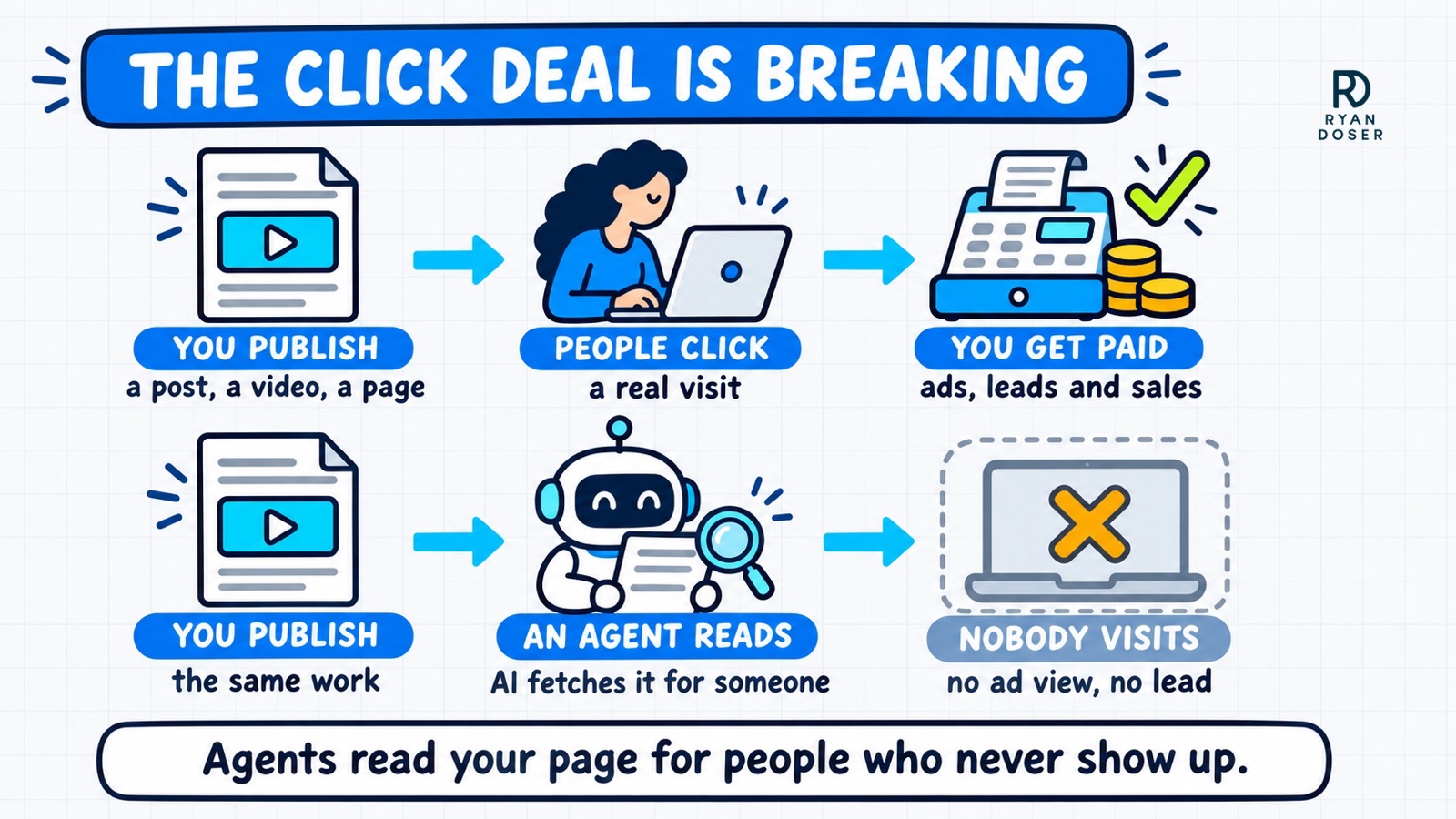
AI tools do read your pages. Cloudflare says AI "user action" crawling, where a bot visits a page because someone asked a chatbot a question, grew more than 15x in 2025.
AI crawling as a whole sends little traffic back. In July 2025, when training made up 79% of all AI crawling, Anthropic's crawlers made about 38,000 crawls for every visitor they sent back, the highest imbalance among major AI players in Cloudflare's count.
beehiiv CEO Tyler Denk put the money problem plainly in a November 2 post: "agents don't look at ads... so the fewer human eyeballs the content gets = smaller sponsorship deals."
Agents are still a sliver of the traffic. HUMAN Security measured traffic from AI agents and agentic browsers growing 7,851% in 2025, but by December it was 1.7% of AI-driven traffic, "small in share but notable in trajectory."
Rand Fishkin calls the bigger shift "the death of the click", and he's skeptical of chasing AI answers, saying almost every business is "overinvesting" in ranking for single ChatGPT prompts. He has a point, and in the same interview he adds that a better AI answer about your brand "will make more sales, but you will never be able to prove that that's why you made more sales."
Why YouTube Is My Bet in a Bot-Heavy Web
If some clicks are automated on one end and thinning out on the other, I'd bet on the channel that at least tries to count humans and that AI already pulls from. For most creators and businesses, I think that's YouTube.
YouTube says it filters its numbers for humans. Its help center says it wants metrics that "come from actual humans and not computer programs", and its fake engagement policy says "page traffic found to be artificial will not be counted".
That's a stated policy with no outside audit. My email reports, by contrast, counted the scanner clicks right along with the human ones.
AI cites it a lot. Pew found Wikipedia, YouTube and Reddit were the sources Google's AI summaries linked to most, and Peec's analysis of 30 million sources ranked YouTube the second most-cited domain in AI answers.
Peec says AI reads video descriptions and auto-generated transcripts, so one video can reach people who watch it and agents that read it. In one dated snapshot from October 27, 2026, Google's AI Overview for "best AI marketing software" featured one of my YouTube videos, cited another and used no page from my site, which I wrote up in GEO vs SEO.
Even Rand, the AI-answer skeptic, says "almost every business is underinvesting" in channels like YouTube. The trade-off is real: video takes more work than a blog post, and AI-made video is growing on YouTube too.
What Marketers and Business Owners Should Do Now
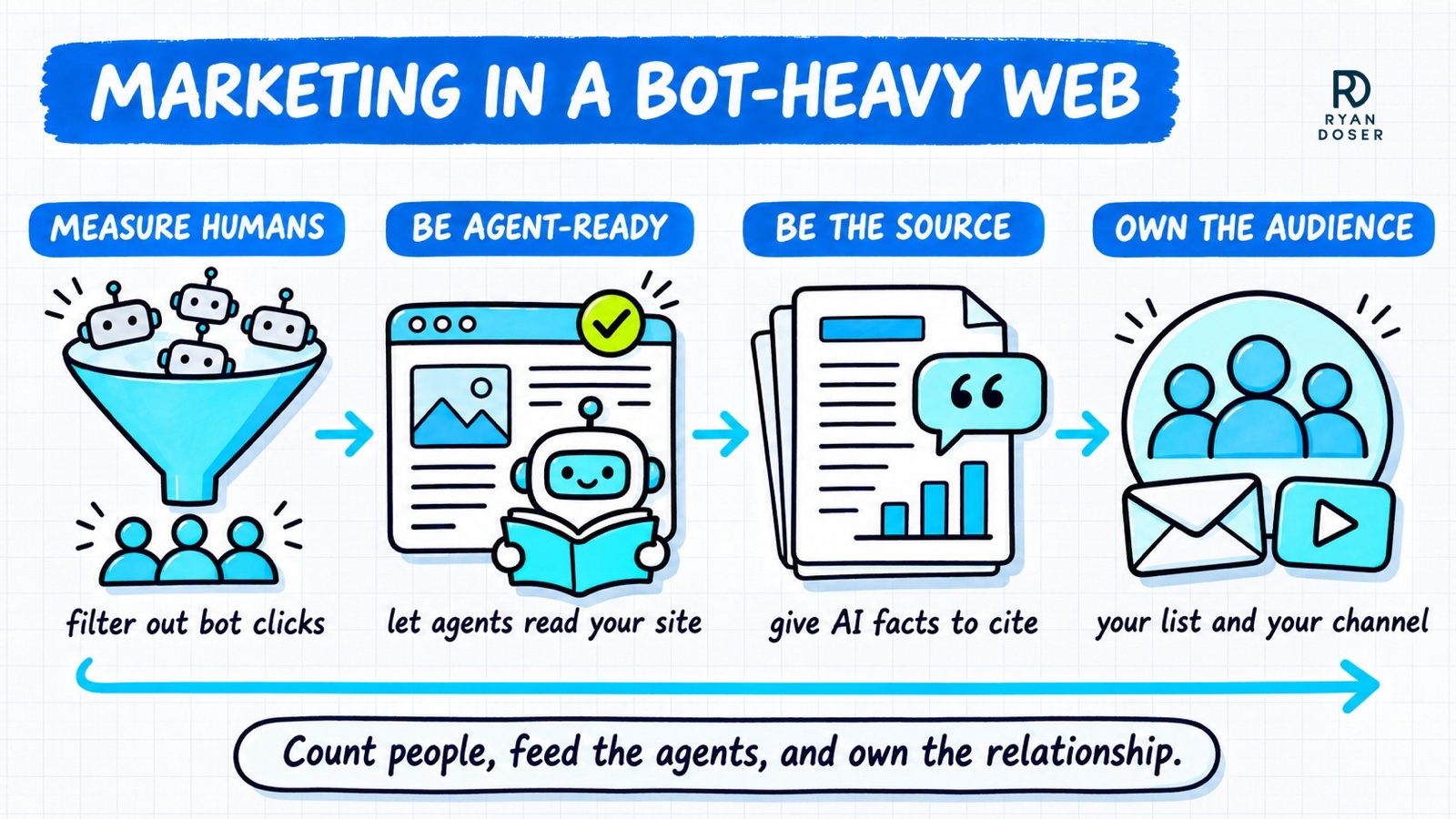
- Count humans first: look for the scanner pattern in your email reports, like a burst of clicks in the first few minutes from work domains, before you trust a click rate. Judge emails by replies and sales, and use my guide to zero click marketing to track what AI search sends you.
- Make your site readable for AI agents: agent traffic is small today, but HUMAN Security measured it growing 7,851% in 2025, and checking your site takes a few minutes. My free AI Agent Readiness Checker shows whether an agent can read and use your site, which is a separate question from whether AI will cite you.
- Shape what AI says about your category: searches still happen inside ChatGPT, Gemini and Google's AI Overviews, and those answers are built from the sources they can find and read. Publish original data and plain fact pages, show up on Reddit and YouTube, and see how to rank in ChatGPT.
- Own the relationship: an email list you measure without the bot clicks, plus a community, gives you a direct line to people that doesn't depend on a search click.
Whatever speed the agents arrive at, the first move is the same: count the people before you count the clicks.
How This Page Was Built
- Newsletter data: 12 weekly sends from July 18 to October 3, 2026, each with the same "Built with Kit" footer badge, pulled read-only from my email platform by Claude agents. A clicker is a subscriber who clicked any link in one send, so the same person can count once in each send they clicked.
- The badge share: the 50.7% figure pools clickers across all 12 sends, with a Wilson 95% range of 48.7% to 52.7% that treats each send's clickers as independent, so it understates the real uncertainty, given how widely individual sends varied. Individual sends ran from 21.5% to 71.6%.
- The badge-adjusted click rate: it removes every account that clicked the badge on any of the 12 sends, then divides the remaining clickers by recipients. Per send, the reported rate ran 1.47 to 4.04 times the badge-adjusted rate.
- Why "scanners," and the limits: the domain split and the timing come from the October 3 send, which went out at 16:00 UTC per my email platform. Last-click times were available for 97% of that send's badge clickers and 74% of the others, and the platform exposes no user agents or IP addresses.
- Errors in both directions: scanners that skip the badge but click other links aren't counted, and any person who clicked the badge out of curiosity is counted. So treat 50.7% as an estimate.
- Outside figures: third-party numbers are quoted as each source reported them, with dates, except the Cloudflare chart value, derived as 100% minus its 47% human share. Cloudflare CEO Matthew Prince's June 3, 2026 post gives no percentage, so this page quotes his words only.
- Who did the work: Claude agents pulled the data, ran the numbers and checked the sources. I chose the angle and wrote the takeaways.
- Disclosure: the "Built with Kit" badge links to my Kit referral link. I run a YouTube channel and argue for YouTube here, and I sell Claude Code products and an AI search system.
Dead Internet Theory and Marketing FAQs
Is the dead internet theory true?
Partly. Bots really do make up about half of the web traffic that security companies measure, and Imperva put them at more than 53% in 2025. But the full theory says most people online are fake and that someone planned it, and nothing in this data shows that. For marketers, the useful version is smaller: some of the clicks you count were never human, and AI answers sit between you and the clicks you want.
How much of the internet is bots?
It depends on whose meter you read. Imperva measured bots at more than 53% of the traffic it saw in 2025 and 51.8% in its 2016 sample. Cloudflare found humans made 47% of requests for web pages on December 2, 2025, and its CEO posted in June 2026 that bots "have now passed human traffic online." These count requests or visits on each company's network, not people or time spent.
What is agentic traffic?
It is traffic from AI agents and agentic browsers, like OpenAI's Atlas or Perplexity's Comet, that plan and act on the web for a person. HUMAN Security measured it growing 7,851% in 2025, but it was still 1.7% of AI-driven traffic by December. Imperva also classed 40% of all the traffic it saw in 2025 as malicious bots.
Do ChatGPT and Claude visit my website when someone asks a question?
They can. OpenAI, Anthropic and Perplexity all document fetchers (ChatGPT-User, Claude-User and Perplexity-User) that may visit a web page when someone asks their assistant a question. Research modes can fan one question out into many searches and subagents, and Google Analytics automatically excludes known bots, so check your server logs or CDN reports to look for these visits.
How do I make my website ready for AI agents?
Start with access: text an agent can read without running JavaScript, and a robots.txt that doesn't block the AI tools you want. Then add the extras that make reading easier, like clear facts on your key pages, llms.txt and markdown versions of your pages. My free AI Agent Readiness Checker runs these checks on any URL, and it answers whether an agent can read and use your site, which is a separate question from whether AI search will cite you.
Cite This Page
You're welcome to use any chart, table or finding here with a link to this page. Please keep the dates and the "12 sends" scope with the newsletter figures, and credit the original source for third-party figures.
Doser, R. (2026). Dead internet theory and marketing: half my email clickers looked like bots. ryandoser.com. https://ryandoser.com/research/dead-internet-theory-marketing/
Chart images
Each chart below is a 1600-pixel PNG with its title and source line built in.