
Zero Click Marketing: How to Measure AI Search for Free
Three recent studies have marketers calling AI search a distraction, because the traffic and brand lift barely show up in analytics. Zero click marketing measures what those reports miss, and you can track it for free with five numbers.
What Zero Click Marketing Means in AI Search
Amanda Natividad and Rand Fishkin popularized the term, and their upcoming book of the same name is open for pre-order. The idea is to give people real value where they already spend time, instead of counting on a click back to your site.
It plays out in three places: Google results that answer the question on the page, social feeds that favor native posts over links, and AI answers that name brands without sending a visit.
Google alone is mostly zero-click already. Rand Fishkin's June 2026 study of Similarweb data found 68.01% of US Google searches ended without a click from January to April 2026, up from 60.45% in 2024.
A LinkedIn post that teaches the whole idea with no link is zero click marketing. So is a bakery getting named when someone asks ChatGPT where to order a birthday cake.
AI answers push it furthest. The answer is the destination, and your brand is either named in it or it isn't.
In an October 22, 2026 article, Mike King at iPullRank argued for judging AI search like a branding channel, and I agree with his core point. What follows is my version for small teams: a free scorecard, a GA4 change his article missed, and a small-business reality check.
If you want the research and content skills I use for this kind of work, my Claude Code Skills Stack holds the ones I run for my own marketing.
Why Traffic Studies Undercount Zero Click Marketing
Marie Haynes looked at 12 months of GA4 data across 100 sites and found ChatGPT sent 0.62% of the sessions Google organic did. The SEO Works found organic delivered 39 times the traffic of AI assistants across 95 websites from September 2025 to August 2026.
Kevin Indig ran 632 tests on four brands and couldn't find a reliable link between AI visibility and later branded search or direct traffic. That study is already being quoted as "632 tests across 12 sites," but the 12 sites were a separate GA4 analysis in the same post.
I believe all three. Grade AI search on referral sessions and it loses.
The ruler is the problem, though. BrightEdge found in August 2025 that ChatGPT mentions brands 3.2 times more often than it cites them with a link, and those extra mentions never show up as a referral.
Google's own surfaces behave the same way. Pew Research tracked 900 US adults in March 2025, and only 1% of visits to a results page with an AI summary ended in a click on a link inside that summary.
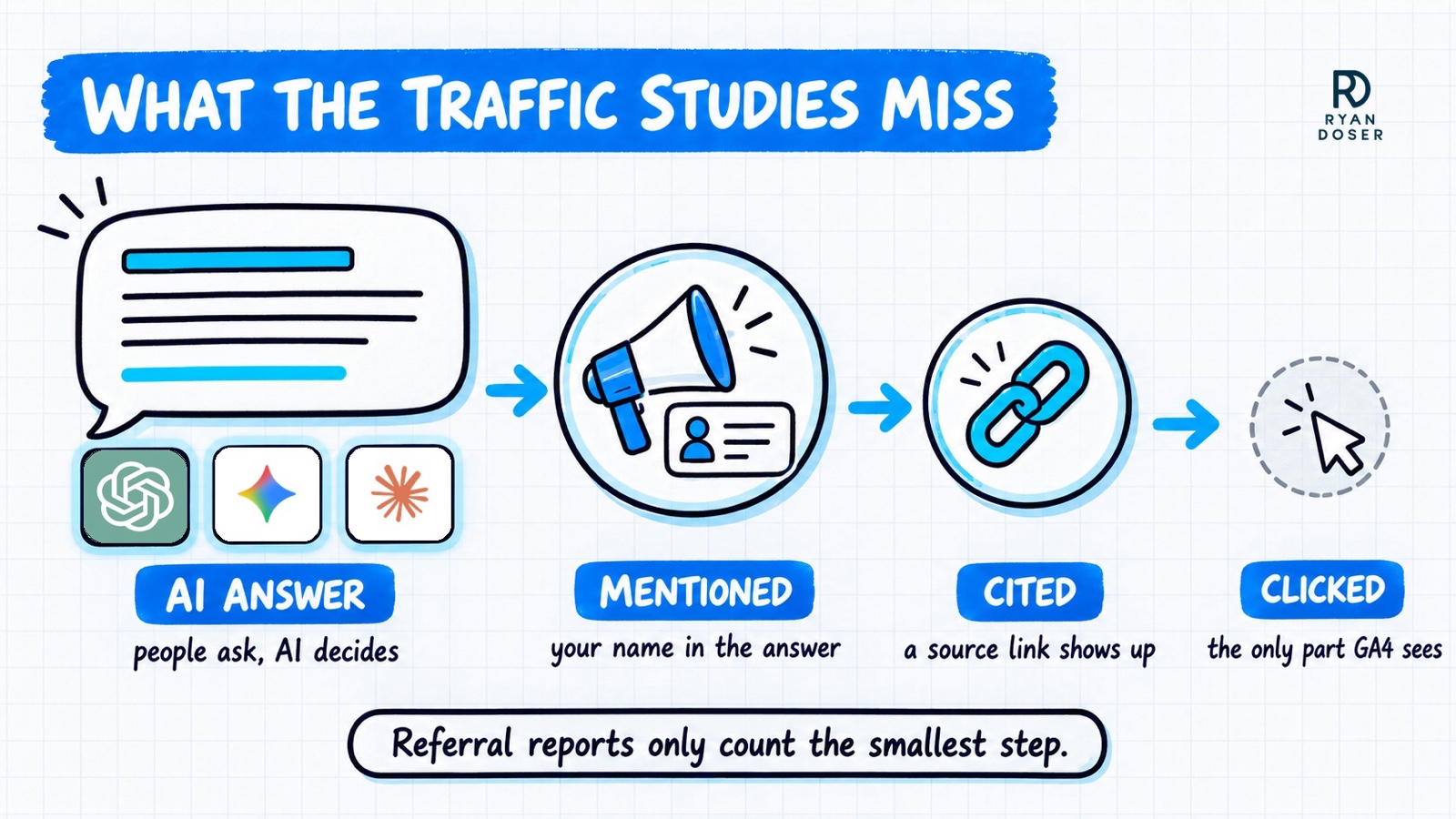
Mike also points out a second leak. Clicks from AI Overviews and AI Mode usually carry a google.com referrer, so they land inside Google organic, the number these studies use as the benchmark.
None of this proves zero click marketing pays off. It just means a referral report is the wrong place to look, so here's where to look instead.
A Free Zero Click Marketing Scorecard
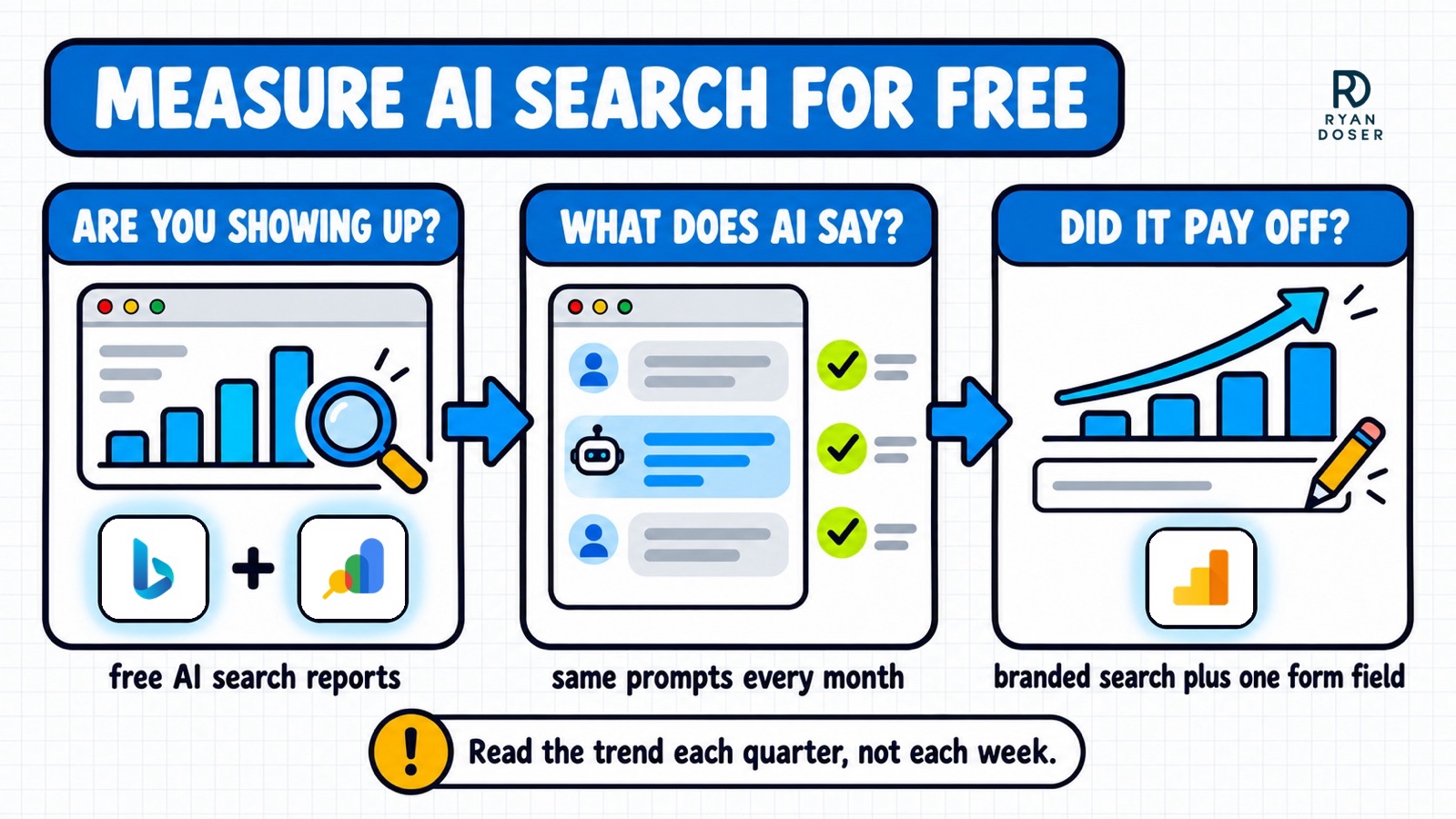
Mike lays out a measurement framework built for enterprise budgets and paid tracking platforms. A small team can approximate the channel and outcome parts of it with five free numbers.
| Number | Where to find it | What it tells you |
|---|---|---|
| AI citations | Bing Webmaster Tools, AI Performance report | How often Copilot and Bing's AI summaries cite your pages |
| AI impressions | Search Console, Generative AI performance report | How often your pages appear in Google's AI answers |
| AI share of voice | A fixed list of 10 to 20 buyer questions, run monthly | How often ChatGPT, Google AI Mode, Gemini, Claude and Perplexity name you versus competitors |
| Branded search | Search Console, Performance report, Query filter set to Branded | Whether more people search your name over time |
| Self-reported source | A "How did you hear about us?" form field, checked against GA4 | What buyers say sent them, AI included |
Record a baseline for all five before you change anything. Without it, you can't tell a trend from a lucky month.
Start with the two AI reports. Bing's AI Performance report, in public preview since February 2026, counts citations across Microsoft Copilot, AI summaries in Bing and select partner integrations.
That report is where this site logged 12.1K AI citations in its first six months.
Google's Generative AI performance report has been live for all sites since August 31, 2026. It shows impressions only, by page, country and device, for Google's AI features like AI Overviews and AI Mode.
How to Measure AI Share of Voice
Write 10 to 20 questions a buyer would really ask, like "best bookkeeper for a small bakery in Austin." Run them once a month on ChatGPT, Google AI Mode, Gemini, Claude and Perplexity, in a fresh chat, with the same wording and location every time.
Count each brand once per answer, and note whether the answer links to you and how it describes you. AI share of voice = your mentions ÷ all brand mentions across those answers × 100.
So if 60 answers name 150 brands in total and you're named in 15 of those answers, your share of voice is 10%. Track that one number over time, by surface.
Single runs swing a lot. My rule of thumb is to trust a change only after it holds for two months, and to treat even that as a lead.
I covered why single answers are so noisy in my guide to tracking AI visibility as a trend, including this episode where one prompt ranked a brand anywhere from #1 to #8.
Branded Search and the Form Field
Search Console's Performance report has a Branded and Non-branded query filter, available since March 2026 to eligible top-level properties with enough search volume.
No Branded option on your site? Use a custom regex query filter with your brand name and its common misspellings.
Read it quarterly. Brand effects show up weeks or months after the exposure, and a rise can come from anything else you did that quarter, so it supports the story without proving it.
Then add one form field that asks "How did you hear about us?" It's the only item on this list that can tell you a buyer saw you in ChatGPT before typing your name into Google.
One Correction: GA4 Now Has an AI Channel
Mike's article says GA4 still has no AI channel grouping out of the box. That changed in May 2026, when Google added a default AI Assistant channel for visits from sources like ChatGPT, Gemini and Copilot.
It helps, but know its limits. It relies on a recognized AI referrer or a medium tagged ai-assistant, so AI visits with neither often land in Direct, and Google says it excludes AI Overviews and AI Mode, which still count as organic search.
So treat GA4 as a sanity check next to your form answers, never as the verdict.
Zero Click Marketing for a Small Business
I've said before that AI search is overrated for most small businesses, and I still think so if it means chasing citations with GEO tricks. Mike's framing fits that view, because if AI search is a brand channel, the work that gets you named is brand work you should already be doing.
His best analogy is PR. An AI answer works like earned media composed by a machine, pulling from your site, your reviews and what other people say about you, so you can't hack your way into it.
Buyers say it shapes their choices. In a Semrush survey of 2,338 US adults, published by MarTech in September 2026, nearly 81% of people who shop with chatbots said they had decided against a purchase based on AI guidance.
Sometimes that's good advice for the buyer. But if your brand is the one being steered away from, or never mentioned at all, no traffic report will ever show it.
Treat that number with care. Semrush ran the survey and owns MarTech, and only 29% of all consumers in it used chatbots for product research.
So go fundamentals first. More reviews, local SEO, a few partnerships, podcast guest spots and content people share all feed the answer.
Keep doing SEO, too. Every site I've watched win AI citations had won traditional search first, which I dig into in my breakdown of how AI search picks its sources.
Skip the paid tracker until the free scorecard shows something worth watching. If you get there, my roundup of AI visibility tools compares what each one actually measures.
Judge AI Search Like a Billboard
The traffic studies settled one thing: AI search is a weak traffic channel.
Whether it builds demand for your business is still an open question, so judge it the way you'd judge a billboard. Do the fundamentals that get you named, run the scorecard for at least two quarters, and let the trend tell you whether zero click marketing is paying off.
Credit where it's due: this post builds on Mike King's iPullRank article on AI search as a branding channel. His article goes deeper on enterprise measurement and is worth reading in full.
Zero Click Marketing FAQs
What is zero click marketing?
In plain terms, zero click marketing means giving people the full value where they already are, so your brand earns trust even when nobody visits your site. Amanda Natividad and Rand Fishkin popularized the term. In AI search, it means getting your brand named inside ChatGPT and Google AI answers, then judging the result by mentions, branded search and what buyers tell you.
Does AI search send traffic to websites?
Very little, compared with Google organic. Marie Haynes measured ChatGPT at 0.62% of Google organic sessions across 100 sites. That undercounts AI's reach, though, because clicks from AI Overviews and AI Mode usually carry a google.com referrer and get counted as Google organic, and most AI mentions never include a link to click at all.
How do you calculate AI share of voice?
Run the same 10 to 20 buyer questions every month on ChatGPT, Google AI Mode, Gemini, Claude and Perplexity. Count each brand once per answer, then divide your mentions by all brand mentions and multiply by 100. If 60 answers name 150 brands and you appear 15 times, that is 10%. Trust a change only after it holds for two months.
How do you measure zero click marketing for free?
Track five free numbers: AI citations in Bing Webmaster Tools, AI impressions in Search Console's Generative AI report, monthly AI share of voice, branded search through Search Console's Branded query filter (or a regex filter if your property isn't eligible), and a "How did you hear about us?" form field. Record a baseline first and review the trend quarterly.
Does GA4 track traffic from ChatGPT?
Partly. Since May 2026, GA4 has a default AI Assistant channel for visits from sources like ChatGPT, Gemini and Copilot. It relies on a recognized AI referrer or a medium tagged ai-assistant, so AI visits with neither often land in Direct, and Google excludes AI Overviews and AI Mode, which still show up as organic search. Expect it to undercount.