
Ryan Doser research · Analysis · Published November 12, 2026
Chinese AI Models and the Open-Source Squeeze: What the Data Says for Marketers
Chinese open-weight models now carry most of the tracked tokens on OpenRouter, a marketplace that routes developer traffic to hundreds of AI models. I had Claude pull its model, price and usage data on November 12, 2026, and a script computed every chart from it. The takeaways for AI prices, AI tools and the people who buy them are mine.

- Token share, Nov 2025 to Oct 2026
- 38 models priced and scored
- Own-data figures recomputed by script
Free to use with a link to this page. Press questions: [email protected]
On this page
Are Chinese Open-Weight Models Squeezing Paid AI?
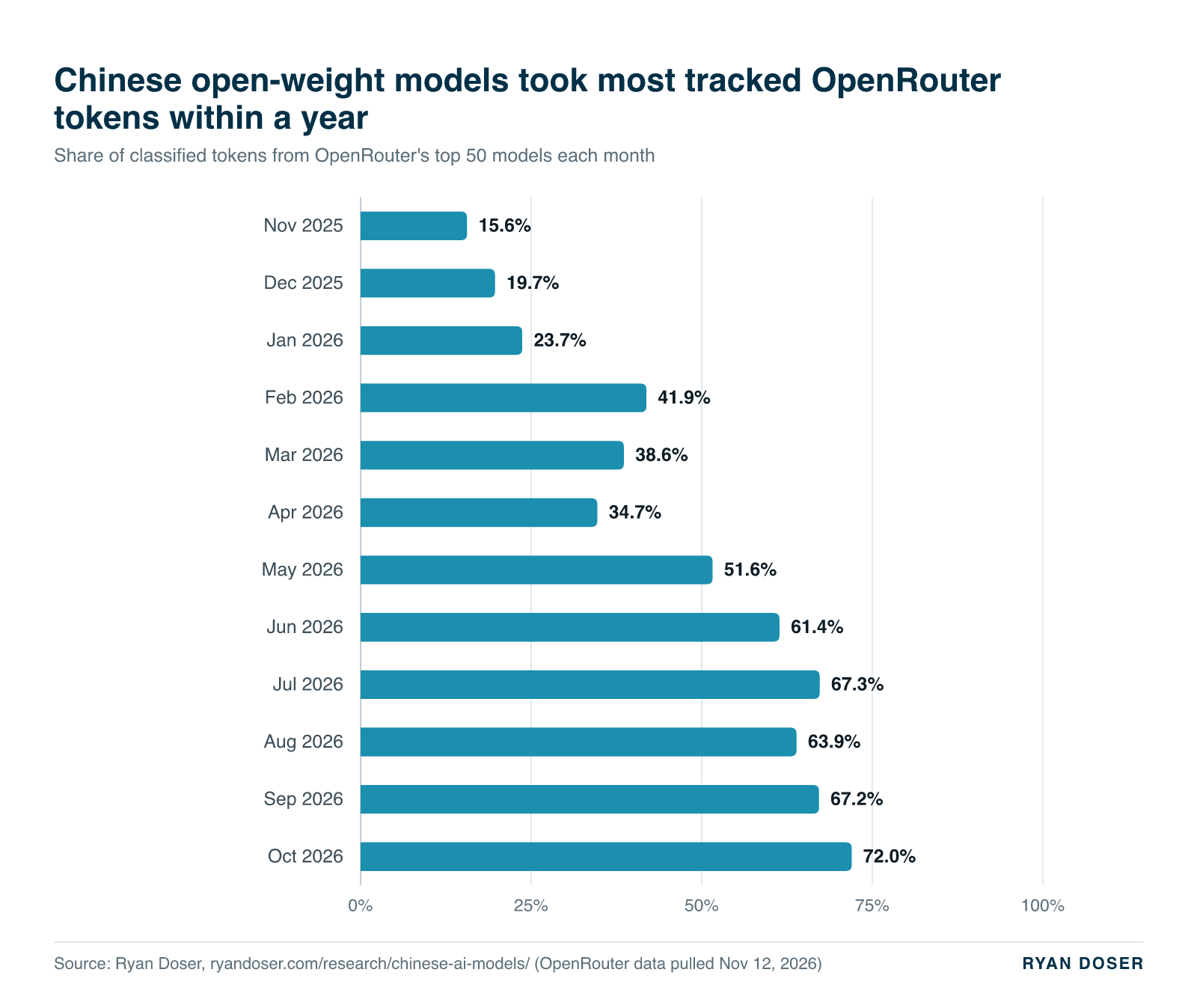
On volume, yes. Among OpenRouter's top 50 models, Chinese open-weight models went from 15.6% of classified tokens in November 2025 to 72.0% in October 2026.
The "100x cheaper" story fails at list prices, though. Kimi K3.1 Pro, the best open model, lists at $2/$10 per million tokens, the same as GPT-6.1 Sol, and Anthropic and OpenAI sell small models at $0.10/$0.50.
The money still mostly flows to closed models, which took 73% of OpenRouter spend in the second week of September and still hold the top scores. The pressure lands on tools that charge a markup for basic AI output, and on sites that depend on search clicks AI answers now absorb.
Key findings
- Among OpenRouter's top 50 models each month, Chinese open-weight models carried 15.6% of classified tokens in November 2025 and 72.0% in October 2026. Closed models fell from 79.6% to 23.0%.
- At developer list prices, open models were not 100 times cheaper. GPT-6.1 Terra ($1/$5 per million input/output tokens) outscored Kimi K3.1 Pro ($2/$10), and Claude Haiku 5.5 and GPT-6 Luna list at $0.10/$0.50.
- The best open-weight model on November 12, 2026, Kimi K3.1 Pro, scored 46.5 on the Artificial Analysis Intelligence Index as shown on OpenRouter. 9 closed models scored higher, led by Claude Fable 5.2 at 64.6.
- Kimi K3.1 Pro, added to OpenRouter on 2026-10-23, outscores Claude Opus 5, added 91 days earlier. That's about three months, a bit faster than Epoch AI's four-month average lag, which uses release dates and its own index.
- Open models are sold by far more hosts: 38 for DeepSeek V4.1 Flash and 36 for GLM-5.3, against a maximum of 5 for any closed model in the set (median 9 vs 3).
Closed vs. Open-Source AI Economics
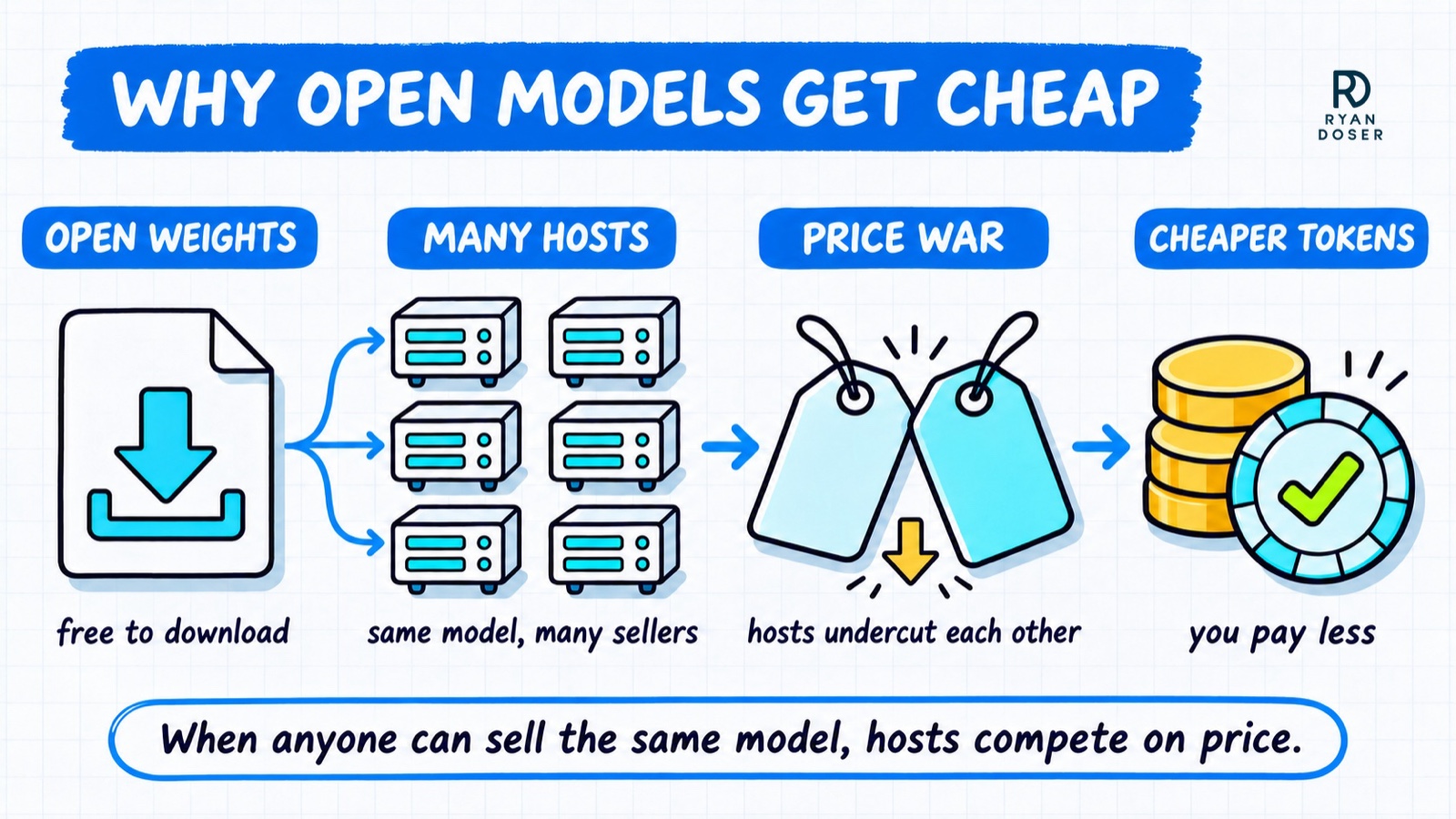
A closed model lives on its developer's servers, and you rent access at whatever price they set. An open-weight model is a file anyone can download and run, and hosts can resell access to it, which makes it closer to a commodity.
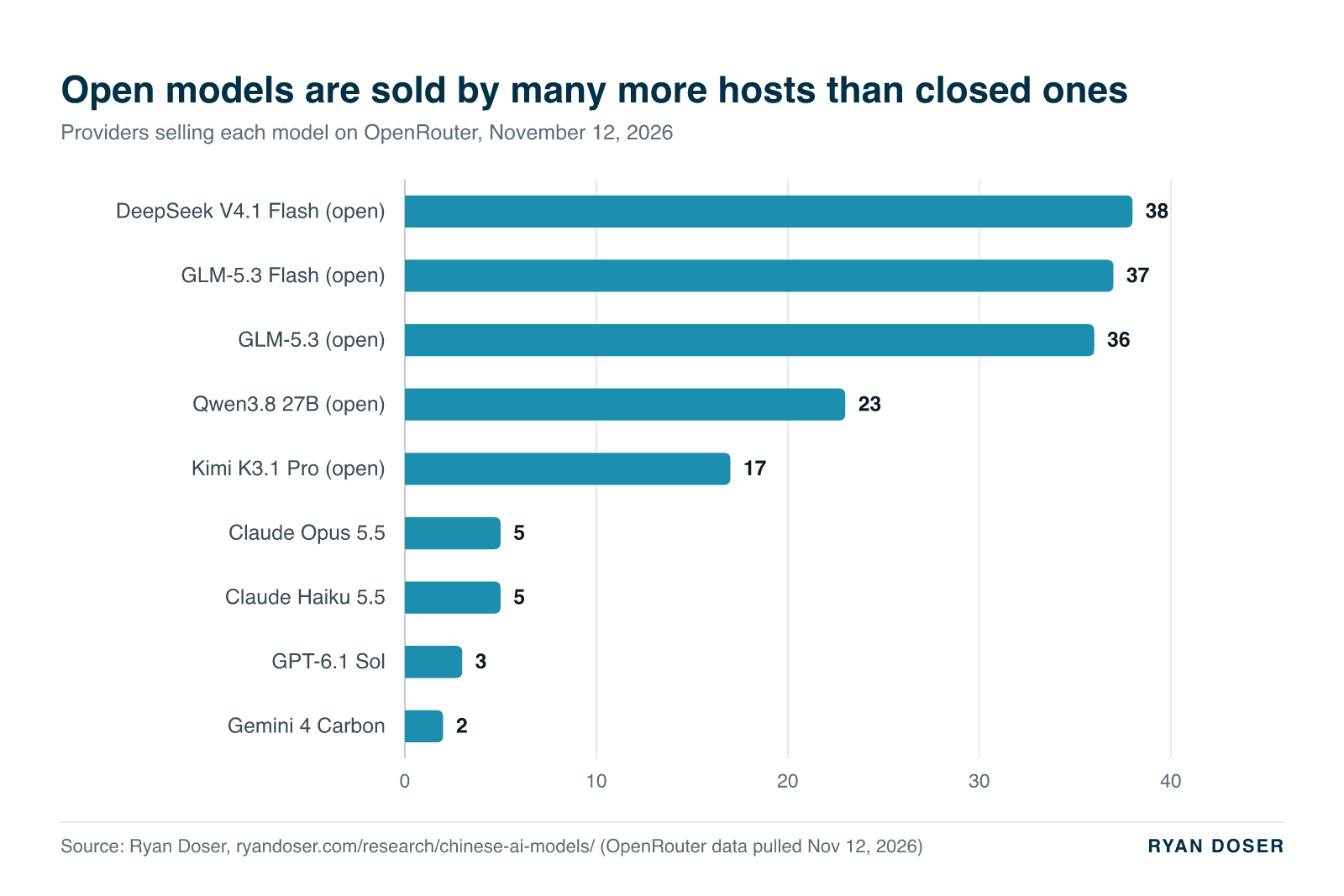
That difference shows up in who sells each model. On November 12, OpenRouter listed 38 providers for DeepSeek V4.1 Flash and 36 for GLM-5.3, while no closed model had more than 5.
Open models are sold by many more hosts than closed ones
Providers selling each model on OpenRouter, November 12, 2026
Show this chart as a table
| Model | Providers |
|---|---|
| DeepSeek V4.1 Flash (open) | 38 |
| GLM-5.3 Flash (open) | 37 |
| GLM-5.3 (open) | 36 |
| Qwen3.8 27B (open) | 23 |
| Kimi K3.1 Pro (open) | 17 |
| Claude Opus 5.5 | 5 |
| Claude Haiku 5.5 | 5 |
| GPT-6.1 Sol | 3 |
| Gemini 4 Carbon | 2 |
More sellers means real price competition. The cheapest host for GLM-5.3 charged 18.7% of Z.AI's own blended price, and the cheapest Kimi K3.1 Pro host charged 59.4% of Moonshot's.
The money behind closed models raises the stakes. Google, Microsoft, Meta and Amazon planned about $725 billion of 2026 capital spending as of their April earnings guidance, Tom's Hardware reported, while OpenAI was on track for roughly $50 billion in annualized revenue in October and Anthropic's run rate hit $65 billion at the end of July.
Those aren't the same measure, since capex is infrastructure spending and run rates are revenue. They do show how much the closed side has riding on people paying for intelligence that open-weight labs publish for anyone to run.
The China Open-Weight Parity Test
One popular claim in the video further down says Chinese open models are "roughly 90 to 95% as good for about 1/100th of the price." The claim names no models, so Claude tested both halves against the best and cheapest models on each side of OpenRouter's live catalog.
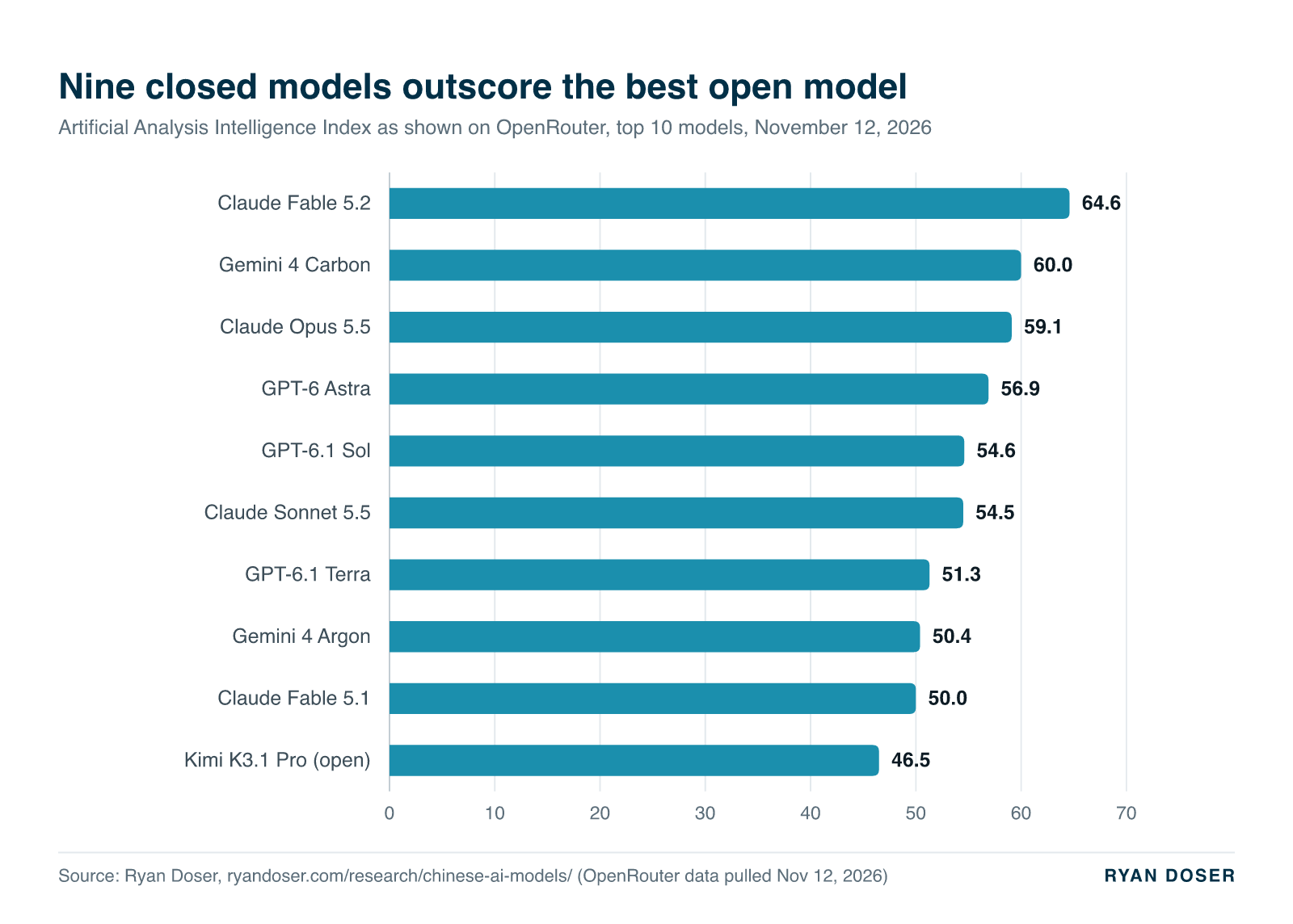
Nine closed models outscore the best open model
Artificial Analysis Intelligence Index as shown on OpenRouter, top 10 models, November 12, 2026
Show this chart as a table
| Model | Intelligence Index |
|---|---|
| Claude Fable 5.2 | 64.6 |
| Gemini 4 Carbon | 60.0 |
| Claude Opus 5.5 | 59.1 |
| GPT-6 Astra | 56.9 |
| GPT-6.1 Sol | 54.6 |
| Claude Sonnet 5.5 | 54.5 |
| GPT-6.1 Terra | 51.3 |
| Gemini 4 Argon | 50.4 |
| Claude Fable 5.1 | 50.0 |
| Kimi K3.1 Pro (open) | 46.5 |
On the Artificial Analysis index, the best-scoring open model in this data, Kimi K3.1 Pro, scores 46.5 to Claude Fable 5.2's 64.6, a gap of 18.1 points. No open model in the set scores 50 or higher.
The gap closes fast, though. Kimi K3.1 Pro reached OpenRouter 91 days after Claude Opus 5 and now outscores it, a bit faster than Epoch AI's estimate that open models trail closed ones by about four months on average (Epoch uses release dates and its own index).
My own tests found the same close-but-uneven picture. Kimi K3 beat the other open models redesigning my homepage, and in my nine-model marketing tests it matched the leaders on sales emails but broke three rules in the brief.
On price, the 1/100th claim doesn't survive list prices. Kimi K3.1 Pro lists at $2/$10 per million input/output tokens, exactly what OpenAI charges for GPT-6.1 Sol, and GPT-6.1 Terra ($1/$5) outscores it.
At the cheap end, the U.S. labs are close to the price floor. Claude Haiku 5.5 and GPT-6 Luna list at $0.10/$0.50, against $0.15/$0.60 for DeepSeek V4.1 Flash and $0.075/$0.30 for MiniMax M3.1 Flash.
Yet Chinese open models still carried most of the tokens, and 6 of October's 10 most-used model versions were Chinese open-weight models (two are versions of DeepSeek V4.1 Flash). List prices alone don't explain that.
One factor this data does show is hosts selling below list. OpenRouter's own report adds another: open models now come close enough to frontier scores that organizations take the cheaper option seriously.
Share of classified tokens from OpenRouter's top 50 models each month
Show this chart as a table
| Month | Chinese open-weight share |
|---|---|
| Nov 2025 | 15.6% |
| Dec 2025 | 19.7% |
| Jan 2026 | 23.7% |
| Feb 2026 | 41.9% |
| Mar 2026 | 38.6% |
| Apr 2026 | 34.7% |
| May 2026 | 51.6% |
| Jun 2026 | 61.4% |
| Jul 2026 | 67.3% |
| Aug 2026 | 63.9% |
| Sep 2026 | 67.2% |
| Oct 2026 | 72.0% |
OpenRouter's own September report tells the same story from the other side. Open-weight models "reached 79% in early July" of its tokens, while closed models still "saw 73% of spend in the second week of September," per OpenRouter.
| Model | Weights | Index | List price (in/out per M) | Cheapest host (blended) | Providers |
|---|---|---|---|---|---|
| Claude Fable 5.2 | Closed | 64.6 | $8/$40 | $16.00 | 4 |
| Gemini 4 Carbon | Closed | 60 | $2/$10 | $4.00 | 2 |
| Claude Opus 5.5 | Closed | 59.1 | $4/$20 | $8.00 | 5 |
| GPT-6 Astra | Closed | 56.9 | $10/$50 | $20.00 | 3 |
| GPT-6.1 Sol | Closed | 54.6 | $2/$10 | $4.00 | 3 |
| Claude Sonnet 5.5 | Closed | 54.5 | $2/$10 | $4.00 | 5 |
| GPT-6.1 Terra | Closed | 51.3 | $1/$5 | $2.00 | 3 |
| Gemini 4 Argon | Closed | 50.4 | $2/$10 | $4.00 | 2 |
| Claude Fable 5.1 | Closed | 50 | $10/$50 | $20.00 | 4 |
| Kimi K3.1 Pro | Open (China) | 46.5 | $2/$10 | $2.37 | 17 |
| Claude Opus 5 | Closed | 44.2 | $5/$25 | $10.00 | 5 |
| GPT-6 Sol | Closed | 44.2 | $2/$10 | $4.00 | 3 |
| Meta Muse Wonder | Closed | 43.6 | $4/$20 | $8.00 | 2 |
| Meta Muse Spark 1.3 | Closed | 36.6 | $1.25/$4.25 | $2.00 | 2 |
| Claude Haiku 5.5 | Closed | 36.5 | $0.10/$0.50 | $0.20 | 5 |
| Grok 4.7 | Closed | 35.5 | $2/$6 | $3.00 | 2 |
| Tencent Hy4 | Open (China) | 34.6 | $0.417/$1.25 | $0.63 | 1 |
| Qwen3.8 Max | Closed | 33.7 | $2/$6 | $3.00 | 1 |
| GPT-5.6 Terra | Closed | 32.3 | $2/$12 | $4.50 | 3 |
| GLM-5.3 | Open (China) | 31.7 | $1.40/$4.40 | $0.40 | 36 |
| Grok 4.6 | Closed | 31 | $2/$6 | $3.00 | 2 |
| Gemini 3.8 Flash | Closed | 30.8 | $0.75/$3.75 | $1.50 | 2 |
| MiMo V2.6 Pro | Open (China) | 29.9 | $0.435/$0.87 | $0.41 | 5 |
| MiniMax M3.1 Flash | Open (China) | 29.1 | $0.075/$0.30 | $0.13 | 10 |
| DeepSeek V4.1 Flash | Open (China) | 28.6 | $0.15/$0.60 | $0.12 | 38 |
| Step 5 Preview | Open (China) | 28.5 | $1/$2.70 | $1.43 | 2 |
| Solar Pro 4 | Closed | 28.2 | $0.15/$0.60 | $0.26 | 2 |
| GPT-6 Luna | Closed | 27.9 | $0.10/$0.50 | $0.20 | 3 |
| GLM-5.3 Flash | Open (China) | 27.8 | $0.15/$0.50 | $0.05 | 37 |
| MiMo V2.6 Flash | Open (China) | 26.7 | $0.14/$0.28 | $0.14 | 8 |
| Mistral Large 4 | Open (Europe) | 26.1 | $0.70/$2.10 | $1.05 | 1 |
"Blended" weights input and output prices 3 to 1, the convention Artificial Analysis uses. The full list of 38 models is in the CSV download.
The Regulatory Moat Trap
The fight over Chinese models moved from benchmarks to Washington this year. Here's the timeline, with each step linked to its source.
- March 12: Nvidia, which makes its money selling AI chips, plans to spend $26 billion over five years building open models, The Decoder reported, citing a company filing.
- July 16: Moonshot released Kimi K3, which Fortune called "the largest open-source model ever released."
- July 21: Treasury Secretary Scott Bessent told Fox Business, "This administration supports open source models, but what we do not support is IP theft," and said that if the U.S. sees overseas models stealing, "we have the ability to sanction them," TechCrunch reported.
- July 24: Nvidia, Microsoft, Meta "and more than 20 other technology companies" urged policymakers to avoid broad limits on open models, and Jensen Huang made it his first post on X, Fox Business reported.
- Early August: The New York Times reported that sanctions and a trade blacklist were among the options and that OpenAI and Anthropic "pushed for restrictions on Chinese rivals" by citing national security, The Decoder summarized. After pushback from Silicon Valley, the administration backed off for now.
- November 3: Democrats won control of the House and Senate, VentureBeat reported, with transparency, shutdown-switch and pre-release approval bills already proposed.
The worry is cost. Rules like mandatory disclosure or testing are easier for a lab with a compliance team to absorb than for a free project with none.
If those rules squeeze out U.S. open models, buyers could still pick Chinese ones. That's the argument in the video below, and it's one scenario worth watching in 2027.
The Hybrid Squeeze: Commoditization Plus Displacement
Two things are happening at once. Basic intelligence is getting cheap from below, and AI answers and agents are taking some clicks and tasks from above.
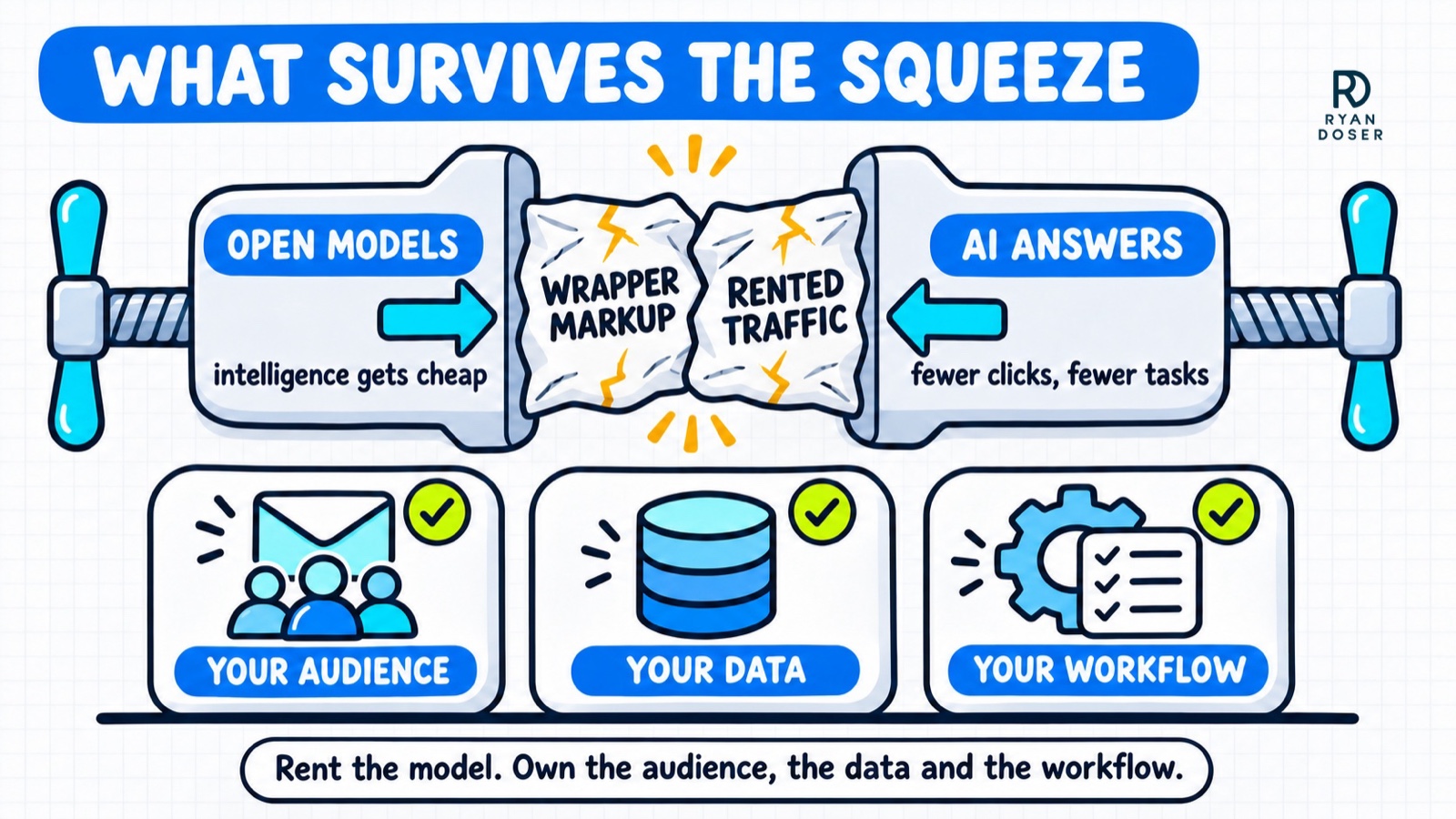
From below: 1,000 blog drafts cost about $1.30 in raw model fees on Claude Haiku 5.5, against $104.00 on Claude Fable 5.2. That's an 80x spread inside one company's lineup.
| Model | Weights | Index | Cost of 1,000 drafts |
|---|---|---|---|
| Claude Fable 5.2 | Closed | 64.6 | $104.00 |
| Claude Opus 5.5 | Closed | 59.1 | $52.00 |
| GPT-6.1 Sol | Closed | 54.6 | $26.00 |
| Kimi K3.1 Pro | Open | 46.5 | $26.00 |
| GLM-5.3 | Open | 31.7 | $13.00 |
| DeepSeek V4.1 Flash | Open | 28.6 | $1.65 |
| Claude Haiku 5.5 | Closed | 36.5 | $1.30 |
| MiniMax M3.1 Flash | Open | 29.1 | $0.83 |
From above: Google users who saw an AI summary clicked a regular result in 8% of visits, against 15% without one, in Pew Research's March 2025 browsing study of 900 U.S. adults.
Entry-level work looks most exposed. Stanford researchers found a 13% relative drop in employment for 22- to 25-year-olds in the most AI-exposed jobs, in their "Canaries in the Coal Mine" paper.
My field test of 392 tech layoffs found few companies saying AI cut their staff needs. So the shift looks slower and messier than the headlines.
What This Means for Marketers & Builders
- Know what the markup buys: 1,000 blog drafts cost $104.00 in raw model fees on Claude Fable 5.2, the priciest model here, and $1.30 on Claude Haiku 5.5. In raw fees, $99 buys about 76,000 Haiku drafts or about 950 Fable drafts. A $99 a month writing tool has to earn the rest with workflow, integrations and support, so ask what you're paying for beyond the prompt. I covered the same pattern in the AI website builder idiot tax.
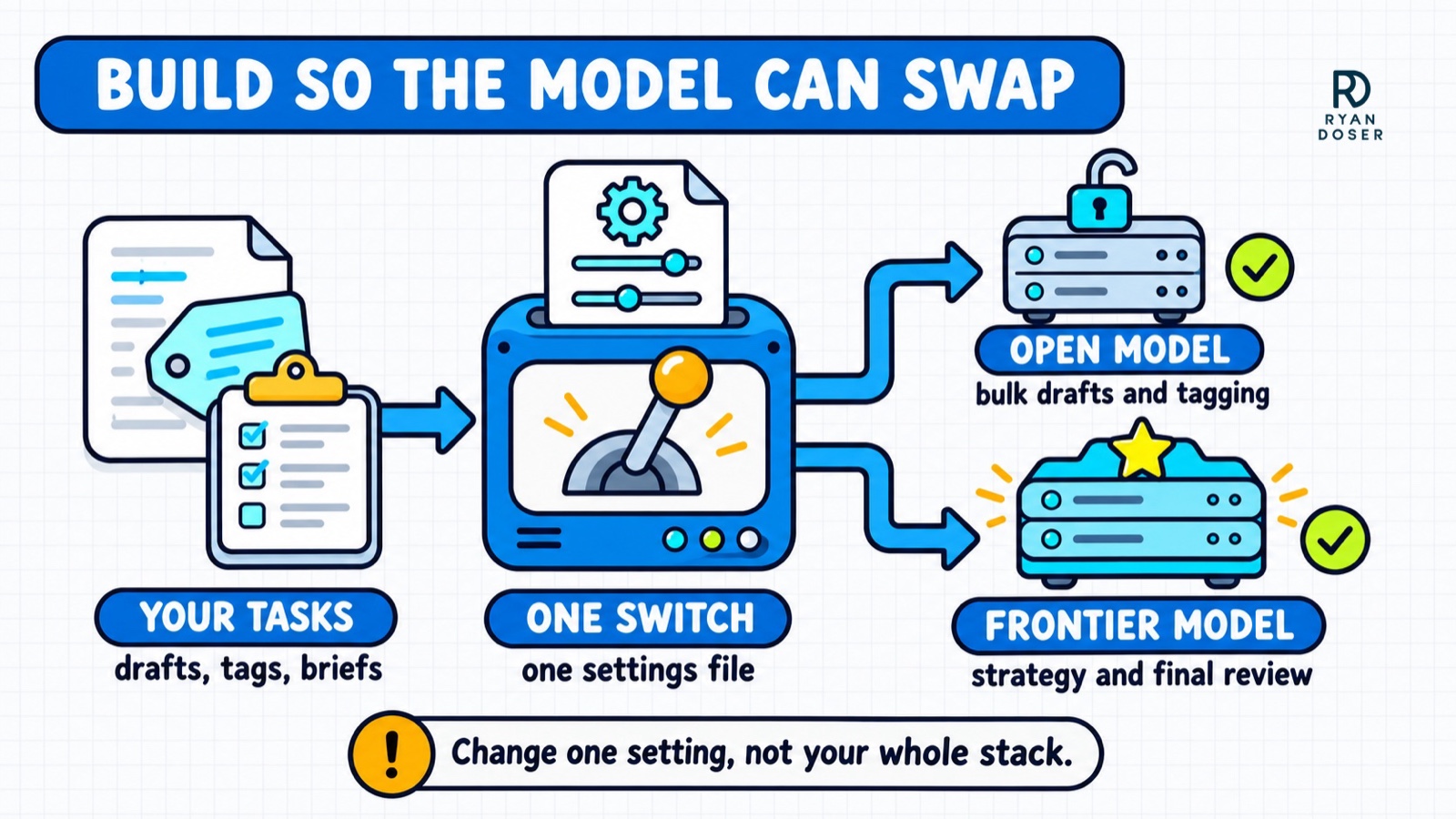
- Build so the model can swap: put your prompts, skills and checklists in files you own, and point them at a model through one setting. OpenRouter in Claude Code or an n8n workflow lets you send bulk work to the cheapest model that passes your checks, open or closed, and keep strategy and final review on a frontier model.
- Own the audience, rent the model: model prices keep falling and AI answers keep absorbing clicks. An email list, a YouTube channel people search for and your own data are harder for a cheaper model to copy, and my newsletter bot analysis shows why the list needs cleaning too.
If you want the hands-on version, my guide to using open source AI models tests three of them on a real landing page. Start with your most boring, highest-volume task.
Method & Sources
- Usage data: OpenRouter's public monthly model rankings list the top 50 models by tokens each month plus an "other" bucket. I used Nov 2025 to Oct 2026 as full months and report November 2026 (Nov 1 to 11) separately.
- Open or closed: a model counts as open-weight when OpenRouter's catalog lists a Hugging Face ID for it. Models no longer in the catalog were labeled from the developer's public release status, and stealth or unclear models stayed "unclassified" (6.3% of October tokens) and were left out of the shares.
- Origin: the country of the lab that published the model, so a German fine-tune of a Chinese model counts as non-Chinese. Tokens outside each month's top 50 (8.3% in October) can't be classified and aren't in the shares. A Hugging Face ID shows the weights are published, not which license applies.
- Scores: the Artificial Analysis Intelligence Index as listed on OpenRouter on November 12, 2026. Some older listings score far below what their developers claim (the original Kimi K3 shows 17.4), so treat a single score as one benchmark, not a verdict.
- Prices: each developer's own standard-tier price on OpenRouter, leaving out flex, priority and "fast" tiers. "Cheapest host" is the lowest standard price among all providers, which can mean heavier quantization.
- Drafts table: an assumed 3,000 input and 2,000 output tokens per blog draft at developer list prices. Real costs vary with prompt length, retries and caching.
- Quoted figures: spend share, policy events, capex, revenue run rates, Pew, Stanford and Epoch figures come from the linked sources and weren't recomputed. A Reuters report on a Capgemini survey was left out because it couldn't be opened for checking.
- Who did the work and disclosure: Claude collected the data and a script computed and checked every own-data figure, while I chose the angle and wrote the takeaways. I sell Claude Code products and use Claude daily, and Claude models are in these charts, so weigh my takeaways with that in mind.
Chinese AI Models FAQs
What are the best Chinese AI models, and are they as good as ChatGPT and Claude?
On the Artificial Analysis Intelligence Index, Moonshot's Kimi K3.1 Pro leads the Chinese models by a wide margin. On November 12, 2026, it scored 46.5, ahead of Tencent Hy4 (34.6), Alibaba's closed-weight Qwen3.8 Max (33.7) and Z.AI's GLM-5.3 (31.7). Claude Fable 5.2 scored 64.6, GPT-6.1 Sol scored 54.6, and 9 closed models scored higher than Kimi. Epoch AI puts the average open-closed lag at about four months.
How much cheaper are Chinese open-source AI models?
It depends on the tier and the host. At developer list prices, Kimi K3.1 Pro costs $2/$10 per million input/output tokens, the same as GPT-6.1 Sol, and Anthropic and OpenAI now sell small models at $0.10/$0.50. The big savings come from third-party hosts: the cheapest host for GLM-5.3 charged 18.7% of Z.AI's own blended price.
Is the U.S. banning Chinese AI models?
Not as of November 12, 2026. In July, Treasury Secretary Scott Bessent said that if overseas models were found to be stealing from U.S. companies, the U.S. could sanction them, and the New York Times reported that sanctions and a trade blacklist were discussed. The administration backed off for now after an outcry from Silicon Valley, per The Decoder's summary of the Times report. That pushback included a July 24 letter from Nvidia, Microsoft, Meta and more than 20 other companies, which Fox Business reported.
Should marketers use Chinese open-weight models?
For bulk, low-risk work like tagging, summaries and first drafts, they are worth testing, ideally through a U.S. host or your own server so prompts don't go to the developer's own API. Keep client data, regulated data and final review on a model and host your contracts cover.
What does open-weight mean?
An open-weight model is one whose trained model file is published, so anyone can download it, run it and resell access to it. Many releases share the weights but not the training data or code, which is why "open weights" is more accurate than "open source."
Cite This Study
You're welcome to use any chart, table or finding here with a link to this page. Please keep the November 12, 2026 date and the "OpenRouter, top 50 models" scope with the figures.
Doser, R. (2026, November 12). Chinese AI models and the open-source squeeze: What the data says for marketers. ryandoser.com. https://ryandoser.com/research/chinese-ai-models/
Chart images
Each chart below is a 1600-pixel PNG with its title and source line built in.