
He Makes $100K/Month With Rank & Rent SEO (AI Proof)
This breakdown explains how a guy known as the website landlord built a six-figure passive income with rank and rent SEO, and why he says AI hasn't dented the model at all.
Rank and Rent SEO Video Guide
I sat down with Kyle, who runs a portfolio of rank and rent local SEO sites pulling in around $100,000 a month. Watch the full conversation below.
If you want to go deeper on building these sites yourself, I documented my own process in my guide on making money with local SEO using Claude Code. It pairs well with everything Kyle covers here.
What Rank and Rent SEO Actually Is
Imagine you build a website for tree services in Savannah, Georgia. It ranks on page one. The phone starts ringing. But you don't cut down trees.
So you call a real tree service in Savannah and offer them a free 7-day trial of those leads. They close three jobs that week. Then you charge them $1,000 a month to keep the calls flowing.
That's the website landlord business model in one sentence. You own a digital asset that ranks, and you rent the lead flow to a local business that does the actual work. The site sits there. The calls keep coming. The client keeps paying.
This is not a marketing agency. An agency manages your online presence for a monthly retainer and can't promise results. Rank and rent flips it. You build the asset first, prove it generates calls, then sell access to those calls. The business owner takes zero risk because they only pay once the leads are real.
Kyle put it bluntly. "You're not building a business here, you're building an asset." He compared it to spending a year building a house you own forever.
How to Pick a Low Competition Niche and City
Most people fail at this model because they chase the wrong markets. Kyle starts with a spreadsheet of niches and cities that interest him, then runs live searches to size up the competition.
He looks at the top three results for a query like "tree service Savannah." For each one he checks domain authority, trust flow, backlink profile, content depth, and whether the site has proper headings and images. Then he picks the weakest markets.
You will find tons of cities where the ranking sites look like they were built in 2005 and never touched. Go in, do 10% better, and you knock them out for good.
The niche selection is where the real edge lives. Skip the markets eaten by private equity.
- Avoid: plumbing, HVAC, roofing in big metros, and personal injury law. Personal injury lawyers in Los Angeles spend $50,000 a month on marketing. Good luck.
- Target: gutter installation, epoxy floors, popcorn ceiling removal, junk removal, septic, towing, auto glass repair. These niches still have owners doing millions in revenue who never invested in their online presence.
Kyle's rule of thumb on city size: there are over 800 US cities with a population above 50,000, and far more below that. A town of 100,000 or less is often full of operators with a pickup truck and a tool belt who don't know SEO and won't gamble $1,500 a month on an agency.
The 80/20 of Rank and Rent Local SEO
What actually moves the needle? Kyle says 80% of the work is content and backlinks, and the weight shifts based on how soft the competition is.
The content rule surprised me. The words on the site are not for the customer. Nobody reads the paragraphs on a tree service website. They scan for a phone number and call. The content exists to tell Google's crawler exactly what you do and where you do it.
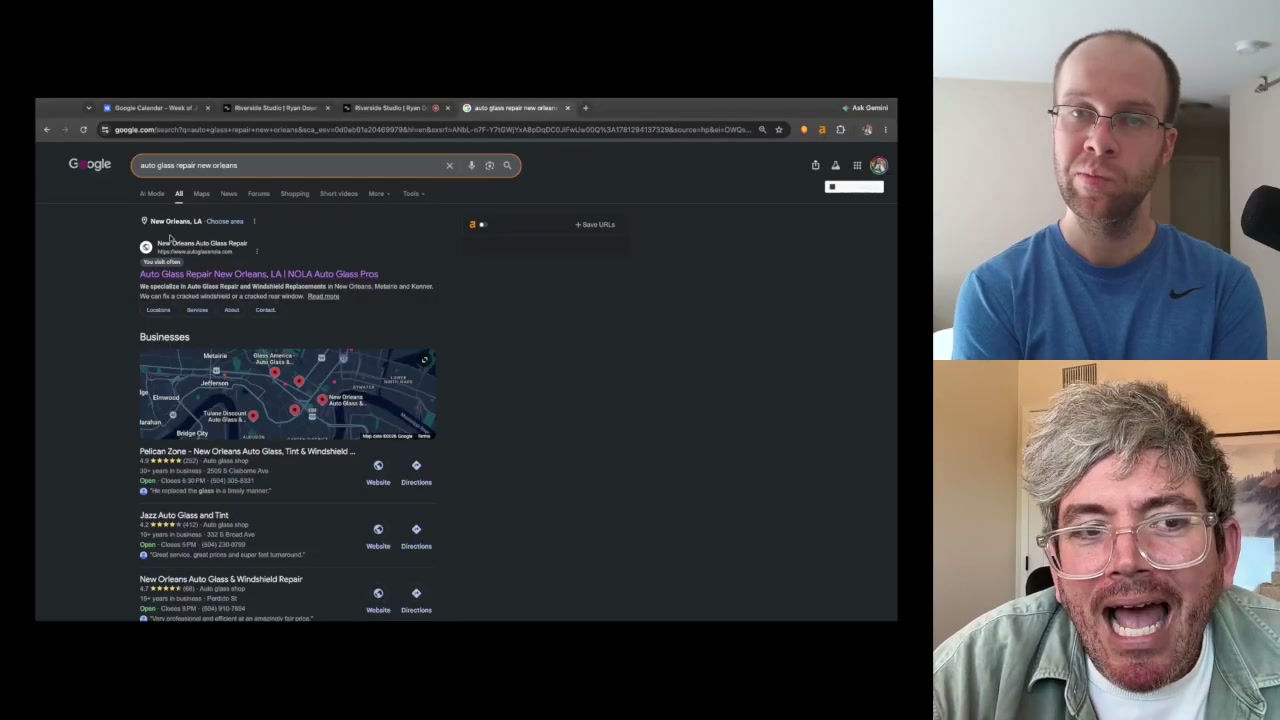
So his sites are blunt. "New Orleans auto glass repair. Windshield replacement in New Orleans." No clever copy. Just crystal-clear relevance signals.
Then there are backlinks, which prove to Google that someone trusts you. Kyle skips the cold-email guest post grind entirely. Two methods do the job in low competition SEO:
- Private community link sharing: students in his program exchange links across each other's sites.
- The copycat method: use a tool like Ahrefs or Mangools to pull the backlinks of a competing site in any city, then grab the free and easy ones for yourself. Blog comments, directory listings, simple citations.
People love to claim those links don't work. In low competition SEO they absolutely work. You don't need a Forbes or CNN backlink to rank for "auto glass repair New Orleans." You just need Google to see that someone knows you exist.
This is the part most SEO advice gets wrong. Almost every expert online is teaching you to compete nationally for top-of-funnel keywords. Outranking real local operators in a small city is a completely different game, and the rules are far more forgiving. If you want the full local playbook, see my deeper breakdown on Claude Code SEO workflows.
Why Rank and Rent SEO Is AI Proof
Here's the question everyone asks. With Google AI Overviews and AI Mode eating the SERPs, does this model still work?
Kyle's answer: so far, AI has only helped him. His sites already rank, and Google's AI just pulls from the standard search results it has trusted for years. He hasn't changed his strategy once.
His logic is sharp. Google spent 30 years building criteria for which local business shows at the top of page one. Gemini defers to all of that work. The AI can't go drive to New Orleans and test auto glass shops. All it knows is what's on your website. So you keep feeding Google what it wants, and you keep showing up in the AI answers too.
The money trail backs this up. Kyle estimates local service ads drive a huge chunk of Google's revenue. Picture the search page like television. The ads at the top are the commercials. The organic local results right below are the actual show people came to watch. Without the show, Google has nothing to sell ads against.
There's a second layer most GEO and AEO hype misses. When ChatGPT, Claude, or Gemini answer a query, they often retrieve live Google and Bing search results in real time. If you ignore traditional SEO fundamentals, no black-hat AEO trick saves you. The fundamentals are the foundation the AI answers sit on.
If anything, AI opens up more long-tail searches. People now type "affordable roofer who specializes in Spanish tile roofs, licensed and insured" instead of "roofers Houston." Kyle's response is to flesh out his sites with more localized content so they cover more of those variations. He doesn't try to rank for all of them. His goal is to capture just 1 to 5% of daily demand, which is plenty for one client.
How AI Builds Rank and Rent Sites in Minutes
Kyle used to pay a writer $25 per 500 words and wait 10 days for content. Now he gives ChatGPT specific instructions and gets it in seconds. AI also helps with market research and pricing.
I took this further. After hearing Kyle's episode on The Koerner Office, I built my own rank and rent site as a test: a septic business at desmoinesseptic.com. I used Claude Code with Cloudflare, the Astro web framework, and GitHub. It ranks on page one for legitimate septic queries in Des Moines.
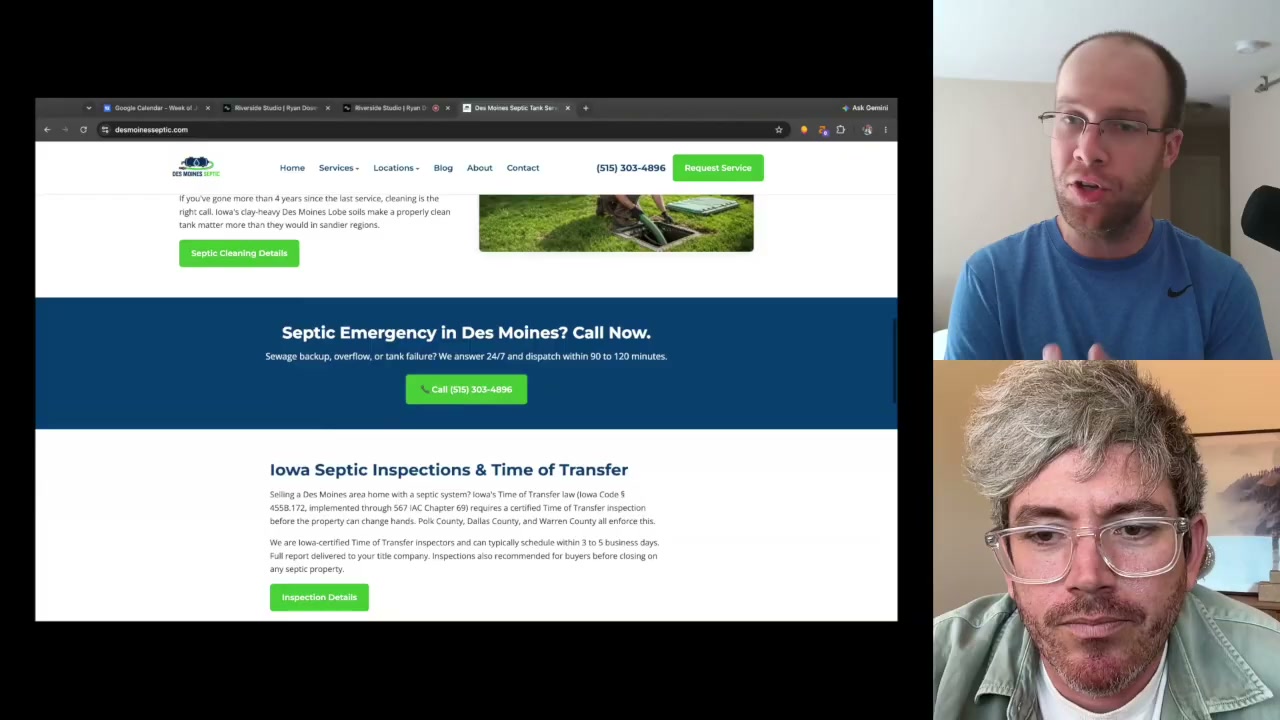
The first build took a couple of hours. Then I saved all that context as a skill markdown file, so now I can spin up a new site in minutes with Claude Fable. If you want to learn how I set up reusable AI systems like this, I walk through it in my Claude Code Skills Stack.
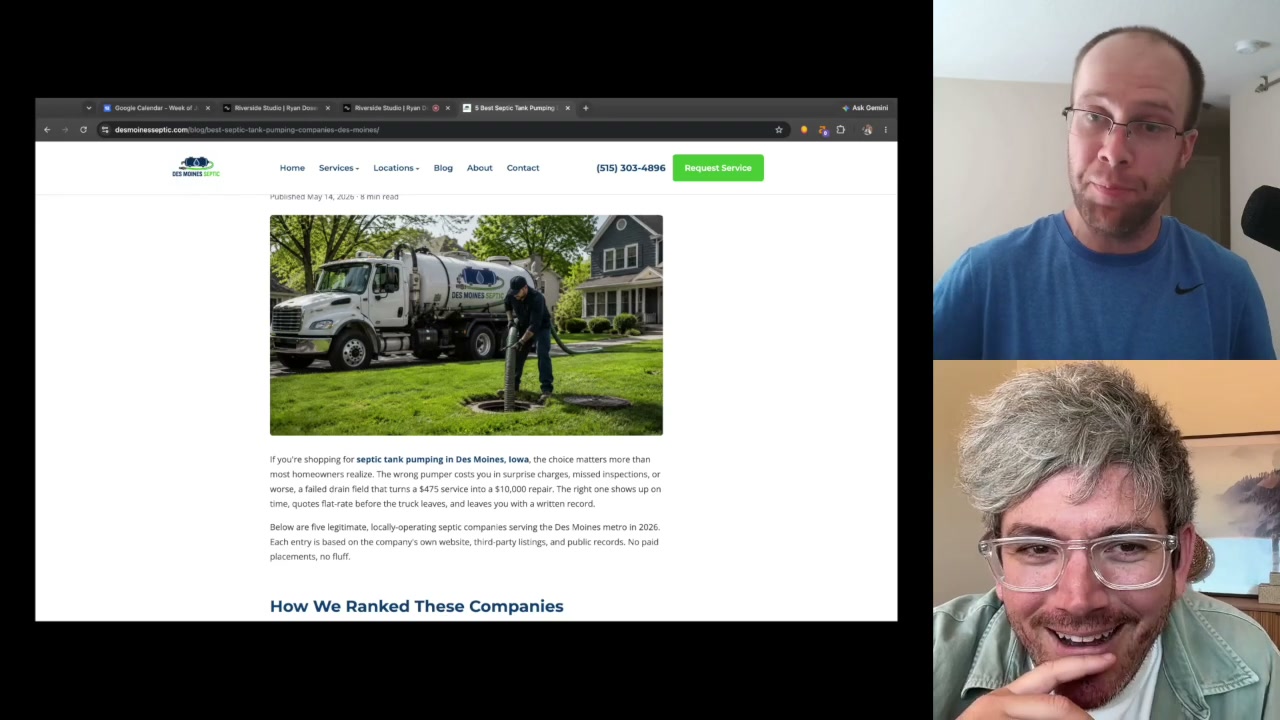
The localized content trick is where AI shines for this model. You can scrape directories and public data, then generate hyper-focused pages about specific streets, neighborhoods, and local details. Google reads that as genuine local expertise. My site even has AI-generated blog images, like a septic truck pumping a tank that looks like it was shot in Des Moines.
Kyle did flag one honest warning. He doesn't push AI on the students he mentors, because AI can wander off and use strategies that don't rank. You might spend three months not knowing why your site is stuck. A real SEO foundation helps you catch that.
Is Rank and Rent SEO Saturated?
The most common objection is saturation. Kyle was worried about it back in 2019 when he started. It has never affected him once.
The math kills the argument. Roughly 1,000 niches, multiplied by 800-plus US cities over 50K population, multiplied by the three to five ranking spots that still pull calls. That's around 2.5 million opportunities. A model most people first heard about a week ago is nowhere near saturated.
Search results also change with every phrasing. Ranking number one for "towing Asheville" doesn't mean you own "best towing Asheville" or "affordable towing Asheville." Every variation is its own little market.
There's real money in the underrated niches too. Kyle has a friend with a popcorn ceiling removal site in Southern California who once landed a $20,000 commercial quote through it. A niche of a niche.
Ryan's Final Thoughts
Rank and rent SEO is one of the more durable AI-era opportunities I've looked at this year. You build a ranking website, rent the leads to a local business, and collect a flat fee while the asset sits and works. Kyle's $100K a month proves the ceiling, and my own septic test proves how fast AI lets you start. Pick a soft niche, niche down hard, and treat each site as an asset you own for life.
You can follow Kyle on TikTok at websitelandlord or learn more about his model at Rent Local Sites. For more on the AI build side, see my full SEO system breakdown.
Rank and Rent SEO FAQs
What is rank and rent SEO?
Rank and rent SEO means building a website that ranks on Google for a local service, then renting the lead flow to a real business in that niche. You own the site as an asset and charge a flat monthly fee, often around $1,000, for the calls and form submissions it generates. The business does the work, you keep the asset.
How much money can you make with rank and rent?
Earnings vary by niche and city, but a single ranked site can generate $1,000 to $2,000 a month in passive income. Kyle, featured in the video above, runs a full portfolio producing around $100,000 a month. The model scales by rinsing and repeating the same formula across new niches and cities.
Is rank and rent SEO still worth it with AI?
Yes. AI search pulls from the same Google rankings that have always mattered, so ranked sites still surface in AI Overviews and Gemini answers. AI also makes building these sites faster and opens up more long-tail local searches. The traditional SEO fundamentals remain the foundation AI answers depend on.
What niches work best for rank and rent local SEO?
Low competition home service niches work best. Think gutter installation, epoxy floors, popcorn ceiling removal, junk removal, septic, towing, and auto glass repair. Avoid heavily funded niches like plumbing, HVAC, and roofing in major metros, plus personal injury law, where competitors spend tens of thousands a month on marketing.
How do you rank a rank and rent website on Google?
Focus on two things: clear local content and simple backlinks. Write blunt, location-specific pages that tell Google exactly what you do and where. Then build easy backlinks like directory listings and citations, often copied from competing sites using a tool like Ahrefs or Mangools. In low competition markets, you don't need premium links to rank.