
BabyLoveGrowth Review: Does the $99 AI SEO Agent Work?
BabyLoveGrowth sells a feature its own homepage describes like this: "Our agent identifies the Reddit and Quora posts that LLMs learn from, then suggests comments that naturally mention your brand."
That is a real feature, sold on the pricing page as a "Reddit AI agent for brand mentions in key communities," and the reasoning behind it is sound. Reddit carries unusual weight in both Google results and AI answers, so being named there genuinely does influence whether an assistant recommends you.
Whether you want that done automatically, on your behalf, in communities that mostly prohibit undisclosed promotion, is a separate question and one you should answer deliberately rather than by accident.
If the appeal is knowing where you are being talked about rather than planting the mentions yourself, a monitoring tool does that job honestly. I covered the one I rate in my Alertmouse review.
This BabyLoveGrowth review covers that feature, but it is not the thing I would most want you to know before paying. That turns out to be a mismatch between the refund the site advertises and the refund its contract actually gives you, and I get to it below.
Before anything else, you should know where I am standing. I sell an AI SEO System that competes with this for the same budget, at $199 once instead of $99 a month. Discount me accordingly. I take no affiliate money here, which is the only reason a post like this is worth writing when the entire first page of results for this product is monetized.
And the limit of what I can tell you: I have read every page of the pricing, the terms, the docs and the public review pool, but I have not run this on a client campaign. So this is a review of what the company commits to in writing and what its customers report happened. It is not a report of what it produced for me.
What BabyLoveGrowth Actually Does
BabyLoveGrowth is an AI SEO and GEO platform that runs your blog on auto-pilot. It analyzes your site and competitors, builds a keyword cluster and content calendar, writes articles, and publishes them straight into your CMS. WordPress, Shopify and Webflow are named on the pricing page.
Around that core it stacks four things most competitors at this price do not bundle together: a backlink exchange across what it calls 4,000+ partner sites, AI citation tracking for ChatGPT, Perplexity and Gemini, a site audit, and the Reddit agent above.
The company is BLG INC., listed at 835 Fifth Avenue, San Rafael CA 94901 on its own pricing page. The founder is Tilen Savnik, who signs the company's Trustpilot replies personally.
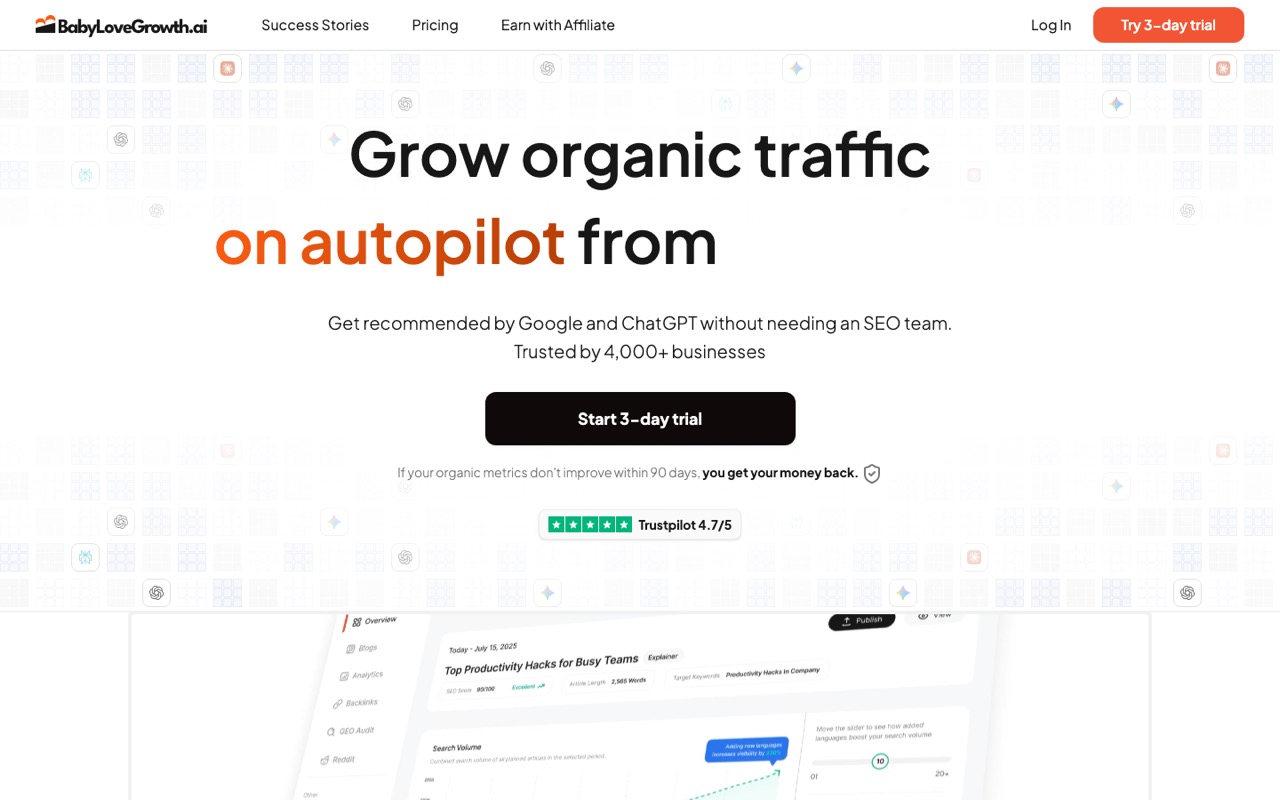
Credit where it is due on the product surface: AI citation tracking on a $99 plan is genuinely useful, and it is the feature I would actually want. Knowing whether ChatGPT names you is the measurement most businesses are missing entirely. That part is a real answer to a real question.
What It Costs, Once You Strike the Anchors
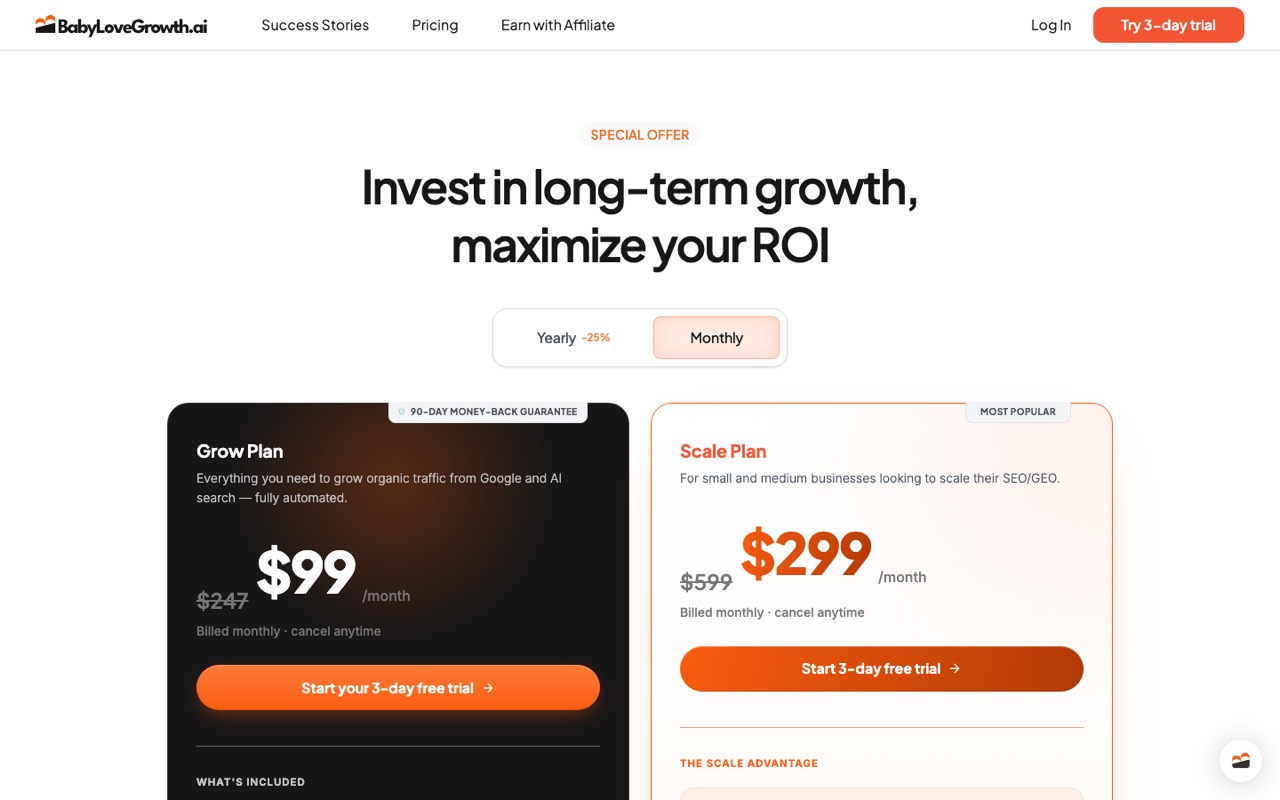
These prices load with JavaScript and the page defaults to the discounted view, so a plain fetch or a cached copy will mislead you. Rendered in full on August 18, 2026, with the monthly toggle active:
| Plan | Anchor price | Actual price | What you get |
|---|---|---|---|
| Grow | $247/month | $99/month | 30 articles, auto-publishing, backlink exchange, AI citation tracking, site audit, Reddit agent, keyword research |
| Scale | $599/month | $299/month | Everything in Grow, plus a dedicated SEO/GEO specialist (2 hours monthly), 3 extra languages, beta access, priority support |
Yearly billing is advertised at 25% off. There is a 3-day free trial, card required, and an advertised 90-day money-back guarantee that its Terms of Use did not contain when I first checked. It is in there now, with conditions that get their own section below.
Two observations on that table.
The $247 and $599 anchor prices are struck through next to the real ones, permanently, under a "Special offer" label. A discount that never expires is not a discount, it is the price. I would price this at $99 and $299 in your head and ignore the anchors entirely.
The 90-Day Guarantee Was Missing From the Binding Terms
Update: BabyLoveGrowth has since added the guarantee to its Terms. As of September 30, 2026, Section 7 says no refunds after the 3-day trial "except under the 90-Day Money-Back Guarantee in Section 8," and Section 8 sets the conditions: it only pays out if none of organic clicks, organic impressions or Domain Rating rises over the 90 days, after at least three consecutive paid months with every article it produced published and publicly visible, not behind a login, paywall or noindex tag. That uses the looser "organic metrics" trigger I flagged below, and impressions tend to rise when you publish 30 pages a month. The rest of this section is the August 18 reading.
This was the finding I most wanted you to have before you entered a card, and it took reading the actual contract to see it.
The homepage advertises a 90-day money-back guarantee, worded: "If your organic metrics don't improve within 90 days, you get your money back." The pricing page carries the same promise with a narrower trigger: "If your organic traffic doesn't increase within 90 days, you get your money back."
The Terms of Use, the document you legally agree to, said this instead on August 18, verbatim: "Due to the operational costs associated with external APIs and AI services, we do not offer refunds after the 3-day trial period has ended. By continuing to use the service after the trial period, you acknowledge and agree to this no-refund policy."
On August 18, the number 90 did not appear anywhere in the Terms. I searched the full document.
The Terms also carved out a discretionary path, which is still there: in "exceptional cases" such as a bug or "if the service is not as advertised," you may request a review for a refund, which requires scheduling a call with support. That is meaningfully different from a guarantee. A guarantee is something you claim. A discretionary review is something you apply for, to the company holding your money, under terms it wrote.
Two more things from that page worth knowing. The Terms are governed by the laws of the United Kingdom, despite the California address and "BLG INC." branding. I am not a lawyer and consumer-protection rules can override a chosen forum, so I will not tell you what that means for your rights. I will say it is worth knowing before a dispute rather than during one. And note that the two pages do not promise the same thing. The pricing page conditions the refund on "organic traffic," which is the number that matters to you. The homepage conditions it on "organic metrics," which is looser: impressions are an organic metric, and impressions tend to move when you publish 90 pages whether or not a single person visits. If you ever needed to claim this, which sentence the company pointed at would matter.
I am not calling this fraud, and there is a plausible innocent explanation: marketing pages and legal pages drift apart at fast-moving startups, and the Terms are dated December 2024. But the mismatch was live on the site that day, it ran in the company's favor, and the version that bound you was the one promising three days rather than ninety. Compare it to Outrank, whose seven-day refund window is at least stated identically in its marketing and its contract.
The 4.6, the Missing Reviews, and Trustpilot's Flag
Update: Trustpilot has since suspended BabyLoveGrowth's rating. As of September 30, 2026, its profile reads "This company's rating is unavailable due to a breach of our guidelines," with a banner stating "This company has been offering incentives for reviews." Everything below is the August 18 snapshot, taken before that flag appeared, and should be read with it in mind.
On August 18, BabyLoveGrowth held a 4.6 TrustScore across 203 reviews, 191 of them in the last twelve months. That was a strong number and I am not going to explain it away.
It also looked, on Trustpilot's own data at the time, unsolicited. I checked the transparency tab rather than assuming: all 191 recent reviews were recorded as organic, with zero collected through invitations, automatic prompts, or redirects. On that data it looked like a 4.6 the company had earned. Trustpilot's later incentive flag is exactly the kind of thing that transparency tab cannot show.
Then I looked at the reporting statistics on the same page, and this is the part nobody else has reported.
BabyLoveGrowth has filed 21 reports against reviews on its own profile. Broken down by star rating, those reports were: 17 one-star, 1 two-star, 1 three-star, and zero four- or five-star. Every review it challenged was a critical one.
The outcome: 10 reviews were taken offline, and 9 of the company's reports were ruled invalid by Trustpilot and the reviews reinstated.
Let me be careful about what that does and does not mean. Reporting reviews is a legitimate tool, companies do get fake and abusive reviews, and 10 of those removals happened because the reviewer never responded to Trustpilot's verification request, which can happen to genuine customers and fraudsters alike. This is not proof of anything improper.
But the shape is worth seeing clearly. A 4.6 that looked unsolicited reads very differently once you know that 19 negative reviews were formally challenged, that nearly half those challenges were judged invalid, and that ten critical reviews are no longer on the page you are reading. Outrank, for comparison, filed 3 reports total. Read how a review pool was maintained, not just how it was assembled.
One number genuinely in BabyLoveGrowth's favor. In August it had 13 negative reviews live, and it had replied to 76.9% of them, averaging 5.7 days. Outrank had replied to 17.4% of its negative reviews and had stopped replying entirely for seven months. Somebody at BabyLoveGrowth was answering unhappy customers, and that counts.
What the Negative Reviews Say, and How the Company Answers
Thirteen negative reviews is a small pool, so treat this as signal rather than verdict. The complaints cluster on two things: content quality and backlinks that do not arrive.
On content: "Their daily blogs are garbage. It would take me every day to edit them into something meaningful and relevant. No sign of back links, not even one."
A three-star reviewer, the most useful review in the pool because he is neither angry nor delighted, described a specific mechanical failure: he added about 30 researched keywords, they vanished from the tool, support could not explain where they went across two weeks, and "it just writes random stuff with no important keywords." He also noted the internal linking chose "old urls that are not even showing on the web site and have no content to them."
On backlinks: "you get literally 1 backlink a month haha, like that's going to help you rank anything... with 10 backlinks a year at this rate." The company's public reply states that "on average, each website gets quality 6+ backlinks a month," which is a useful number to have on record and one you can hold them to.
Now, the pattern in the replies. To four separate negative reviewers, the founder responded that he could not find their account: "I wasnt able to locate your account in our database." "I am not able to locate any account under this name." "there is no account linked to Garry Walker."
There is a mundane explanation worth putting first. Trustpilot display names frequently do not match billing names, so a founder searching by display name would genuinely fail to find real customers. That is the likeliest reading, and I am not going to imply otherwise.
But notice the effect regardless of intent. A public reply saying "this person is not in our database" reads to every future shopper as a suggestion the complaint is not from a real customer, while asking the reviewer to email privately moves the resolution somewhere nobody else can see. Used four times on four different critics, that becomes a pattern worth naming even when each individual instance is innocent.
The Incentivized-Review Allegation
Update: Trustpilot has since flagged this profile for incentivized reviews. As of September 30, 2026, the profile carries the banner "This company has been offering incentives for reviews" and its rating is withheld for a breach of guidelines. Trustpilot does not say what the incentive was, so the reviewer's specific claim that it was backlink credits is still unverified.
One reviewer made a specific and serious claim: "most of these reviews on this site are not honest as they give you credits which is against trust pilots policy (which you cant even spend or use) for backlinks to give a good rating."
He is alleging customers were given backlink credits in exchange for positive reviews. I want to handle this precisely, because it is exactly the kind of claim that gets repeated carelessly.
On August 18 I wrote this: I could not verify it, and there was evidence against it. Trustpilot's own data field for this profile recorded hasCollectedIncentivisedReviews: false at the time, and Trustpilot flags profiles where it detects incentivization. One anonymous reviewer's assertion was not proof, so I reported it as an allegation rather than a finding.
I include it for one reason: it is in the public pool that shapes this product's reputation, it is the sort of thing a buyer should be able to weigh, and the responsible thing was to show you both the claim and the evidence as it stood, rather than either amplifying it or hiding it. Trustpilot's later flag is why the update above matters.
The Reddit Strategy Is the Real Story
BabyLoveGrowth's Reddit agent is sold as a feature. The homepage says it identifies Reddit and Quora posts "that LLMs learn from," then suggests comments that "naturally mention your brand." The pricing page lists it as "Reddit AI agent for brand mentions in key communities."
The underlying theory is correct, and I want to give it that. Reddit is weighted heavily in both AI answers and Google results, and third-party mentions genuinely do influence whether a model names you. I have run my own tests on how much those mentions actually move AI citations, so this is not a mechanic I dismiss.
The company was open about using it. In February 2025 the founder posted a thread titled "I grew BLG in 3 weeks to $850 MRR using only Reddit," which still surfaces in Google's results today. A founder promoting his own product on Reddit is ordinary startup behavior, and I am not accusing this company of running fake accounts. I found no evidence that it does.
What changes the calculation is selling it as a service. A founder talking about his product in public is participating. An agent generating brand mentions across communities on behalf of paying customers is manufacturing the third-party signal that AI models mistake for consensus, in communities that mostly ban undisclosed promotion.
There are only two ways to be present in the sources AI assistants read, and they age in opposite directions. You can earn the mentions, by publishing things people cite and by being genuinely useful somewhere public. Or you can generate them. Both work today. Only one of them gets safer over time.
Generated mentions are a bet that detection stays where it is. Every incentive at Reddit, Google and the model labs points the other way, because a platform whose recommendations are gameable at $99 a month is a platform with a corroded product. When that detection improves, earned mentions keep compounding and generated ones become a cleanup project on a domain you cannot swap out. That asymmetry is the whole argument, and it applies to every tool in this category rather than just this one.
The practical version for a business owner: if a tactic would embarrass you when the community it targets finds out, it is a rental, not an asset. Price it accordingly.
The Link Exchange Problem
The exchange is where I would spend your attention, because unlike a wasted subscription it can cost you an asset you cannot re-buy.
The backlink exchange trades links across a partner network. Google's spam policies name the mechanic directly, listing as link spam: "Excessive link exchanges ('Link to me and I'll link to you') or partner pages exclusively for the sake of cross-linking."
That is Google's own wording, not my characterization, and a network where members' sites link to each other is that pattern by construction. The company's framing is that these are real contextual links inside relevant articles on relevant sites, which is a meaningful distinction in quality but not one that changes the reciprocal structure underneath.
The content half meets a second policy. Google defines "scaled content abuse" as "when many pages are generated for the primary purpose of manipulating search rankings and not helping users," naming "using generative AI tools or other similar tools to generate many pages without adding value for users."
The word doing the work in that definition is value, not AI. Nothing in the policy prohibits machine-written pages, and I publish AI-assisted content on the site you are reading. What it targets is publishing at a scale nobody is curating, which means the article count is not the variable that decides your exposure. Whether a person is deciding each page deserves to exist is.
Does It Work on Its Own Site?
This is the test I apply to every tool in this category, and BabyLoveGrowth passes it better than most.
Its own pages rank. Its pricing page shows up on page one for its brand-review query, its LinkedIn presence is active, and its case studies name real founders at real companies with specific figures: DR 12 to DR 32, 620 to 14K organic reach, 1.4M impressions. Named customers with checkable companies are a materially stronger form of evidence than anonymous testimonials, and several of these are more specific than what most competitors publish.
The honest caveat is what those case studies measure. The headline metrics are overwhelmingly Domain Rating, impressions and traffic. Domain Rating is an Ahrefs score Google does not use, and it responds directly to acquiring links, which is what a link exchange does. Impressions are the metric that inflates most easily and convert least reliably. Almost none of the case studies lead with revenue or qualified leads.
Then I ran the tool's own domain through a rank check rather than taking the case studies on faith, and this is where it gets awkward.
BabyLoveGrowth's site publishes roughly 4,800 URLs across six language versions, the same pages mass-translated into French, Dutch, German, Spanish and Portuguese. That is the product's own strategy applied to itself at full volume.
The return on those 4,800 pages, per a DataForSEO rank pull I ran on August 18, 2026, is 694 ranking keywords in the US. For comparison, that is a smaller keyword footprint than plenty of single-author blogs with 100 posts.
What it ranks for is the more interesting part. Setting aside its own brand name, its best-performing pages are: "4p in marketing example" at position 4, "student blog template" at position 6, "how long is an article" at position 5, and "seo for electricians" at position 13. Its single biggest listing is a page for "search google or type a url", sitting at position 28.
In the top 25 keywords by traffic value, exactly one is a commercial term for the category it sells into: "auto seo platform," at position 8, with 390 monthly searches.
So the machine produces pages that rank for student blog templates and the four Ps of marketing, not for the buyers of AI SEO software. That is the actual output profile, measured on the one site where the tool has unlimited budget, full control, and every incentive to prove itself. No case study can tell you as much, because no case study is selected by anyone other than the vendor.
The Three Questions That Decide It
Rather than a list of buyer types, here are the three questions whose answers actually determine whether this is a good purchase for you. Answer them honestly and the decision makes itself.
Question one: who is reading the articles before they publish? If the answer is nobody, stop here. Auto-publishing unreviewed pages to your domain while pointing exchange links at it is the configuration that collides with both of the Google policies quoted above at the same time. If the answer is "me, every one of them," the picture changes completely, and at $99 for 30 drafts with real CMS publishing this is fairly priced as a pipeline.
Question two: can you afford to be wrong about the links? This is the question about your domain rather than your budget. A throwaway project, a niche site you could abandon, a brand you have not built anything on yet: the downside is small and the upside is real. The business whose domain carries ten years of equity and whose leads come through search: that is a different bet entirely, and the exchange is the part I would leave switched off.
Question three: is your real bottleneck volume, or is it knowing what to publish? Volume is a solvable problem and this tool solves it. Judgment is not, and a machine producing 30 articles a month multiplies whatever judgment you bring to it, including none.
One genuine recommendation that cuts across all three. If you do buy in, the $299 Scale tier is the more interesting purchase than the $99 one, because it includes two hours a month with an actual SEO specialist. That is the only part of this product that cannot be commoditized, and two hours of a competent human looking at your specific site is worth more than 30 additional articles nobody reads.
The one thing I would not buy at any tier is the Reddit agent. Automated brand mentions in communities that explicitly ban undisclosed promotion is a moderation risk stacked on a reputational one, and a tactic that only works until the platforms notice is not a strategy you can build on.
The Part Where I Am Selling Something
Everything below is my pitch. Read it that way.
BabyLoveGrowth's underlying premise is one I agree with completely: if you want AI assistants to recommend you, you have to exist in the sources those assistants read. That is not marketing spin, it is how retrieval works, and most businesses still have no plan for it.
My disagreement is the durability point I made above: the generated version of that presence is a rental with an expiry date, and the earned version compounds.
I have run the earned version on my own property rather than a client's, which is the only reason I will put numbers next to it. Starting from nothing in February 2026, no backlinks and no history, six months produced 5.77K clicks and 890K impressions in Search Console, 12.1K AI citations logged in Bing Webmaster Tools, and north of $100K in revenue. Not one link came from an exchange and not one comment was automated. The charts are on the consulting page if you want to audit them.
What I sell is that process rather than a subscription that performs it for you. The AI SEO System is $199 paid once, it drives the AI tools already on your bill, and the reason I think it beats renting this category is unglamorous: you still have it next year whether or not you are still paying me. When someone would rather I just look at their site and rank the fixes, that is the consulting session.
Wider context lives in my best AI SEO tools roundup and my AI SEO strategy breakdown.
My Verdict on BabyLoveGrowth
BabyLoveGrowth is the better-run of the two $99 auto-publishing tools I have looked at this month. The support answers, the case studies name real people, and the AI citation tracking is a genuinely good inclusion at this price.
It is also built on two mechanics Google's documentation describes as spam, and it sells automated brand-mention seeding as a feature. Both of those are true at the same time, and neither cancels the other.
So the question is not whether the company is competent. It is whether you want your domain's long-term equity riding on link exchanges and manufactured mentions to save time you could spend learning what to publish. For a throwaway project, the math might work. For the business you intend to still own in three years, I would not take that trade, and I would not advise a client to.
And if you do subscribe, make your decision inside the first three days. The contract now includes the 90-day guarantee, but it only pays out if none of organic clicks, organic impressions or Domain Rating rises over the 90 days, after at least three consecutive paid months with every article it produced published and publicly visible, not behind a login, paywall or noindex tag, so treat the three-day trial as your real exit.
BabyLoveGrowth Review FAQs
How much does BabyLoveGrowth cost?
BabyLoveGrowth costs $99 per month for Grow and $299 per month for Scale, shown against permanent struck-through anchors of $247 and $599. Grow covers 30 auto-published articles, a backlink exchange, AI citation tracking and the Reddit agent; Scale adds two hours a month with a human SEO specialist. There is a 3-day trial with a card required. The Terms now include the advertised 90-day money-back guarantee, but it only pays out if none of organic clicks, organic impressions or Domain Rating rises over the 90 days, after at least three consecutive paid months with every article it produced published and publicly visible, not behind a login, paywall or noindex tag. Prices verified on a full render of babylovegrowth.ai/en/pricing, August 18, 2026; Terms rechecked September 30, 2026.
Is BabyLoveGrowth legit?
Yes, in the sense that matters most narrowly: it is a real company (BLG INC., San Rafael, California) with a working product, 209 Trustpilot reviews (though Trustpilot has suspended its rating for offering incentives for reviews), named case-study customers, and a founder who answers complaints publicly under his own name. It replied to roughly 77% of its negative reviews when I checked in August, which is high for this category. Legitimate as a business is a separate question from safe for your site, though, and its backlink exchange and auto-published content both map onto practices Google's spam policies name directly.
Is BabyLoveGrowth's backlink exchange safe?
It carries real risk. Google's spam policies explicitly list "excessive link exchanges ('Link to me and I'll link to you') or partner pages exclusively for the sake of cross-linking" as link spam, and a partner network that trades links between member sites is that structure by design. The company frames its placements as real contextual links inside relevant articles, which is a genuine quality distinction but does not change the reciprocal mechanic. Separately, several reviewers report receiving far fewer links than expected, with the company publicly stating an average of "6+ backlinks a month" per site.
What is the BabyLoveGrowth Reddit agent?
It is a feature that, in the company's own words on its homepage, "identifies the Reddit and Quora posts that LLMs learn from, then suggests comments that naturally mention your brand." The pricing page lists it as "Reddit AI agent for brand mentions in key communities." The underlying theory is sound, since Reddit is weighted heavily in both AI answers and Google results, but automating brand mentions into communities whose rules prohibit undisclosed promotion carries moderation and reputational risk that sits on you rather than on the vendor.
BabyLoveGrowth vs Outrank: which is better?
They are near-identical products at $99 a month for 30 auto-published articles plus a link exchange, and the differences are operational rather than functional. On reviews the picture has changed: Trustpilot has suspended BabyLoveGrowth's rating for offering incentives for reviews, while Outrank holds 3.7 across 87. BabyLoveGrowth still replied to 77% of negative reviews against Outrank's 17% when I checked in August, and it names its case-study customers. On refunds, BabyLoveGrowth's 90-day guarantee is now in its Terms but pays out only if none of organic clicks, impressions or Domain Rating grows, and only after three paid months with every article published and publicly visible, while Outrank's 7-day window is stated the same way in its marketing and its contract. Outrank offers a REST API and CLI for coding agents, broader CMS integrations, and cheaper multi-site volume discounts. Read my full Outrank review for the billing complaints that shape that comparison, or the wider field of tools doing this job if neither convinces you. Both rest on the same two mechanics Google names as spam, so the honest answer is that the choice between them matters less than the choice of whether to run this playbook at all.
What is the best BabyLoveGrowth alternative?
It depends what you are missing. If you want drafting and publishing, the category is crowded and largely interchangeable, and I compare the options in my best AI SEO tools roundup alongside Rankability and Adaptify. If what you actually lack is knowing which pages to write and how to earn AI citations without buying links, no subscription supplies that, which is why my AI SEO System teaches the process instead of running it for you, at $199 paid once. Swapping one link exchange for another is not an alternative, it is the same bet with a different logo.
How I sourced this: pricing, guarantee, feature and company details were read off full JavaScript renders of babylovegrowth.ai on August 18, 2026, since those pages load their prices with JavaScript. Trustpilot ratings, review counts, review text, verification sources and reply statistics were pulled from the live Trustpilot profile the same day. The suspended rating, incentive banner and 209-review count were read from the same profile on September 30, 2026, when the Terms were also rechecked. Google policy language is quoted verbatim from Google Search Central's spam policies documentation. Ranking-keyword and URL counts come from a DataForSEO pull run on August 18, 2026. Reddit blocks automated access, so the Reddit section relies only on the founder's own public thread and on the company's own published description of its Reddit feature. I am not a BabyLoveGrowth affiliate and earn nothing if you buy it. I sell a competing AI SEO product, which is disclosed at the top of this post. Full disclosure.