
Alertmouse Review: The Best Way to Track Brand Mentions Online
Alertmouse is a brand mention tracker built by Rand Fishkin, cofounder of Moz and SparkToro, along with Adam Doppelt and Nathan Kriege. It starts free, and it is a genuine upgrade on Google Alerts.
It is the best tool I have found for tracking brand mentions across the open web, and I want to be precise about that boundary. Alertmouse does not track mentions inside ChatGPT, Gemini, or Perplexity answers, and I checked that against every page the company publishes about the product.
That distinction is the whole reason this Alertmouse review is worth your time. The tool watches the open web, which is the material AI answers get built from, and that turns out to be a more useful job than the one people assume it is doing.
My position, so you can weigh the rest: I have read the pricing page, the API docs, the terms, and the FAQ, and I have not run this on a client campaign for six months. I can tell you what it commits to in writing and where the marketing outruns the product, not what it produced for me over a long haul.
I earn nothing if you sign up. There is no affiliate link in this post.
What Alertmouse Actually Does
You give it a phrase. It searches the web for that phrase and emails you when it finds something.
That is genuinely the whole product, and the team says so plainly on the about page: "We make alerts. Really. That's our whole thing."
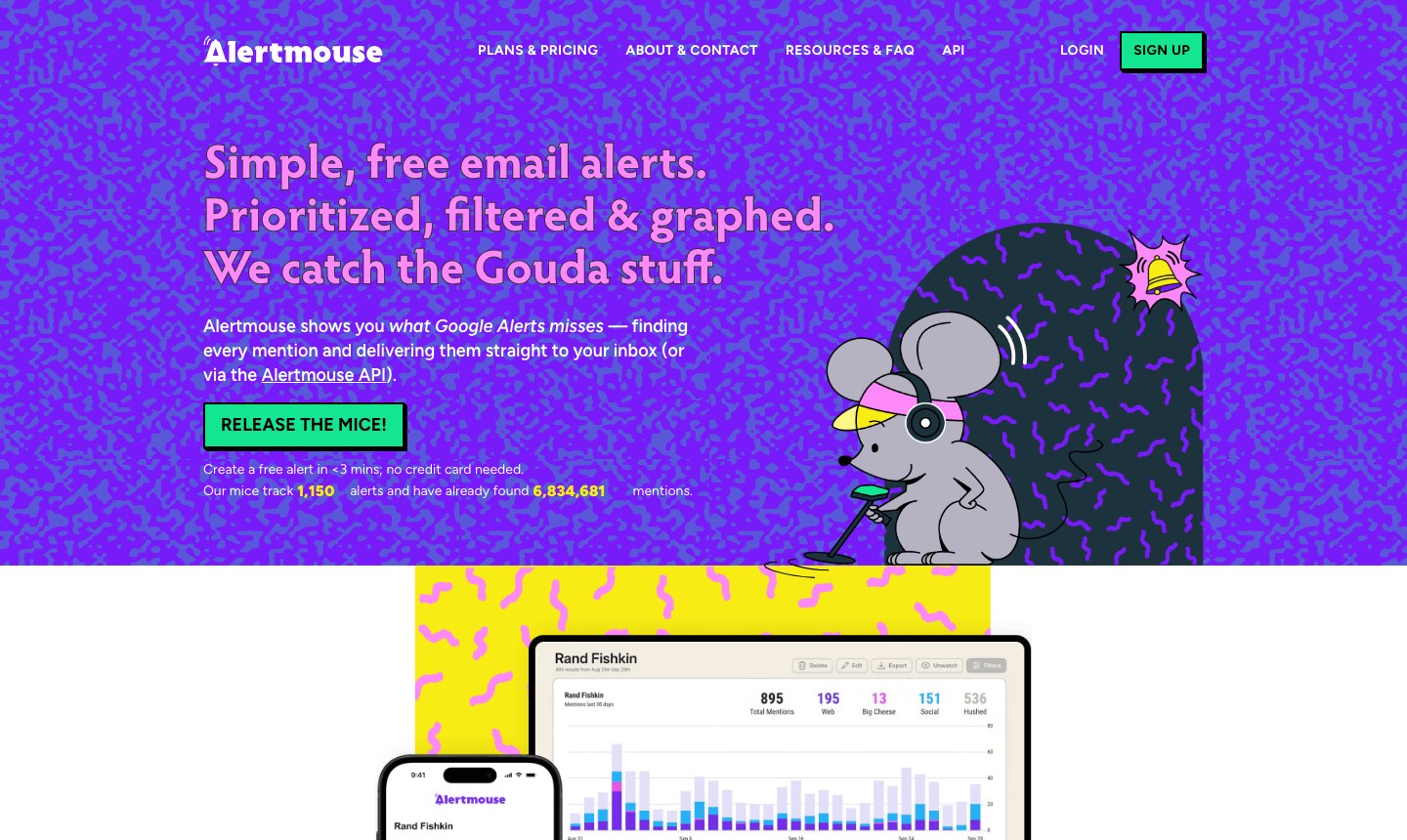
What separates it from Google Alerts is what happens between finding a mention and sending you the email. Alertmouse scores, sorts, and suppresses.
Every mention gets a score from 1 to 100, which the API documentation confirms. Mentions from prestigious outlets and accounts get flagged as "big cheese."
Mentions the system judges unimportant or spammy get "hushed," meaning they never reach your inbox but stay visible in gray on your dashboard. That last detail matters more than it sounds.
Suppression you cannot inspect is just data loss. Suppression you can audit is a filter you can actually trust, because you can go check what it decided to hide from you.
Why Brand Mention Tracking Became an AI Search Problem
This is the part that moved Alertmouse from mildly interesting to something I think marketers should genuinely care about.
When someone asks ChatGPT or Claude to recommend a tool in your category, the model draws on what the open web says about you, plus whatever it can retrieve at answer time. Your own homepage copy carries far less weight in that process than most marketers assume.
Your brand's reputation across blogs, forums, news, and Reddit is the raw material those answers get built from. Which means the mentions you never saw are still shaping how you get described to buyers.
The same goes for the people behind your brand. Chris Panteli of Linkifi says ChatGPT often recommends a named specialist over the firm on local questions, which I cover in why ChatGPT recommends the person behind the business.
Alertmouse names this audience directly on its homepage. It lists "AI marketers and SEOs monitoring how their brand mentions co-occur with words that influence search engine and LLM answers" as a target user.
Co-occurrence is the useful idea buried in that sentence. What matters is not simply whether you get mentioned, but which words sit next to your name when you do.
If your brand keeps appearing beside "expensive" or "hard to cancel," that pairing is exactly the kind of material these systems can retrieve and repeat. Catching it early is a content and PR problem you can act on, and one you cannot act on if nobody tells you it happened.
I wrote more about how this fits a wider plan in my breakdown of AI SEO strategy, and the tooling side in the best AI SEO tools.
The Thing Alertmouse Does Not Do
Several published roundups imply otherwise, so here is what the vendor actually says.
Alertmouse will not tell you whether ChatGPT recommended you last Tuesday. Nothing on the homepage, pricing page, API docs, FAQ, about page, or terms of service claims to read model output.
Notice how carefully the company words its own AI pitch, though. Marketing itself for mentions that "co-occur with words that influence" LLM answers is a claim about the input side, and it stops there rather than promising to read model output.
I give them credit for that restraint. This is a team whose about page cheerfully calls Google Alerts "so bad it might as well not exist," so they are clearly not shy about marketing claims, and they still did not overreach on the AI question.
The vendor silence is the actual evidence here. For what it is worth, ChatGPT with live web search reached the same conclusion when I asked, but the reason to believe it is that a company this happy to market itself has never once claimed the capability.
So if your goal is a dashboard showing your share of AI answers, this is the wrong purchase and no amount of clever alert setup will get you there. A dedicated AI visibility tracker is the tool built for that job, and I worked through what one actually measures in my Searchable review. If you want the cheap end of that market, Otterly starts at $29 a month, with the caveat that three of the seven AI engines it advertises are billed separately.
What it does instead is monitor the layer underneath. Public web content is a major part of what those answers get assembled from, and Alertmouse watches that layer closely.
Both jobs are real. They are not the same job, and I would rather you buy the right one.
Alertmouse Pricing, Verified
I pulled these from the live pricing page on August 28, 2026.
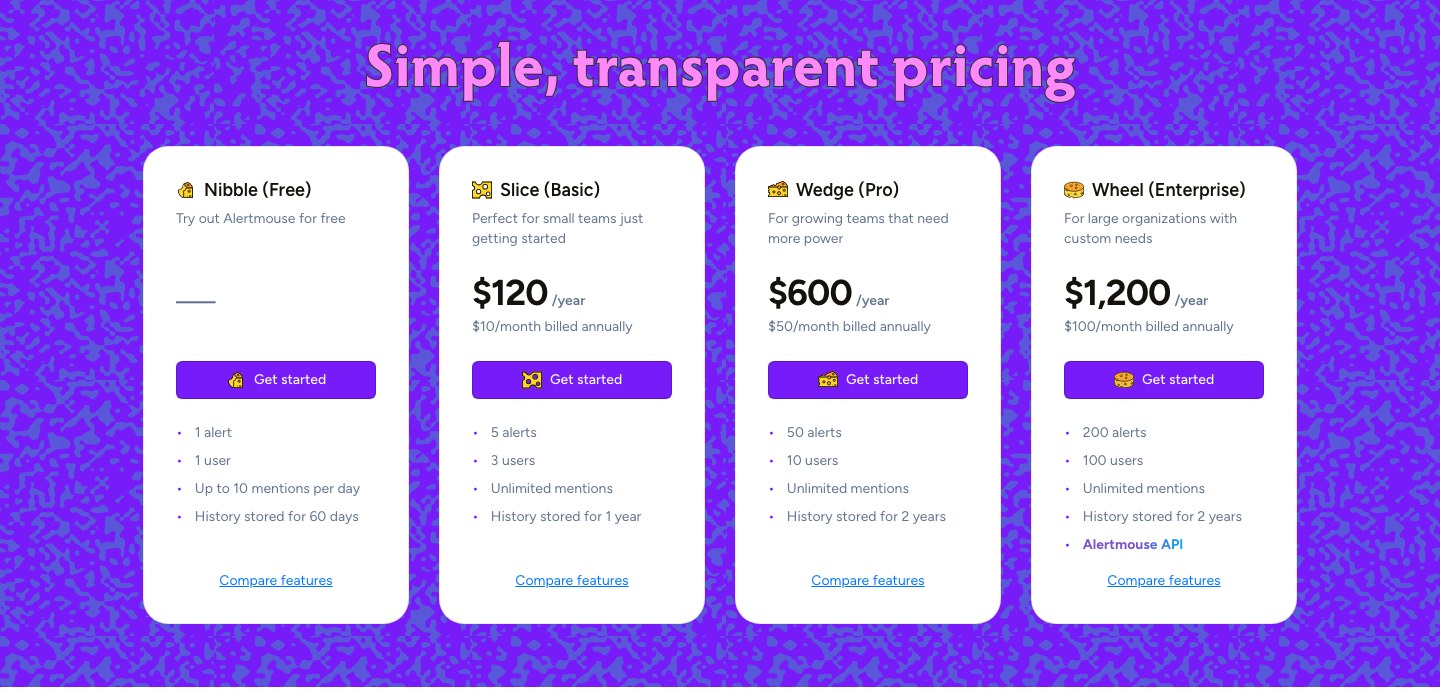
| Plan | Annual price | Alerts | Users | Mentions/day | History | API |
|---|---|---|---|---|---|---|
| Nibble (Free) | Free | 1 | 1 | Up to 10 | 60 days | No |
| Slice (Basic) | $120 | 5 | 3 | Unlimited | 1 year | No |
| Wedge (Pro) | $600 | 50 | 10 | Unlimited | 2 years | No |
| Wheel (Enterprise) | $1,200 | 200 | 100 | Unlimited | 2 years | Yes |
Now the detail the cards bury. Every paid tier is billed annually.
The page shows "$10/month billed annually" under Slice, and there is no monthly toggle anywhere on it. The arithmetic is honest, since $120 divided by 12 is exactly $10, but the commitment is a year of cash up front rather than ten dollars.
For Slice that is a $120 decision, which is small enough that most people will not care. For Wedge it is $600 committed before you have seen how it handles a busy month for your brand.
The free tier is what makes this defensible. One alert, forever, no card, is a real evaluation path and not a countdown trial, so you can point it at your own brand name and see what it surfaces before you commit anything.
Watch the free plan's ceiling of 10 mentions a day, though. If your brand is mentioned more than that, you are sampling rather than monitoring, and the tool will feel quieter than reality.
The API Is Enterprise Only
This is the limitation most likely to bite the people reading my site, so it gets its own section.
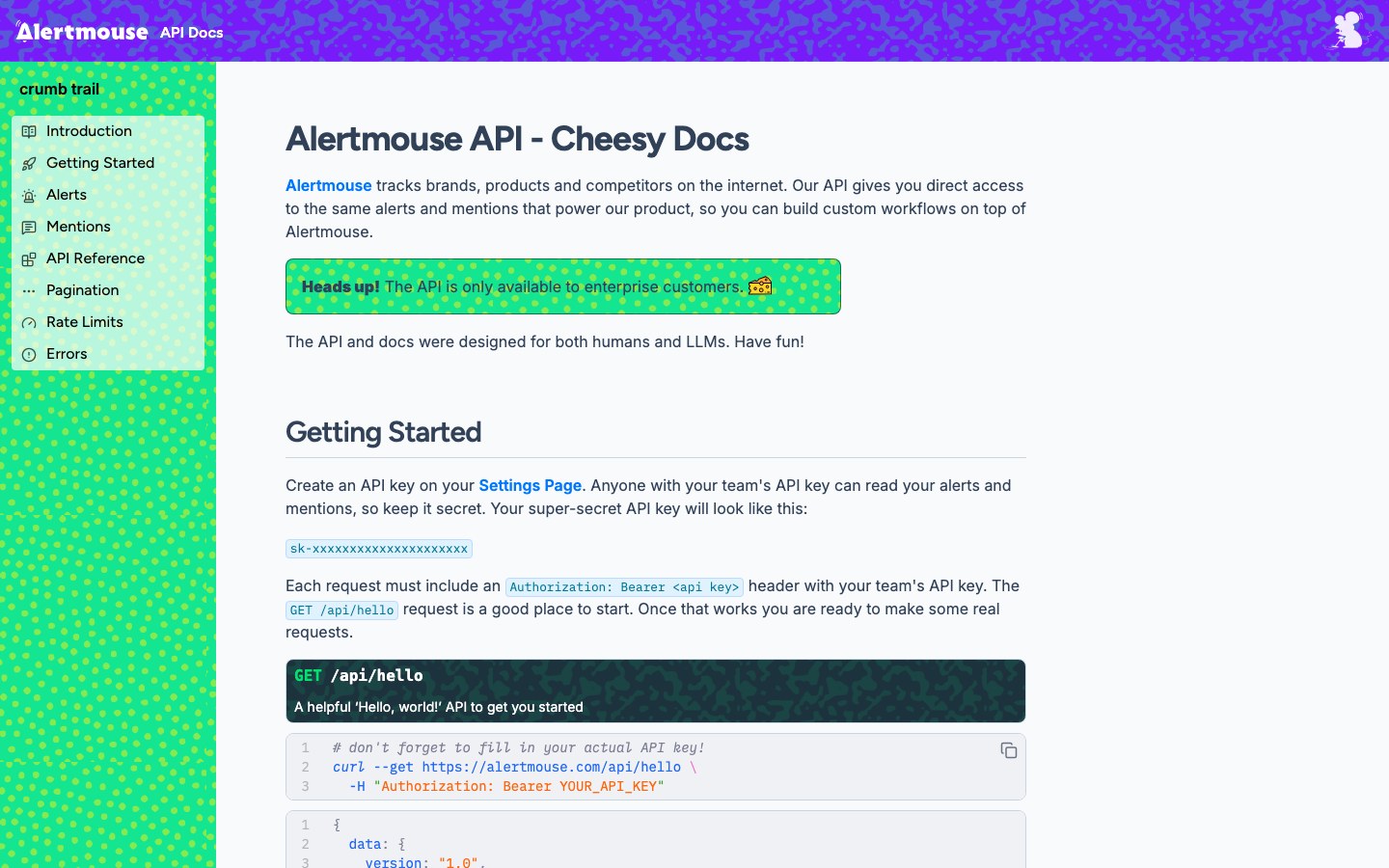
API access is gated to the $1,200 Wheel plan. The docs say it outright: "Heads up! The API is only available to enterprise customers."
If you were planning to pipe mentions into a Claude workflow or an automation on the cheap plan, that door is closed. Everyone below Wheel gets email and the dashboard, full stop.
One thing worth knowing if that gate stings: the precise filtering is in the web interface too, so you do not need API access for it. You can require a keyword or exclude one, which is how you rescue a brand name that collides with a common word.
If you have ever tried to monitor a brand named after an ordinary noun, you already know why that matters more than API access does.
What Other Alertmouse Users Actually Say
My read is one data point, so here is the public pool. The pattern in it is unusually consistent.
Arielle Johncox, Head of Marketing at Balsamiq, calls it "1000x better than Google Alerts" and credits it for catching conversations across Google, Reddit, job postings, and social media.
Talia Wolf, CEO of GetUplift, says she keeps "uncovering new blogs, sites, forums, and profiles that mention me, that I had no idea about." Jono Alderson, a digital marketer the site describes as an exceptionally picky software user, calls it "far better at detection and noise reduction than anything else I've ever used."
Coywolf reviewed it in October 2025 and updated the piece in June 2026, highlighting the inclusion and exclusion keywords and the auto-ignore rules among the upgrades over Google Alerts.
Two honest caveats about that pool. These are marketers in Rand Fishkin's professional orbit, which is exactly the crowd most likely to try a tool he built and least likely to be neutral about it.
And there is no large independent review base yet. I could not find a G2 or Trustpilot listing with meaningful volume, so what exists is testimonials and a handful of blog posts rather than hundreds of scored reviews from strangers.
The praise clusters tightly around one specific thing, though, and it is the thing that matters: detection. Different people, independently, saying it found things they did not know existed.
Where Rand Fishkin Fits In
Rand Fishkin's SparkToro bio lists Alertmouse as one of the companies he cofounded, alongside SparkToro itself.
His history is the relevant credential here. He cofounded Moz and grew it past 200 employees and $50 million in revenue across 17 years, stepping down as CEO in 2014 and leaving the company in 2018.
I want to be precise about why that matters, because founder pedigree is usually a lazy argument. Founder pedigree alone does not prove the software works.
What it does explain is the product's shape. SparkToro is an audience research tool, and Alertmouse is a monitoring tool, and both are bets that knowing what the web says about you is worth paying for.
Fishkin has also published research arguing that AI systems are strikingly inconsistent when they recommend brands. A person who believes that is going to build for the durable layer, which is the mentions themselves, rather than for a dashboard of model outputs that shift week to week.
Worth noting for anyone tempted to read this as an endorsement of him as a service provider. He left the SEO consulting world in 2018, as I noted in my roundup of AI SEO experts worth following. He builds software now.
Alertmouse vs Google Alerts
The comparison is unavoidable, since the company frames its entire existence around it.
| Alertmouse | Google Alerts | |
|---|---|---|
| Price | Free tier, then $120/year | Free |
| Mention scoring | Yes, 1 to 100 | No |
| Spam suppression | Yes, auditable on dashboard | No |
| Include/exclude filters | Yes | Limited to search operators |
| Dashboard and graphs | Yes | No |
| Mention history | 60 days to 2 years by plan | None retained |
| API | Enterprise plan only | No |
The honest version of this comparison: Google Alerts was never really finished.
It sends you links with no scoring, no history you can go back through, no way to see what it decided to skip, and no view of whether mentions are trending up or down. It notifies you and stops there, which leaves the actual monitoring work on your desk.
Alertmouse is the same job with the missing half built. Whether that half is worth $120 a year depends entirely on whether anyone at your company would act on a mention.
It is worth knowing the wider field, because Alertmouse is not the only answer here. Talkwalker Alerts is the usual free recommendation, F5Bot covers Reddit and Hacker News for nothing, and Mention, Awario, and Brand24 sit at the heavier social-listening end with pricing to match.
Alertmouse sits in a gap those leave open. It is better filtered and better organized than the free tools, and far cheaper and simpler than the listening platforms, which is the whole reason I rate it for a solo operator or a small team.
If nobody would, stay on Google Alerts and save the money. This is not a tool that creates value on its own.
Where Alertmouse Falls Short
The annual billing is my biggest complaint. No monthly option means the cheapest way to actually test a paid tier is to commit to a full year.
The free plan softens this a lot, but 10 mentions a day is a low ceiling for exactly the brands most likely to buy.
The API gate is the second issue. Locking programmatic access to the $1,200 tier puts it out of reach for the solo operators and small teams who would get the most creative use out of it.
Third, no tool catches everything, and Alertmouse admits it. Under a FAQ entry for a mention that looks wrong, the company says pages with "messy or strangely formatted text can confuse our parsers" and that "documents and PDFs can be particularly difficult."
I would rather read that than a promise of total coverage. It is still a limitation, and if you need legally defensible completeness, no email alert product is your answer.
Fourth, mentions surface with two different dates. The system records when it discovered something and separately notes any date found in the content, because old pages turn up at any time.
That is the correct design, but it means a fresh alert is not always fresh news, and you will occasionally get excited about a mention from 2021.
Finally, this is a small operation. Three cofounders, an all-remote team in Seattle, and a deliberately narrow product, which keeps it focused and also means support and roadmap move at the pace of a very small crew.
Who Should Actually Buy Alertmouse
Buy it if your name or your brand is the product. Founders, consultants, authors, podcasters, and anyone whose reputation drives their pipeline get the clearest return, because a single caught mention can be worth the annual price.
Buy it if you do digital PR or run comms and you currently find out about coverage when someone forwards it to you. The history and the graphs turn scattered mentions into something you can put in front of a client or a boss.
Buy it if you are working on AI search visibility and you want to see what the web is actually saying about you, since that is the material models draw on when they describe you to a buyer.
Skip it if you are hoping to track your presence inside ChatGPT answers. That is a different category of tool and this one does not claim the job.
Skip it if nobody on your team has the time or authority to act on a mention. An alert nobody responds to is just email.
Skip the paid tiers if the free alert covers you. One well-built alert on your brand name genuinely is enough for a lot of solo operators, and the company seems fine with that.
Final Notes from Ryan
Alertmouse is a narrow tool that does one job properly, and I have a lot of time for that in a market where everything wants to become a platform.
The strategic case is stronger now than it would have been three years ago. Brand mentions used to be a PR metric, and now they are an input into how AI systems describe you to people evaluating a purchase.
My honest reservation is the annual commitment on a product with such a thin independent review base behind it. Use the free alert first, for a few weeks, on your own name, and see whether it surfaces things you genuinely did not know.
If it does, the paid tier is easy math. If it goes quiet, you learned that cheaply and you are out nothing.
The part I keep coming back to is that "hushed" mentions stay visible in gray. A tool confident enough to show you what it filtered is a tool built by people who expect to be checked, and that is rarer than it should be.
Alertmouse Review FAQs
How much does Alertmouse cost?
Alertmouse is free to start. The Nibble tier gives you one alert, one user, up to 10 mentions a day, and 60 days of history, with no credit card required, and the company describes that first alert as free forever. Paid plans are Slice at $120 a year, Wedge at $600, and Wheel at $1,200.
All paid tiers are billed annually, with no monthly-only option on the pricing page. The per-month figures on the cards, $10, $50, and $100, are the annual price spread across twelve months rather than a separate monthly rate.
Who created Alertmouse?
Rand Fishkin, Adam Doppelt, and Nathan Kriege. Fishkin cofounded Moz and is CEO and cofounder of SparkToro, and his SparkToro bio lists Alertmouse as one of three companies he cofounded. Doppelt previously founded Urbanspoon and Dwellable. The company is Alertmouse LLC, based in Seattle, and the about page describes an all-remote team.
Does Alertmouse track brand mentions in ChatGPT or other AI answers?
No. Alertmouse monitors the open web, including news, blogs, forums, and social media, and it does not read or report on what AI chatbots say about you. If you want a share-of-answers dashboard across ChatGPT, Gemini, or Perplexity, this is the wrong tool. What it does track is the kind of public web content those systems commonly draw on, which is why it still matters for AI search visibility.
Is Alertmouse better than Google Alerts?
For most people who care about the answer, yes, and the gap is in what happens after a mention is found. Google Alerts sends links with no scoring, no retained history, and no record of what it chose not to send you, while Alertmouse does all three.
The tradeoff is cost. Google Alerts stays free forever, while the first paid Alertmouse plan costs $120 a year if you outgrow the free tier, whether from needing more alerts or from passing its 10-mentions-a-day ceiling.
What are the best Alertmouse alternatives?
Talkwalker Alerts is the most common free alternative, and F5Bot covers Reddit and Hacker News at no cost. At the paid end, Mention, Awario, and Brand24 offer heavier social listening with sentiment analysis and reporting, at prices well above Alertmouse. Alertmouse occupies the middle: better filtered and better organized than the free options, much cheaper and simpler than the listening platforms.
Does Alertmouse have an API?
Only on the $1,200 Wheel plan. The documentation states plainly that the API is available to enterprise customers only, so Nibble, Slice, and Wedge users get email alerts and the dashboard and nothing programmatic. Worth noting the include and exclude keyword filters work in the web interface, so you do not need the API for precise alerts.
Disclosure: this post contains no affiliate links and I earn nothing if you sign up for Alertmouse. I have no relationship with Alertmouse or its founders. Method: I reviewed the live Alertmouse homepage, pricing page, about page, FAQ, API documentation, and terms of service on August 28, 2026, alongside published coverage and public testimonials, and I verified the AI-answer tracking question against a live web-search-enabled model query. I have not run Alertmouse on a long-term client campaign, and this review reflects documented capabilities rather than firsthand long-term use. I sell my own AI SEO training, which competes for the attention of the same readers. Full disclosure.