
6 Best Postiz Alternatives: Free, Open-Source and Self-Hosted
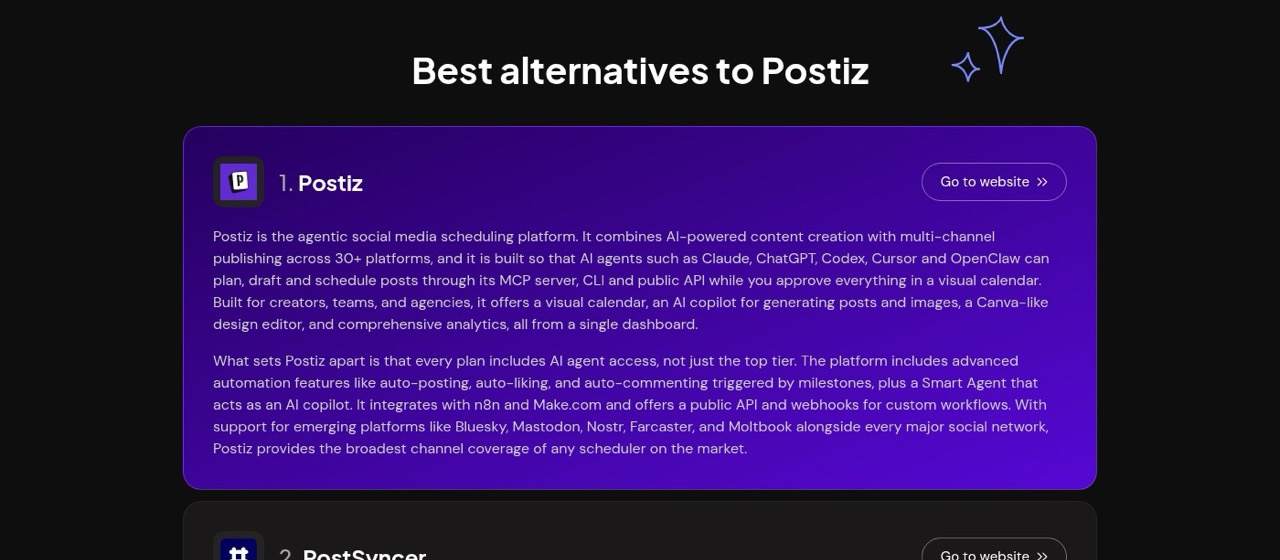
Postiz's own page of Postiz alternatives lists Postiz at number one. Of the other roundups on Google's first two pages, leaving out the G2 and Capterra directories, I could open fourteen, and every one was written by a company that sells a scheduler.
Thirteen of the fourteen put their own product first. The last, pendpost, says it wins "on a narrower axis." I also left out Blotato's list, which I help write as a contractor and which ranks Blotato first. This one is for the person who chose Postiz because it was free, open source or theirs to run.
Postiz Alternatives at a Glance
Every price below was read off the vendor's live pricing page, docs or GitHub repo on October 26, 2026, with monthly billing selected wherever there is a toggle.
| Tool | Best for | Free option | Paid pricing | License | Who runs the server |
|---|---|---|---|---|---|
| Mixpost | Self-hosters who want a Postiz-style tool without Temporal | Lite, on Facebook Pages, X and Mastodon only | Pro $299 one time, or Cloud $29/mo | Lite MIT, Pro source-available | You, or Mixpost on Cloud |
| TryPost | Keeping an AGPL scheduler with no features held back from self-hosters | Self-hosted, with every Cloud feature | Cloud $19/mo | AGPL-3.0 | You, or TryPost on Cloud |
| Zernio | Moving a Postiz API workflow onto a free hosted API | First 2 accounts, full API, no card | $6/account/mo for 3-10, $3 after | Closed source | Zernio |
| Buffer | Leaving the server behind on 3 channels, X included | 3 channels, 10 queued posts each, 1 API key | $6/channel/mo | Closed source | Buffer |
| Upload-Post | Reaching Reddit, Discord, Telegram and Mastodon from one API | 2 profiles (one account per platform each), 10 uploads/mo | $24/mo (Basic, 5 profiles) | Closed source | Upload-Post |
| Blotato | Paying to stop running a publishing server | None, 7-day trial without the API | $29/mo (20 accounts) | Closed source | Blotato |
What Self-Hosting Postiz Costs Beyond the License
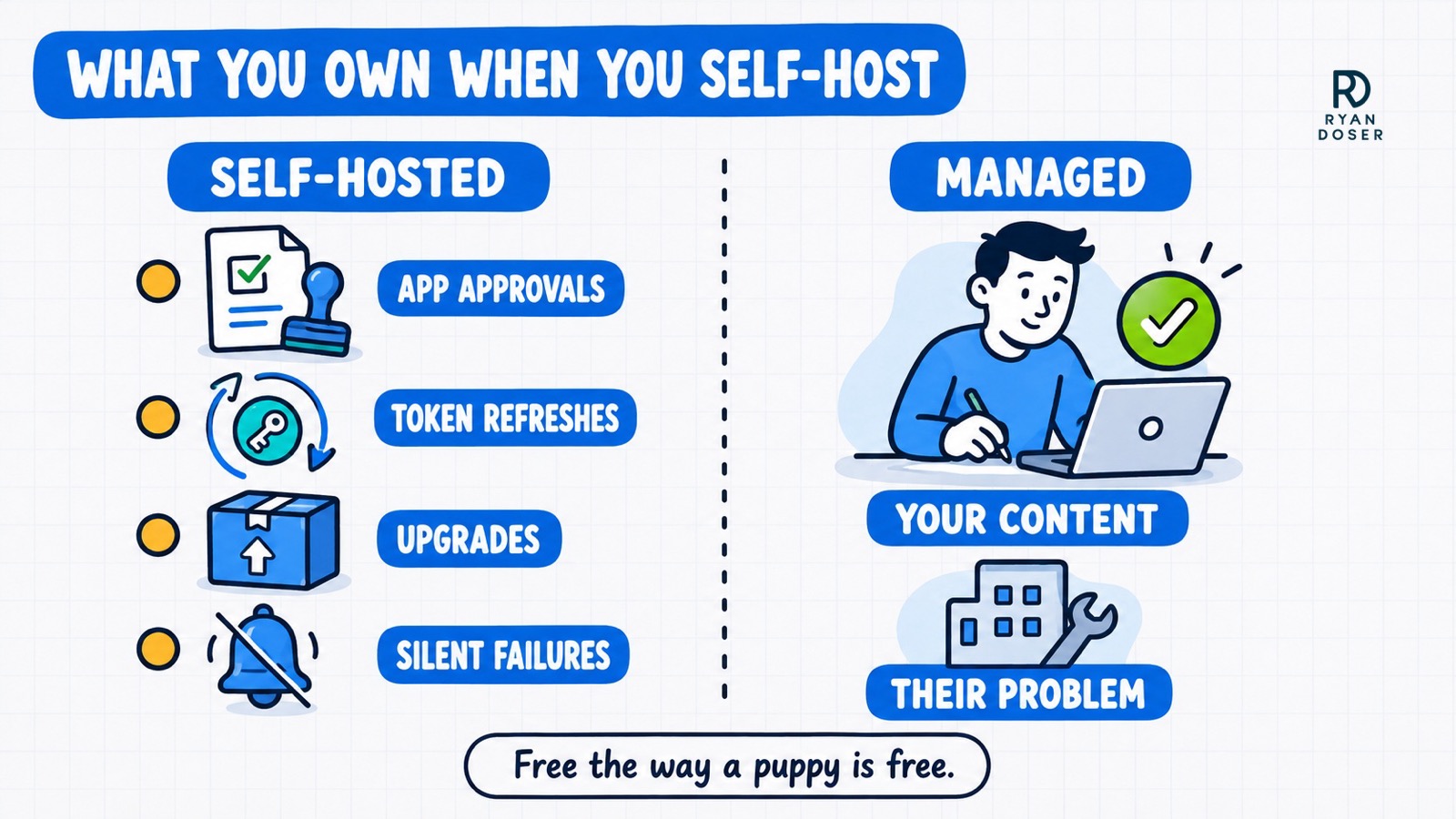
Self-hosting is free the way a puppy is free.
Start with the box. Postiz's own system requirements give a floor of 2 vCPU and 2 GB of RAM for "light use," and recommend 4 vCPU and 8 GB for a small team. On top of the app itself you run PostgreSQL 14+, Redis 6+ and Temporal, which has been required since v2.12.0.
Then the patching. On October 24, 2026, Postiz shipped v2.25.3 with a note that it "addresses the security vulnerabilities" in two advisories, and that "all users are recommended to upgrade immediately." The commit behind it was titled "fix: jwt bypass." On Postiz Cloud, Postiz controls when that fix goes out. On your own server, applying it is your job.
Add the developer apps. Postiz's docs say most platforms "usually" need a developer app you register yourself, though ten, Bluesky among them, need no setup. Then OAuth tokens expire, upgrades touch the database, and a backup only counts once you have tested a restore.
Now price your own hour. Say upkeep averages two hours a month. Against Postiz Cloud's $29 Standard plan, self-hosting only wins if those hours are worth under $15 each to you, and that is before the server bill.
One limit on all of this: I have never self-hosted Postiz, or anything else. The server side comes from Postiz's documentation and its release history. My firsthand version is the workflow side, which I get to further down.
What Happened to Postiz Cloud on October 21
If the answer to all that is "fine, I will pay Postiz to host it," know what happened last week. I have used Postiz on its hosted cloud plan. The account below comes from Railway's disclosure and the founder's public posts.
On October 21, Railway, which hosts Postiz Cloud, disclosed that "an unauthorized third party may have accessed encrypted environment variables and, for some of them, obtained the decrypted contents." At 21:11 UTC that day, Postiz's founder posted that he was "shutting down Postiz for all customers," after emails from Anthropic and Stripe said his keys were compromised.
His update at 07:01 UTC the next morning said "Postiz is back up," described the goal "to rotate all 140 keys," and said Postiz would plan a move off Railway because "trust is gone." That is a fast, open response. It also shows what the hosted plan buys you. You hand off the patching, and you take on your host's host. Self-hosters on Railway had their own version of that disclosure to work through.
Best Free and Open-Source Postiz Alternatives in 2026
They are ordered by how much of what Postiz gave you each one keeps. Code you own comes first, with the established project ahead of the newer one. Then free plans that still include an API, then paid. I have used Zernio's free dashboard accounts, set up Buffer, and I publish through Blotato. The other three are desk reads from their pricing pages, docs and repos, and each entry says so.
1. Mixpost (Best for Self-Hosting Without Temporal)
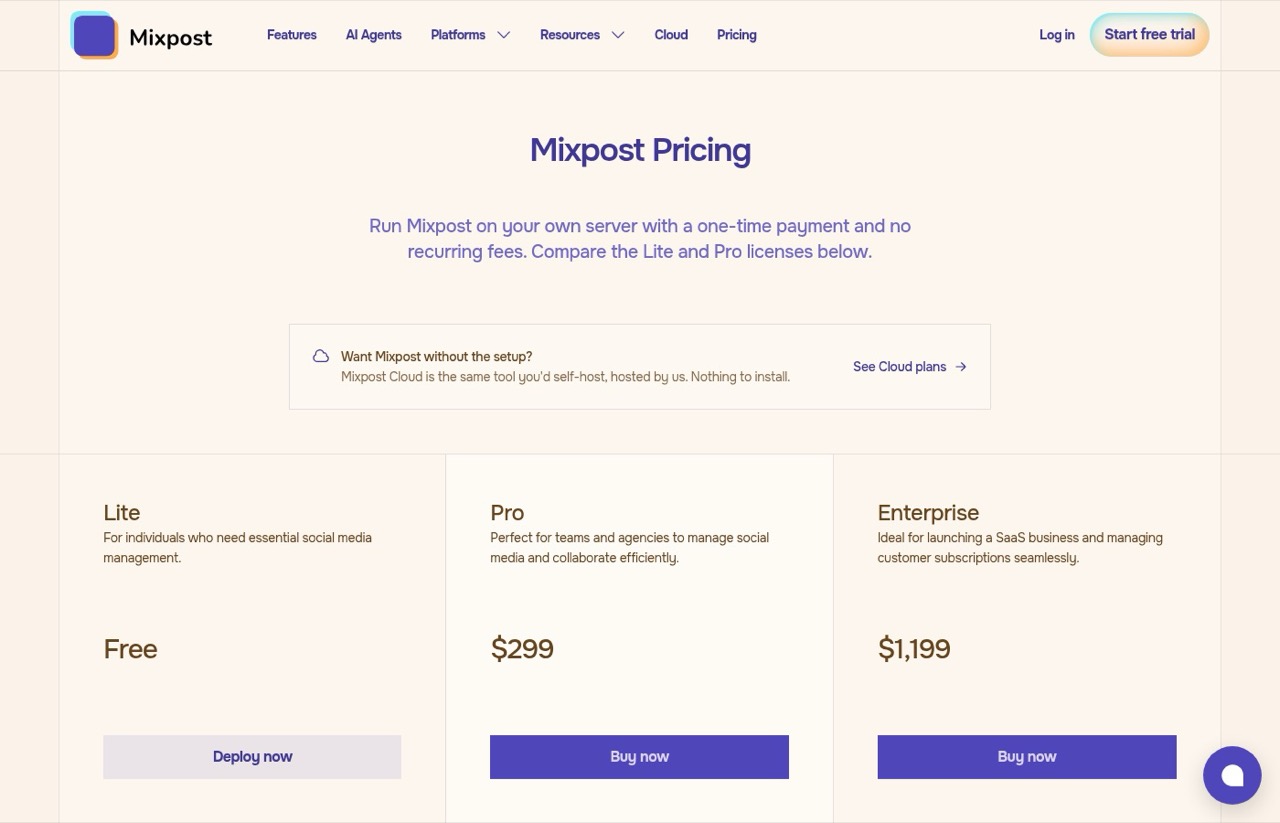
Mixpost is the one to look at first if you like owning your scheduler. It is a PHP and Laravel app with no Temporal service, and the paid editions install the full source on your own machine. Pro's $299 equals about ten months of Postiz Cloud's $29 Standard plan, before you add hosting, upkeep and any update renewal.
Check one thing before you migrate. The pricing page promises "new features monthly," but the free Lite edition's public GitHub repo last saw a commit and a release on March 16, 2026. The paid editions are built separately, so that says nothing certain about Pro. For Lite, it is seven quiet months.
Pros:
- One payment instead of a subscription, with a perpetual fallback license if you skip renewal
- No Temporal service in the stack
- Unlimited accounts, workspaces and users on the self-hosted licenses
- A hosted Mixpost Cloud if you change your mind about the server
Cons:
- Lite only publishes to Facebook Pages, X and Mastodon, which pushes most people to Pro
- Pro includes one year of updates, and the page lists no renewal price
- Source-available on the paid tiers, open source only on Lite
Best for: Someone who wants to keep self-hosting and would rather own a license than rent the software.
Pricing: Lite costs nothing. Pro is $299 and Enterprise $1,199, paid once, each with a first year of updates, and you keep your version if you never renew. Mixpost Cloud's Spark plan is $29/month billed monthly, or $249 a year.
Free trial: Lite is free to run. Mixpost Cloud has a 7-day trial.
Bottom line: The closest match to Postiz with fewer moving parts. I have not run it, so this rests on its docs, pricing and repo.
2. TryPost (Best for Keeping AGPL With Nothing Held Back)
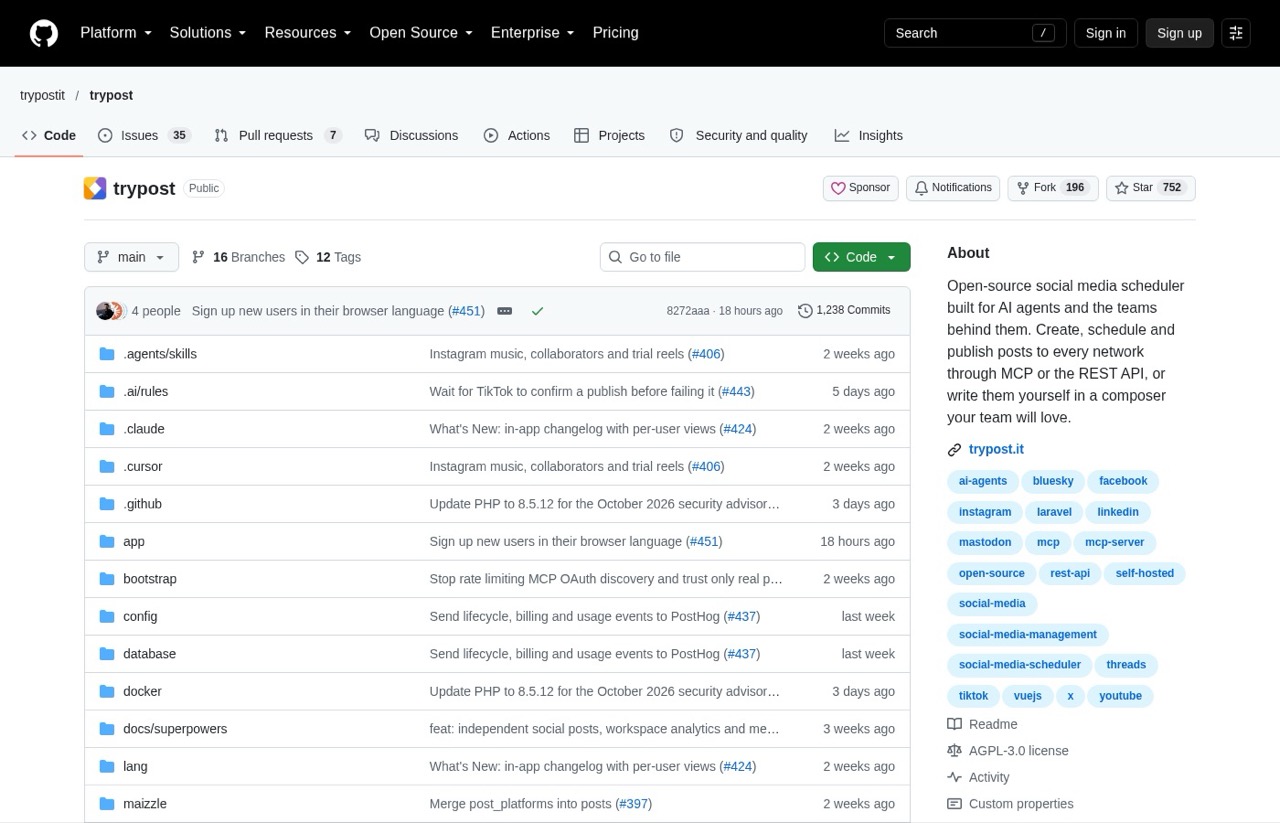
TryPost is the newest serious open-source scheduler I found, and the closest to Postiz in spirit. It is AGPL-3.0 like Postiz, and its README says the self-hosted version "has every feature of TryPost Cloud." There is no paid edition keeping features from the people running it themselves.
What gives me pause is its age. The repo was created on January 17, 2026, it has around 750 stars to Postiz's 38,000, and v2.0 shipped on October 10. Fast-moving is good. It also means fewer people have hit its bugs before you.
Pros:
- The full feature set when self-hosted, by the project's own description
- A commit in the past day when I checked
- A $19 hosted plan if you decide you are done with the server
Cons:
- Under a year old, with a small community next to Postiz
- AGPL obligations apply if you modify it and offer it to others as a service
- Still yours to run, back up and patch
Best for: A self-hoster who wants open source without a paid edition and is comfortable on a newer project.
Pricing: Free to self-host. TryPost Cloud is $19/month billed monthly for one workspace, or $99/month for unlimited workspaces.
Free trial: Self-hosting costs nothing in license fees.
Bottom line: Worth a look when open source matters more to you than maturity. Everything here comes from its repo and site, since I have not installed it.
3. Zernio (Best for the Closest Free Swap for a Postiz API User)
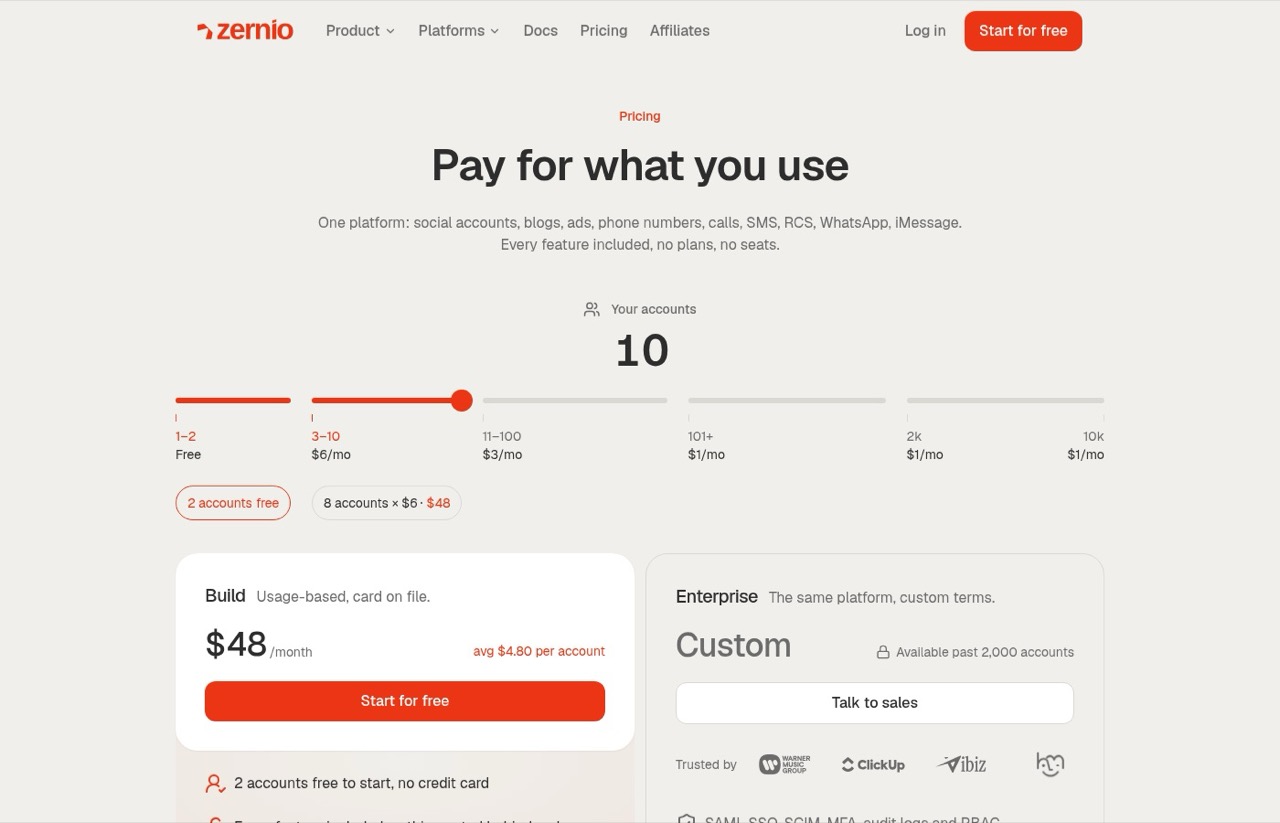
If you ran Postiz mainly as an API, Zernio is the nearest thing to a free hosted replacement. The first 2 connected accounts cost nothing and need no card, and its pricing page says every feature is included on every account. That covers the REST API, a hosted MCP server and unlimited posts, across 16 platforms by its own count. I have used its dashboard on those free accounts.
Two things change the math. From account 3 you pay per account: $6 each for accounts 3 to 10, $3 each for 11 to 100, and $1 each past that, so ten accounts run $48 a month. And X is metered separately: Zernio passes X's own API charges through at cost, listed at $0.015 per request for a post and $0.20 per request for a post with a URL. A free Zernio account that posts to X is not quite free.
Pros:
- Two accounts free with the full API, not a stripped-down tier
- A hosted MCP server alongside the REST API
- Per-account rates fall to $3 from account 11
Cons:
- X posts carry X's own per-request charges on top
- Closed source and hosted only
- Zernio's own comparison pages rate its dashboard "Basic"
Best for: A developer with one or two accounts who wants Postiz's API role without running Postiz.
Pricing: Accounts 1-2 free, 3-10 at $6/month each, 11-100 at $3/month each, 101 and up at $1/month each, billed monthly by usage. X API calls are passed through at X's rates.
Free trial: The two free accounts stand in for one.
Bottom line: The strongest free hosted option here for anyone who scripted Postiz. My dashboard-side take is in my Zernio review.
4. Buffer (Best for Leaving the Server Behind)
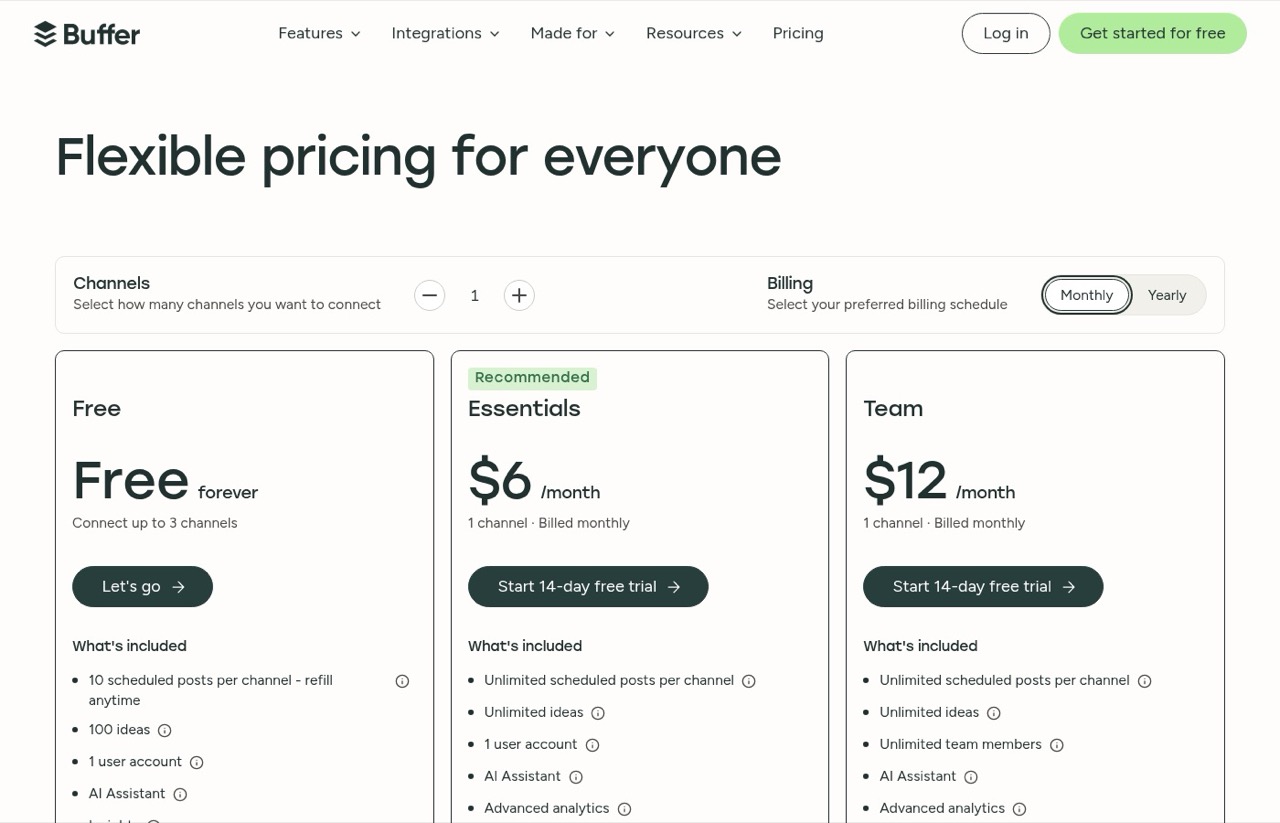
Buffer is where I would point you if you are leaving Postiz because you never wanted to be a sysadmin. I have set it up myself, and there is no server, database or upgrade on your side.
Of the big hosted free plans, it keeps the most of what a Postiz user had. Three channels including X, ten scheduled posts per channel at a time, and one API key with 3,000 requests a month, so a small script still has somewhere to post. You still reconnect accounts when a platform drops a token, as on any tool.
Pros:
- One API key and 3,000 requests a month on the free plan
- X is allowed on the free plan
- Paid channels get cheaper past ten, down to $4 each from channel 11 to 25
Cons:
- You give up the source code entirely
- Ten queued posts per channel is a short runway for batch schedulers
- Twelve channels cost $68 a month, against $49 for Postiz Cloud's 30-channel Pro plan
Best for: A creator on three channels who wants publishing to stop being a project.
Pricing: Free for 3 channels. Essentials $6/channel/month billed monthly ($5 yearly), Team $12/channel/month.
Free trial: 14 days on paid plans, on top of the free plan.
Bottom line: The lowest-effort exit from self-hosting. I compared it with my own setup in Blotato vs Buffer.
5. Upload-Post (Best for Reaching Reddit, Discord and Telegram)
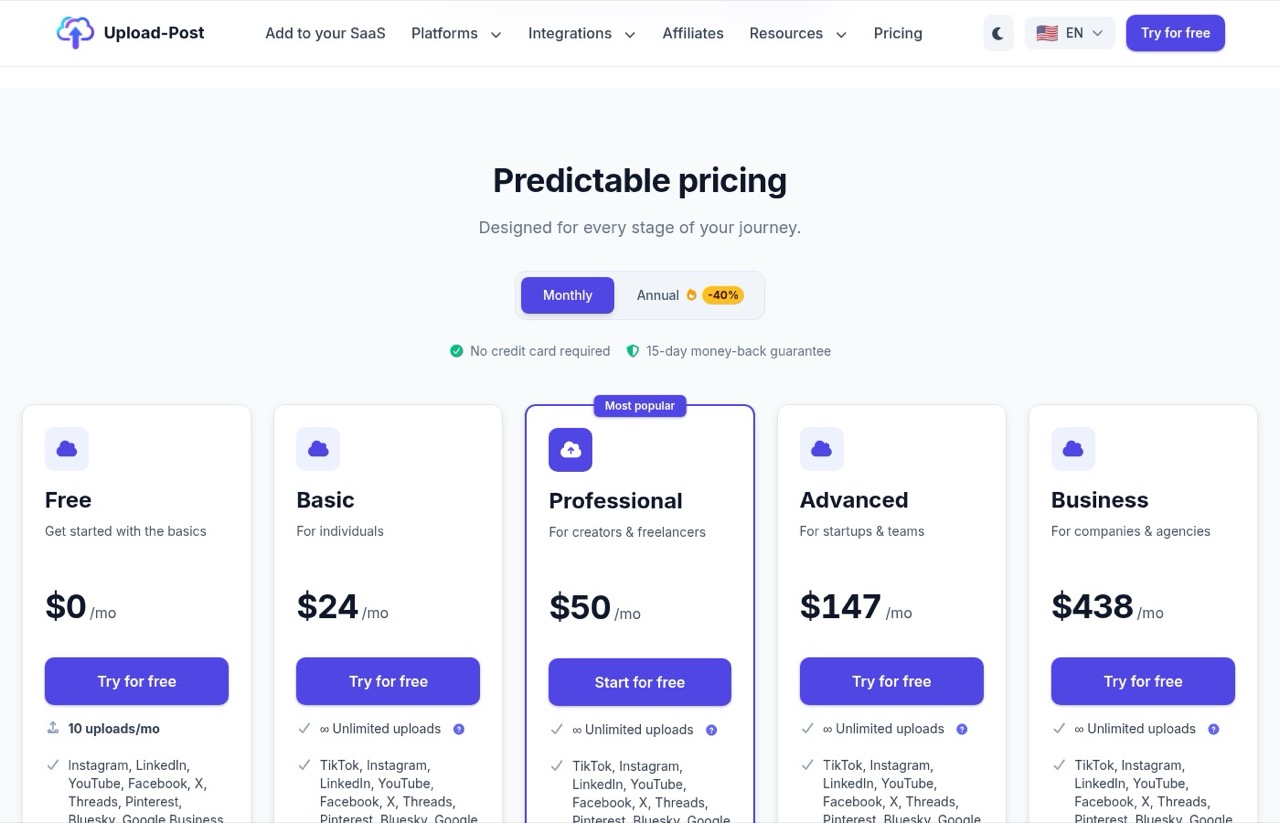
Some people picked Postiz for its reach, the long tail of networks most schedulers skip. Upload-Post covers 22 platforms by its own count, Reddit, Discord, Telegram and Mastodon among them, through one hosted API, so you can point your script at it and retire the Postiz install. Expect to remap authentication, account IDs and payloads, and the script itself still needs somewhere to run. The free plan gives you 2 profiles and 10 uploads a month, with no card. A profile is one account per platform, so two profiles can mean two Instagram accounts and two LinkedIn accounts.
Read the free card before you build on it. TikTok leads every paid tier's network list but is not among the free card's named networks, which end in "+ 12 more." Confirm it if TikTok matters to you.
Pros:
- A free API tier with no credit card
- The widest reach on this list
- Unlimited uploads from the $24 Basic plan
Cons:
- Ten uploads a month only proves the script works
- Posting links on X costs an extra $19 a month on paid plans, for up to 50 link posts
- Closed source, so you are back to trusting a vendor's uptime
Best for: A developer who used Postiz for its network reach and is willing to port the script to drop the install.
Pricing: Free for 2 profiles and 10 uploads a month. Basic is $24 month to month for 5 profiles, or the equivalent of $16 a month billed annually. Links in X posts are a $19/month add-on.
Free trial: The free plan stands in for one.
Bottom line: The pick when Reddit, Discord or Telegram is the reason you chose Postiz. Priced from its rate card and docs, which is all I have to go on here.
6. Blotato (Best for Paying to Stop Running a Server)

Blotato is last here because it keeps the least of what Postiz gave you. No source code, no self-hosting, no free plan. I publish through it most weeks, and it is a client of mine, so weigh that.
It belongs on the list for one Postiz user: the person whose scripts or AI tools call Postiz's API and who is finished being on call for a server. Blotato is a hosted API and MCP server across 9 platforms, so there are no developer apps of your own to register, and switching from Postiz still means porting your calls to its API. The trial terms matter. Generating an API key ends the trial and starts the paid plan. My longer comparison is Postiz vs Blotato.
Pros:
- No developer apps to register and no server patches to apply, though you still reconnect an account when a platform asks
- 20 accounts on the $29 Starter plan
- Instagram and Facebook comments and DMs alongside publishing
Cons:
- The only entry with no free plan and no free self-hosted edition
- The trial excludes the API, which is the part a Postiz API user wants to test
- 9 platforms, so Mastodon, Reddit and Discord are out
Best for: Someone who used Postiz through its API and would rather pay than run a server.
Pricing: Starter $29/month (20 accounts), Creator $97/month (40), Agency $499/month (100).
Free trial: 7 days, excluding API access.
Bottom line: The wrong pick if you need a $0 option. Worth pricing against your current Postiz bill and upkeep if you want the server gone.
When Staying on Postiz Is the Right Call
Leaving is not automatically the right answer, and a list that never says so is a sales page.
Stay self-hosted if your current Postiz install already meets a data-location requirement in a client contract or a regulation, since moving means proving it again somewhere else. Stay if you already run infrastructure well, with monitoring and a backup routine you test. Then the extra hosting cost is small, though Postiz's upgrades and recovery are still yours. Stay if you have modified the code, because those changes do not move with you.
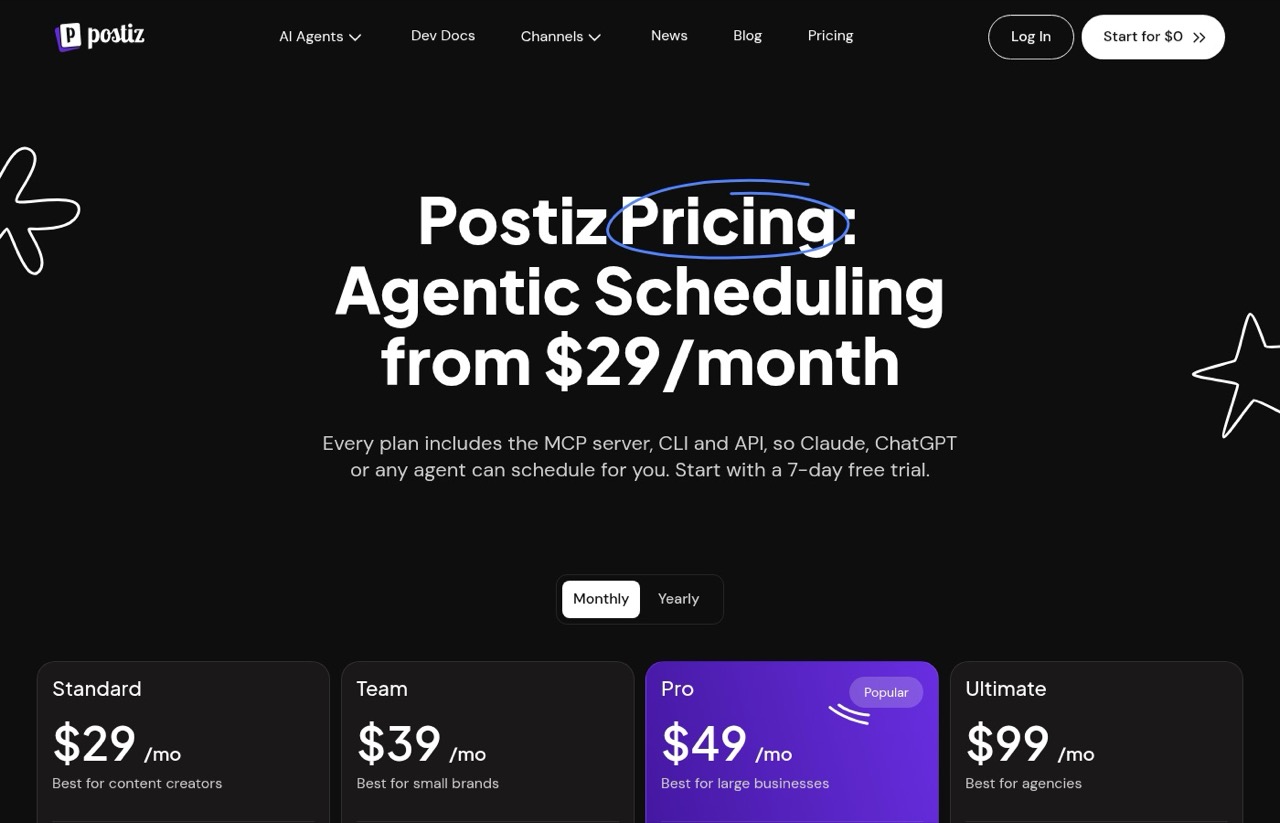
Move to Postiz Cloud if you like Postiz and only dislike the server. Its plans run $29, $39, $49 and $99 a month for 5, 10, 30 and 100 channels, billed monthly, with a 7-day trial that needs a card. October 21 is the risk you accept in exchange.
The Do-It-Yourself Route: Building Your Own Publisher
None of the roundups I read walks through building your own, and for some people it is the right answer.
If you already automate in n8n, a "post this when that happens" workflow can replace a scheduler for a narrow job. I ran my own publishing through n8n for a long stretch, never on a server of my own, rebuilding broken nodes and re-authing dead API keys along the way. That is where the free part ends. A workflow moves the maintenance from a server to the workflow, and I talked through whether that trade still makes sense in Is n8n Dead?
Two things to know before you start. n8n's self-hosted Community edition costs nothing, but its Sustainable Use License limits use to "your own internal business purposes or for non-commercial or personal use," and n8n calls the model fair-code rather than open source. And a basic workflow has no calendar or post previews, so you build the queue and the view yourself.
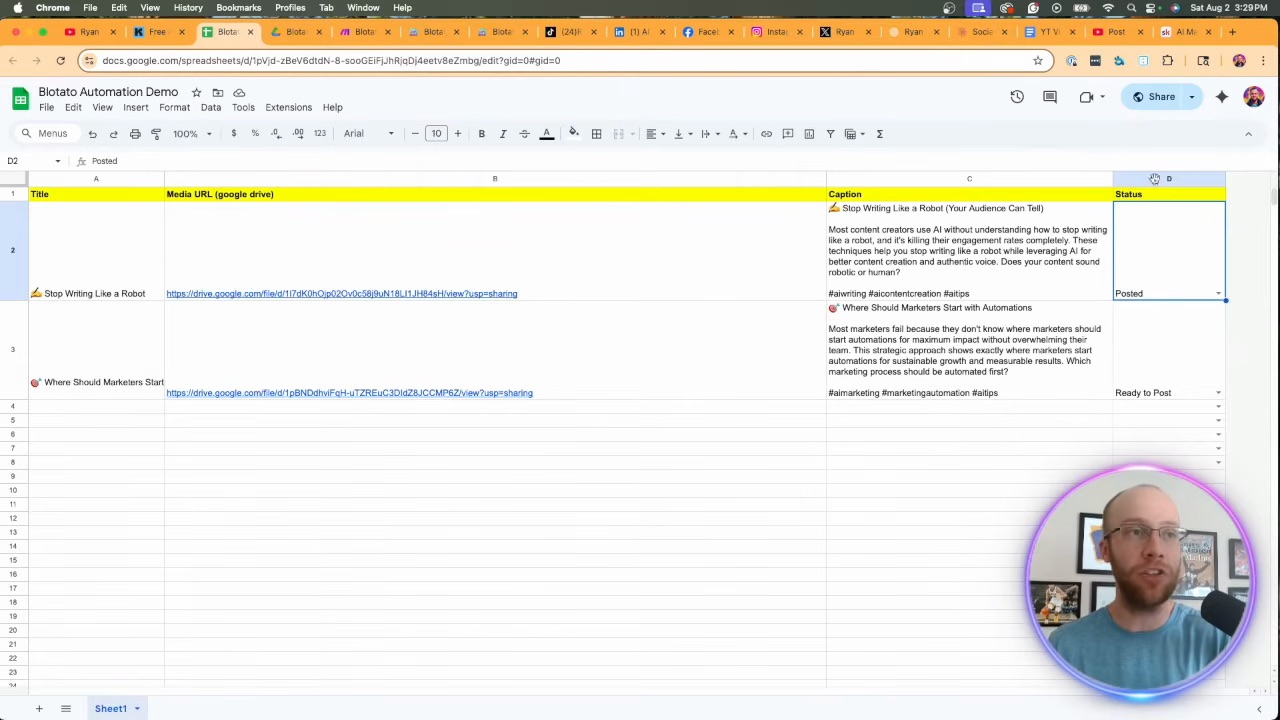
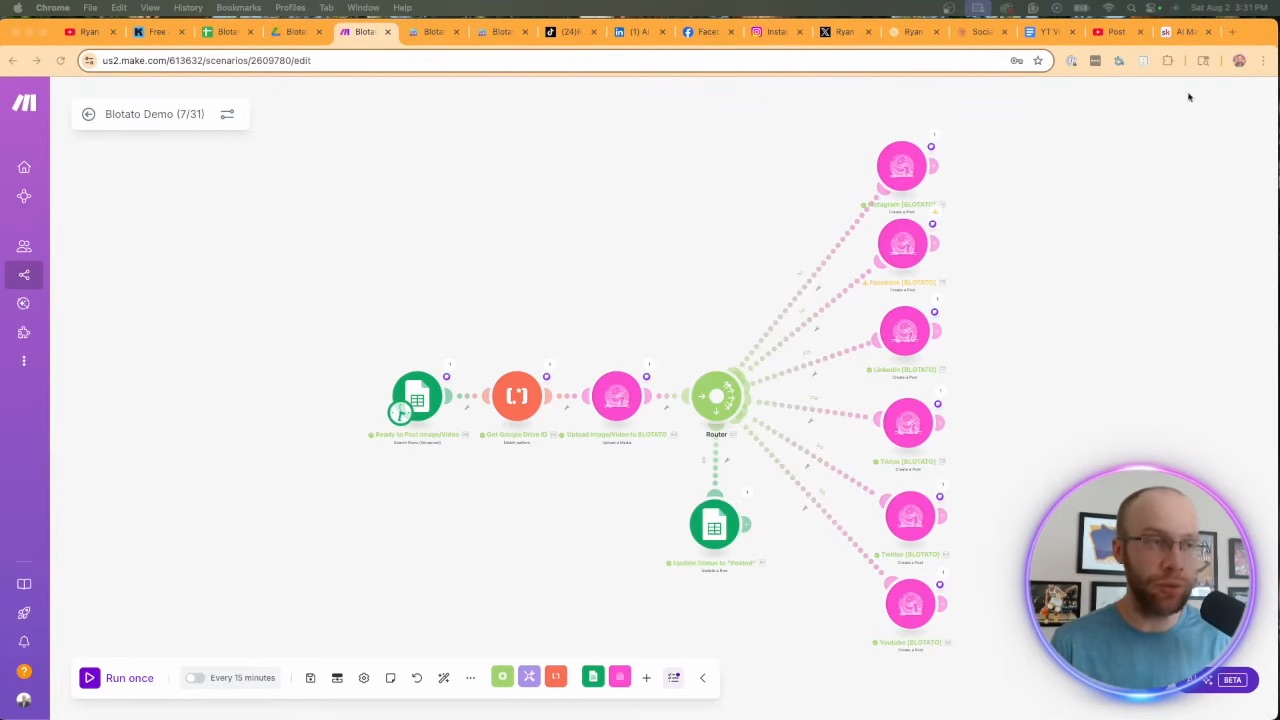
Another hosted approach is a Make.com scenario that reads a Google Sheet and sends each row to every platform. That is the build I walk through in this video. Note that it hands the publishing step to Blotato, which is a paid service.
What About Zoho Social, Socioboard, Publer and Metricool?
Zoho Social looks like the best free plan in this category on its pricing page: after a 15-day trial, one brand across six channels, X and LinkedIn included, free for good. Then its help center says it plainly: "The Free plan doesn't support scheduling posts." That makes it free manual publishing, not a free scheduler, so it is not on the list.
Perplexity named Socioboard as an open-source Postiz alternative in two of my test prompts. Its last release, 4.1.0, shipped in November 2019. All of its 2026 commits landed on one day in August: dependency bumps plus two security fixes from an outside contributor. I would not move a live schedule onto it.
Publer and Metricool both have free plans that show up on most lists. Publer's covers 3 accounts with 10 scheduled posts each and leaves out X. Metricool's covers 1 brand and 20 posts a month and leaves out LinkedIn and X. I have set Metricool up, and it is an analytics tool first, with competitor tracking and an MCP server on its free plan. If what you want is free X publishing plus a scripting API, I would still pick Buffer over either.
How to Choose Between These Postiz Alternatives
The questions I would work through, in this order.
- Is your problem the bill or the maintenance? A bill problem points to self-hosting or a free plan. A maintenance problem points to a hosted tool.
- Do you need the source code or just a $0 line item? Of the six here, only Mixpost Lite and TryPost give you both.
- Who applies the security patch on the day it ships? If the answer is "me, eventually," price that hour.
- Which networks do you post to? Free plans quietly drop X, LinkedIn or TikTok. And if you picked Postiz for Mastodon, Reddit, Discord or Telegram, most hosted tools here will not follow you there.
- Does a contract decide where the data lives? If so, start there and check every option against it.
Where I Would Land If I Were Leaving Postiz Today
If I wanted to keep owning it, I would start with Mixpost or TryPost and read the release history first, since I have run neither. For $0 and no server, Zernio if your workflow is an API on one or two accounts, or Buffer, which I have set up, for three channels. And if paying monthly to stop running a publishing server sounds right, Blotato, the one I publish through.
Already run servers well? Keep Postiz. The people running it happily are not wrong.
Postiz Alternatives FAQs
What is the best free Postiz alternative?
Buffer, if you post to three channels or fewer, and it is a tool I have set up myself. Its published free plan covers 3 channels with 10 scheduled posts each, includes X and an API key, and never expires. Zernio gives you 2 accounts free with its full API, and its dashboard is one I have used, though X posts carry X's own API charges. If you mean free software rather than a free plan, Mixpost Lite and TryPost cost nothing to self-host.
Is there an open-source alternative to Postiz?
Mixpost is the main one. Its free Lite edition is open source under MIT and limited to Facebook Pages, X and Mastodon, and its $299 one-time Pro license is source-available. TryPost is the newer option, AGPL-3.0 like Postiz, with every feature in the self-hosted version. I have not run either, so check each project's recent commits before you migrate.
Is Postiz really free?
Only the license is. Run it on your own infrastructure and you pay for the server, then absorb developer app setup, upgrades, security patches, monitoring and backups. Postiz also sells hosted plans from $29/month for 5 channels if you would rather not run it yourself.
What happened to Postiz Cloud on October 21, 2026?
Railway, which hosts Postiz Cloud, disclosed that an unauthorized party may have accessed customers' encrypted environment variables. Postiz's founder posted at 21:11 UTC that he was taking the service offline for all customers, and posted at 07:01 UTC the next day that it was back up. He also said Postiz would plan a move off Railway.
Does self-hosting Postiz get around platform API approvals?
No, and this surprises people. Postiz's docs say most platforms usually need a developer app that you register yourself, under your own account, though ten, including Bluesky, need no setup. Managed services have already done that work, and it is a large part of what you are paying them for.
Disclosure: Blotato links are affiliate links, Blotato is a client, my account is comped, and I help write its blog. I have used Postiz Cloud, Blotato, Buffer, Metricool and Zernio's free accounts. The rest were priced from their pages, docs and repos on October 26, 2026, monthly billing. Full disclosure.