
Zernio Review: A Fact Check of Its Biggest Marketing Claim
Zernio is a developer-first social media API and hosted MCP server that publishes, schedules, and pulls analytics across 16 social platforms and 7 ad networks. This Zernio review covers what it genuinely does well, who it is built for, and one marketing claim of theirs I could not make add up.
Set my credentials correctly before you weigh any of it. I signed up, connected the free accounts and went through the dashboard and the docs. I have not run Zernio in production.
So this is a pricing, documentation and positioning review from someone who runs a competing tool every day, not a six-month field report. Where I make a claim about how it behaves under real load, I will tell you whose evidence that is.
Let me be upfront about my position before you read another sentence. I use Blotato as my daily driver, it is a client of mine, my account there is comped rather than paid, and some links below are affiliate links.
You should read everything that follows with that in mind.
I am telling you this at the top rather than the bottom because the whole point of this post is checking a claim against documentation. It would be strange to ask you to verify Zernio's math while hiding my own conflicts until the footer.
Here is the short version. Zernio is a decent tool for social media automation.
The free tier is genuinely generous, the API is clean, and the platform coverage is broader than Blotato's.
Where it lost me was managing social media through an MCP with AI agents like Claude Code and Codex, which is how I actually work. I will show you the specifics.
It is worth being precise about what that phrase means, because "has an MCP server" has stopped being a useful signal. Nearly everything in this category ships one now, including Zernio, so the checkbox tells you almost nothing.
What I care about is narrower. When I ask an agent to publish something, how many separate services does that one sentence have to touch before a post exists?
Zernio delivers. It does not create. So the agent still needs somewhere to write the copy and something to make the image, and I am back to stitching services together in a conversation that should have been one instruction.
That is a preference, not a defect, and if you already have generation solved it is not a reason to avoid Zernio at all. But it is the specific thing that kept me from switching, and it is more useful to you than another paragraph about response times.
What Zernio Actually Is
Zernio positions itself as "a developer-first REST API and hosted MCP server that lets apps and AI agents post, schedule, and analyze content across 16 social platforms plus 7 ad networks."
Read that again, because the important word is infrastructure. Zernio does not write your posts.
It does not make your images. It is a pipe, and a well-built one. You bring the content, it handles the messy business of talking to fifteen different platform APIs so you never have to apply for TikTok developer access yourself.
That is a real problem worth solving. Anyone who has tried to get approved for a platform API directly knows the process is genuinely miserable.
The Late and GetLate Rebrand
If you researched this category more than a few months ago you probably met this product under a different name. Zernio's own rebrand page confirms it: Late is now Zernio, same API, same team, same /api/v1 endpoints, no breaking changes.
This matters when you are researching. Plenty of third-party pages about this product still file it under the old name.
Capterra and Software Advice both still host their Zernio listings at /Late/ URLs. If a review seems oddly stale, check whether it was written pre-rebrand.
Zernio Pricing Is the Best Thing About It
I want to lead with praise here because it is deserved, and because a review that only criticizes a competitor is not a review, it is an ad.
Zernio's pricing is one of the more honest structures I have seen in this category. Your first 2 accounts are free with no credit card.
After that it is graduated per account: $6/month each for accounts 3 through 10, $3/month each for 11 through 100, and $1/month each past 101.
No plans, no seats, no feature gating. Every capability is available on every account.
That last part is rarer than it sounds. Most tools in this space put the API behind a higher tier, or lock analytics behind Business.
Zernio does not do that, and I respect it.
If you are a developer with two accounts who wants to test a real publishing API without a credit card, Zernio's free tier is the easiest on-ramp I found while researching this category. That is not a backhanded compliment, it is the strongest thing about the product and you should take advantage of it.
Where the Per-Account Math Turns
The graduated model is elegant at small scale and expensive at large scale. That is just arithmetic, not a criticism. I priced that curve against six competitors at 5, 20 and 100 accounts in my Zernio alternatives breakdown.
| Connected accounts | Zernio monthly cost |
|---|---|
| 2 | $0 |
| 5 | $18 |
| 10 | $48 |
| 20 | $78 |
| 50 | $168 |
So the decision rule is simple. Under about 8 accounts, Zernio's per-account pricing beats most flat-rate competitors outright. Past roughly 10 accounts, a flat plan starts winning and the gap widens fast. The same crossover logic decides whether Ayrshare's $149 single-profile entry price is absurd or reasonable, which comes down entirely to who you are publishing for.
If you want the full head-to-head on that crossover point, I broke the pricing down against the tool I use in my Blotato review, including the exact account counts where each one wins.
The 40x Faster Claim Does Not Hold Up
Now the part that made me want to write this post.
Zernio runs a comparison page arguing you should switch from Blotato, and its headline number is that Zernio has "40x faster rate limits than Blotato." The phrase also shows up in their search snippets, so it is the first thing a lot of people read about both tools.
I went to verify it, expecting to confirm it and move on. It does not survive contact with the documentation.
Here is how they get to 40x. Their page states "Zernio: 60 req/min on free tier.
Blotato: 1.5 posts/min." Sixty divided by 1.5 is forty.
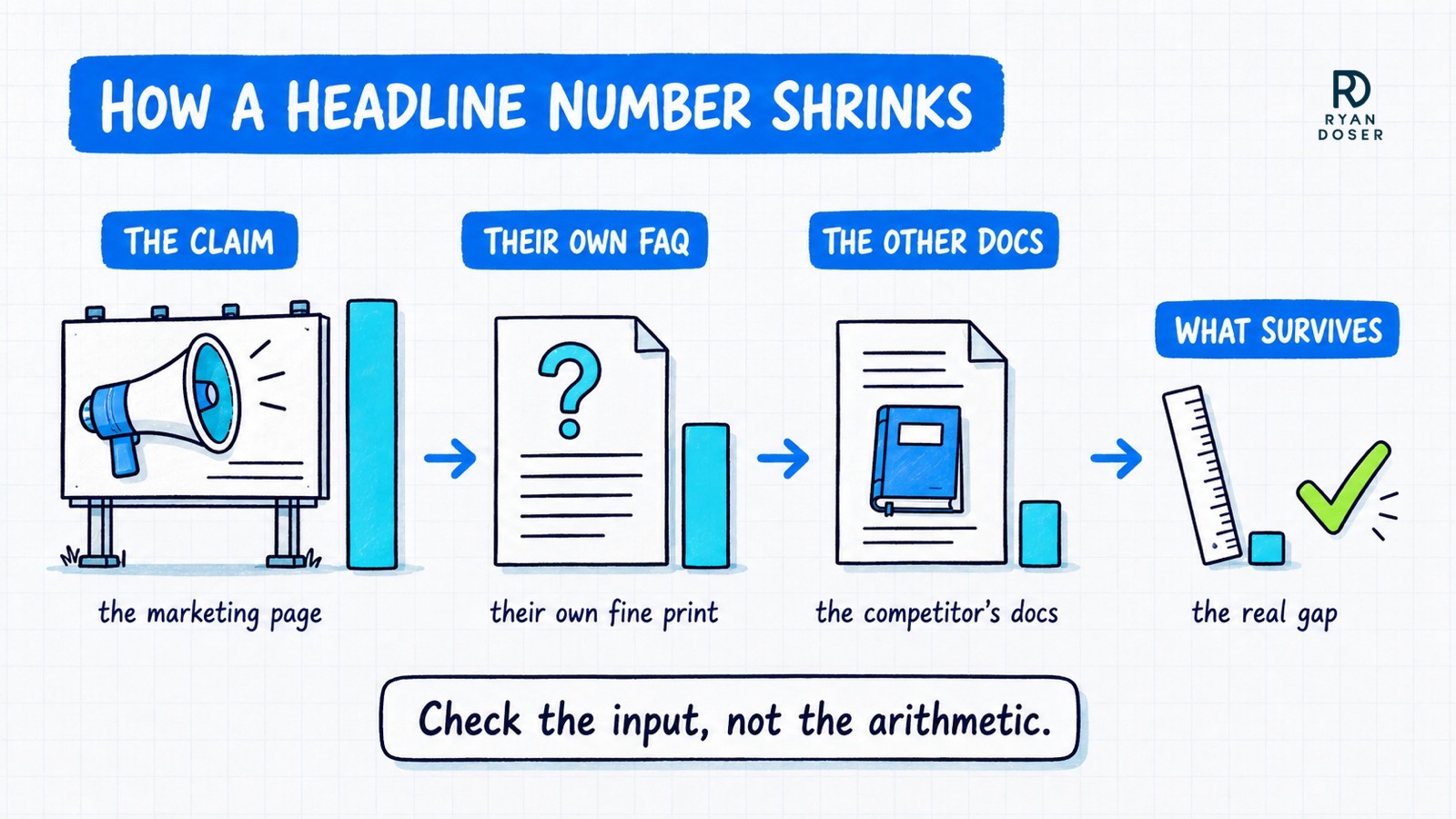
The arithmetic is fine. The input is not.
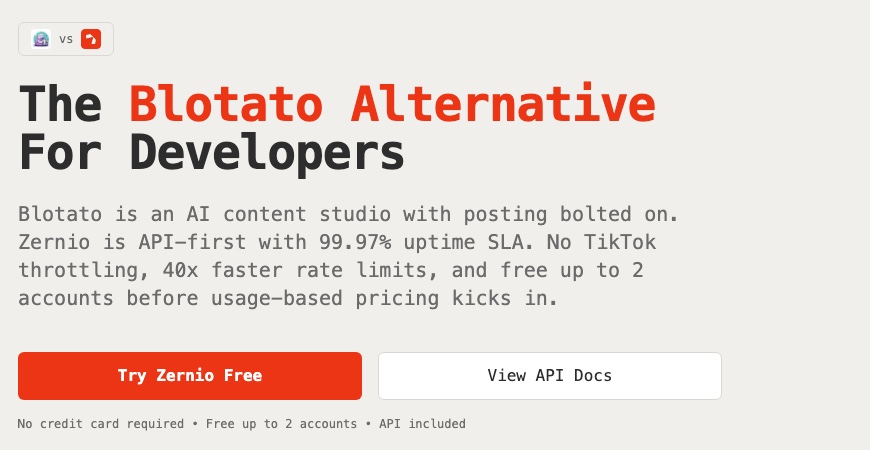
I am screenshotting this because a marketing page can change. Claim verified live on 1 August 2026, and archived at the Wayback Machine so you can check it yourself even if the page is edited later.
If Zernio corrects it, good, and this paragraph is why you will still be able to tell what it said today.
Blotato's own API documentation puts POST /posts at 30 requests per minute. I confirmed that figure in two separate places in their docs, including the error reference.
Not 1.5. Thirty.
Sixty against thirty is 2x. Not 40x.
To be fair to Zernio on the underlying point, its rate limits do climb with the tier, up to 1,200 requests per minute at the top end, so a paying customer gets considerably more headroom than 2x. That is a legitimate advantage and they could have simply said so.
But the comparison they published comes from their free tier, and 40x is not the number that falls out of it on any reading.
Here is the detail that convinced me this was worth writing about: further down that same page, Zernio's own FAQ says "Blotato caps at 30 posts/min globally, regardless of plan." Their comparison table above it lists 1.5. So the correct figure and the one that produces the 40x headline both appear on a single page, a few scrolls apart.
So where does 1.5 come from? I genuinely do not know, and I am not going to invent a theory to fill the gap.
It does not appear in Blotato's documentation, and Zernio does not show its work. The same page separately claims Blotato's Starter plan caps you at 3 unique TikTok accounts per 24 hours, which would be a platform-level posting restriction rather than an API throughput number, but I could not verify that limit in Blotato's docs either.
What I can say with confidence is narrower and still damning: the number Zernio divides by does not match the documented figure, and it does not match the figure in Zernio's own table.
I am not going to tell you Zernio is a bad tool because of this. It is not.
But when a company's central marketing claim is off by a factor of twenty against a number printed in its own table, that tells you something about how carefully to read the rest of the comparison.
Check the vendor's actual docs, every time. That habit has saved me more than once.
Why It Did Not Replace What I Run
Heads up: the next section links to a tool I have an affiliate relationship with. Full disclosure here.
My honest summary after working through the product and its docs is that Zernio is a decent tool for social media automation. If your job is "move media I already made to fifteen platforms," it is built for that and it is cheap at low account counts.
Where it did not fit was the specific way I work. I manage social media through an MCP with AI agents, mostly Claude Code and Codex, and on that dimension Blotato does more of the job.
My agent does not just need somewhere to send a finished post. It needs to generate the post, make the image, and publish it, all inside one conversation without me opening a dashboard.
Zernio is publishing infrastructure by design. Their own page says so plainly, and I think that focus is a legitimate product decision rather than a gap.
But it means an agent workflow built on Zernio needs a content generation layer bolted on upstream, which is one more service, one more key, and one more thing to debug at 11pm.
I wrote up how that agent setup actually works in my guide to running social media from Claude Code, if you want to see the workflow rather than take my word for it.
Pick Zernio If
You are a developer with a handful of accounts who already has content generation solved. You want a clean REST API and a free on-ramp with no card.
You publish to Telegram, Discord, WhatsApp, Snapchat or Google Business, none of which Blotato reaches. Or you need ad network management alongside organic publishing, which Blotato does not do at all.
Skip Zernio If
You want the tool to write the post and make the visual, not just deliver it. You are running more than 10 accounts and want the bill to stop moving. Or you want one MCP surface where an agent handles creation and publishing in a single conversation.
What Real Zernio Users Say
My experience is one data point from someone with an obvious bias, so weigh the independent signals too.
On Trustpilot Zernio rates well, in the mid-4s out of 5 across roughly 90 reviews depending on when you check.
The praise concentrates on customer service and responsiveness. I cannot vouch for that from long use, but it is consistent across enough reviews to be worth something.
The picture is less flattering elsewhere, though the sample sizes are tiny enough that I would not weight them heavily. Software Advice shows a single 1.0 review calling it an "interesting concept, not the best user experience" and flagging pricing.
Capterra also carries a lone 1-star rating. One review is an anecdote, not a pattern.
On Product Hunt the feedback is positive and specifically mentions the MCP responding reliably, which lines up with my testing. The connection itself was not the problem for me.
A Note on the Platform Count
One thing to watch if you are comparing spec sheets. Zernio's homepage currently says 16 social platforms.
Capterra says 14+, and several roundups say 15. Those directory pages may simply reflect older coverage rather than a different count today.
Trust the vendor's current page over any roundup, including this one by the time you read it. Then verify the two or three platforms you actually need rather than the headline count, because "16 platforms" means nothing if the one you care about is the missing one.
Ryan's Final Thoughts
Zernio is a good product with a marketing problem. The free tier is real, the graduated pricing is honest, the API is clean, and the team is responsive.
If I were building a SaaS that needed to publish on behalf of users, it would be on my shortlist, and the two free accounts make testing it cost nothing but an afternoon.
What I cannot get past is that its loudest claim about a competitor is off by a factor of twenty, with the correct number sitting in its own FAQ a few scrolls below. Good products do not need that. The pricing argument alone is strong enough to stand on.
For my own work I stayed with Blotato, because I run everything through an MCP and I want creation and publishing behind one surface. Your workflow may weigh that differently, and if you already have content generation solved, the calculus genuinely changes.
Whichever way you go, verify the claim before you believe it. That is the actual lesson here, and it applies to my posts as much as theirs.
Zernio Review FAQs
What is Zernio?
Zernio is a developer-first social media API and hosted MCP server that lets applications and AI agents publish, schedule, and analyze content across 16 social platforms and 7 ad networks, a count worth re-checking on their site (see the platform-count note above). It is publishing infrastructure rather than a content creation tool, so it moves content you have already made.
Is Zernio the same as Late or GetLate?
Yes. Late rebranded to Zernio, and its rebrand page confirms the API, endpoints, and response schemas did not change. Existing integrations kept working. Some directory sites still list it under the old name.
Does Zernio have a free plan?
Yes, and it is genuinely useful. Your first 2 connected accounts are free with no credit card required, and every feature including full API access is available on those accounts. For testing a real publishing API without committing a card, it is hard to beat.
How much does Zernio cost?
Pricing is graduated per connected account after the first 2 free ones: $6/month each for accounts 3 through 10, $3/month each for 11 through 100, and $1/month each past 101. Five accounts costs $18/month and twenty costs $78/month.
Is Zernio really 40x faster than Blotato?
The claim does not hold up as written. It divides Zernio's 60 requests per minute by a figure of 1.5 posts per minute for Blotato, but Blotato's API documentation lists 30 requests per minute for publishing, and Zernio's own comparison table on that same page also lists 30. Comparing the two documented publish limits gives roughly 2x, not 40x.
Does Zernio work with Claude Code?
Yes. Zernio ships a hosted MCP server, so Claude Code, Codex, and other MCP-capable agents can call it directly. In my testing the connection worked reliably. The limitation is that Zernio does not generate content, so your agent still needs a separate writing and image layer.
Which platforms does Zernio support that Blotato does not?
Zernio covers Telegram, Discord, WhatsApp, Snapchat, and Google Business, which Blotato does not reach. It also manages ad networks alongside organic publishing. Blotato covers 9 platforms and adds AI writing, image, and video generation that Zernio does not offer at all.
Should I use Zernio or Blotato?
Use Zernio if you are a developer with under 10 accounts, already have content generation handled, and need its broader platform list or ad network support. Use Blotato if you want one MCP surface where an AI agent writes the post, makes the visual, and publishes it, or if you run enough accounts that flat pricing wins.
Disclosure: some links in this post are affiliate links, specifically Blotato. If you buy through them I may earn a commission at no extra cost to you. Blotato is also a client of mine and my account there is comped rather than paid. I have no relationship with Zernio. I only recommend tools I actually use. Full disclosure.