
Postiz vs Blotato: Which AI Social Media Tool Wins in 2026?
Postiz vs Blotato comes down to one question: do you want to own the software or rent the outcome? Postiz is open source, self-hostable, and gives you 5 channels for $29 a month on its cloud plan. Blotato is hosted only and gives you 20 channels for the same $29. Both ship an MCP server, so both work with Claude and other AI agents, and both show up in my roundup of MCP servers for marketers.
I run Blotato daily. It publishes most of my content through Claude Code, and I have been on it since early 2025. I signed up for Postiz cloud and ran my own accounts through it to write this, so the comparison below is based on using both rather than reading two marketing pages.
One boundary worth stating up front: I used Postiz on its hosted plan, not self-hosted on my own server. So when I get to the self-hosting section, I am reporting what the docs specify and what the community reports, not what I personally maintained at 2am. Everything about the actual app is firsthand.
Postiz vs Blotato at a Glance
| Postiz | Blotato | |
|---|---|---|
| Entry price | $29/mo (Standard) | $29/mo (Starter) |
| Channels at entry | 5 | 20 |
| Cost for ~20 channels | $49/mo (Pro, 30 channels) | $29/mo |
| Cost for ~30 channels | $49/mo (Pro) | $97/mo (Creator, 40) |
| Self-hosting | Yes, AGPL-3.0 | No |
| Platforms | 28+ (21 with in-app setup) | 9 |
| MCP server | Yes, 9 tools | Yes |
| CLI for agents | Yes | No, API and MCP |
| AI content generation | AI copilot, images, video by tier | Text, images, video |
| Free trial | 7 days | 7 days, excludes API |
What Each Tool Is Actually Built For
These two get compared constantly because both now market themselves at the AI agent crowd. Underneath that shared pitch they solve slightly different problems, and picking the wrong one is usually a mismatch of intent rather than a mismatch of features.
Postiz began as an open-source scheduler and still carries that DNA. Its headline is running social media on autopilot with AI agents, and it backs that with a CLI, an MCP server, webhooks, and a public API on every plan. It is a developer tool that grew a friendly calendar on top. The people who love it tend to be the people who wanted to own their stack.

Blotato started from the opposite end. It was built to generate content first and publish second, which is why the entry plan bundles AI writing, image generation, and video alongside the 20 channels. Its 2026 repositioning toward agent infrastructure added the API and MCP surface, but the creation engine is still the reason people pay for it.
You can feel this the moment you open each one. Postiz drops you into a calendar and expects you to bring posts to it. Blotato drops you into a content workspace and expects you to bring a source, a video, an article, an idea.

So the real question is not which has more features. It is whether you already have something writing your content. If you do, you are shopping for a publishing layer and Postiz is a strong candidate. If you do not, a publishing layer alone leaves you with a scheduler and nothing to schedule.
Pricing: The $29 Is Not the Same $29
This is the part most comparisons get lazy about. Both tools open at $29 a month, which makes them look interchangeable. They are not.
Postiz Standard at $29 gives you 5 channels, unlimited posts, the AI copilot, API access, and 3 AI videos a month. Team at $39 moves you to 10 channels and unlimited team members. Pro at $49 gets you 30 channels, and Ultimate at $99 covers 100.
Blotato Starter at $29 gives you 20 channels and 1,250 AI credits. Creator at $97 moves to 40 channels and 5,000 credits, and Agency at $499 carries 28,000 credits.
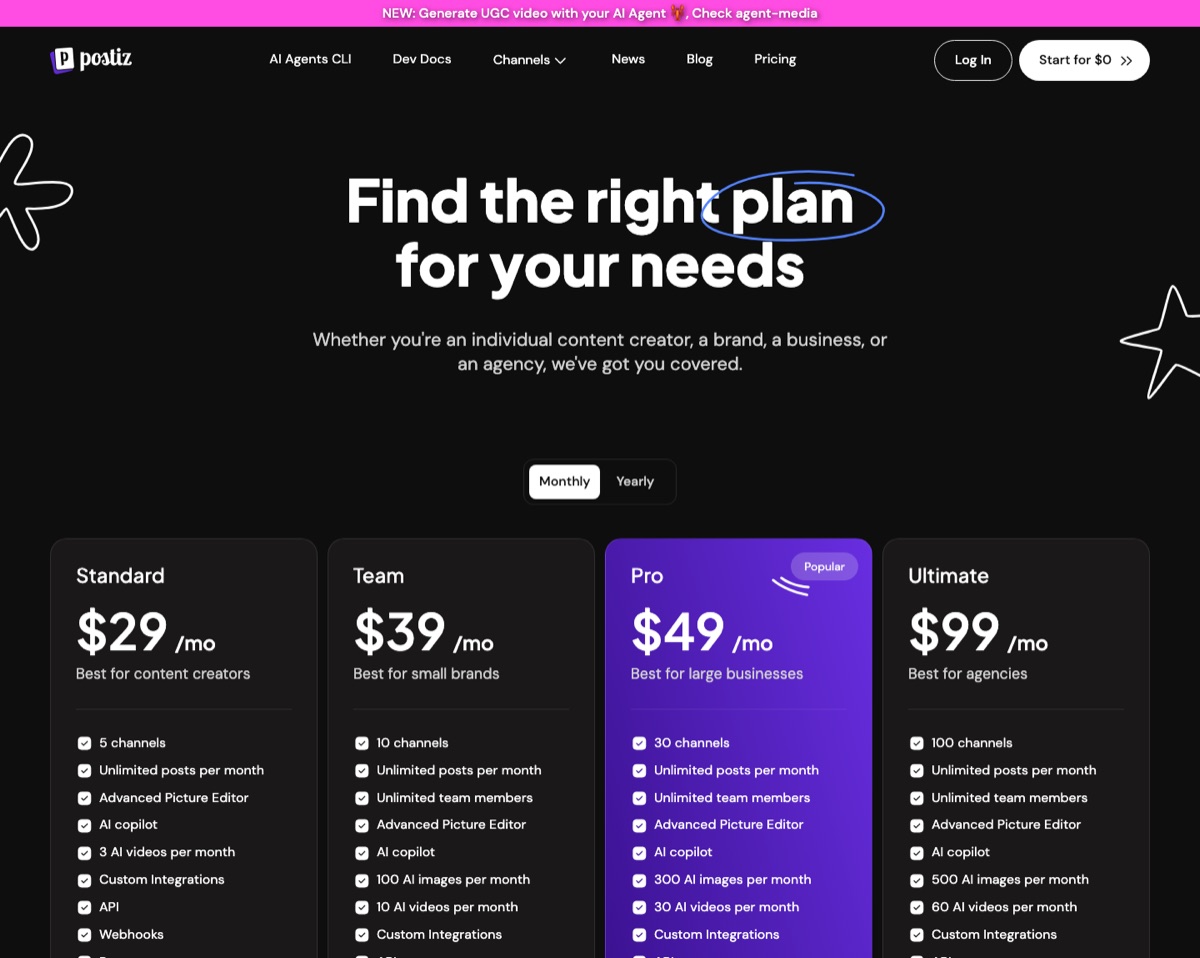
Blotato's rate card is shaped differently. Three tiers instead of four, and the jump between them is much steeper, which turns out to be the whole story once you count accounts.
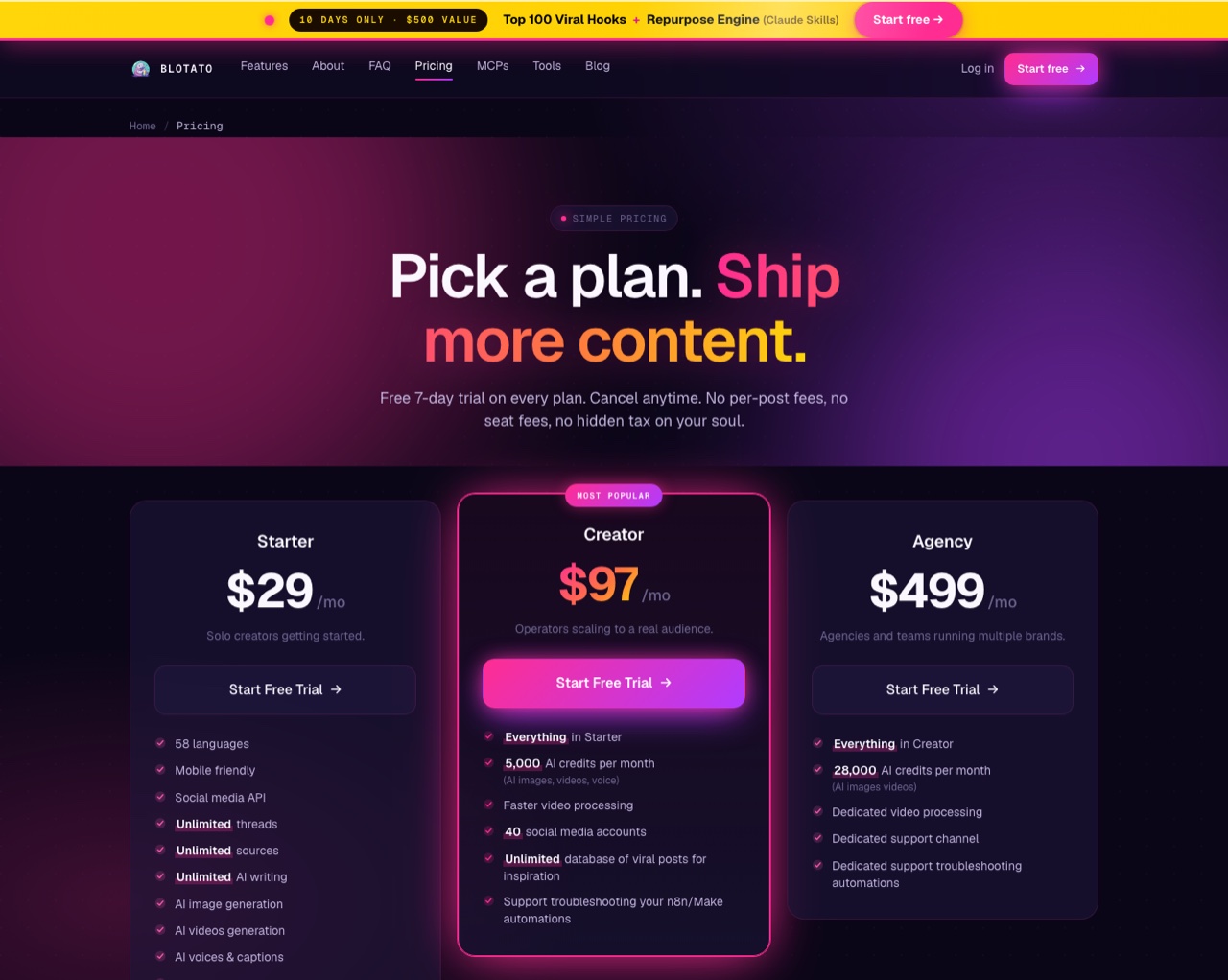
So the honest read is this. At 5 or fewer accounts the two cost the same and you should pick on features, not price. Between 10 and 20 accounts Blotato is meaningfully cheaper on the cloud version, $29 against $39 to $49.
The crossover lands at about 25 channels. Past Blotato's 20-account Starter cap you jump to Creator at $97, while Postiz Pro covers 30 channels for $49 and Ultimate covers 100 for $99, and Blotato publishes nothing between Creator's 40 accounts and Agency at $499. If you genuinely run more than 20 accounts, Postiz is the cheaper cloud product and it is not close.
And if you self-host Postiz, the license fee is zero, which is where this comparison gets interesting.
Postiz vs Blotato on Self-Hosting and the AGPL Catch
Postiz is genuinely open source. The repository sits at nearly 34,000 stars on GitHub and you can deploy it on your own infrastructure without paying Postiz anything. Blotato has no self-hosted option at all. If that is your requirement, the comparison ends here and Postiz wins.
Two things deserve more attention than they usually get.
First, the license is AGPL-3.0, not MIT. For most readers that is fine. You can self-host it for your own business, run client work through it, and keep your data private with no obligations. The catch only bites if you modify Postiz and offer that modified version to others over a network, which is the classic agency-white-label scenario. Do that and you owe your modifications back under the same license. Read the license terms before you build a product on top of it.
Second, free is not free. Self-hosting means you own the Postgres database, the Redis instance, the upgrade path, and every OAuth token refresh across every connected platform. Social APIs change constantly, tokens expire, and platform approvals are their own bureaucracy. That work does not disappear because the software is free. It moves onto your calendar.
If you enjoy running infrastructure, that trade is great. If your goal is to publish content, paying $29 to never think about it is the cheaper deal in real terms.
Postiz vs Blotato for AI Agents
Both tools have leaned hard into the agent use case, and this is where they are closest.
Postiz exposes an MCP server with 9 tools, so Claude, ChatGPT, Cursor, or any MCP client can list your connected accounts, read a platform schema, and schedule posts through natural language. It also ships a CLI, which is a genuinely nice touch if you want to script posting from a terminal or a CI job rather than a chat window.
Blotato exposes an MCP server and a REST API. I use it daily through Claude Code, and the workflow is conversational: point it at a YouTube video, have it write platform-specific posts against a skill file that holds my tone, then publish or schedule without leaving the editor. Here is the full build, start to finish.
The detail that sold me on that setup was small. I asked it to schedule a LinkedIn post for 1pm the next day, it checked my calendar, found I already had something in that slot, and asked me to pick another time instead of quietly double-booking. I have written up that whole workflow in my Blotato review, and it is the backbone of my AI social media system.
Testing the same kind of thing on Postiz, the MCP connection worked and the agent could list my accounts and schedule posts. What it does not do is write the content for you to the same depth. Postiz has an AI copilot, but Blotato is built around generation and it shows. If your agent is already producing the copy, that gap does not matter and Postiz is the cleaner publishing target.
The practical difference is the trial. Postiz gives you 7 days with API access included. Blotato gives you 7 days too, but the API is explicitly excluded, and generating an API key ends the trial and starts billing immediately. If you are evaluating purely as a developer, Postiz lets you test the integration for free and Blotato does not. That is a real advantage and worth knowing before you sign up expecting otherwise.
Platform Coverage
Postiz supports 28 or more platforms by its own count, with 21 of them wired up for in-app connection and the rest reachable through the public API. That list includes several Blotato does not touch: Mastodon, Discord, Slack, Telegram, Reddit, Farcaster, Dribbble, Twitch, WordPress, and Dev.to. Blotato covers 9: Instagram, TikTok, LinkedIn, Facebook, X, Threads, Bluesky, Pinterest, and YouTube.
On raw count Postiz wins, but count is the wrong metric. Nine platforms covers essentially every network a marketer or creator actually monetizes. The extra Postiz providers matter if you are a developer publishing to Mastodon and Discord communities, and they are irrelevant if you are a business posting to Instagram and LinkedIn.
Ask which specific platform you need rather than which number is bigger. If it is Discord, Telegram, or Mastodon, that decides it outright.
What Self-Hosting Actually Costs You
Since the free tier is the main reason people choose Postiz, it is worth being concrete about what "free" buys.
You need somewhere to run it, which for a small setup means a VPS at roughly $10 to $20 a month once you account for the Postgres and Redis instances Postiz depends on. Call that the easy part.
The harder part is maintenance, and here I want to be straight with you: I ran Postiz on its cloud plan, not on my own box. What follows is what the docs specify and what shows up repeatedly in the project GitHub issues, not a war story of my own.
Postiz needs Postgres, Redis, and Temporal alongside the app itself, which is more moving parts than a single container. Every connected platform issues OAuth tokens that expire, and when one lapses your posts stop going out until you notice. Several networks require their own developer approval before a self-hosted app can post at all, and that process is between you and the platform. Account connection is the first category listed in the project's own known-issues documentation, and it recurs steadily in the GitHub issues.
None of that is a reason to avoid self-hosting. It is a reason to price it honestly. If you already run infrastructure and this is one more service on a box you maintain anyway, the license savings are real and Postiz is a genuinely good piece of software with an active project behind it.
If publishing content is the actual goal and servers are not your hobby, $29 a month to make all of it someone else's problem is not the expensive option.
Two Things the Comparison Pages Get Wrong
If you search this matchup, the first results you hit are written by the two vendors about themselves. Worth knowing what each leaves out.
Postiz's comparison page marks Blotato as having no analytics at all. That is wrong. Blotato tracks views, likes, comments, shares, reach, and watch time on published posts, in the app and through the API.
Coverage is nearly complete. Blotato's documentation puts analytics on eight of its nine platforms, with LinkedIn the only one that reports nothing.
The same page also lists Blotato as supporting five platforms when it publishes to nine.
Blotato's page is more accurate on the numbers, but it leans on Postiz's heaviest self-hosted server requirements without making clear that those apply to running it yourself. If you use Postiz cloud, none of that is your problem, and the hosted version starts at the same $29 Blotato does.
Neither page mentions what independent users think. Blotato holds 4.8 out of 5 across 377 reviews on Trustpilot and 4.7 from 73 on SourceForge. Postiz does not have comparable review volume on those sites, but it has close to 34,000 GitHub stars and ships updates most days, which is its own kind of signal. Different evidence, both worth weighing.
Which One Should You Pick?
If you only take one thing from this post, take this diagram. It is the whole decision in one image.
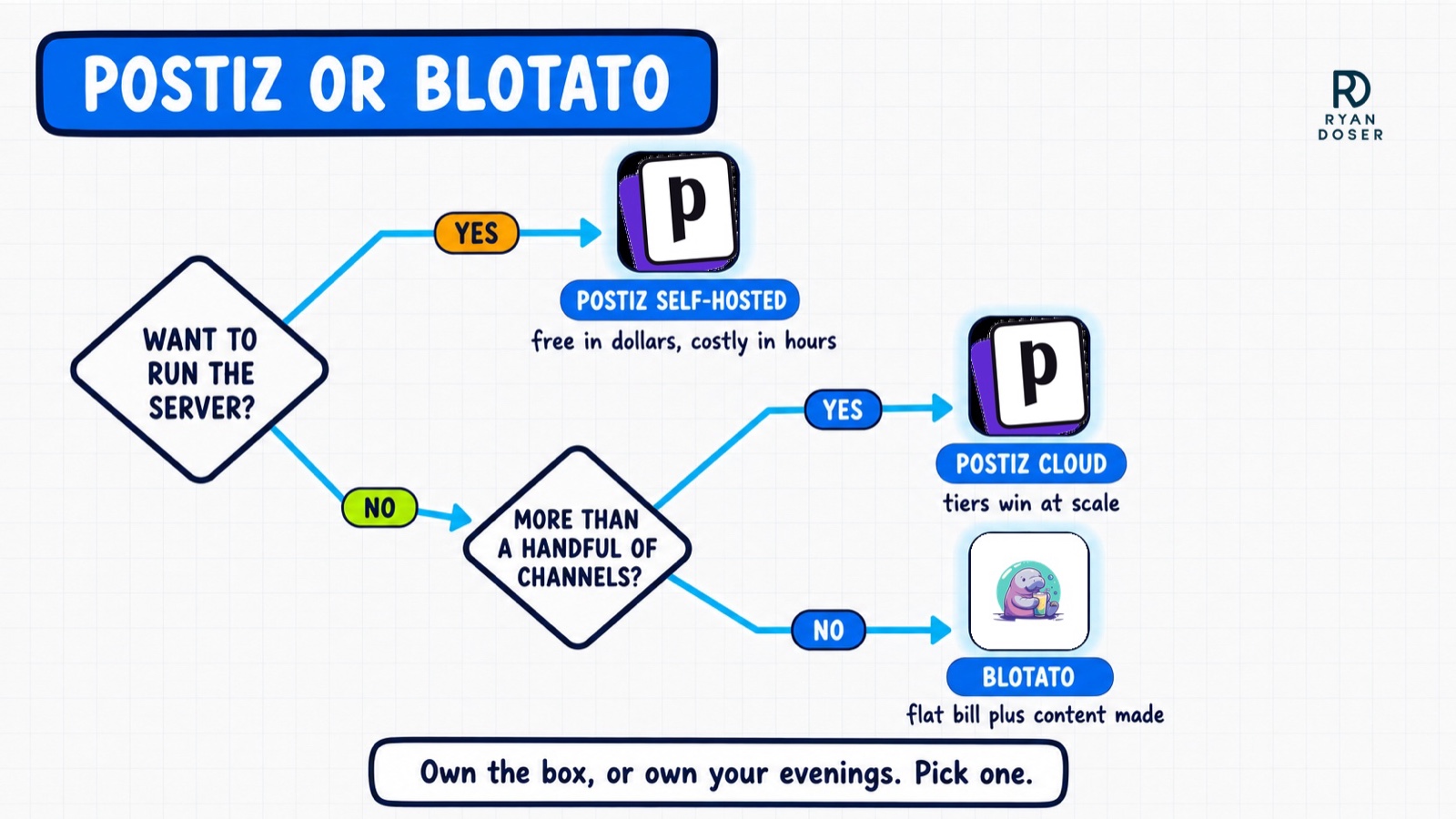
Pick Postiz if you want to self-host, you are comfortable owning infrastructure, you need one of the platforms outside Blotato's nine, you want to test an API integration for free before paying, or you run more than 20 channels where Pro at $49 and Ultimate at $99 are clearly the better rate.
Pick Blotato if you run somewhere between 10 and 20 accounts, you want content generation and publishing behind one flat bill, and you would rather spend your evenings making content than maintaining a scheduler. At 20 channels it is $29 against Postiz's $49, and nothing to host.
For most solo creators and small businesses reading this, that second paragraph is the honest answer, and it is the setup I run myself. For developers and self-hosting enthusiasts, the first one is, and I would not try to talk you out of it.
If neither fits, I compared eight of these side by side in my roundup of social media automation tools, and if you are weighing Blotato against a hosted mainstream scheduler rather than an open-source one, Blotato vs Buffer covers that matchup. For the analytics-first alternative, see Blotato vs Metricool.
If you are weighing Postiz mainly because you would rather not pay a subscription, I also mapped out the maintenance cost of self-hosting against the managed options.
Postiz vs Blotato FAQs
Is Postiz really free?
The software is free to self-host under AGPL-3.0. The cloud version starts at $29 a month for 5 channels. Self-hosting costs you server hosting plus your own maintenance time, so it is free in license terms rather than free in total cost.
Does Postiz work with Claude and other AI agents?
Yes. Postiz ships an MCP server exposing 9 tools, so Claude, ChatGPT, Cursor, and other MCP clients can manage posting through natural language. It also has a CLI for scripted workflows. Blotato ships an MCP server and REST API that work the same way.
Which is cheaper, Postiz or Blotato?
It depends entirely on channel count. Both start at $29, but Postiz gives 5 channels there and Blotato gives 20. Up to 20 channels Blotato wins at $29 against Postiz Pro's $49. Past 20 the order flips: Postiz Pro covers 30 for $49 while Blotato Creator is $97 for 40, and Blotato publishes no tier between 40 accounts and Agency at $499. Self-hosted Postiz has no license cost at any count.
Can I use Postiz commercially if I self-host it?
Yes. AGPL-3.0 permits commercial use, including running it for your own business or client work. The obligation only triggers if you modify Postiz and make that modified version available to others over a network, in which case you must release your changes under the same license.
Does Blotato have a free plan?
No. There is a 7-day trial that requires a card and converts to a paid subscription unless you cancel, and the trial excludes API access. Postiz also runs a 7-day trial, but with API access included.
How many platforms does each one support?
Postiz supports 28 or more by its own count, with 21 offering in-app setup and the rest available through its public API, including Mastodon, Discord, Slack, Telegram, Reddit, and WordPress. Blotato supports 9: Instagram, TikTok, LinkedIn, Facebook, X, Threads, Bluesky, Pinterest, and YouTube.
Disclosure: some links in this post are affiliate links, specifically Blotato. If you buy through them I may earn a commission at no extra cost to you. Blotato is also a client of mine. Postiz is not an affiliate relationship and I have no commercial interest in it. I only recommend tools I actually use. Full disclosure.