
Blotato vs Metricool: Full Comparison for Social Media Management
Blotato vs Metricool looks like a close call on the pricing pages. Metricool starts at $20 a month, Blotato starts at $29, and both now ship an MCP server so an AI agent can post for you. Then you look at what each one is actually counting, and the two stop being comparable at all.
Metricool bills per brand. Blotato bills per connected account. Those are different units, and the vendor pages ranking for this term mostly compare the two numbers as though they were the same thing.
I run Blotato daily and it publishes most of my content through Claude Code, so my experience there is long-running and hands-on. For this post I set up a Metricool account, connected profiles, and wired its MCP server into Claude to see how the agent side compares. That is weeks against years, and I will flag where the difference matters.
Blotato vs Metricool at a Glance
| Blotato | Metricool | |
|---|---|---|
| Entry price | $29/mo (Starter) | Free, then $20/mo |
| Pricing unit | Per social account | Per brand |
| What the entry plan holds | 20 accounts | 5 brands |
| Free plan | No | Yes, 1 brand |
| Platforms | 9 | 11 |
| AI content generation | Text, images, video, voice | Text only |
| AI credits per month | 1,250 | 20 per brand |
| Analytics coverage | 8 of 9 platforms | All connected networks, plus ads |
| MCP server | Yes, paid plans | Yes, including the free plan |
| REST API | Yes, paid plans | Advanced or Custom only |
| Free trial | 7 days, excludes API | Free plan, no trial needed |
A Brand Is Not an Account
This is the part the comparison pages get wrong, and it decides most of these purchases.
In Metricool, a brand is a container. Per Metricool's own documentation it holds one profile per network, so a single brand can carry an Instagram account, a Facebook page, a LinkedIn page, a TikTok account, a YouTube channel, a Pinterest account, Threads, Bluesky, a Google Business Profile listing, Twitch, and X, plus ad accounts and a website. That is one brand.
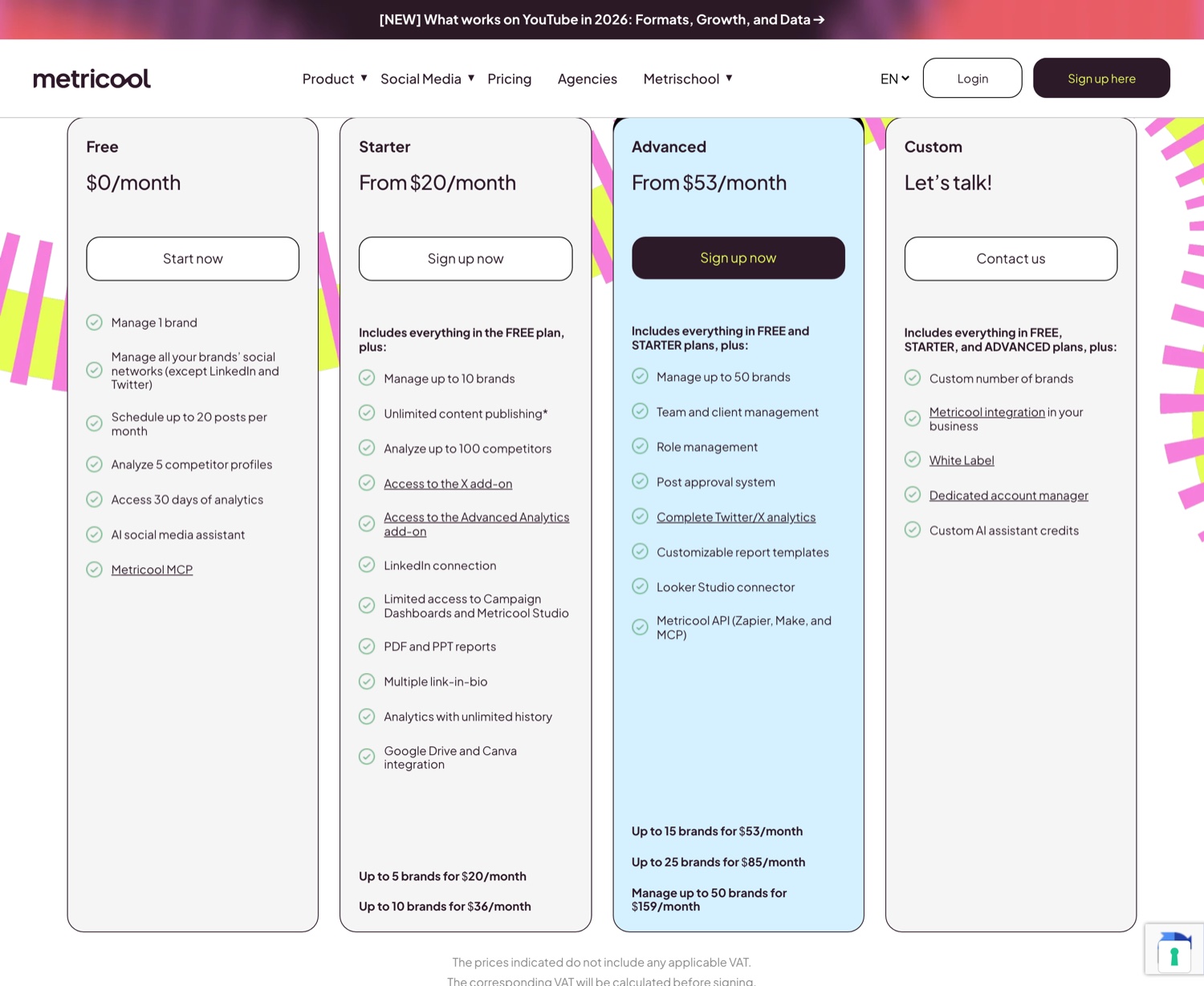
So Metricool Starter at $20 a month for 5 brands is not five accounts. Filled out, it is potentially dozens of connected profiles. Blotato Starter at $29 gives you 20 social accounts, and every profile you connect counts as one of those 20.
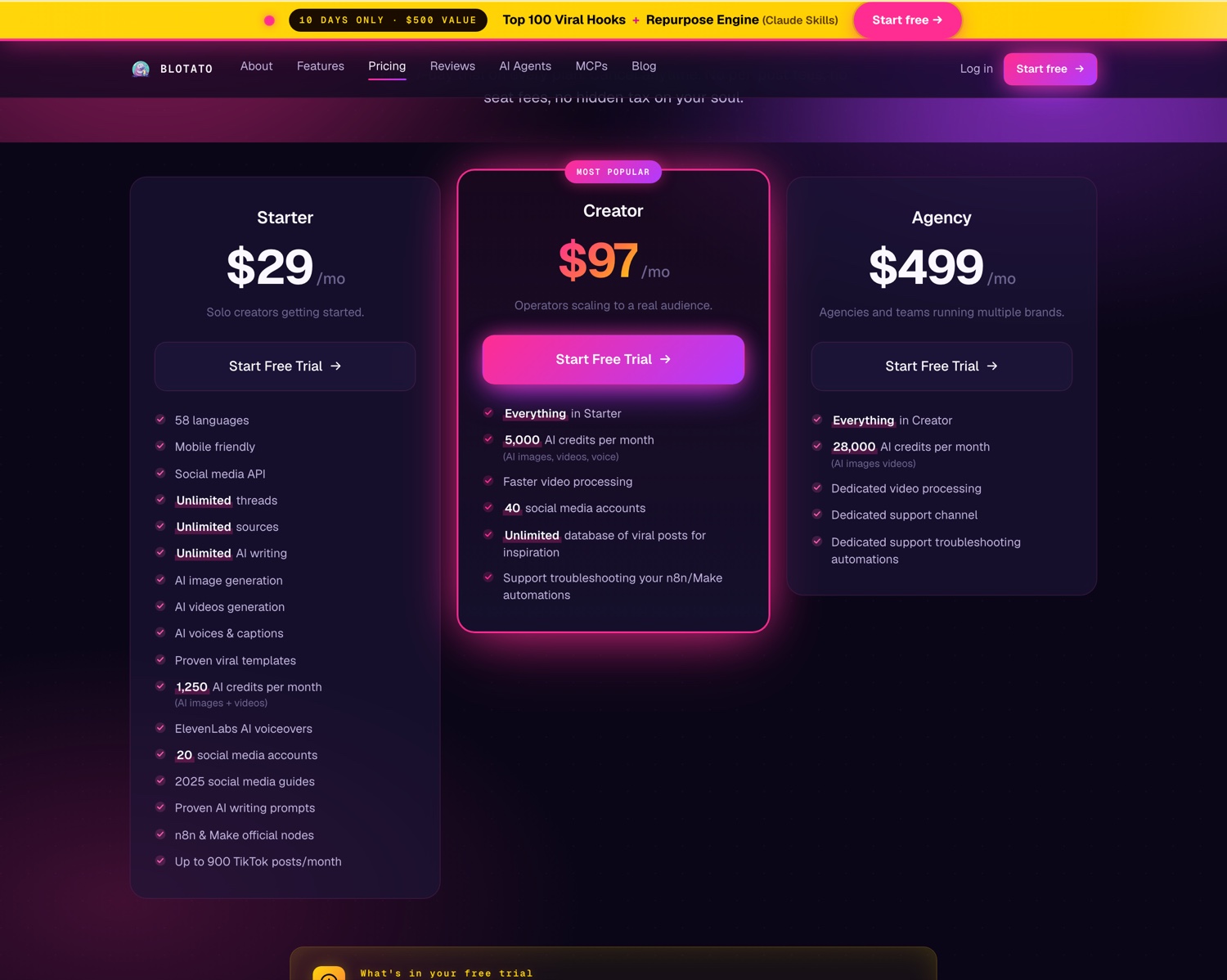
Run that against real setups and the answer flips depending on shape, not size.
If you are one business posting to seven networks, that is 1 brand in Metricool and 7 accounts in Blotato. Metricool covers it free. If you are an agency with five clients on six networks each, that is 5 brands at $20 against 30 accounts in Blotato, which needs the $97 Creator plan. On sticker price alone Metricool wins that setup, though the $97 is also buying the content generation that Metricool does not do at any tier.
Where Blotato pulls ahead is when you run many profiles under one identity and want them all generating content. Twenty accounts on one flat bill with AI generation included is a different product from twenty profiles you still have to write for.
Two caveats before you price it out. Metricool's listed prices are annual billing and exclude VAT, and monthly billing runs higher at $25 for 5 brands. More importantly, X costs extra. Connecting an X account requires a paid add-on at $10 per month per account, a price that took effect on July 13, 2026, and one add-on covers one X account per brand. If X is central to your posting, add that to every brand and re-run the math.
The Agent Story Is the Opposite of What You Would Expect
Both tools ship an MCP server, and the access rules run opposite to what the marketing on either side would suggest.
Metricool's MCP server runs at ai.metricool.com/mcp and works on any plan, including the free one. Its documentation covers Claude, ChatGPT, Cursor, n8n, Make, Zapier, and the Gemini CLI. I connected it on Claude and the agent could see my brands, pull metrics, and create and schedule posts. Your plan limits still apply through the agent, so a free account is still capped at 20 scheduled posts a month, but the connection itself costs nothing.
The Metricool REST API is a separate product with a different gate. It requires the Advanced plan, which is $53 a month. So if you want to hit endpoints from your own code rather than chat with an agent, Metricool's entry price is not $20, it is $53.
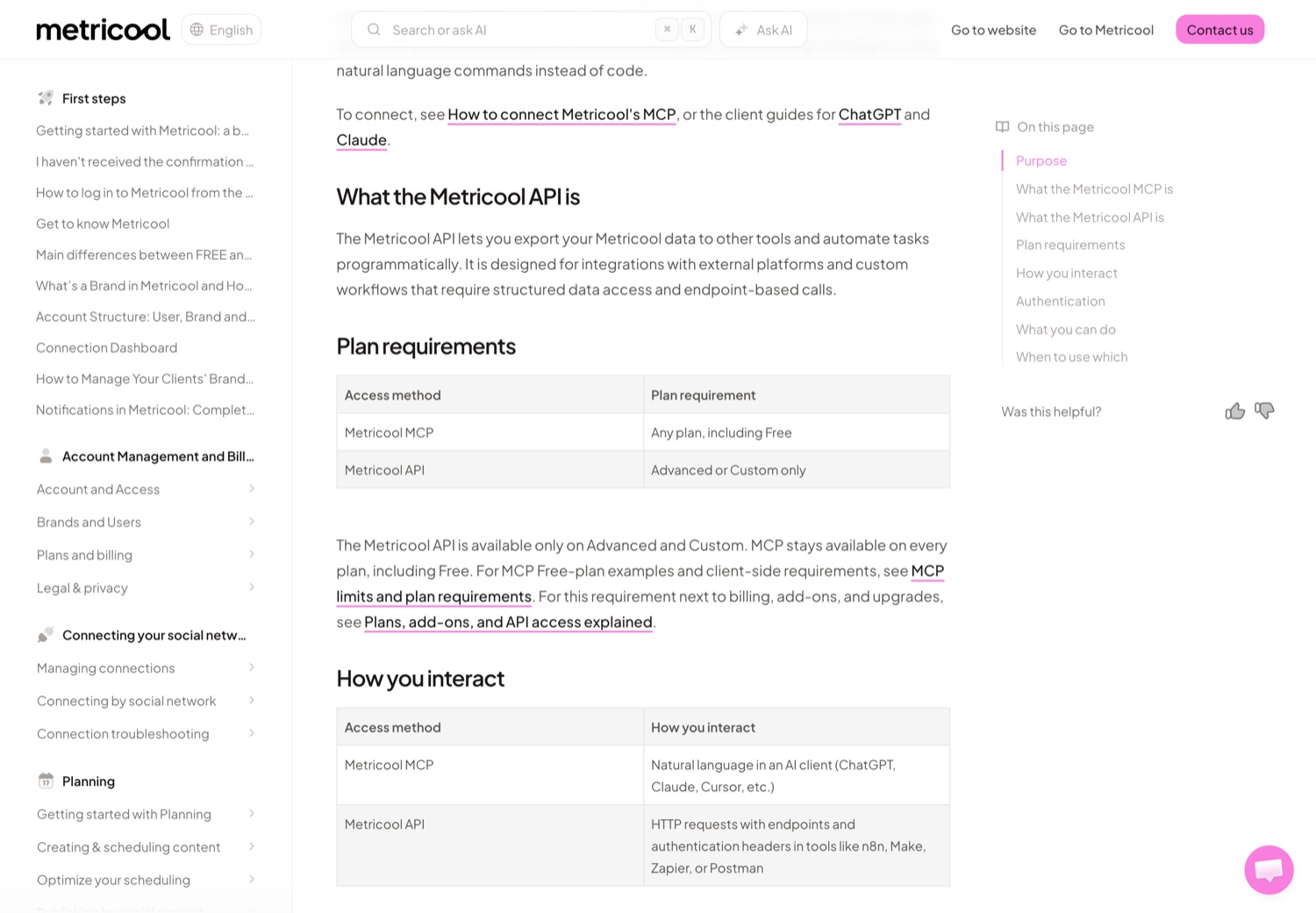
Blotato inverts this. Its REST API and MCP server are both on the $29 Starter plan, so there is no separate tier to reach for programmatic access. But the 7-day trial excludes the API entirely, and generating an API key ends the trial and starts billing immediately.
So if you want to test an agent connection before paying, Metricool is the only one of the two that lets you. If you want a REST API on the cheapest paid plan, that is Blotato at $29 against Metricool's $53.
Here is what the Blotato side looks like once an agent is driving it.
Running the same kind of request against both, the split is clear. Metricool's agent answers questions about performance well, because that is what the underlying product is good at. Ask it to produce a week of posts and you are still the one writing them. Blotato's agent will draft the week, generate the images, and put them in the queue. I wrote that setup up in my Blotato review, and it is the backbone of my AI social media system. Both tools also appear in my roundup of MCP servers for marketers.
One Writes the Content, One Measures It
Pricing aside, this is the difference that outlasts any rate card.
Metricool's AI assistant is a text tool. By Metricool's own feature list it creates and translates copy, fixes spelling and grammar, changes tone, adds calls to action, suggests hashtags, adds emoji, shortens or lengthens posts, and adapts them per platform. That is a genuinely useful editing companion. It does not generate images, and it does not generate video.
The credit allowances match that scope. Free gives you 5 credits per brand per month, Starter 20, and Advanced 35. Those numbers are sized for polishing captions, not producing a content library.
Blotato is built the other way around. Point it at a YouTube video, an article, or an idea, and it produces the copy, the images, the AI video, and the voiceover, then schedules the result. Starter includes 1,250 AI credits a month, Creator 5,000, and Agency 28,000. That gap between 20 credits and 1,250 is not a pricing quirk, it is the whole difference in what the two products are for.
So the question that decides this is not which tool is better. It is whether something already produces your content. If you have a writer, an agency, or your own agent generating posts, you are shopping for a publishing and reporting layer, and Metricool is an excellent one that starts at free. If nothing is producing the content, a scheduler leaves you staring at an empty calendar.
Analytics: Metricool's Home Turf
If reporting is the reason you are buying, this section will decide it.
Metricool is an analytics product that grew a scheduler, and it shows. You get analytics across every network you connect, competitor tracking on up to 100 profiles, PDF and PPT reports, and paid ad data from Meta, Google, and TikTok sitting next to your organic numbers. Check the tier before you buy, because the reporting features are split across plans: the Looker Studio connector, customizable report templates, and client and role management all sit on Advanced at $53, not on the $20 Starter.
Reporting is where Blotato is still catching up. Per Blotato's own API documentation, metrics come back for eight of its nine platforms, with LinkedIn the only one returning nothing today. If a monthly LinkedIn report is the thing you are paid to deliver, that gap decides it. If you mostly need to know what worked so you can make more of it, the eight covered platforms include the ones most creators actually live on.
Here is where my Metricool time runs out, as promised. A few weeks tells you the reports build, export cleanly, and pull the numbers they claim to. It does not tell you whether the data holds up against native platform analytics over a quarter, how the numbers behave when a client disputes them, or what support is like when a connection breaks the day a report is due. Those are the questions that decide whether an analytics tool is any good, and they need longer than I have given it. On its reputation for stability I am relaying what long-time users say rather than something I have proven.
Blotato does have two surfaces Metricool matches rather than loses on: comments and direct messages, both limited to Instagram and Facebook. Metricool's Inbox handles comments and messages too, so treat that as a tie rather than a differentiator.
Platform Coverage
Metricool connects to 11 networks: Instagram, TikTok, YouTube, Threads, X, Twitch, Google Business Profile, Bluesky, Facebook, Pinterest, and LinkedIn.
Blotato publishes to 9: X, LinkedIn, Facebook, Instagram, TikTok, Pinterest, Threads, Bluesky, and YouTube.
The two Metricool has that Blotato does not are Twitch and Google Business Profile. If you are a local business that posts to Google Business Profile, Blotato cannot do it at any price, so that alone rules it out. Worth remembering that X on Metricool is the paid add-on, and that LinkedIn and X are both unavailable on its free plan.
What the Comparison Pages Get Wrong
Search this matchup and the first page is almost entirely vendors writing about themselves. Blotato's own comparison ranks first, a competitor's comparison page sits in the top five, and Metricool's own versus page is there too. Google's AI Overview for the term leans almost entirely on the vendor pages.
Two claims get repeated across those pages that are worth correcting. If you want the wider field rather than this head-to-head, I ran the pricing math across eight Metricool alternatives at two different account counts.
The first is treating brands and accounts as the same unit, which makes Metricool look either far cheaper or far more expensive than it is depending on which side wrote the page. It is neither. It is priced differently, and the answer depends on whether your profiles cluster into brands.
The second is the assumption that Metricool is the non-technical option and Blotato is the developer one. On MCP access that is backwards. Metricool ships MCP on its free tier while Blotato requires a paid plan and blocks API access during the trial. Blotato is the stronger agent platform once you are paying, because the API sits on the entry plan rather than a $53 tier, but "try before you buy" belongs to Metricool.
On reputation, Blotato holds 4.8 out of 5 from over 350 reviews on Trustpilot. Metricool does not have comparable volume there, which reflects where each company asks for reviews more than product quality, so I would not read much into the gap either way. Metricool is the older and larger product, and stability is the thing people consistently credit it with.
Which One Should You Pick?
The whole decision, in one image.
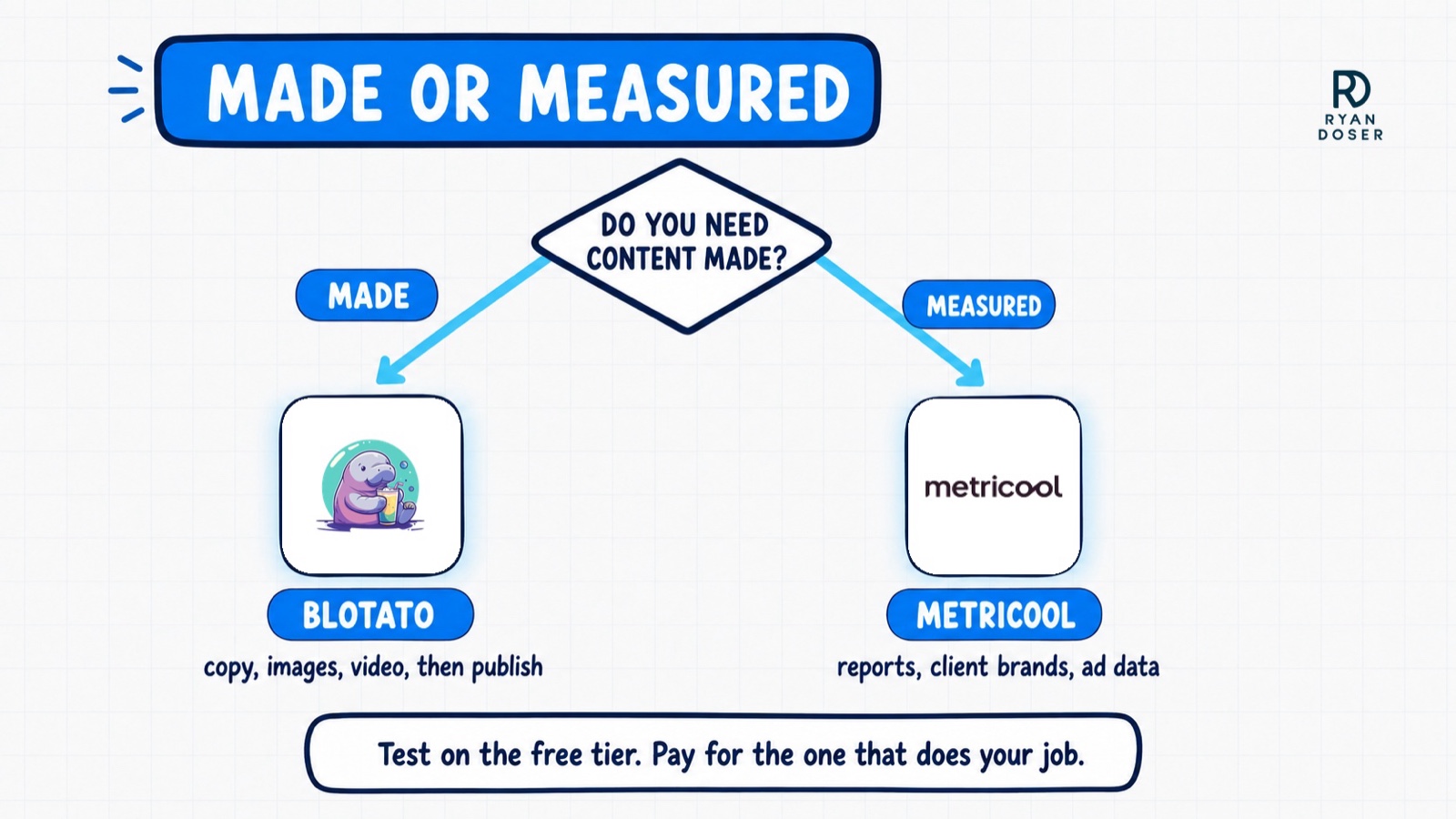
Pick Metricool if you manage separate client brands, reporting is your actual deliverable, you need competitor tracking or ad data alongside organic numbers, you post to Google Business Profile or Twitch, or you want to test an agent connection without paying anything. The free plan is permanent rather than a trial, so you can answer the question before spending anything.
Pick Blotato if nothing is currently writing your content, you want copy, images, and video generated rather than just scheduled, and you want a REST API on the entry plan instead of a $53 one. The two credit systems are not measuring the same unit, so do not read 1,250 against 20 as a 60x ratio, but the direction is not in dispute: one tool is built to produce media and the other is built to polish text.
The cleanest way to read it: Metricool is the better deal if you already have content and need to publish and measure it. Blotato is the better deal if the content itself is the bottleneck. That is why I run Blotato, and if reporting were my deliverable instead of creation, I would be on Metricool and I would not feel like I had compromised.
There is also a case for running both. Metricool's free plan reports on one brand while Blotato generates and publishes, which covers each tool's weak spot for $29 a month total. Two caveats keep that from being a free win: the free plan excludes LinkedIn and X, and you are maintaining two dashboards with a manual handoff between them. It works if reporting genuinely drives your decisions and one brand is all you need to measure.
If neither fits, I compared eight of these side by side in my roundup of social media automation tools. For other head to head matchups, Blotato vs Buffer covers the mainstream scheduler and Postiz vs Blotato covers the open-source option.
For the developer-side equivalent of this comparison, I put two API-first tools head to head in Postiz vs Zernio.
Blotato vs Metricool FAQs
Is Metricool cheaper than Blotato?
Usually yes on sticker price, but they count differently. Metricool is free for 1 brand and $20 a month for 5 brands on annual billing, while Blotato is $29 a month for 20 social accounts. A Metricool brand holds one profile per network, so 5 brands can carry far more than 5 profiles. If your accounts cluster into client brands, Metricool is cheaper. Add $10 a month per X account, and note that API access needs Metricool's $53 Advanced plan against Blotato's $29.
Does Metricool work with Claude and other AI agents?
Yes. Metricool runs an MCP server at ai.metricool.com/mcp and it works on every plan including the free one, with documented setups for Claude, ChatGPT, Cursor, n8n, Make, Zapier, and the Gemini CLI. Your plan limits still apply through the agent. The Metricool REST API is separate and requires the Advanced plan or Custom.
Does Blotato have a free plan?
No. Blotato runs a 7-day trial that requires a card and converts to a paid subscription unless you cancel, and the trial excludes API access. Generating an API key ends the trial and starts billing immediately. Metricool has a genuine free forever plan for 1 brand, though it excludes LinkedIn and X and caps you at 20 scheduled posts a month.
Which one is better for AI content creation?
Blotato, and it is not close. It generates copy, images, AI video, and voiceovers from a source you give it, with 1,250 AI credits a month on the entry plan. Metricool's AI assistant works on text only. It writes and rewrites captions, adjusts tone, translates, and suggests hashtags, but it does not generate images or video, and the entry plan includes 20 credits per brand per month.
Which has better analytics?
Metricool, on breadth. It reports across every connected network except X, which needs a paid add-on, and adds competitor tracking, PDF and PPT reports, a Looker Studio connector on Advanced, and paid ad data from Meta, Google, and TikTok. Blotato returns metrics for eight of its nine platforms, with LinkedIn the only one reporting nothing yet. Pick Metricool if reporting is the deliverable; the gap matters less if analytics mainly tell you what to make next.
How many platforms does each support?
Metricool connects to 11: Instagram, TikTok, YouTube, Threads, X, Twitch, Google Business Profile, Bluesky, Facebook, Pinterest, and LinkedIn. Blotato publishes to 9: X, LinkedIn, Facebook, Instagram, TikTok, Pinterest, Threads, Bluesky, and YouTube. Metricool's extras are Twitch and Google Business Profile, though X requires a paid add-on and LinkedIn is unavailable on its free plan.
Can I use both together?
Yes, and it is a reasonable setup. Blotato generates and publishes while Metricool's free plan reports on one brand, which covers each tool's weak spot for $29 a month total. Note that Metricool's free plan excludes LinkedIn and X, and you are running two dashboards with a manual handoff, so it only makes sense if reporting genuinely drives your decisions.
Disclosure: some links in this post are affiliate links, specifically Blotato. If you buy through them I may earn a commission at no extra cost to you. Blotato is also a client of mine. Metricool is not an affiliate relationship and I have no commercial interest in it. I only recommend tools I actually use. Full disclosure.