
Blotato vs Buffer in 2026: Which Social Media Tool is Best?
Blotato vs Buffer is usually framed as the AI content engine against the plain old scheduler. That framing is out of date. Buffer shipped a public GraphQL API in May 2026 and a hosted MCP server, so it now talks to Claude just like Blotato does. The real split is pricing shape and whether you need something to write the content in the first place.
I run Blotato daily and it publishes most of my content through Claude Code, so my experience with it is long-running and hands-on. I also went back into Buffer for this post, connected accounts, and wired its MCP server into Claude Code to see how close the two have actually gotten. Those are not equivalent amounts of testing, and I will flag where that matters.
One thing to flag before the details: almost every comparison ranking for this term right now, including the one Google's AI Overview leans on hardest, still describes Buffer as a scheduler with no API story. If you make your decision on those pages you are deciding on 2025 information.
Blotato vs Buffer at a Glance
| Blotato | Buffer | |
|---|---|---|
| Entry price | $29/mo (Starter) | Free, then $6/channel |
| Pricing shape | Flat, 20 accounts included | Per channel |
| Free plan | No | Yes, 3 channels |
| Cost at 10 accounts | $29/mo | $60/mo ($50 annual) |
| Cost at 20 accounts | $29/mo | $100/mo, volume discount included |
| Platforms | 9 | 11 |
| AI content generation | Text, images, video, voice | AI Assistant, text only |
| API | Yes, paid plans only | Yes, including free plan |
| MCP server | Yes | Yes |
| Free trial | 7 days, excludes API | 14 days, plus a free tier |
The Pricing Shapes Are Completely Different
This is the whole decision for most people, so I want to be precise about it.
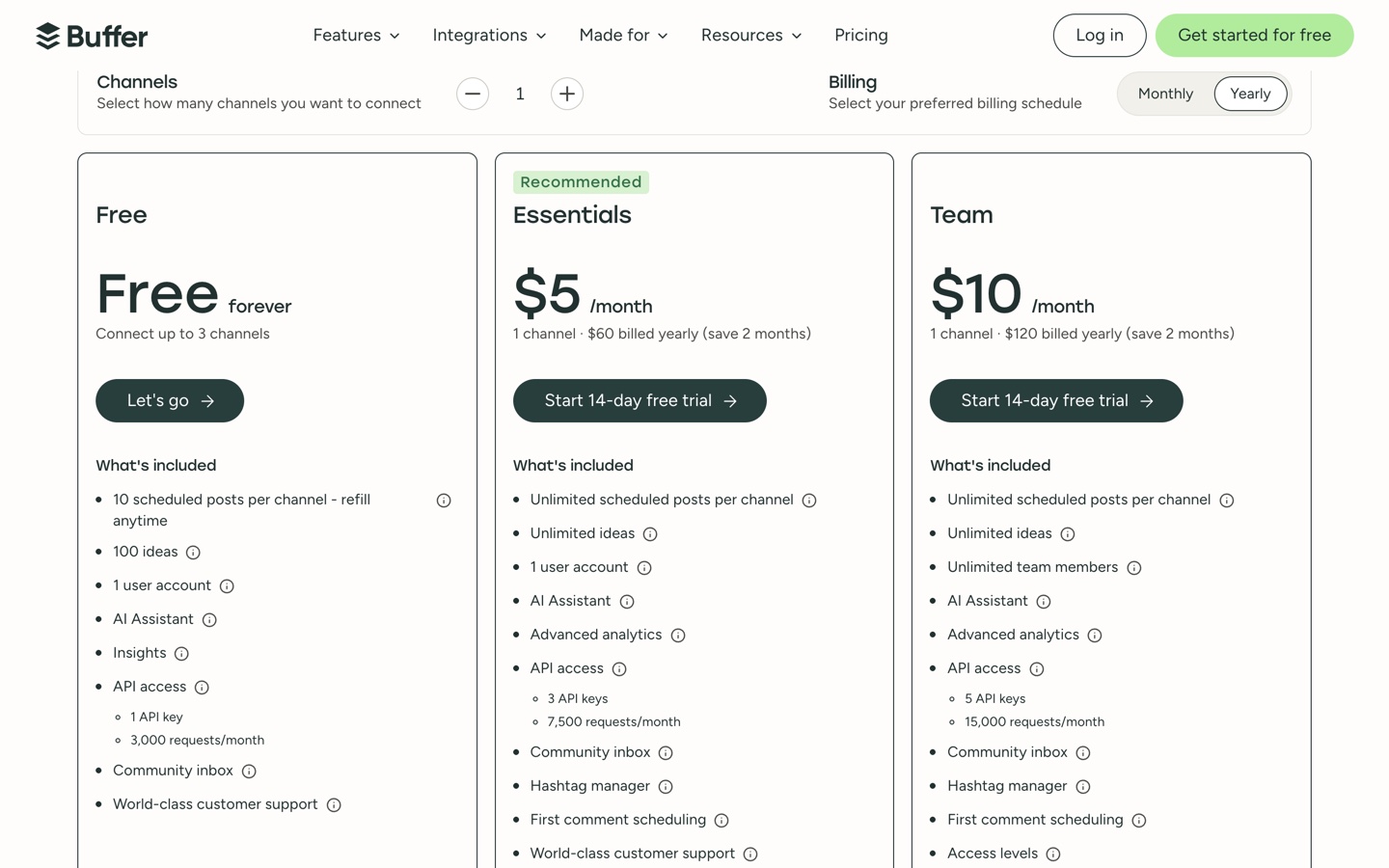
Buffer charges per channel. Essentials is $6 per channel per month billed monthly, or $5 billed yearly. Team is $12 monthly, or $10 yearly. A channel is one connected account, so an Instagram profile and a LinkedIn page are two channels. There is also a genuine free tier: 3 channels, 10 scheduled posts per channel, and the AI Assistant.
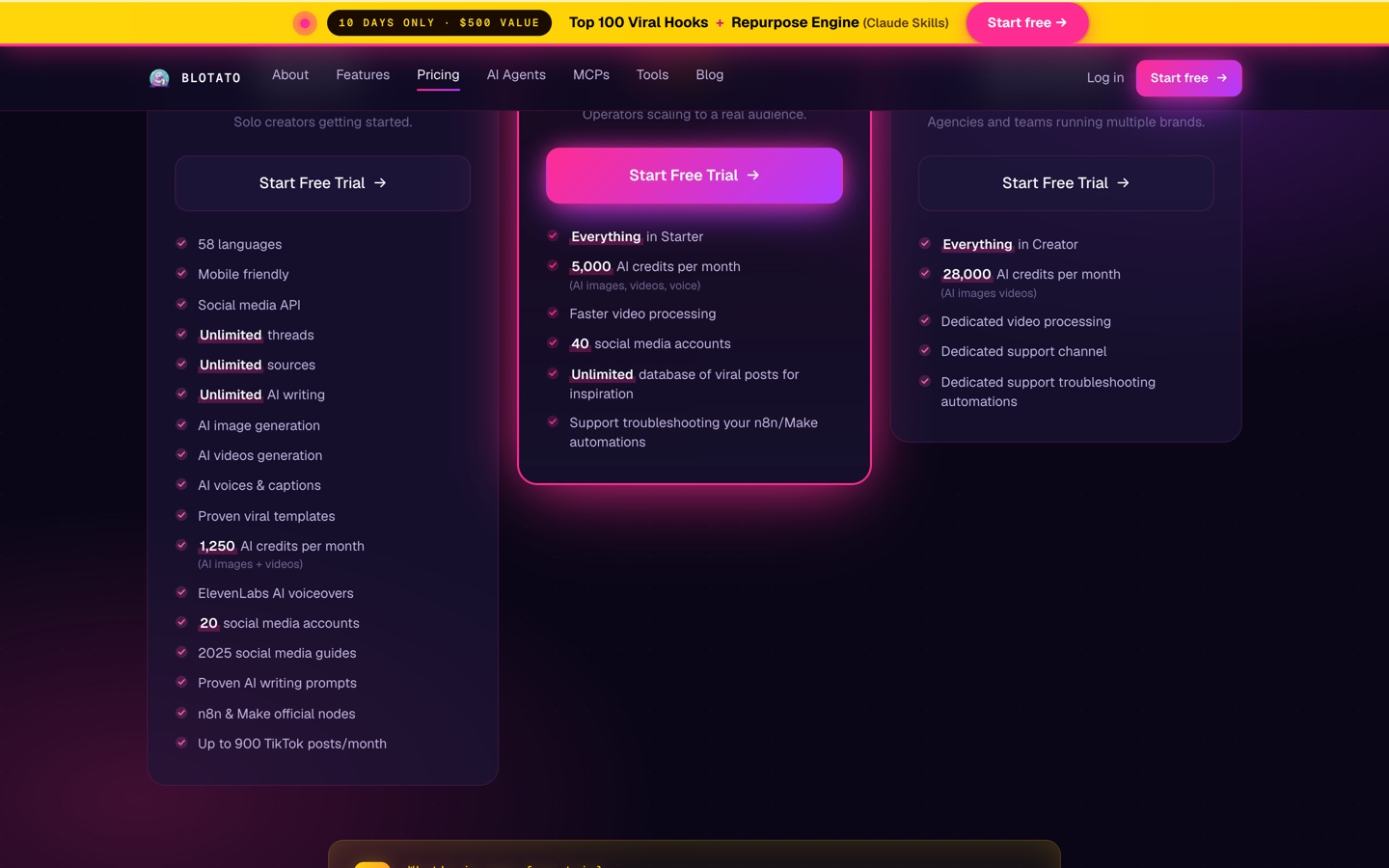
Blotato charges flat. Starter is $29 a month and includes 20 social accounts and 1,250 AI credits. Creator is $97 for 40 accounts and 5,000 credits. Agency is $499 with 28,000 credits.
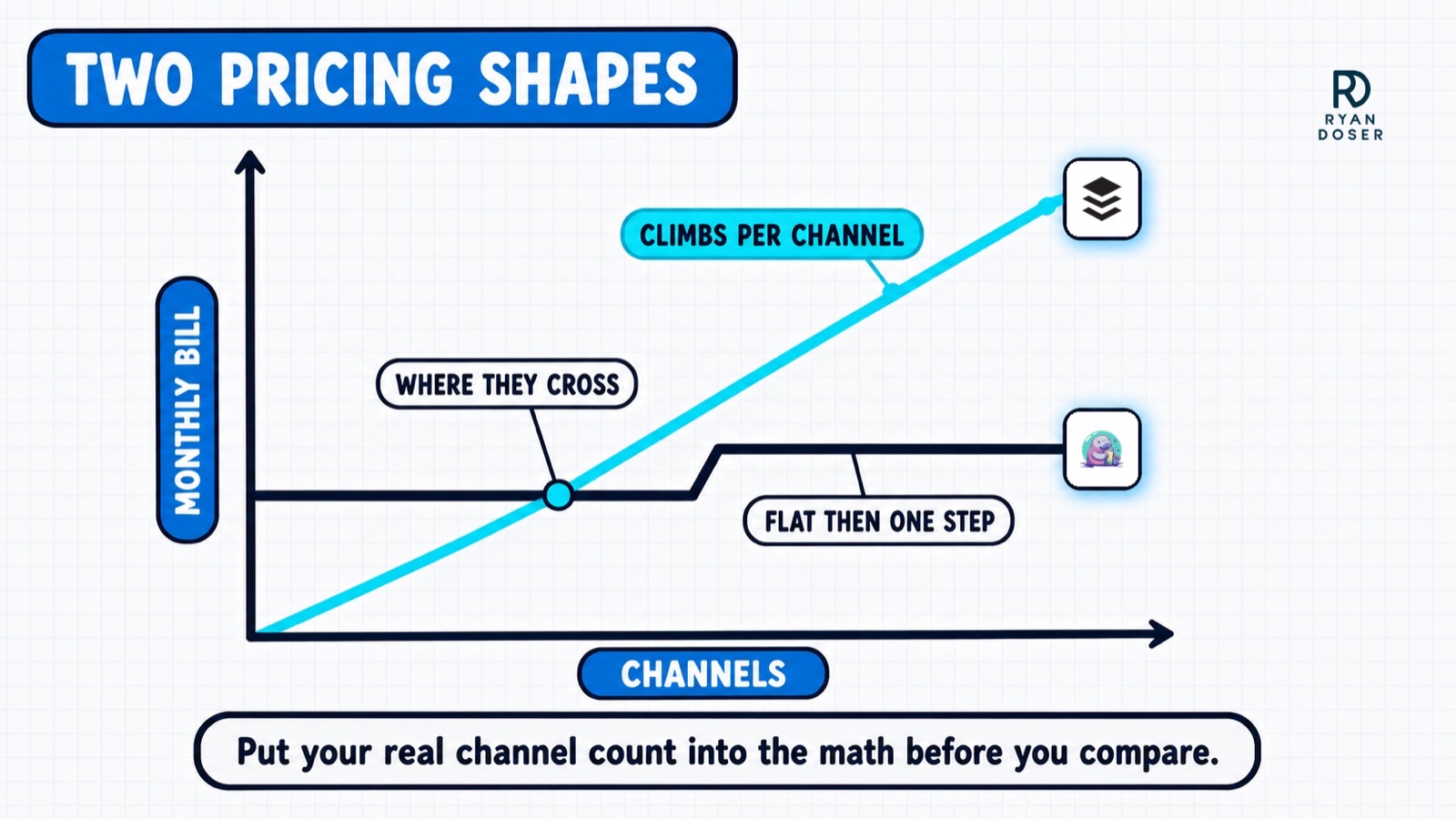
Run the math and the crossover is early. At 3 channels Buffer is free and Blotato is $29, so Buffer wins outright. At 5 channels Buffer is $30 monthly or $25 annual against Blotato's $29, so call it a tie you break on features. At 10 channels Buffer is $60 monthly or $50 annual against Blotato's $29. The tipping point lands at 5 channels on monthly billing and 6 on annual.
Past 10 channels there is an important wrinkle most comparisons ignore. Buffer discounts each channel above 10, and it now publishes the bands. On Essentials, channels 1 to 10 are $6 each, 11 to 25 drop to $4, 26 to 50 to $3, and anything past 50 to $1. On Team the first 10 are $12 each and the same $4 and $3 bands apply above that.
What that means practically: straight-line math overstates Buffer's bill at higher channel counts. Twenty channels on Essentials is $100 a month, not the $120 you would get by multiplying. If you are pricing a setup that size, put your real channel count into the slider on Buffer's pricing page and read the total, because that is the only figure I would trust.
The shape of the thing still holds. Buffer is cheapest when you are small and keeps climbing as you add channels, just more gently than the sticker rate suggests. Blotato costs more on day one and then stops moving until you pass 20 accounts.
Buffer Is Not Just a Scheduler Anymore
This is the part that makes most Blotato vs Buffer comparisons stale, and it is the reason I rewrote my own assumptions while researching this.
Buffer put its public API and MCP server into public beta in February 2026, then opened it up properly on May 27, 2026. It is GraphQL, it has managed OAuth, it shipped with a CLI, and it is available on every plan including the free one. The free tier gives you 1 API key and 3,000 requests a month. Essentials gives 3 keys and 7,500 requests. Team gives 5 keys and 15,000.
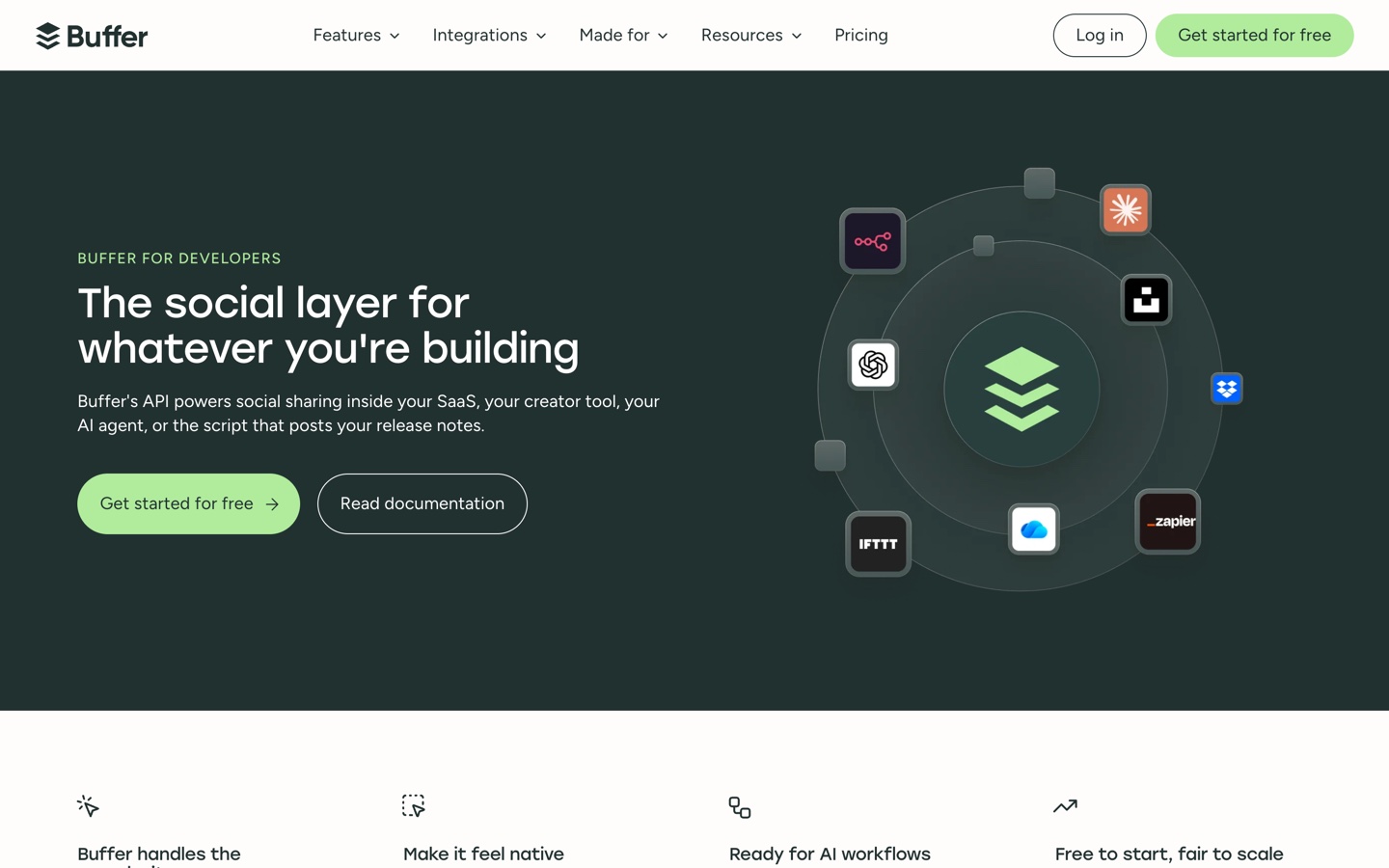
There is also a hosted MCP server at mcp.buffer.com/mcp, with native support listed for Claude, ChatGPT, Cursor, Raycast, and Perplexity, and a first-party setup guide covering Claude, Claude Cowork, and Claude Code. I connected it and the agent could see my channels, draft posts, review the queue, and schedule. It works.
So if you have been avoiding Buffer because you assumed it had no agent story, that assumption is now wrong, and being able to test an API integration on a free plan is a real advantage. Blotato's 7-day trial explicitly excludes the API, and generating an API key ends the trial and starts billing immediately. As a developer evaluating both, you can try Buffer's API for $0 and you cannot do that with Blotato.
One limit worth knowing before you build on Buffer's API: there is no image upload through the GraphQL API. Media has to already be hosted somewhere public and passed in as a URL. Buffer lists it as the top item on its own developer roadmap, so it is a known gap rather than a design choice. Creating, editing, and deleting posts are all documented mutations, so the queue itself is manageable from an agent.
The Actual Difference: One Writes, One Schedules
Strip out the pricing and the API parity and you are left with the thing that genuinely separates these two.
Buffer assumes you arrive with a finished post. Its AI Assistant will rewrite, repurpose, and adjust tone on text you give it, and it is good at that, but it is an assistant sitting next to a composer. It does not generate images or video.
Blotato assumes you arrive with a source and nothing else. Point it at a YouTube video, an article, or an idea, and it produces the copy, the images, the AI video, and the voiceover, then schedules the lot. That is what the AI credits on each plan actually buy.
Here is the workflow I run daily, end to end.
The detail that sold me was small. I asked it to schedule a LinkedIn post for 1pm the next day, it checked my calendar, saw I already had something in that slot, and asked me to pick another time rather than quietly double-booking. I wrote up that whole setup in my Blotato review, and it is the backbone of my AI social media system.
So the question that actually decides this is not which tool is better. It is whether something is already producing your content. If you have a writer, an agency, or your own agent generating posts, you are shopping for a publishing layer and Buffer is an excellent one at a lower price. If nothing is producing the content, a scheduler leaves you with an empty calendar.
Platform Coverage and Analytics
Buffer connects to 11: LinkedIn, X, Instagram, Threads, Facebook, TikTok, Pinterest, YouTube, Bluesky, Mastodon, and Google Business Profile.
Blotato publishes to 9: X, LinkedIn, Facebook, Instagram, TikTok, Pinterest, Threads, Bluesky, and YouTube. The two Buffer has that Blotato does not are Mastodon and Google Business Profile. If you are a local business posting to Google Business Profile, that single line decides this comparison for you.
On analytics Buffer is the stronger product and it is not particularly close, though Metricool beats them both on reporting depth. Advanced analytics come with Essentials, while exportable branded reports, extended date ranges, and custom metric sets sit on the Team plan, so check which tier holds the reporting you actually need before you buy. Blotato's analytics now return metrics for eight of its nine platforms, with LinkedIn the only one that reports nothing. If LinkedIn reporting is the reason you are buying, that single gap decides it, but the coverage is far wider than it was earlier this year.
Blotato does have two surfaces Buffer does not: comments and DMs, both currently limited to Instagram and Facebook. Useful if engagement is part of your workflow, though narrower than the marketing implies, and narrower than the dedicated Instagram DM automation tools built for that job alone.
What About Reliability and Support?
Buffer is the older, more established product, and stability is its reputation. It has been running since 2010, which is a long time to have been doing one job. I did not run it long enough to vouch for its uptime myself, so treat that as reputation rather than something I measured.
Blotato is a much younger product moving much faster. It holds 4.8 out of 5 from 377 reviews on Trustpilot, which is customer sentiment rather than uptime data, though my own experience matches it. A fast-moving product does ship changes, and I have hit the occasional platform connection that needed reauthorizing. Each time it was a few minutes of clicking rather than a missed posting day, but it is a different profile from a product that has been doing one thing since 2010.
Pick accordingly. If you want the tool nobody ever thinks about, that is Buffer. If you want the tool doing the most, that is Blotato, and you accept a little more motion.
Before You Buy Either One
A few practical things that decide more purchases than the feature lists do.
How to try each without wasting money
Buffer is the easy one. The free plan is permanent, so connect 3 channels, schedule a week of posts, and see whether the workflow fits before you pay anything. If you want the paid features, the 14-day trial sits on top of that.
Blotato has no free tier. The 7-day trial requires a card and converts unless you cancel, so treat it as a paid month you can back out of. More importantly, if you are evaluating the API or MCP, do not plan to test it on the trial: generating an API key ends the trial and starts billing immediately. Budget for the first month of Starter and decide inside it.
What switching actually costs you
Neither tool locks up your content, but neither migrates it either. Scheduled posts do not transfer between them. If you switch, you reconnect every social account through OAuth and rebuild anything still sitting in the queue, which is an afternoon at 5 accounts and a genuine project at 20.
The thing that does not come with you is history. Buffer's analytics live in Buffer, so leaving means leaving the reporting record behind. Export anything you need before you cancel.
Contracts, cancellation, and the annual question
Both bill monthly by default and both offer a discounted annual option. Blotato states "cancel anytime" on its pricing page and puts annual savings at around 17%, with bonus credits attached. Buffer's annual billing saves you two months, which is worth taking only once you are sure, since a per-channel annual commitment gets awkward if you drop channels later.
My advice on the annual toggle is the same for both: run a month at monthly pricing first. The savings are real but small next to picking the wrong tool for a year.
The upgrade cliff to watch
Blotato's jump from Starter to Creator is $29 to $97, and Starter caps at 20 accounts. If you are sitting at 18 or 19, know that your next few connections roughly triple the bill. Credits are the other thing to watch, since Starter's 1,250 a month is what funds the AI images and video, and heavy generation is what burns them. Buffer has no cliff, because it scales one channel at a time. That is the tradeoff between the two pricing shapes in one sentence.
Which One Should You Pick?
If you only take one thing from this post, take this.
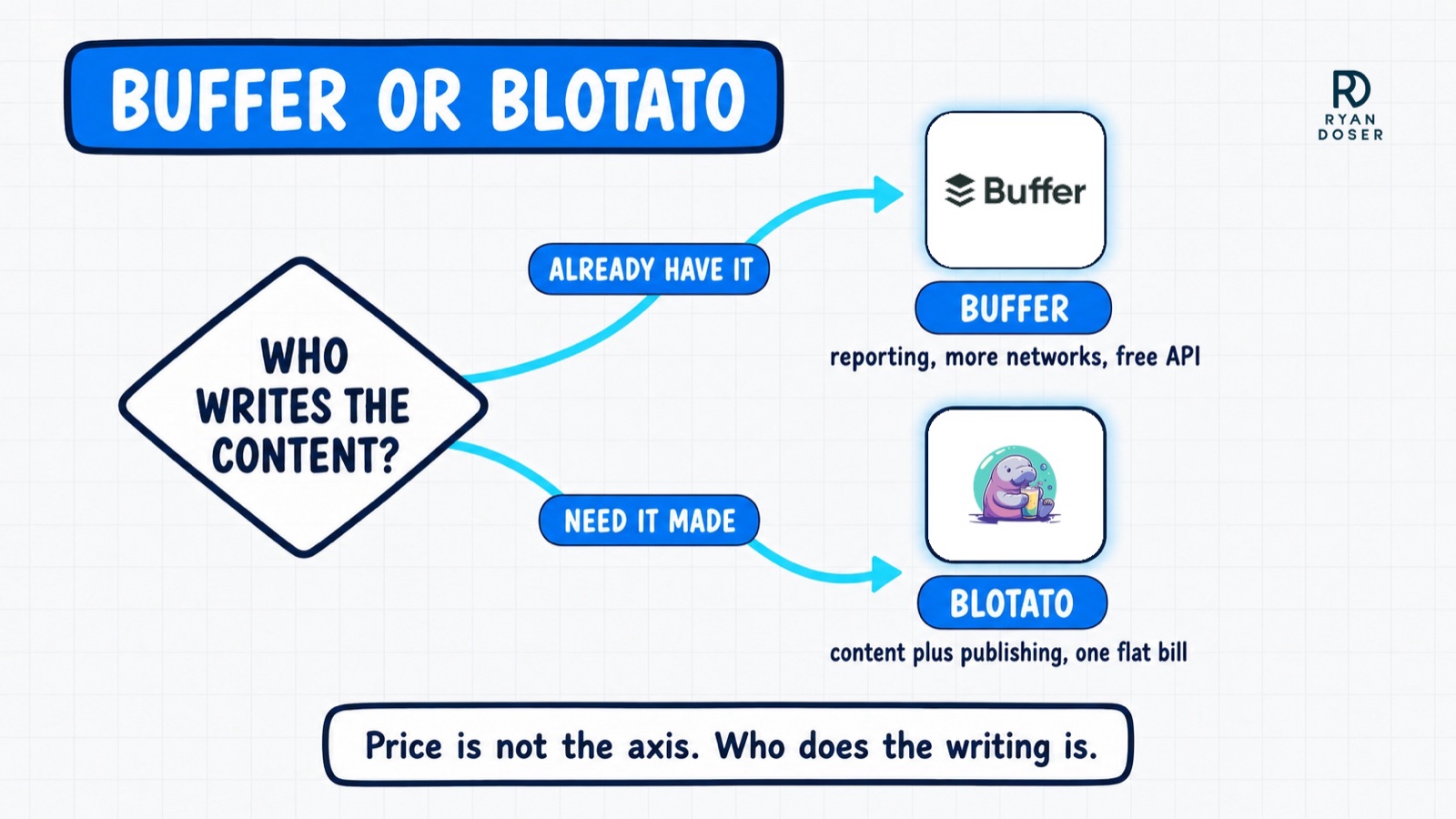
Pick Buffer if you already have something writing your content, analytics and reporting are central to your job, you need Google Business Profile or Mastodon, you run a handful of channels, or you want to test an API integration for free before paying anything. Note that the first three of those hold at any account count. Price is not the only axis, and if reporting is your job Buffer stays the right answer at 20 channels too.
Pick Blotato if you need the content generated as well as published, you run enough accounts that per-channel billing starts to sting, and you want one flat bill instead of one that grows every time you add a channel. At 20 accounts it is $29 flat against a Buffer bill of $100, volume discount already applied.
The cleanest way to read this: the price crossover sits at 5 or 6 accounts depending on billing, but the product crossover is generation. If nothing is currently writing your posts, that matters more than the money, and it is why I run Blotato. If something already is, Buffer does the publishing job well for less, and I would not talk you out of it.
If neither fits, I compared eight of these side by side in my roundup of social media automation tools, and I put Blotato head to head with an open-source option in Postiz vs Blotato. If analytics are what pulled you toward Buffer, Blotato vs Metricool covers the tool that reports better than either.
Buffer is the mainstream comparison. On the developer side people cross-shop per-account publishing APIs instead, which I covered in Zernio alternatives.
Blotato vs Buffer FAQs
Is Blotato cheaper than Buffer?
At 5 connected accounts on monthly billing, or 6 on annual, yes. Buffer's Essentials plan is $6 per channel monthly or $5 yearly, so 10 channels is $60 monthly or $50 annual against Blotato's flat $29. Above 10 channels Buffer discounts each additional channel, to $4 each for channels 11 to 25, $3 for 26 to 50, and $1 past 50 on Essentials, so 20 channels is $100 a month. Blotato is a flat $29 for up to 20 accounts, then $97 for up to 40. Below 5 accounts Buffer is cheaper, and at 3 accounts Buffer is free.
Does Buffer work with Claude and AI agents?
Yes. Buffer launched a public GraphQL API in May 2026 and runs a hosted MCP server at mcp.buffer.com/mcp, with native support listed for Claude, ChatGPT, Cursor, Raycast, and Perplexity. The API is available on every plan including the free one. The main gap is that the GraphQL API does not support image upload, so media has to be hosted elsewhere and passed in as a public URL.
Does Blotato have a free plan?
No. Blotato runs a 7-day trial that requires a card and converts to a paid subscription unless you cancel, and the trial excludes API access. Buffer has a genuine free forever plan with 3 channels and 10 scheduled posts per channel.
Which one is better for AI content creation?
Blotato, clearly. It generates copy, images, AI video, and voiceovers from a source you give it, which is what the AI credits on each plan pay for. Buffer's AI Assistant rewrites and repurposes text you already have and does not generate images or video.
How many platforms does each support?
Buffer connects to 11: LinkedIn, X, Instagram, Threads, Facebook, TikTok, Pinterest, YouTube, Bluesky, Mastodon, and Google Business Profile. Blotato publishes to 9: X, LinkedIn, Facebook, Instagram, TikTok, Pinterest, Threads, Bluesky, and YouTube. Buffer's extras are Mastodon and Google Business Profile.
Which has better analytics?
Buffer, and it is not close. Advanced analytics come with Essentials, with branded exportable reports and extended date ranges on Team. Blotato returns analytics for eight of its nine platforms, with LinkedIn the only gap.
Can I use both together?
You can, and there is a real case for it: Blotato generating the content, Buffer scheduling it and handling the reporting Blotato does not yet cover. That combination fixes each tool's weak spot. The cost is two subscriptions and a manual handoff between them, so it only makes sense if analytics genuinely drive your decisions. Most people should pick one side of the split and revisit later.
Disclosure: some links in this post are affiliate links, specifically Blotato. If you buy through them I may earn a commission at no extra cost to you. Blotato is also a client of mine. Buffer is not an affiliate relationship and I have no commercial interest in it. I only recommend tools I actually use. Full disclosure.