
A Six-Figure One Person Business With No Staff: Running It on AI
A one person business is a company with no employees besides the owner, and mine is a six-figure marketing agency run on about $300 a month in AI subscriptions. From February 23 to October 11, 2026, 71% of my site's Google clicks went to posts that started as my YouTube videos (56% in the final 28 days), and my digital products sold over $40,000 between May and mid-October 2026.
Watch Me Explain My One Person Business on Market Movers
I joined Chris Panteli on Linkifi's Market Movers podcast to walk through how the agency runs, with a screen share of my real workspace.
I opened the episode with the one-line version: "I run a six-figure marketing agency by myself just using AI systems behind the scenes."
In practice, I use Claude Code and Codex for "99% of my work," paired with MCP connections and a stack of context files inside VS Code. The tools do the execution, and the judgment is still mine.
That only works because I did marketing for 10-plus years before AI could. You can't open Claude or ChatGPT, type "do my SEO," and expect results.
If you want to see how that experience turns into instructions a model can follow, my Claude Code Skills Stack holds the skills I run for my own marketing every week.
How AI Models Replace Staff in My Agency
What does an org chart look like when the owner is the only person on it? In my one person business, it lives in one file, AGENTS.md, which every Claude Code chat reads before it does anything.
That file assigns each model a job the way a manager assigns staff. Here is the split I showed Chris:
- Daily driver: Claude Opus 5.5 plans and drafts, including anything a client sees.
- Workhorse: Claude Sonnet 5.5 handles research and keyword data pulls, so Opus tokens aren't wasted on busywork.
- Grunt work: Claude Haiku 5.5 takes the lists and mechanical checks.
- Gatekeeper: GPT-6.1 Sol, run through Codex, critiques every Claude Code draft, so a model from a different lab reads everything before I do.
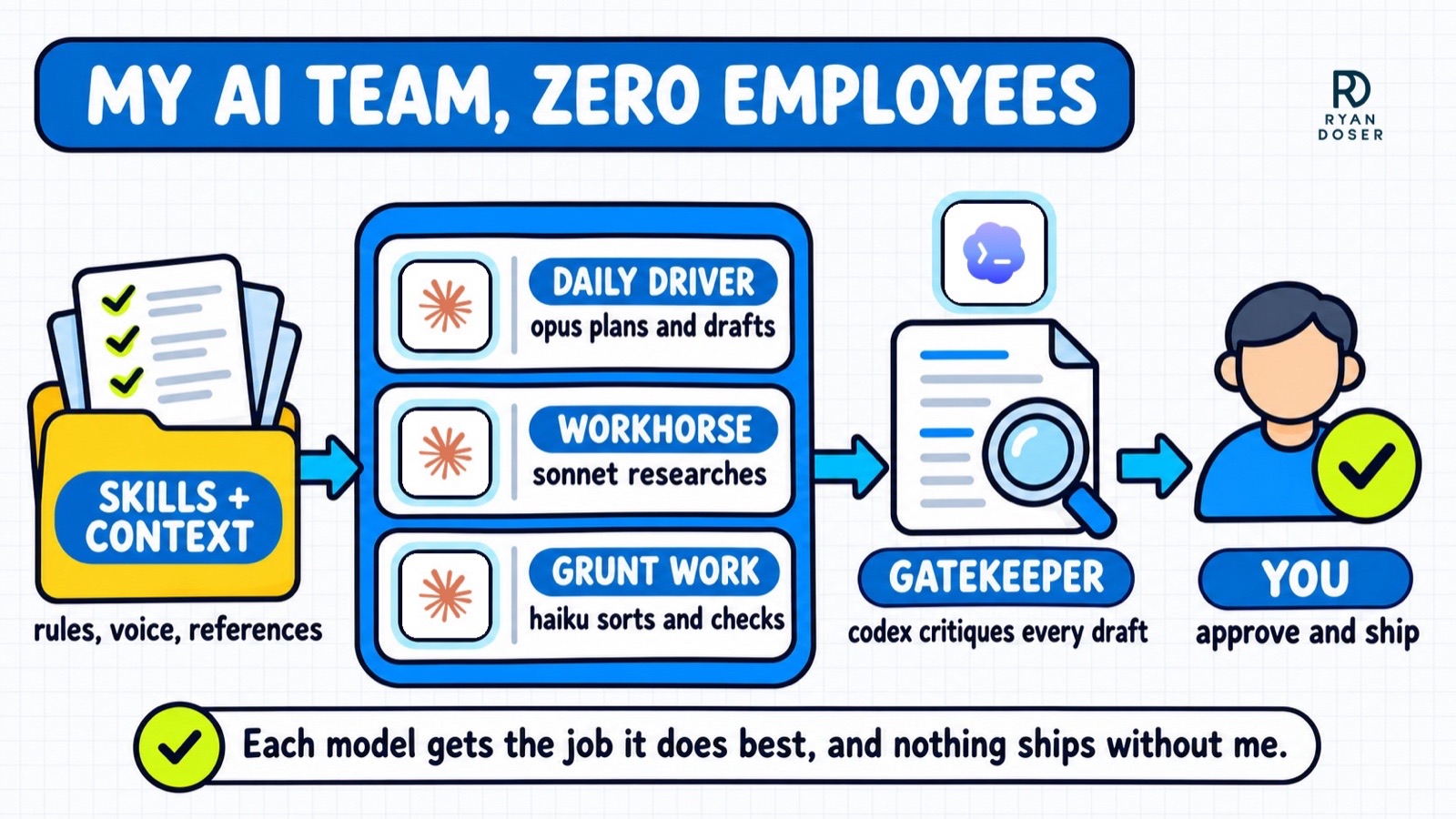
That is why I told Chris the "Claude Code versus Codex" debate is a skills gap. Claude Code is stronger at marketing, research and copy, Codex is, I'd say, better at images and technical work, and I run both in one VS Code window (the full case is in why I use Claude Code and Codex together).
The website side runs on the same pair plus Cloudflare, GitHub and the Astro framework. DataForSEO and a Google Search Console MCP feed both agents third-party and first-party search data.
The AI bill is two subscriptions: Anthropic's $200-a-month Claude plan and the $100-a-month ChatGPT Pro tier, which includes Codex (why I pay for ChatGPT Pro). Those are November 2026 prices, so check each vendor's live pricing page before you budget.
One part still runs by hand. When a new model ships, I edit AGENTS.md myself, because releases aren't frequent enough yet to justify automating it.
Skills and References Keep the Output Out of Slop
Chris asked what every skeptic asks: how does mass repurposing with AI avoid slop? My answer on air was "skills, skills, and references," and the full setup is in how I avoid AI slop.
A skill is a markdown SOP that tells Claude Code or Codex how to do one job. My YouTube thumbnail skill ships with my logos and headshot plus past thumbnails that performed well, so the model copies what already worked.
None of these came out right on the first try. My YouTube repurpose command took "10, 15, 20 iterations" of reviewing output and updating the skill before I trusted it.
Even now, as I admitted in the episode, "these aren't 100% perfect," so every run in my one person business still ends with my own final read.
Two habits keep the system from rotting. A passive skill updater checks every run against the skill's rules and patches the skill once the same failure shows up three or more times, which I walk through in how I update Claude Code skills on autopilot.
One correction to how I put it on the show: Andrej Karpathy's autoresearch is a loop for machine learning experiments. My updater borrows its core idea: an unattended loop that improves the instructions without me in the chair.
The other habit is a /clean-up command. It scans my workspace for clutter and reorganizes it, with guardrails against deleting anything important.
71% of My Google Clicks Go to Video-Based Posts
This is the number behind the content side of my one person business. From February 23 to October 11, 2026, 71% of Google clicks to ryandoser.com landed on posts that started as one of my YouTube videos, per my Search Console page data, though the share was 56% in the final 28 days.
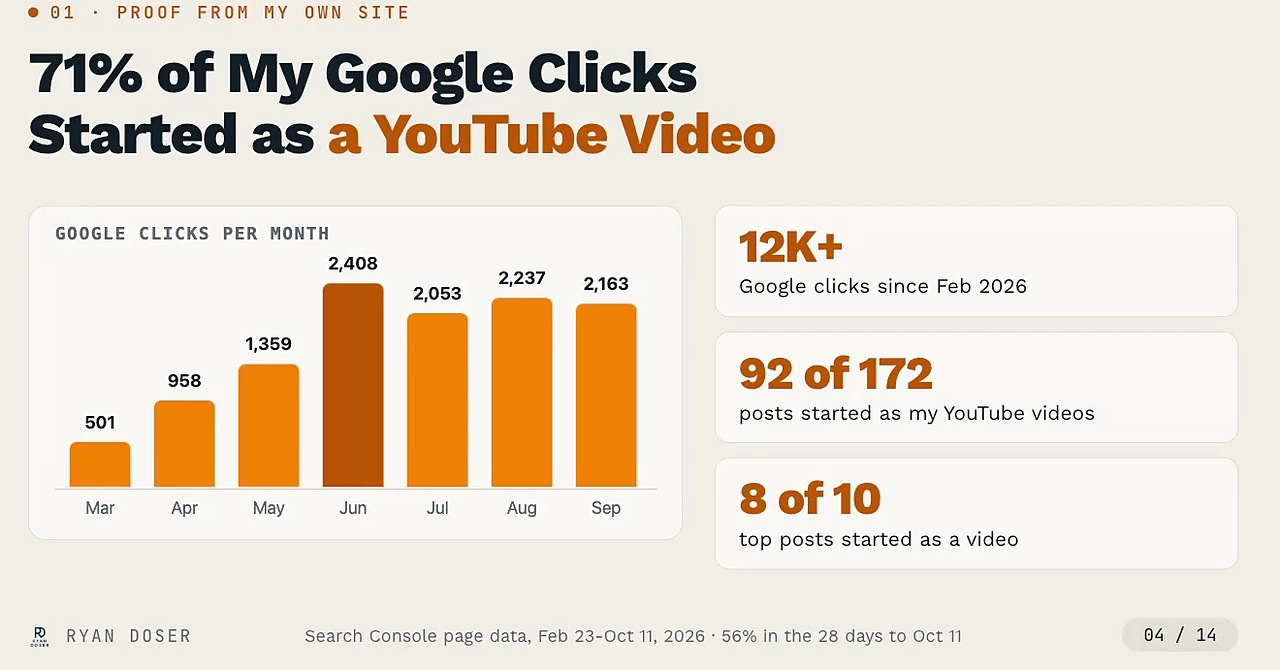
The same slide shows 92 of my 172 posts started as videos, and so did 8 of the 10 top posts. That tells you where the clicks land, not why, since topic choice and post age play a part too.
My repurpose command starts with research. It pulls search data from Google and five AI answer surfaces, adds my company, customer, offer and voice files, then builds the angle around a gap those answers miss.
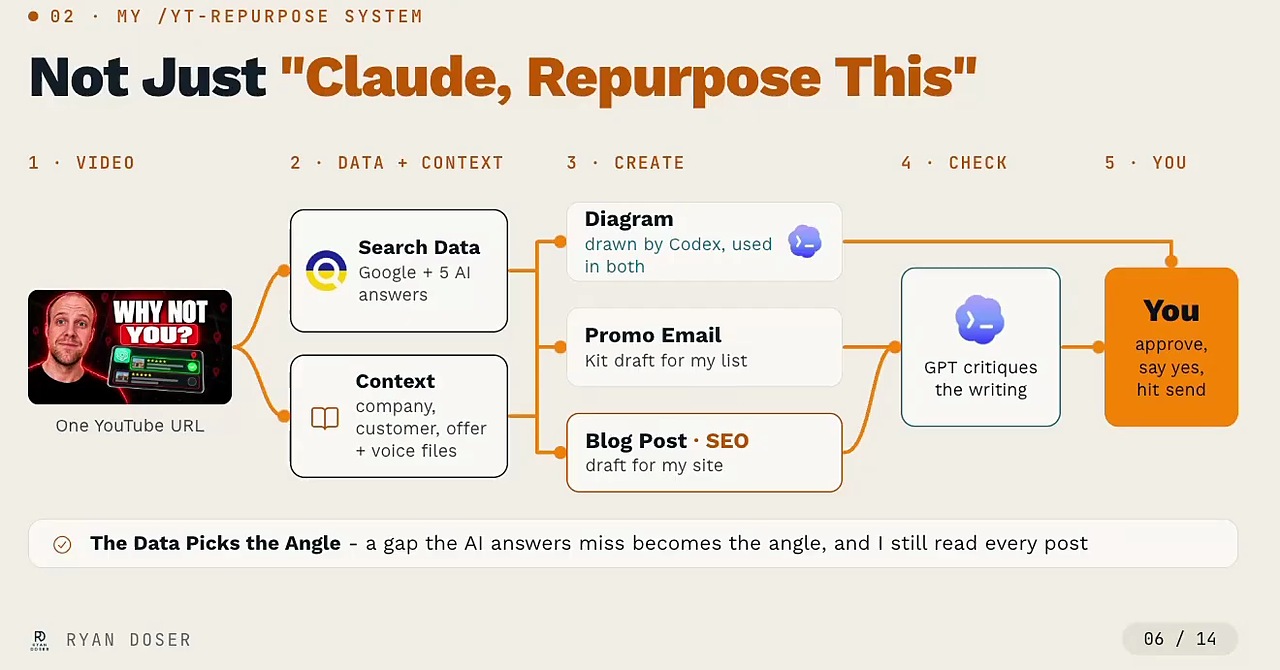
Video comes first for two reasons. In the episode I called YouTube "the ultimate parasite," because it carries huge authority and gets cited often in Google's AI Overviews.
It is also my real voice, and that matters in what I call a trust recession. Readers can't be sure AI didn't write a blog post, but a long-form video of me explaining a concept builds trust a page alone can't.
How the Visibility Turns Into Revenue
A one person business needs some of that traffic to pay, and not every win shows up as clicks. Here is where mine went, per the numbers I shared in the interview:
- Over $40,000 in digital product sales between May 2026 and the October recording, mostly my Claude Code Skills Stack.
- Prospective clients filling out forms on the site and reaching out.
- Affiliate deals, including Blotato, a social media scheduler I also do SEO for.
The Blotato example shows the upside and the limit together. When I searched "Blotato review" for the October recording, my YouTube review from July 2025 showed up near the top, with my written Blotato review further down the same page.
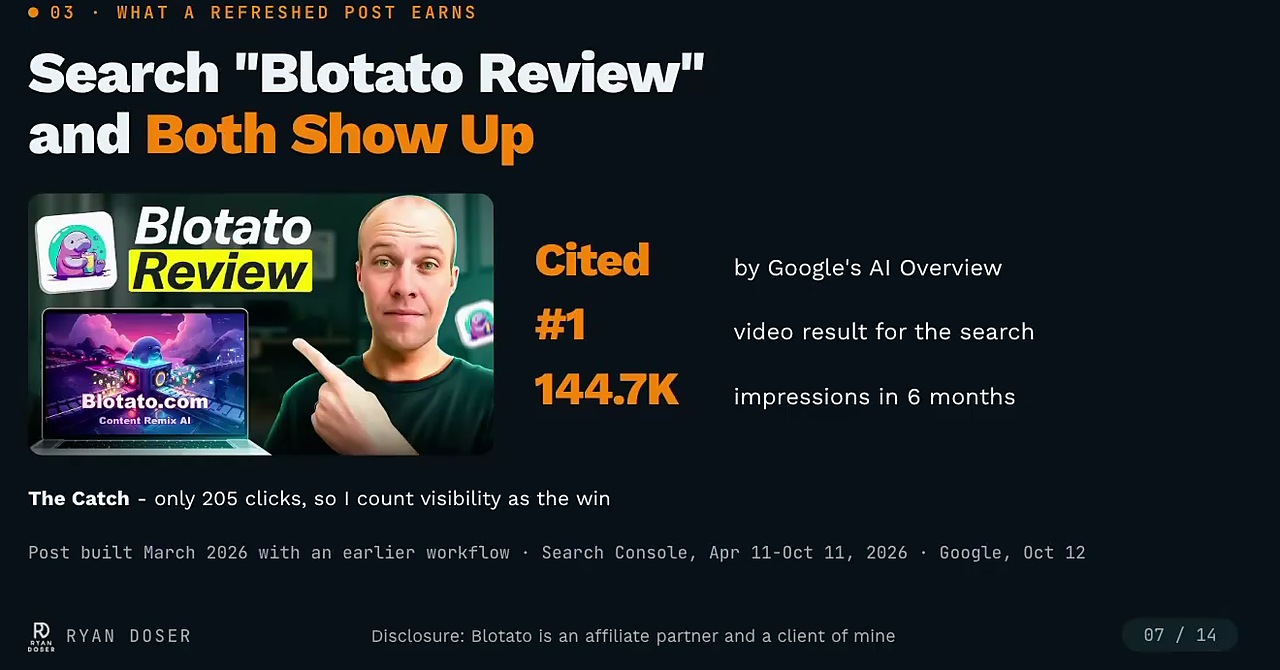
That post drew 144.7K impressions and only 205 clicks from April 11 to October 11, 2026. As the slide puts it, I count visibility as the win.
It also predates my current /yt-repurpose workflow, so it proves the YouTube-first approach more than the newest version of the system.
Client SEO follows the same logic. In a private-window search during the recording, Medix Dental IT, an IT provider for dental offices and one of my clients, showed up at number two in the cited results and the map pack for "best dental IT support companies," a spot I said it trades with number one.
I also run a test septic site, built 100% with AI, that ranks for local money keywords and sells its leads to real businesses.
Where This Model Breaks
Who shouldn't copy this one person business setup? Three limits are worth naming, and I'd rather do that than oversell it.
First, YouTube isn't always worth the effort. In a low-competition niche like septic pumping it probably won't pay off, but in a competitive space I think it's a must.
Second, cheaper data comes with a data-quality tradeoff. DataForSEO is pay-as-you-go with a $50 minimum top-up that lasts me at least two months, but from my testing its data gets me about 80 to 85% of what Ahrefs gives.
Third, the Google data that AI tools rely on is getting noisier. Nozzle's November 3 update found that on 27.6% of the results pages it judged since September 13, 2026, page 1 or 2 had most of the usual sites swapped out, against 0.28% in the weeks before.
I dug into Nozzle's first release in my poisoned Google SERPs research, including how to tell a swapped page from a real ranking drop.
Why Expertise Outlasts Every Model Upgrade
The model names in that diagram will be out of date within a year. When the next one ships, I update AGENTS.md, and the skills, references and voice files carry straight over.
That is the part of a one person business worth building first. Write down what you already know works, and every new model starts from your playbook instead of a blank page.
One Person Business FAQs
Can one person run a marketing agency with AI?
Yes, if that person already knows marketing. I run a six-figure agency with no employees, using Claude Code and Codex for most of the execution, with three Claude models splitting the work by difficulty and GPT-6.1 Sol reviewing every draft. The strategy and the final approval still come from 10-plus years of doing marketing by hand before AI could.
What tools does a one person business need to run on AI?
Mine runs on Claude Code and Codex inside VS Code, with DataForSEO and a Google Search Console MCP for search data, and a website built on Astro, GitHub and Cloudflare. The tools matter less than the skills and context files that tell each model how you work. Without those, every model writes the same generic copy everyone else gets.
How much does it cost to run a one person agency on AI?
My core spend is two subscriptions: Anthropic's $200-a-month Claude plan and the $100-a-month ChatGPT Pro tier that includes Codex. DataForSEO adds a pay-as-you-go balance with a $50 minimum top-up that lasts me at least two months. Those are November 2026 prices, so confirm them on each vendor's site, since AI plan names and tiers change often.
Should a one person business start its content with YouTube?
In a competitive niche, I think so. From February 23 to October 11, 2026, 71% of Google clicks to ryandoser.com went to the 92 of my 172 posts that began as YouTube videos, though that share was 56% in the final 28 days. That shows where clicks land, not why, and in a low-competition local niche like septic pumping, video probably won't pay off.
Disclosure: some links in this post are affiliate links, specifically Blotato. If you buy through them I may earn a commission at no extra cost to you. Blotato is also a client of mine. Full disclosure.