
AI Consultant vs AI Coach vs Fractional CAIO: Which One You Actually Need
If you are asking should I hire an AI consultant, the honest answer is that you might be shopping in the wrong category. There are three different roles being sold to business owners right now, they run from under $500 a month to $25,000 a month, and most owners cannot tell them apart.
So in September 2026 I ran a small experiment. I asked ChatGPT and Perplexity, both with live web search on, the same question a non-technical owner would ask: which of these should I hire first?
Both landed in the same place. Start with a coach. That is the tier I sell, so treat my answer with the suspicion it deserves and read the four questions below before you take anyone's word for it, mine included.
That is one snapshot, not a law. Ask again next month and it could shift. But it is worth knowing what your customers are being told when they ask.
Perplexity put it as "pick an AI coach first if you are still deciding where AI fits." ChatGPT said "if you're just getting started, have a small team, and mainly need education, quick wins, and guardrails, hire an AI coach first." Two systems, different source sets, same answer.
Here is the problem with that advice. Perplexity also noted that the coaching category has no strong universal price. Individual firms do publish rates, as you will see below, but they are so far apart that the category number is meaningless. So the assistants point owners at a category, then hand them no way to judge what a fair price inside it looks like.
Below is what each of the three roles actually does, what each one costs according to firms that publish their rates, and the four questions that decide which one you need. My own numbers are in here too, including where I am the wrong hire. Once you have settled on a consultant, there is a separate list of questions that tell an operator apart from a repackager.
The Three Roles Are Selling Three Different Things
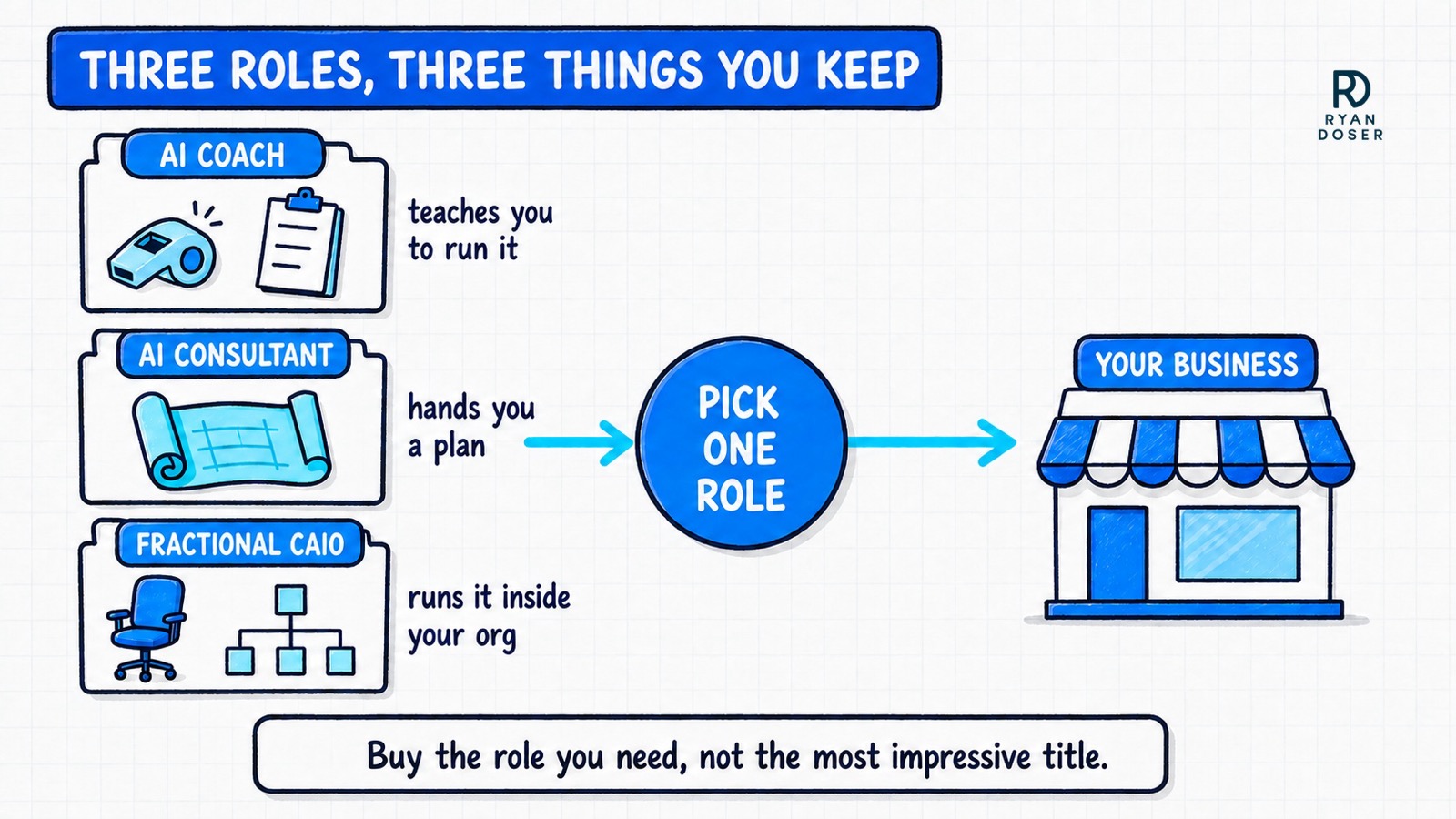
The category names are close enough to sound interchangeable. They are not. What separates them is who ends up holding the work when the engagement ends.
An AI coach builds the capability in you
You sit down together, you do the work, and you keep the skill. njin.co, one of the few firms that publishes a full ladder across all three roles, defines it plainly: "An AI coach teaches. Their job is to build capability in you or your team."
The output of a coaching month shows up as something you can now do in your business that you could not do last month, and you can do it again without calling anyone.
An AI consultant assesses and recommends
A consultant looks at your business, finds where AI fits, and hands you a plan or a built system. njin.co's version: "An AI consultant assesses and recommends. They come in, look at your business, identify where AI can make a difference and give you a plan."
The output is a document or a working system. Whether the knowledge stays after they leave depends entirely on how the engagement was run.
A fractional CAIO owns AI across the company
This is a part-time executive, not a project. They own strategy, governance, vendor selection, and budget across multiple departments. Applied AI Leadership, which publishes its rates for the role, frames the cost comparison against mid-market salary benchmarks rather than against a small business budget.
The output is a portfolio and a set of policies. It is a management function, not a build.
Notice what separates them. A consultant hands you a fish. A coach teaches you to fish and then leaves you with the rod. A fractional CAIO takes over the fishery. And the fourth option most owners are also weighing, an agency, just runs the pond for you, which I come back to below. All four are legitimate. They just leave you in very different places when the money stops.
What Each One Costs, From Firms That Publish Rates
Most of this category quotes a range and asks you to book a call. These four publish actual numbers, so they are the ones worth quoting.
Coaching. njin.co lists $500 to $3,000 a month, with outcomes visible in four to twelve weeks. My own AI Concierge sits in this tier at $999 a month, and its limits are written out below. useai.coach publishes $495 a month for what it calls "AI Coach on Call," cancel anytime, no minimum term, alongside a separate $4,500 flat fee for a four-week first build. Both figures sit below what the same firms charge for a scoped consulting engagement.
Consulting. Palavir publishes $150 to $400 an hour, $5,000 to $30,000 for a single automation project, and $1,500 to $5,000 a month for an ongoing advisory retainer. njin.co puts a scoped engagement at $3,000 to $20,000 and up. I broke the full consulting ladder down separately in what AI consultants actually cost.
Fractional CAIO. Applied AI Leadership says retainers "cluster between $10,000 and $25,000 per month," with $15,000 as the most common anchor in 2026. I went deeper on that role in my breakdown of how the fractional Chief AI Officer model works.
This next part cuts against my own interests. useai.coach's $495 is real, standalone, and cancellable. If price is your only filter, that is cheaper than what I charge and I am not going to pretend otherwise. What you compare after that is what a month actually contains. Mine is 90 minutes one-on-one with me on a screen share, building the thing in your own accounts, plus VIP access to my community and all three of my products. Compare that against whatever the cheaper option puts in front of you, and if theirs is the better fit for where you are, take it.
The Fourth Option: Just Hiring an Agency
Everything above compares three ways of buying advice. Most owners are weighing a fourth thing at the same time: hiring an agency to just do the marketing. It is the one where the work is most likely to still be someone else's job a year from now, which is either the whole appeal or the whole problem.
The published numbers overlap the tiers above more than you would expect. Arc Intermedia publishes $150 to $500+ an hour, $5,000 for a focused project up to $100,000 to $500,000+ for enterprise programs, and monthly retainers "often starting near $2,000/month and scaling to $50,000+/month." That $2,000 floor lands inside the consulting advisory range already quoted above, and just above the $2,000 starting point I use in what AI consultants actually cost. The tiers do not stack in a neat price ladder. What separates them at the same monthly number is what you are buying, not what you are paying.
First Movers draws the line more usefully than the price does: "A company or agency usually sells you the output on a retainer, while a consultant builds the capability inside your business and hands it over." That is the actual fork. You are choosing between renting the result and owning the machine.
The case for just buying the outcome
When you do not want to learn this. That is a legitimate position, and it is the honest dividing line between an agency and everything I sell. If marketing is not where you intend to build a personal skill, and you would rather buy the outcome and spend your attention elsewhere, an agency is a reasonable purchase and the other three tiers are probably a detour.
The risk to raise in the sales call
The month you stop paying. If the agency built the workflows, prompts, and context documents on their side, that is what leaves with them. You keep the results they produced and lose the machine that produced them. That is question four again. A fractional CAIO has the same answer and is openly sold that way, so you know going in. With an agency it is worth asking directly, because a monthly retainer does not advertise what it leaves behind.
Four Questions That Decide It
Skip the category names. Answer these four about your own business. If two of them point different directions, question two wins, because who has to run the thing in six months outlives any single project.
1. Do you know what you want AI to do yet?
If you can name the specific workflow, you have a scoping problem and a consultant can solve it. If you are still at "everyone says I should be using this," you have a judgment problem, and no amount of building fixes that. This is the question both assistants were answering when they said coach first.
2. Who has to be able to run it in six months?
If the answer is you or someone on your small team, buy the thing that transfers the skill. If the answer is a vendor and you are fine with that, buy the build. Both are reasonable. Choosing the build and then expecting the skill is where owners get burned.
3. How many departments are involved?
One workflow is a project. Several departments with competing requests, vendor decisions, and a policy question is a management function. That is the honest trigger for a fractional CAIO. Before you get there, you are buying executive overhead for a problem that has not arrived.
4. What happens the month after you stop paying?
This is the one nobody asks in the sales call, and it is the most useful of the four. If the answer is "everything stops," what you bought was access rather than capability. Sometimes that is the correct purchase, and a fractional CAIO is openly sold that way. Just make sure you chose it on purpose instead of discovering it in month seven.
Where the Category Advice Falls Down for Small Owners
One of the better-argued pieces on this question comes from Perceptive Analytics, on hiring a consultant versus building in-house. Its direct answer is good: hire a consultant when you need a working system fast and have not yet proven where AI creates value, then build in-house once you have proven use cases.
But read who it is written for. Operations leaders, CTOs, and founders with technical authority. It assumes you follow data environments, production systems, and deployment methodology. And it never offers coaching as a third option at all. Its framing is consultant or in-house team.
That is the actual gap. If you run a ten-person company and cannot evaluate a model deployment plan, "hire a consultant or build a team" is not a menu you can order from. Both options require you to already know what you are buying.
To be fair to the consulting model, that same piece makes the right point about knowledge transfer: a well-run engagement "documents the system, transfers ownership, and trains your team so the knowledge doesn't leave when the consultant does." That is a real thing good consultants do. It is just not the default, and it is not what you get by accident.
Where My Own Offer Sits, and Who It Is Wrong For
I sell the coaching tier. My AI Concierge is $999 a month, month to month, limited spots, by application. It is one 90-minute one-on-one working call a month on a screen share, where we set up a real improvement in your business live, in your own accounts. VIP membership of my community and all three of my digital products come with it.
It is coaching and direction. It is not done-for-you. I say that early because it disqualifies people, and it should.
Who it is right for: an owner or founder who can make a 90-minute call each month, wants to end up able to run this without me, and has one part of the business that is genuinely costing them time right now. Knowing which area hurts is enough. If you had already scoped the exact workflow and just wanted it built, question one would send you to a consultant instead, and it should. If you are not technical, that is fine. Most of the owners I talk to are not.
Who it is wrong for: if you want your marketing run for you, buy the agency tier from someone, not me. If you have one bounded question rather than something you want to build a habit around, a single session at my hourly rate answers it faster and costs you less. And if you need a guarantee of a specific revenue number, nobody in this category can honestly give you one, including me.
I also publish the other two options rather than pretending coaching wins every time. Hourly consulting with me is $500 an hour, and on-site work starts at $5,000. All three sit on my AI consulting page. If the four questions above point you at a build rather than a coaching engagement, take that answer.
The Sequence Most Small Businesses Should Actually Follow
Both live AI answers landed on roughly the same order, and on this one they are right.
Start with coaching only while you are still figuring out where AI fits, not as a default. Two or three months is usually enough to find the real bottleneck, because the first thing you think is the problem is usually not. My 90-day implementation plan walks through how to do that part yourself.
Move to a scoped consulting project once you can name the specific workflow and want it built properly.
Add a fractional CAIO only when AI stops being a project and becomes a standing management function across several departments. Most small businesses never reach that point, and that is not a failure.
The mistake is buying the expensive tier first because it sounds more serious. Paying for executive oversight before you have decided what you want done just buys you a more expensive version of the same confusion.
If the four questions pointed you at coaching and you want to do that with me, the AI Concierge runs by application. You tell me what is eating your week, I tell you honestly whether a monthly working call fixes it or whether you want one of the other two. I have talked people out of it before.
If you would rather sit across a table for that conversation, I am based in Des Moines and work with businesses around Iowa.
Should I Hire an AI Consultant FAQs
Is a consultant the same as a coach?
No, and the difference is who holds the work at the end. A consultant assesses your business and hands you a recommendation or a built system. A coach works alongside you so the capability stays with you and your team. A consultant is measured by the deliverable. A coach is measured by what you can do without them.
How much does an AI coach cost?
Published rates run from $495 a month at useai.coach up to $3,000 a month at the top of njin.co's coaching tier. My own AI Concierge is $999 a month, and you can see how it compares with seven other consultants' published prices. Rates spread this wide because the category has no standard unit, so compare what a month actually includes, and how many hours of it are with the person you are hiring, rather than the headline number.
Do I need an AI consultant if I am not technical?
Often not as your first hire. A lot of consulting content assumes you can already evaluate a technical plan, which is the thing a non-technical owner cannot do yet. Asked this directly in September 2026 with live search on, both ChatGPT and Perplexity pointed a non-technical small business owner at coaching first. Once you can name the specific workflow you want built, a consultant becomes the right buy.
When is a business too small for a fractional CAIO?
Applied AI Leadership, one of the few firms publishing rates for the role, states no minimum company size and no typical client size at all. So headcount is the wrong test. The real one is whether several departments are making competing AI decisions that need a single owner. If AI is still one workflow in one part of the business, you are buying executive overhead you do not need yet.
Should I hire an AI consultant or a marketing agency?
Start with capacity, not preference. If the work genuinely needs more hands than you have, coaching will not fix that and an agency is the honest answer. If the shortage is judgment rather than hours, meaning you could get it done but cannot tell whether it is any good, an agency will happily fill the gap and you will still not be able to grade the output. Price will not settle it either way: Arc Intermedia starts agency retainers near $2,000 a month while njin.co puts a full agency engagement at $5,000 to $15,000+, and consulting advisory retainers run $1,500 to $5,000 in between.
Is an AI marketing consultant cheaper than an agency?
Often, but not always, and the ranges overlap. Arc Intermedia puts agency retainers as starting near $2,000 a month, which sits inside the $1,500 to $5,000 advisory-retainer range Palavir publishes for consulting. njin.co, quoted earlier in this post, puts a full AI agency engagement higher at $5,000 to $15,000+ a month. So the honest answer is that a consultant is usually cheaper than a full-service agency retainer and roughly the same price as an agency's entry tier. What you are actually choosing between at the same monthly number is output versus something you keep.
What questions should I ask before hiring any of them?
Ask what you will be able to do yourself when the engagement ends, who owns the accounts and the setup, and what happens the month after you stop paying. That last one separates a capability from a rental faster than any credential check.
Disclosure: this post has no affiliate links. The firms and prices quoted are competitors I am citing as sources, and I sell a coaching offer in the same category, which I have named and priced openly above so you can weigh it against them. I also run a marketing agency myself, solo, so the section on agencies is written by someone inside that category rather than outside it. See my full disclosure.