
AI Consultant for Small Business: 9 Questions to Ask First
Hiring an AI consultant for small business has a structural problem nobody selling the service will mention. Almost every guide teaching you how to vet one was written by someone who wants the job.
I checked, once, on one day. In September 2026 I asked Perplexity, with live web search on, how a small business owner should vet an AI consultant. It returned twenty sources. Every one of them was a consulting firm, an agency, or a marketplace selling access to consultants. The closest thing to an independent voice was a personal site writing honestly about red flags, and it ends with a booking link for the author's own practice.
That is one snapshot, not a law. Ask next month and the mix will shift. But it is worth knowing that when you go looking for help choosing, the help is mostly selling. I am not outside that either. I sell an AI Concierge at $999 a month, so I carry the same conflict as everyone else on that page. The difference is that I am going to hand you the questions that would disqualify me, and then tell you where they land.
Almost Nobody Is Actually Using AI Yet
Start here, because it reframes the entire purchase.
Goldman Sachs surveyed 1,256 small business owners in early 2026 and found 76% report currently using AI. That number gets repeated constantly in sales decks.
Now the measured figure. The SBA Office of Advocacy, using Census Bureau Business Trends and Outlook Survey data, found that 8.8% of small businesses actually use AI to produce goods or services, up from 6.3% six months earlier.
Those two are not measuring the same thing. One is owners saying they use AI. The other is firms using it in production, counted by the Census Bureau. The gap between them is where most AI consulting gets sold.
What it means for you: you are not late, and urgency is the oldest lever in the room.
What an AI Consultant Actually Does for a Business Your Size
The category covers wildly different work, and the confusion is expensive.
At the small end, the job is picking two or three workflows worth automating and getting them running. Lead intake. Quote drafting. Support triage. Nothing exotic. At the large end it is data infrastructure, model selection, and governance, which is real work you almost certainly do not need at eight employees.
The distinction that matters is whether the person builds or only advises. An advisor leaves you a document. An implementer leaves you a running system. Both are legitimate, they are not interchangeable, and the price gap between them is not proportional to the value gap for a small operator.
If you are still deciding which category you need at all, I broke the three roles apart in AI consultant vs AI coach vs fractional CAIO. This post assumes you have landed on a consultant and are now trying to pick one.
Nine Questions That Separate Operators From Repackagers
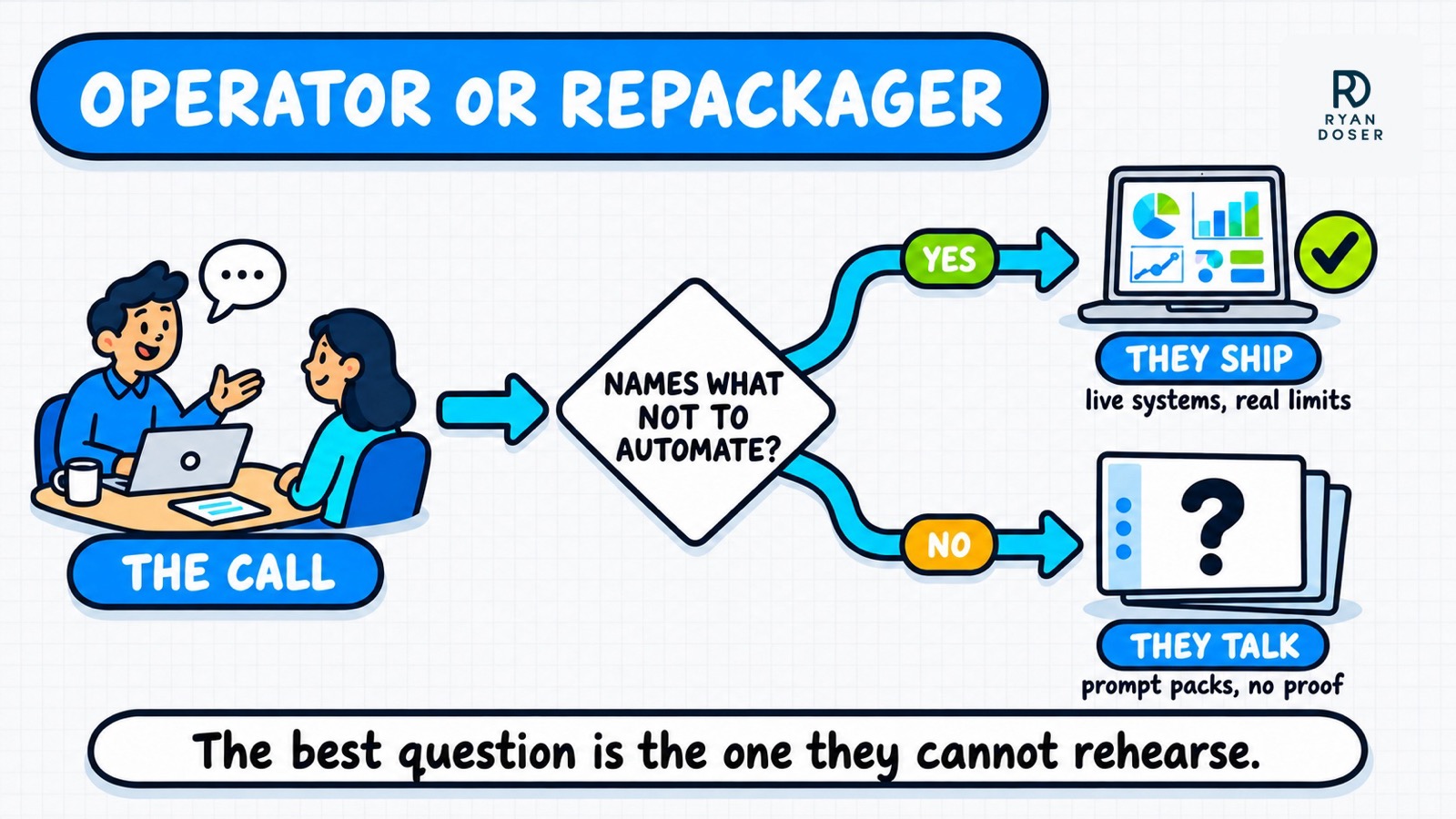
Ask these in a first call. You are not testing technical depth. You are testing whether they have shipped anything for a business like yours.
1. What would you look at first in my business, and why that?
A real answer asks about your process before naming a tool. If the first substantive noun out of their mouth is a product name, you have your answer.
2. Show me two systems you built for a company under 50 people that are still running today.
Still running is the load-bearing part. Anyone can demo a build. Fewer can point at something that survived six months of a real team using it.
3. Do you implement, or only advise?
Both answers are fine. An unclear one is not. If they advise only, ask who builds it and what that costs, because that number belongs in your budget now rather than in a surprise next month.
4. What will I have in writing at the end of phase one?
You want a named deliverable and a date. "A roadmap" is not a deliverable. "A working lead-intake automation connected to your CRM, live, by October 15" is.
5. What would you tell me not to automate?
The best question on the list. Anyone who has done this work answers fast and specifically, usually about judgment calls or anywhere being wrong is expensive. Someone who cannot name a single thing has never hit the limits.
6. Who owns the accounts, the workflows, and the data when we are done?
The answer should be you. Work built inside a consultant's own accounts is a bargaining chip against you at renewal. Ask where it lives before, not after.
7. Do you earn anything if I buy the tools you recommend?
Affiliate revenue and partner commissions are common and not automatically disqualifying. Undisclosed ones are. The answer tells you whether the tool recommendation is advice or distribution.
8. What happens when it breaks?
Automations break. Models change, an API deprecates, a form field gets renamed. Ask what maintenance costs. No answer means you are buying something with a shelf life nobody quoted you.
9. Can I talk to a client who is roughly my size?
Not a logo wall. A phone call with an owner whose business is shaped like yours. Enterprise case studies say nothing about working inside your constraints.
The Red Flags That Should End the Call
Some answers are not weak, they are disqualifying.
A discovery phase longer than two weeks. Past that point you are paying to educate someone about your own business.
No fixed-scope option at all. If nobody will commit to a defined deliverable at a defined price, the engagement has no floor and no ceiling.
A branded proprietary framework. Methodology names exist to make a process feel bigger than it is. The work is picking workflows and building them.
Vague data handling. If customer data touches a model, you need a concrete answer on where it goes, how long it is kept, and whether it trains anything.
A team you have not met. Meeting a senior partner in the sale and juniors in delivery is the oldest move in consulting.
Promises about transforming your entire business. The realistic outcome of a first engagement is two or three workflows running better than they did.
What This Costs at Each Level
Iternal Technologies lists $100 to $300 per hour for advisory, $2,500 to $10,000 for a fixed-scope quick win, and $1,500 to $8,000 a month for a fractional retainer. It also notes tooling runs $20 to $50 per user per month on top, which most quotes leave out.
The AI Consulting Network publishes a higher ladder: $2,000 to $8,000 for a readiness assessment, $8,000 to $25,000 for strategy and roadmap, $15,000 to $50,000 for a pilot implementation. It puts most small firms in the $10,000 to $50,000 range and says positive ROI typically arrives in four to eight months.
Both are honest about their own pricing. Notice the shape though. The assessment tier runs $2,000 to $8,000 and produces a document. Paying that to be told which workflows to automate, before anything is automated, is the most common way this goes wrong at small scale.
Get two or three quotes, starting with a shortlist of AI marketing consultants who post their prices, before you accept any of these as the going rate. My own breakdown of what AI consultants charge runs higher at the hourly end because it samples independent operators rather than firms.
The Case for Not Hiring Anyone Yet
The strongest version of this advice: a lot of small businesses should not hire anyone this quarter.
If your processes are not written down, a consultant's first act is writing them down at consulting rates. If your data is scattered across three tools nobody trusts, automation makes the mess faster rather than smaller.
Run the arithmetic before the sales call. Hours a week you would save, times a loaded hourly cost, times 26. If that is not at least double the project cost, it does not clear.
One caveat on where you look for that person. Several of the results you get for a city search are national firms running a page for your city, so check the address before you assume the top result is nearby. I wrote up what that looks like on my own market's page one.
The SBA's own guidance makes the same point: start small, test cheap tools, see what adds value. One person, one workflow, one month.
One distinction matters here, because "do not hire anyone" is too blunt. If that month produces nothing because you could not tell which workflow was worth the effort, that is a judgment gap, and an hour with someone who has seen fifty of these is cheap. If it produced nothing because nobody had time to sit down and do it, that is a capacity gap, and coaching will not fill it. If you are not sure which one you have, my 90-day plan for implementing AI without a technical team is the cheapest way to find out. Buy advice for the first problem and hands for the second.
Now Disqualify Me With the Same Nine
Fair is fair. Here is where I fail my own list.
My Concierge is $999 a month for one 90-minute call. That is coaching, not implementation.
I fail questions two, three and four. I cannot show you two client systems still running, because what I have built is my own operation. I advise, I do not build. And what you leave with is a recording and notes, not a working automation wired into your CRM. On question seven, I earn affiliate revenue on some tools I mention, disclosed at the bottom of every post here.
Where I hold up is question five. Most of what I actually do on those calls is talk people out of automating things.
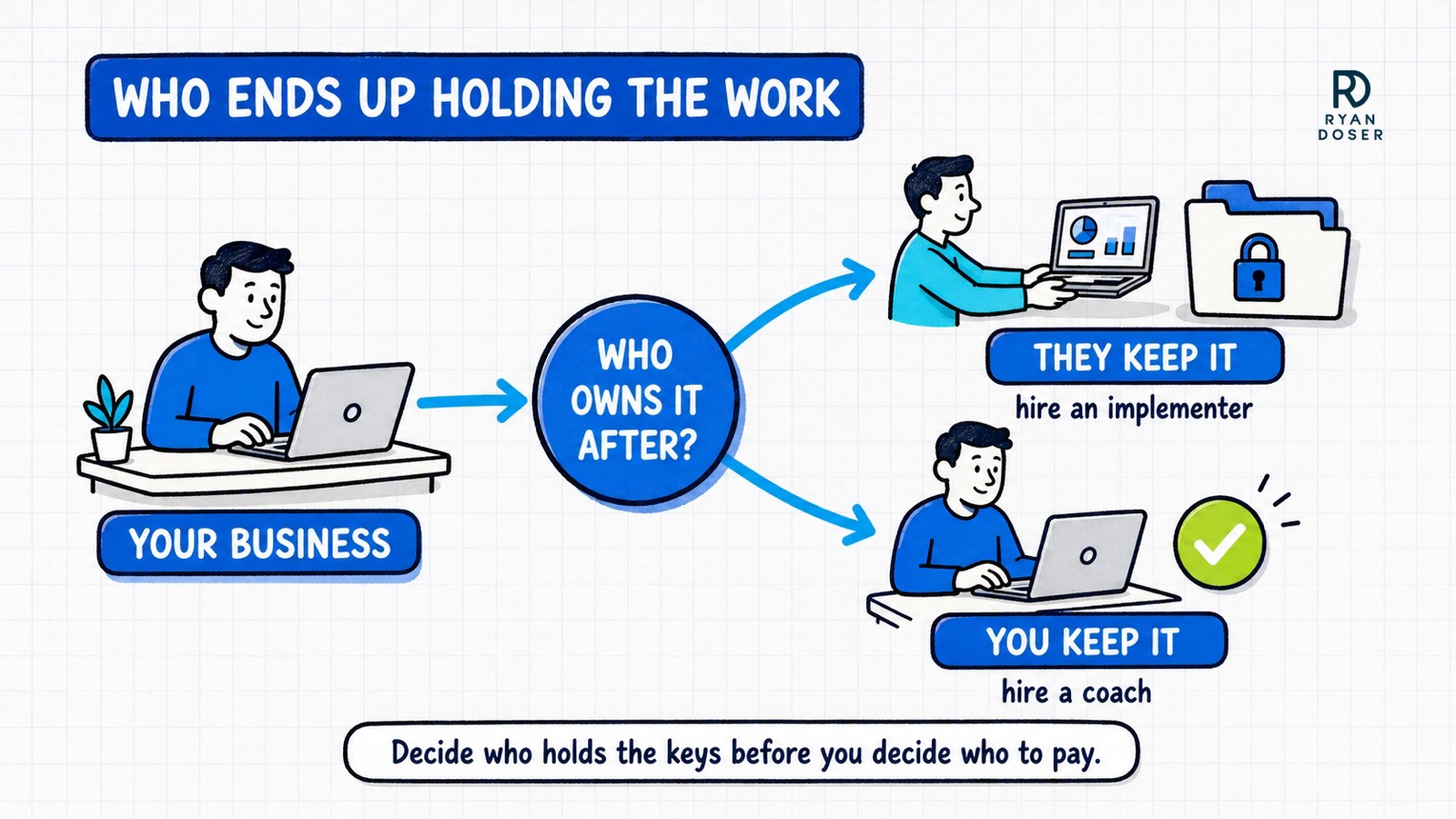
Which points at the real fork. If you want the work handed to you finished, hire an implementer and run all nine questions on them hard. If you would rather understand your own stack well enough to direct it, that is a different purchase with a different list, and the question to ask is whether they teach or just do. I sell the second kind, so weigh that accordingly.
AI Consultant for Small Business FAQs
How much does an AI consultant cost for a small business?
Published rates run $100 to $300 an hour for advisory work, $2,500 to $10,000 for a fixed-scope project, and $1,500 to $8,000 a month on retainer. Those are firm rates; independent operators often start higher per hour, closer to $150 to $350. Firms quoting the higher ladder put most small businesses in the $10,000 to $50,000 range for a first implementation. Tooling is usually separate, around $20 to $50 per user per month.
What is the most important question to ask an AI consultant?
Ask what they would tell you not to automate. Anyone who has done the work has a specific answer involving judgment calls or high-cost exceptions. Someone who cannot name anything has never hit the limits of the tools they are selling.
Do small businesses actually need an AI consultant?
Most do not need one yet. Census Bureau data puts actual small business AI use at 8.8%, so there is no adoption emergency. If your processes are undocumented or your data is scattered, fix that first, because a consultant will otherwise bill you consulting rates to do it.
How do I tell a real AI consultant from someone repackaging ChatGPT tips?
Ask for two systems they built for a company under 50 people that are still running today. Demos prove nothing. Something a real team has used for six months without abandoning it is the only durable signal, and repackagers cannot produce one.
What are the biggest red flags when hiring an AI consultant?
A discovery phase longer than two weeks, no fixed-scope option, a branded proprietary framework, vague answers about where your data goes, and promises to transform your whole business. A realistic first engagement improves two or three workflows.
Some links in this post are affiliate links. If you buy through them I may earn a commission at no extra cost to you. I only recommend tools I actually use or would recommend regardless. See my full disclosure.