
How to Start an AI Business Anyone Can Launch (Copy This)
Corey Ganim's answer to how to start an AI business without writing code is a service: teach business owners to use Claude on two calls a month, for a monthly retainer.
Watch Corey Ganim Explain How to Start an AI Business
Corey came back on AI Rabbit Holes to walk through the offer he calls AI Concierge. His first episode covered the $999 AI tools assessment that feeds this offer.
Plenty of advice on how to start an AI business means building a software product. This episode takes the other road, a service you can sell with tools you already use.
Corey's clients end up with Claude skills built around their own business. If you want to see what finished skills look like, my Claude Code Skills Stack holds the ones I run for my own marketing work.
How to Start an AI Business Corey's Way, Step by Step
The steps below follow the order you would actually do them in. Every number is Corey's, from the episode or his own newsletter, unless I say otherwise.
Pick an industry you already know
I raised this in the episode, and Corey agreed. Someone with 20 years in law could run this for lawyers, an accountant for accountants, and I would pick marketing agencies and marketing departments.
A shotgun offer for anyone makes results harder to deliver consistently. As I put it in the episode, industry experience is the moat most people have without realizing it, because a $20-a-month model still misses the nuances of a trade you have worked in.
Corey admitted his own clients span financial services, info products, D2C, fintech and insurance, industries where he has little background. He spent nine years in e-commerce and said, mid-conversation, that an e-commerce version might let him charge more.
His guess is that a former realtor selling to realtors could charge $3,500 to $4,000 a month, against his roughly $2,000 without that background. Treat that as his estimate, not market data.
I run a smaller version of this myself, my AI Concierge, with a few clients on it. Most of my client work is marketing on the agency side.
Aim at owners who can pay
The buyer is an owner who is good at business and barely uses AI. Corey pitches his assessment to companies doing $500,000 to $10 million a year, and the monthly offer to bigger ones.
His smallest concierge client does roughly $5 million a year in revenue. The largest is the CEO of a $150 million company, who pays him $2,000 a month.
I added a point here during the episode. Owners at five, ten or twenty million dollars in revenue are the better fit, because the return is easier to measure and there is budget to spend.
That gap between money and AI skill is wide. Across US businesses of every size, fewer than one in four (23.8%) told the Census Bureau's Business Trends and Outlook Survey they used AI in the two weeks ending September 6, 2026.
One of Corey's first clients was his financial planner, whose firm he estimates at seven or eight million dollars a year. She was not using AI at all, and his first two calls with her went to making her marketing assets look consistent in Claude.
Build one Claude skill for yourself
Corey's qualification bar is low on purpose. He says that if you have built one Claude skill for yourself, you are qualified to sell this, because most owners have no idea where to start.
That bar covers the sale. Delivering results for a $5 million company is the part to be honest with yourself about.
If you have not built one yet, my guide to creating your first Claude skill covers four ways to do it.
Start with people who already know you
Corey's first six sales conversations were calls already on his calendar, including his financial planner and his insurance agent. He mentioned what he was working on, and they asked what it cost.
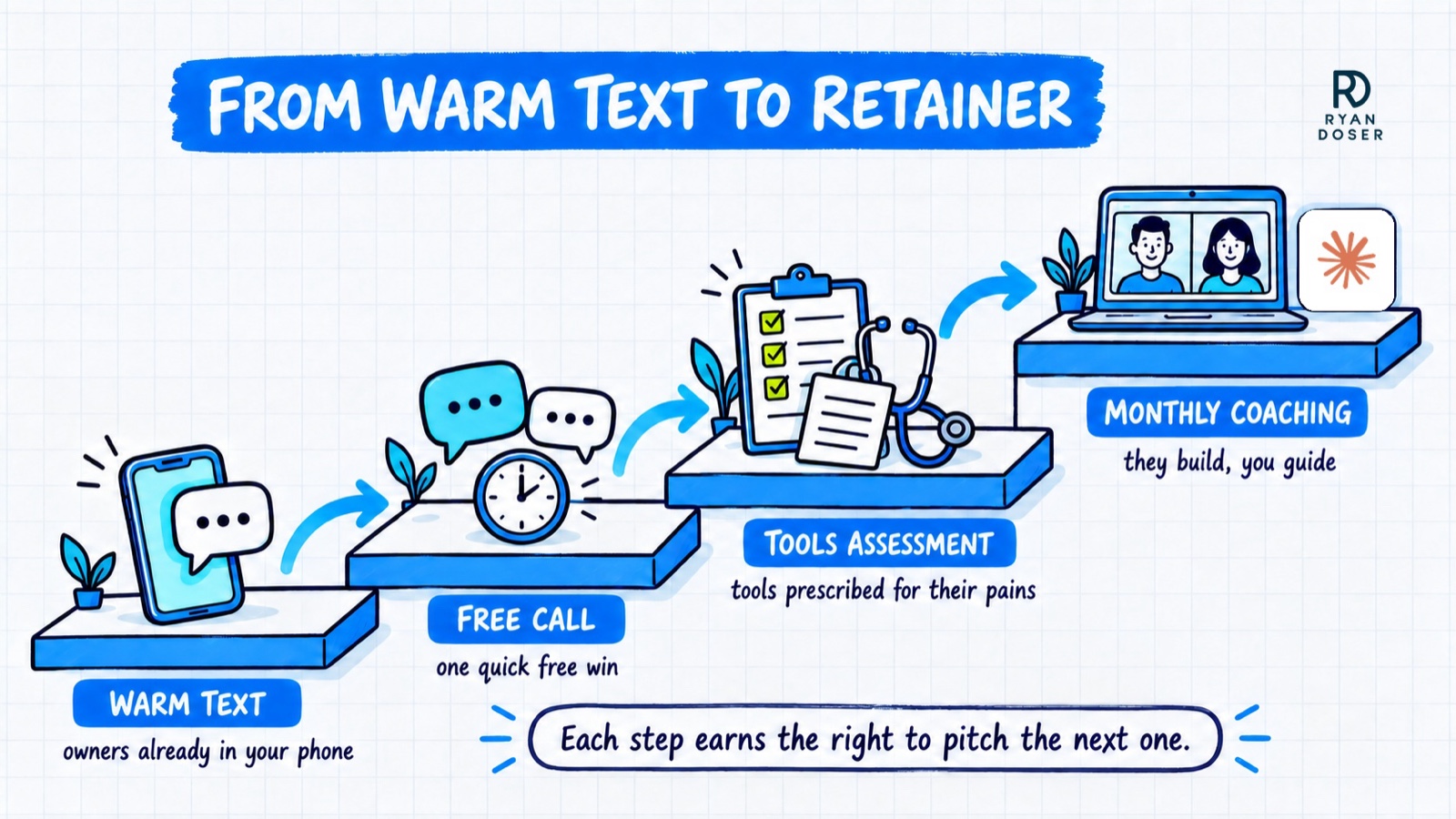
For anyone without that network, his script is a text to five small business owners in your phone. Church, the gym, and the parents of your kids' friends all count.
The message is short: you recently got into AI, found tools that might save the business time or money, and would like to spend 15 free minutes showing how they apply. Worst case they learn something about AI, and best case they leave with a real result.
Of five texts, Corey expects two or three yeses.
Or host a free local meetup
His slower channel is an in-person meetup called AI for Business. He rented a coworking space for about $200 for two hours and posted it in local Facebook groups.
About 25 people came to the first one. The format is 30 minutes of networking, a 15-minute demo, then 30 more minutes of networking.
At the first meetup the demo was building a very simple Claude skill. Whoever runs the room becomes the AI person in town, and Corey calls it his best long-term channel for local clients, with a lead time of two to six months or more.
Turn a free call into a paid assessment
The free call covers one problem and one tool. If it lands, Corey offers the full AI tools assessment at $999.
That assessment is a 45-minute interview that ends with three to seven off-the-shelf tools prescribed for the owner's problems. In Corey's telling, a good one leaves the owner wanting a guide.
Pitch the monthly coaching
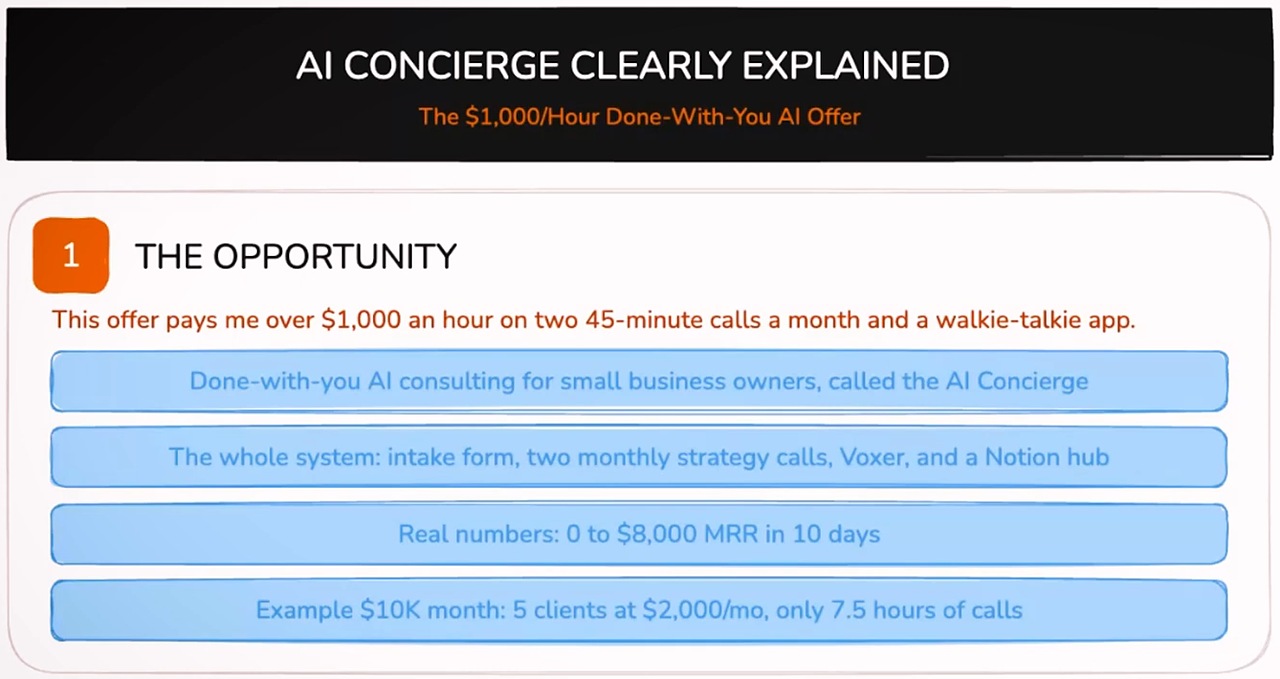
This is the AI Concierge offer itself, which Corey describes as done-with-you consulting. He meets the owner on a video call twice a month, for 45 minutes each time.
On those calls he teaches the owner to use Claude and turns their manual processes into Claude skills. The owner does the clicking, while Corey tells them what to prompt and what to build.
Price it, then cap it
Corey built the offer backwards from one question: what would need to be true for him to earn $1,000 an hour consulting on AI? Hourly Zoom calls, in his view, top out around $500 an hour, and few buyers pay even that.
Two 45-minute calls add up to an hour and a half a month. At $1,500 a month that works out to $1,000 an hour of call time, and at $2,000 it is $1,333.
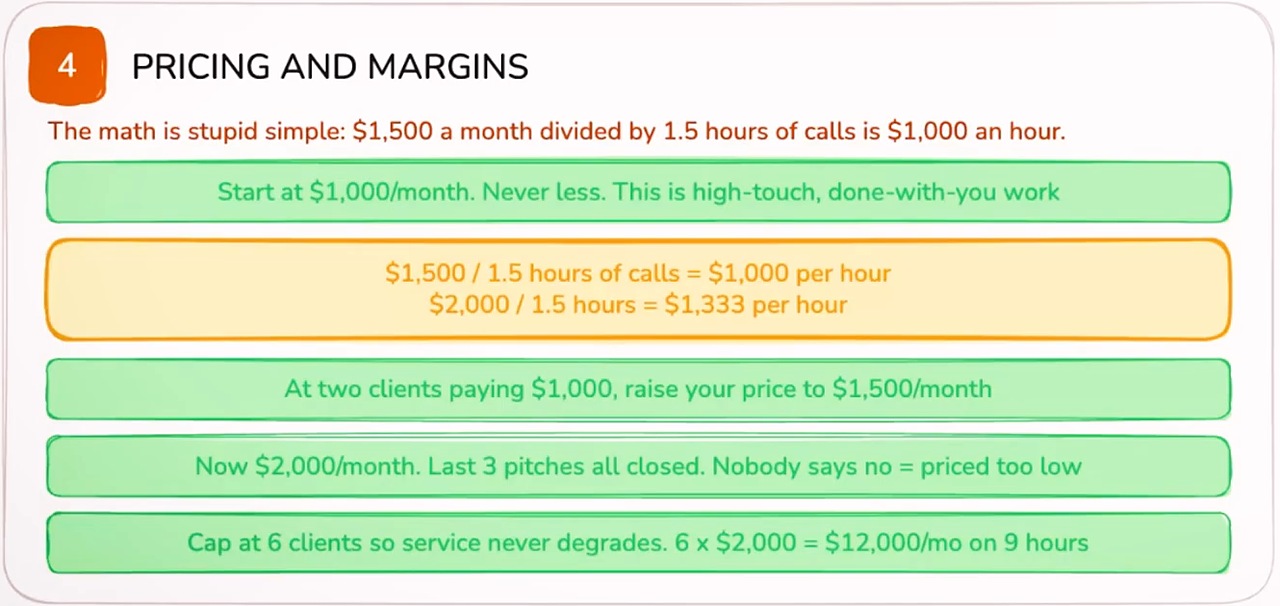
The slide gives a beginner's ladder. Start at $1,000 a month and never less, then raise the price to $1,500 once two clients are paying $1,000.
His own first clients came in at $1,200 to $2,000 a month. Per his newsletter, five of the first six people he pitched said yes, at $1,200, $1,500, $1,500, $1,800 and $2,000, which adds up to $8,000 a month.
A yes rate that high told him he was cheap. He now quotes a $2,500 minimum, which is about $1,667 per call hour by my math.
He gave three reasons for the raise: more confidence, testimonials and case studies from five months of this work, and the value of the time he buys back. His claim is that saving an owner five to ten hours over an engagement is worth tens of thousands of dollars a year to them.
He caps the offer at six clients so the service does not slip. Here is the whole offer in one place.
| Corey Ganim's AI Concierge offer | His numbers (September 2026) |
|---|---|
| Calls | Two 45-minute calls a month, 1.5 hours total |
| First five clients, signed in his first ten days | $1,200, $1,500, $1,500, $1,800 and $2,000 a month, $8,000 combined, from six pitches |
| Current minimum | $2,500 a month |
| Rate per call hour | $1,000 at $1,500 a month, $1,333 at $2,000 (call time only) |
| Client cap | Six clients |
| Assessment buyers | Companies doing $500,000 to $10 million a year |
| Retainer buyers | Companies doing roughly $5 million to $150 million a year |
Two caveats before you run those numbers on yourself. The hourly rate ignores prep, the intake review and messages between calls, and none of this is a promise of what you will earn.
For context, my rate card on what AI consultants charge puts most monthly retainers at $2,000 and up. Corey's $2,500 minimum sits near the bottom of that range, for about an hour and a half of calls a month.
The cap is worth copying before the price is. Six clients is nine hours of calls a month, and your calendar runs out long before demand does.
Deliver four things every month
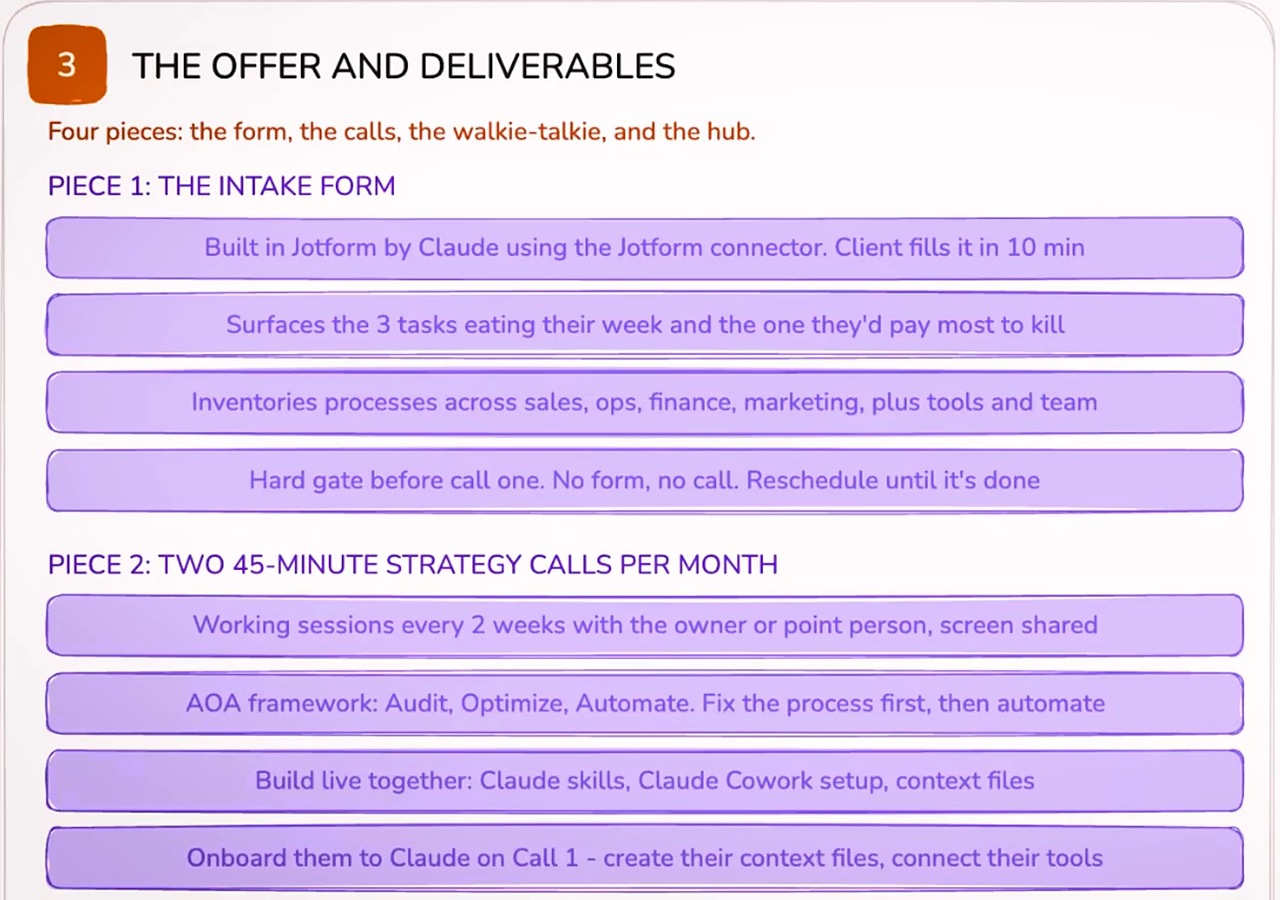
Corey's offer has four pieces, and the last one is what keeps clients renewing.
- An intake form that Claude builds for him through a form-tool connector. It surfaces the three tasks eating the owner's week, and no form means no first call.
- Two 45-minute working calls every month. Call one gets the owner set up in Claude, and later calls build skills live on screen.
- Unlimited messages between calls on Voxer, a walkie-talkie style app.
- A shared Notion hub with everything built together, the call transcripts, and his contact details.
The hub is his renewal tool. The owner can see, on one page, everything the two of them have built together.
My addition on the call was to put those transcripts to work. Feed them into the client's AI systems, and everything you covered becomes material their workflows can learn from.
Corey took it a step further and said he would probably steal it. His version is one Claude Project per client that holds every call transcript, a brain for the engagement the owner can question between calls.
Why Owners Will Still Pay When Claude Gets Smarter
The obvious objection is that Claude will soon be good enough for owners to do this themselves. My answer on the call was that they could do it right now if they wanted to, because the models are already good enough.
Corey's answer is the website. Claude can build a site in minutes that looks better than what $10,000 bought ten years ago, in his words, and people still pay for websites in 2026.
His example buyer is a manufacturing shop owner who is excellent at his trade and has no interest in learning AI. Better models do not change what that owner wants, which is someone to show him the way.
If you are still deciding how to start an AI business, begin with the owners in your phone and a trade you have worked in.
How to Start an AI Business FAQs
How much does it cost to start an AI business?
For the service version in this post, very little. You need a paid AI subscription, roughly $20 a month at the entry tier, plus a calendar and a video call tool. If you host a meetup, Corey paid about $200 to rent a coworking space for two hours. The real cost is time: learning Claude well enough to build a skill, then finding the first client.
Do you need to know how to code to start an AI business?
Not for this model. Corey's clients learn Claude and build Claude skills, which are folders of instructions, scripts and resources rather than an app you build and sell. His bar for selling the service is having built one Claude skill for yourself. Building an AI software product is a different path, and that one usually needs engineering help.
How much should a beginner charge for AI coaching?
Corey's slide says to start at $1,000 a month, never less, then move to $1,500 once two clients are paying $1,000. He now quotes a $2,500 minimum after five months with five clients. His signal that you are too cheap is when nobody says no. Firms price monthly retainers higher, which the rate card linked above covers tier by tier.
Do AI consultants make good money?
Some do, and Corey's numbers are one person's results, not a benchmark. His call-time math reaches $1,000 to $1,333 an hour, but prep, intake reviews and messages between calls are unpaid hours on top. Only 23.8% of US businesses reported using AI in early September 2026, which is the skills gap this model sells into, yet income depends on finding owners who can pay.