
Software Subscriptions: Every One I Pay For Each Month
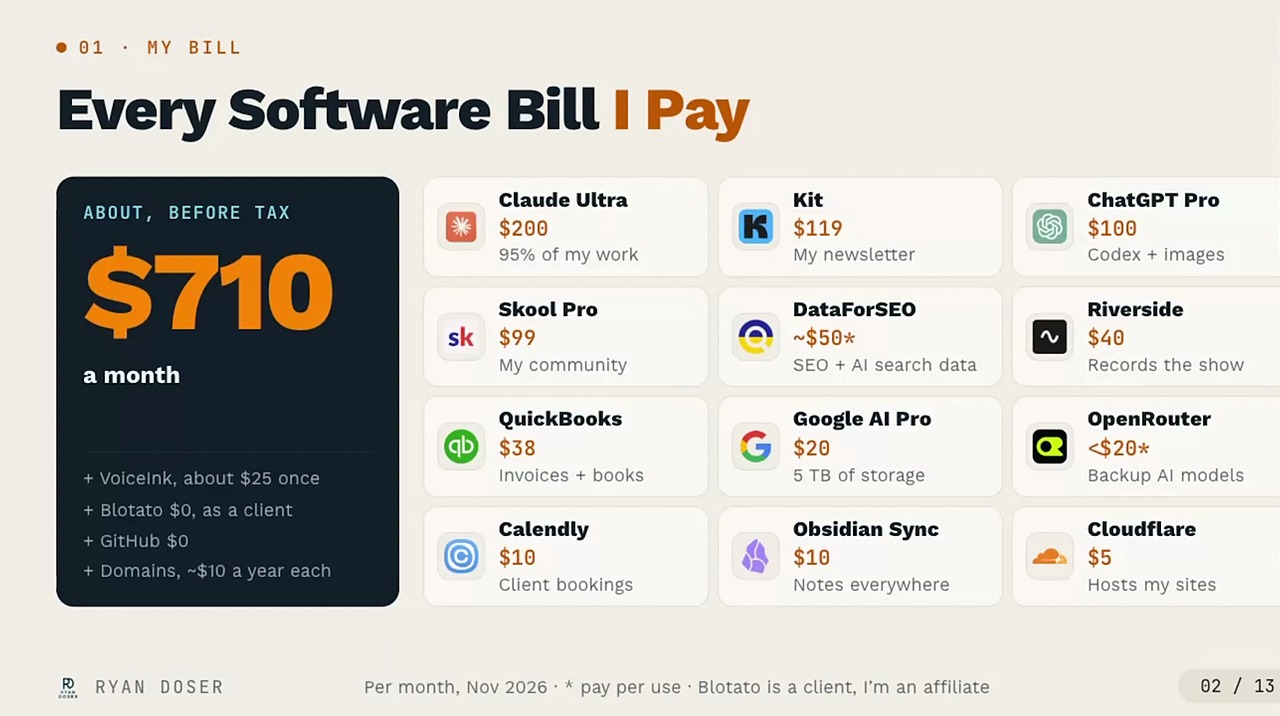
My software subscriptions run about $710 a month before tax, and the priciest line, a $200 Claude Ultra plan, is the best value on the whole bill. Here's every subscription I pay for, what each one pays back, and the two I'm debating canceling.
All the Software Subscriptions I Pay For
Aaron Makelky and I opened our real software bills on AI Rabbit Holes and picked each other's apart. This post covers my software subscriptions, line by line.
A software subscription is a tool you pay for every month or year instead of buying it once, and my 12 range from $5 to $200 a month each.
One caveat up front: I had Claude estimate the total by scraping my MCP connections, APIs and CLIs. I don't know if it's fully accurate.
| Tool | Monthly cost (November 2026) | What it does for me | Verdict |
|---|---|---|---|
| Claude Ultra | $200 | 95% of my work | Keep |
| Kit | $119 | My newsletter | Keep |
| ChatGPT Pro | $100 | Codex and images | Keep |
| Skool Pro | $99 | My community | Keep |
| DataForSEO | About $50, pay as you go | SEO and AI search data | Debating |
| Riverside | About $40 | Records the podcast | Keep |
| QuickBooks | $38 | Invoices and books | Keep |
| Google AI Pro | $20 | Storage and Gemini | Keep |
| OpenRouter | Under $20, pay as you go | Backup AI models | Keep |
| Calendly | $10 (annual plan) | Client bookings | Keep |
| Obsidian Sync | $10 | Notes on every device | Debating |
| Cloudflare | $5 | Hosts my sites | Keep |
On top of that, I paid about $25 once for VoiceInk, GitHub costs me nothing, and domains run about $10 a year each.
The small lines barely need a defense. Google AI Pro is mostly a storage purchase plus Gemini on my phone, OpenRouter is pay-as-you-go access to models I want to test, and Cloudflare's free plan is so generous I'm not sure I even need the $5 Workers plan.
Claude Ultra does 95% of my work, and my Claude Skills Stack holds the skill files I run on it every day.
How I Decide What Stays
Every line on that bill has to pay me back in money or in hours. Here's how I put it on the episode: "if you're getting an ROI, not only just from the price, but I would say also in terms of time and opportunity costs, I think it's a no-brainer to keep paying for software."
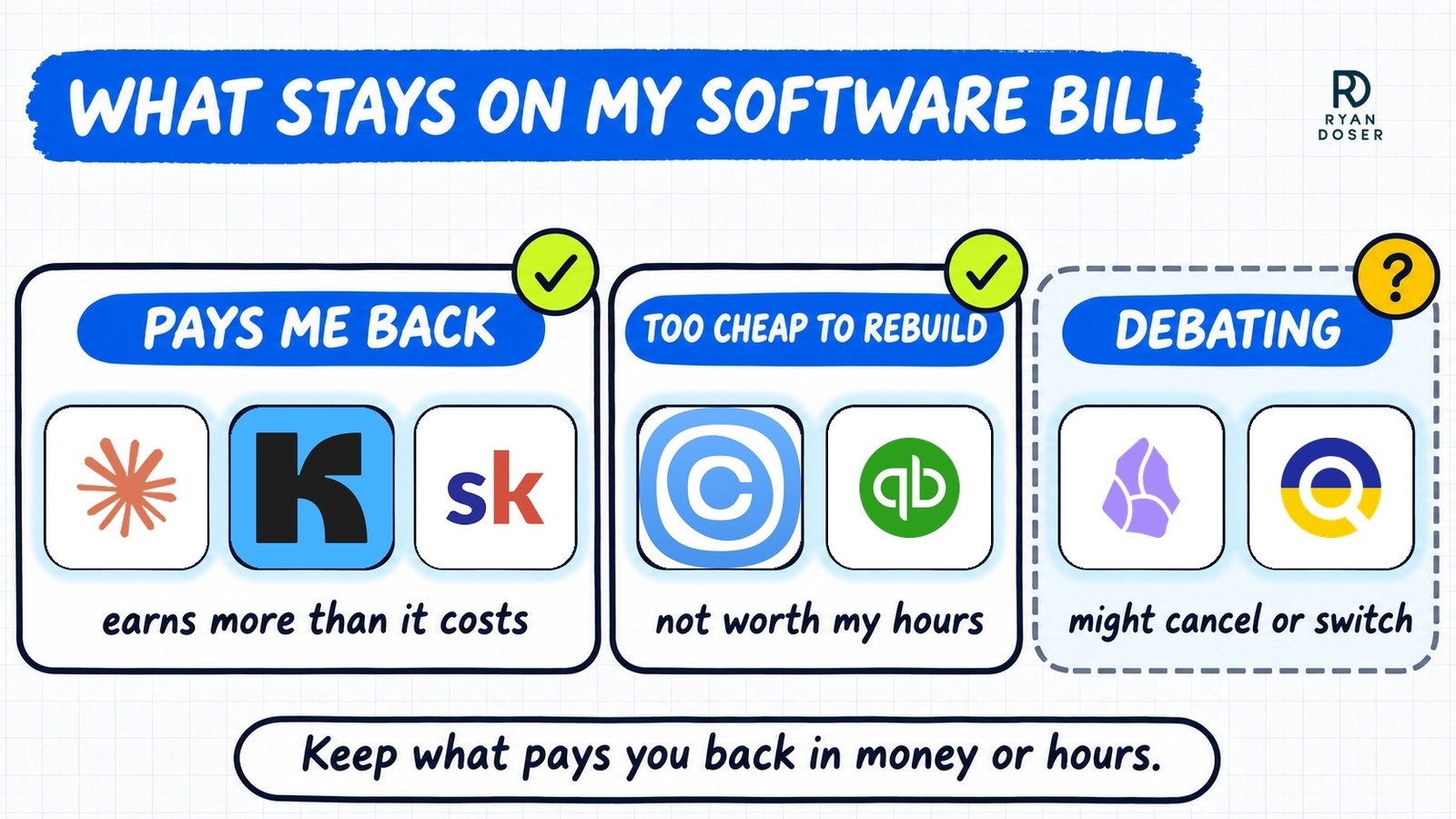
That rule sorts my software subscriptions into three piles. Some earn more than they cost, some are too cheap to be worth rebuilding, and two are on the fence.
One more rule sits behind all three piles: I skip almost any tool that won't plug into my AI setup through an MCP, CLI or API. That test, plus the questions I ask before anything renews, lives in my build vs buy software breakdown.
Your bill won't look like mine, and just because I buy something doesn't mean you should.
The Tools That Pay Me Back
The biggest software subscriptions on my bill are also the easiest calls. Each one makes me money directly or carries a big share of my work.
Claude Ultra ($200)
Claude Ultra is the most expensive line I pay for, and nothing else on the bill does more work. It runs my client work, SEO, content, websites, podcast intros, decks and newsletters, plus Claude Duet on my phone.
My slide for the episode put a number on it: about $6,400 of Claude Code usage priced at Anthropic's pay-per-use API rates, which is not what I paid. That covers about 30 days, October 20 through November 19, 2026, on a $200 plan.
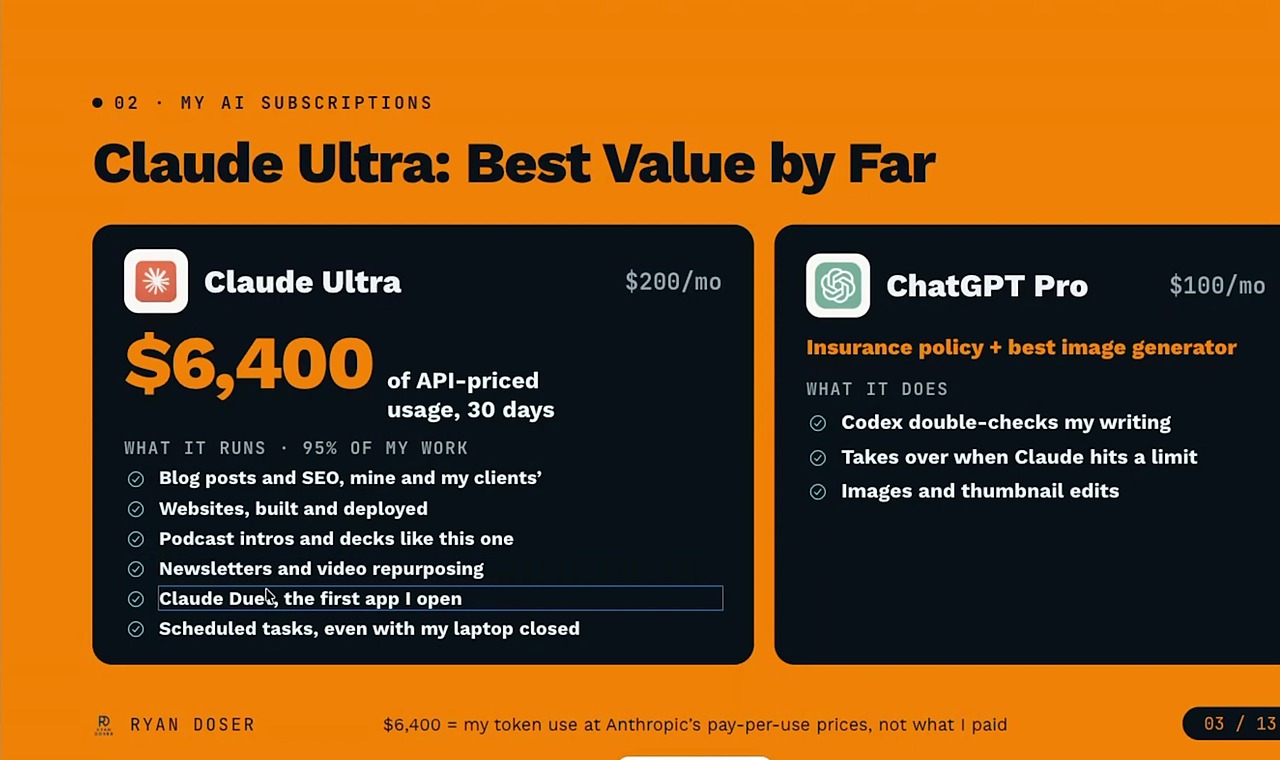
ChatGPT Pro at $100 is my insurance policy. When Claude Code is down or I run out of usage, Codex picks up where I left off.
It also checks Claude's work as a second set of eyes, and I compare both plans in my best AI subscription picks.
Kit ($119)
Kit pays for itself, because I make more than $119 a month off my email list. On the episode I called it about 8,000 people, which is my Kit plan tier, and Kit showed 6,584 active subscribers on November 24, 2026.
A list that size could run on Kit's free plan, which covered up to 10,000 subscribers as of November 19, 2026. My $119 pays for features like unlimited automations and sequences, and the paid price climbs with list size.
The bigger reason is deliverability. "It's getting harder and harder to hit that inbox," and I don't want my list riding on a vibe-coded tool that might land in spam or the Promotions tab.
Aaron's math: the hours you'd spend vibe coding a replacement would earn more if you spent them growing the list.
Skool Pro ($99)
Skool follows the same math. I pay $99 monthly for my community and make more than that from it.
Skool's pricing page listed two plans as of November 19, 2026: Hobby at $9 a month with a 10% transaction fee, and Pro at $99 a month with a 2.9% fee.
It's also the one exception to my MCP rule, since Skool doesn't have a working MCP yet. Aaron called me out on it, and I told him Skool is the one exception I'll make.
Riverside (about $40)
I'll happily pay about $40 monthly so Riverside can record our podcast live. Its MCP has been phenomenal for me, hooking into Claude Code to handle the editing and packaging.
I showed how a Claude Code skill makes the cuts inside Riverside in my AI video editing post.
The Cheap Tools I Won't Vibe Code
These two software subscriptions stay because they're cheap and wired into how I work. Rebuilding or moving a $10 tool costs more hours than it will ever save.
Calendly ($10)
I pay $10 monthly for Calendly on the annual plan ($12 if you pay month to month), and yes, I understand I could vibe code my own. My meeting links sit all over ryandoser.com and inside my workflows, and my note taker connects to it.
Trying to vibe code your own Calendly is "the worst example of a waste of an opportunity cost."
Aaron pushed back hard on this one. He wouldn't start anyone on Calendly today, and for power or a team he'd pick Cal.com, which he uses himself and which supports paid meetings and custom forks.
If you're a solo consultant who already pays for Google Workspace, his pick is its built-in booking tool, which he called "ninety-five percent as good." I agreed with him on both.
QuickBooks ($38)
QuickBooks might be my most unpopular keep. It already has an MCP connection, and my accountant, who I like, runs his other clients on it.
Switching means moving my books and getting him on board, and at $38 a month that hurdle isn't worth clearing. If it cost $100 a month, that would probably put me over the edge.
Aaron pitched two swaps. One was SlowBooks Pro, a free, open-source QuickBooks-style app that keeps your books on your own computer, made by a friend of his (he said so up front).
The other was Mercury, a business bank with built-in bookkeeping that I want to look into.
The Two I'm Debating
Two of my software subscriptions could go. One has a free path I already use, and the other has a data problem I'm watching.
Obsidian Sync ($10)
Obsidian Sync is the one I'm closest to canceling. It keeps my vault synced across my devices, including a Mac Mini running 24/7, and every conversation I have dumps right into it.
The problem is that GitHub can do the same job, and I already back up my whole AI setup to a private repo there. I walk through that in my guide to using GitHub as a non-coder.
I haven't made the move because things are already wired together, so the $10 keeps running on autopilot. My plan is Sync Plus billed monthly, and Obsidian listed Sync Standard at $5 a month as of November 19, 2026.
Aaron's cheaper path for Apple users who are just starting out is to keep the vault in an iCloud folder and skip Sync. His own Git-backed vault works, but in his words, "it is kind of a pain."
DataForSEO (about $50)
DataForSEO is pay as you go. I top it up $50 at a time, it showed up as about $50 on my bill estimate, and it runs higher in heavy months.
For basic keyword research, SERP data and AI citation data, it costs far less than an Ahrefs or Semrush plan.
I'm looking at other SERP trackers because Google started feeding fake results pages to scrapers this fall. DataForSEO's own CTO estimated in October that 20% to 30% of its scraped results had been affected since September 26, 2026, and the company shipped a fix on November 16.
We recorded three days after that fix and I was still weighing a switch. I broke down the numbers and the fix in my best SERP API comparison.
For a beginner who needs keyword data on a budget, it's still where I'd start.
Price Your Hours Before You Cancel Anything
Across my software subscriptions, the expensive tools stay because they earn their keep, and the cheap ones stay because moving them would cost more of my time than they cost me.
Before you cancel a $10 tool to vibe code your own, put a dollar figure on the hours it'll take.
As I told Aaron, "Opportunity costs. That's the key takeaway here."
Software Subscriptions FAQs
How much does a software subscription cost?
A software subscription is a tool you pay for every month or year instead of buying it once. My 12 range from $5 to $200 a month and total about $710 before tax, a figure Claude estimated from my connected accounts. Claude Ultra alone, at $200, covered about $6,400 of Claude Code usage on my Mac at Anthropic's list API rates over about 30 days, which is not what I paid.
What are the best Calendly alternatives?
Aaron Makelky's picks were Cal.com, which he uses himself and which supports paid meetings, teams and custom forks, and the booking tool built into Google Workspace, which he called "ninety-five percent as good" as Calendly for solo consultants already paying for Workspace. Calendly listed its Standard plan at $10 a month billed yearly, or $12 billed monthly, as of November 19, 2026.
What are the best QuickBooks alternatives for a small business?
Aaron suggested SlowBooks Pro, a free, open-source app with a QuickBooks-style interface that keeps your books on your own computer (he's friends with its maker), and Mercury, a business bank with built-in bookkeeping. I stayed on QuickBooks at $38 a month because my accountant works in it and it already has an MCP connection, so check that your accountant can use any new tool before you move.
How much does Skool cost?
The transaction fee is the real difference between Skool's two plans. As of November 19, 2026, Hobby cost $9 a month plus a 10% fee and Pro cost $99 a month plus 2.9%. I pay for Pro because my community earns more than $99 a month, even though Skool has no working MCP yet, which makes it the one exception to my rule that tools must plug into my AI setup.
How much does Kit cost?
I pay $119 a month for Kit, my plan tier for lists up to about 8,000 people, and Kit showed 6,584 active subscribers on my list on November 24, 2026. Kit's pricing page listed a free plan for up to 10,000 subscribers as of November 19, 2026, with paid plans priced by list size. The paid tiers add unlimited automations and sequences, which is the part I pay for.
I use DataForSEO and earn a commission if you sign up through my link. Every other link in this post is unpaid, and the prices shown are what each vendor listed on the dates noted.