
10 AI Side Hustles for Marketers That Actually Pay (2026)
The best AI side hustles for marketers are not the ones every generic "make money with AI" list keeps recycling. They are the boring, client-facing services you can already half-do in your sleep, now run at 5x the speed.
Why Most "AI Side Hustle" Lists Are Useless to You
I have read a lot of these lists. They all say the same thing: train AI models on Mercor, sell prompt packs, make faceless YouTube videos, publish AI coloring books on Amazon.
None of that is built for a marketer.
You already know how to write a subject line, brief an ad, or map a content calendar. That skill is the edge. AI does not replace it, it multiplies it, and that gap between "knows marketing" and "knows how to prompt" is exactly what people pay for right now.
So this is not a generic income list. Every idea here is a marketing side hustle, framed for someone who can sell an outcome to a business owner. I have run or coached most of these, and I will tell you the real income ranges and the honest downside on each one, not the clickbait "$35,677 in a weekend" version.
The 10 Best AI Side Hustles for Marketers in 2026
Skim the fast version first, then go deep on the ones that fit you. Every income range below is a realistic monthly target for a part-time operator with one to four clients, not a viral outlier.
| # | Side Hustle | Best for | Realistic income |
|---|---|---|---|
| 1 | AI newsletter operator | Writers, editors | $800 to $2,500/mo per client |
| 2 | AI email-sequence writer | Copywriters, e-com marketers | $1,500 to $5,000 per project |
| 3 | AI ad-creative variation service | Paid-social marketers | $1,000 to $3,000/mo per client |
| 4 | Short-form video repurposing | Social media managers | $1,000 to $3,000/mo per client |
| 5 | Niche social media manager | Generalist marketers | ~$1,000/mo per client |
| 6 | Brand-voice GPT/skill builder | Prompt-savvy marketers | $500 to $2,500 per build |
| 7 | AI lead-gen + outreach copy | B2B marketers | $500 to $2,000/mo per client |
| 8 | Local AI marketing installer | Local/agency marketers | $500 to $2K setup + retainer |
| 9 | Sell marketing skills + templates | Anyone with a repeatable process | $500 to $5,000/mo at volume |
| 10 | Build a paid AI marketing community | Marketers who like teaching | $3,000 to $5,000/mo at 80-150 members |
1. AI Newsletter Operator
What it is: You run a client's weekly newsletter end to end. Research, draft, edit, schedule, and report. AI handles the first draft and the repurposing so one newsletter feeds five social posts.
Who it fits: Marketers who can write and edit and would rather own one deliverable than juggle ten.
Realistic income: $800 to $2,500 per month per client. Two clients is a real part-time income.
How to start: Pick one niche you understand (SaaS founders, real-estate agents, local gyms). Offer a done-for-you weekly send on a platform like beehiiv. Use AI to draft, but you edit every line so it does not read like a robot wrote it.
The downside: It is recurring work every single week. Miss a send and the client notices. This is a commitment, not a passive play.
2. AI Email-Sequence Writer
What it is: You write the automated flows that make e-commerce and SaaS brands money on autopilot. Welcome series, cart abandonment, post-purchase, win-back.
Who it fits: Copywriters and email marketers. This is the highest-skill, highest-pay idea on the list.
Realistic income: $1,500 to $5,000 per project. Experienced specialists command $150 an hour and up.
How to start: Learn one email platform well (Klaviyo flows for e-com, a lifecycle tool for SaaS). Use AI to draft variations fast, then apply real copywriting judgment on the hooks and offers. The judgment is what they pay for.
The downside: AI writes competent email. It does not know the offer, the margin, or the brand's voice. If you cannot bring strategy on top of the draft, you are just a slower version of the client's own ChatGPT.
3. AI Ad-Creative Variation Service
What it is: Paid-social teams burn through creative. You use AI to expand a few strong angles into a clean set of hook and headline variations the media buyer can actually test, then you cut the weak ones before they ever ship.
Who it fits: Marketers who understand direct response and why one ad beats another.
Realistic income: $1,000 to $3,000 per month per client. At agency scale this becomes a real retainer business.
How to start: Get one paid-social client or agency. Start from a handful of angles you believe in, use a tool like AdCreative.ai to generate variations of each, then hand-pick the ones worth testing. You are the filter, not a firehose.
The downside: Volume without strategy is just expensive noise. Spraying 100 versions of a bad angle gets you fired fast. The whole value is your judgment on which hooks are worth a dollar of spend.
4. Short-Form Video Repurposing
What it is: You take one long video (a podcast, a webinar, a YouTube upload) and turn it into 10 to 20 Reels, Shorts, and TikToks with AI editing, captions, and clip selection.
Who it fits: Social media managers and anyone comfortable with basic video tools.
Realistic income: $1,000 to $3,000 per month per creator or brand client.
How to start: Find one creator or founder who publishes long content and hates editing. Use an AI clipping tool like Opus Clip to surface candidate moments, then apply human taste on the few that actually land. Deliver a small set of strong clips, posted and captioned, not a dump of everything the tool spat out. If the credit math on a clipper decides whether this is profitable for you, I priced seven of them on monthly billing.
It is the same split I landed on for my own podcast, where AI cuts the long-form episode and a human editor still finishes the shorts.
The downside: The tools pick clips by transcript keywords, not by what is genuinely good. Your edge is knowing which handful are worth posting and killing the rest. Hand over all 20 raw and you are just an export button.
5. Niche Social Media Manager
What it is: Full social media management for one specific niche. Content, scheduling, light community engagement, monthly reporting, all sped up with AI drafting.
Who it fits: Generalist marketers who want steady recurring clients without deep specialization.
Realistic income: Around $1,000 per month per client. Two to four clients is a solid side income.
How to start: Pick a niche where the businesses have money and no time (med-spas, dental practices, real-estate teams). Run it all from one scheduler like Buffer and sell the same package to several of them so your systems and prompts carry over.
The downside: This is the most crowded idea on the list. Everyone offers social media management. Your only real moat is the niche focus and the results you can show, so pick a lane and go deep.
6. Brand-Voice GPT or Skill Builder
What it is: You build a custom AI assistant trained on a company's voice, style, and offers so their internal team can draft on-brand without you. You are selling a reusable asset, not your time.
Who it fits: Prompt-savvy marketers who like building systems more than doing weekly grind work. If you already lean on Claude for client work, this is a natural extension of the Claude AI side hustle path.
Realistic income: $500 to $2,500 per build. Add a retainer to maintain and update it.
How to start: Take a company's best content, their style guide, and their positioning, and package it into a custom GPT or a Claude skill their team can use. Charge for the build, then charge again to keep it current.
The downside: It is a newer offer, so you have to educate the buyer on why it is worth paying for. And a voice model is only as good as the material you feed it. Thin inputs make a thin assistant.
7. AI Lead-Gen and Outreach Copy
What it is: You build small, highly targeted prospect lists and write genuinely personalized outreach for B2B clients. Not blast lists. A tight list of the right people with a message that actually references their world.
Who it fits: B2B marketers who understand that outreach lives or dies on the offer and real personalization, not volume.
Realistic income: $500 to $2,000 per month per client.
How to start: Use an enrichment tool like Clay to research each prospect deeply, then write outreach that proves you actually looked. Ten messages that land beat a thousand that get ignored. Sell the research and the copy as one package.
The downside: I have to be blunt here. The lazy version of this is spam, and mass AI outreach gets domains blacklisted and burns your client's reputation. If you are not willing to keep it small and genuinely personal, skip this one. Do it wrong and you are part of the problem.
8. Local AI Marketing Installer
What it is: You set up the AI marketing stack for local businesses. A chatbot on the site, review-request automation, a social scheduler, maybe a simple lead-capture flow. Setup fee plus a monthly retainer to run it.
Who it fits: Marketers who like working with local business owners and want both an upfront fee and recurring income.
Realistic income: $500 to $2,000 setup, plus a $300 to $800 monthly retainer per client.
How to start: Pick one vertical (dentists, gyms, home services). Build one repeatable "install" package around tools like Podium for reviews and chat, then sell the same thing down the street. Local owners want the outcome, not a tools tutorial.
The downside: Local owners can be slow to pay and slower to adopt. You will do some hand-holding. The upside is that retainers stack and the same setup repeats across clients.
9. Sell Marketing Skills and Templates
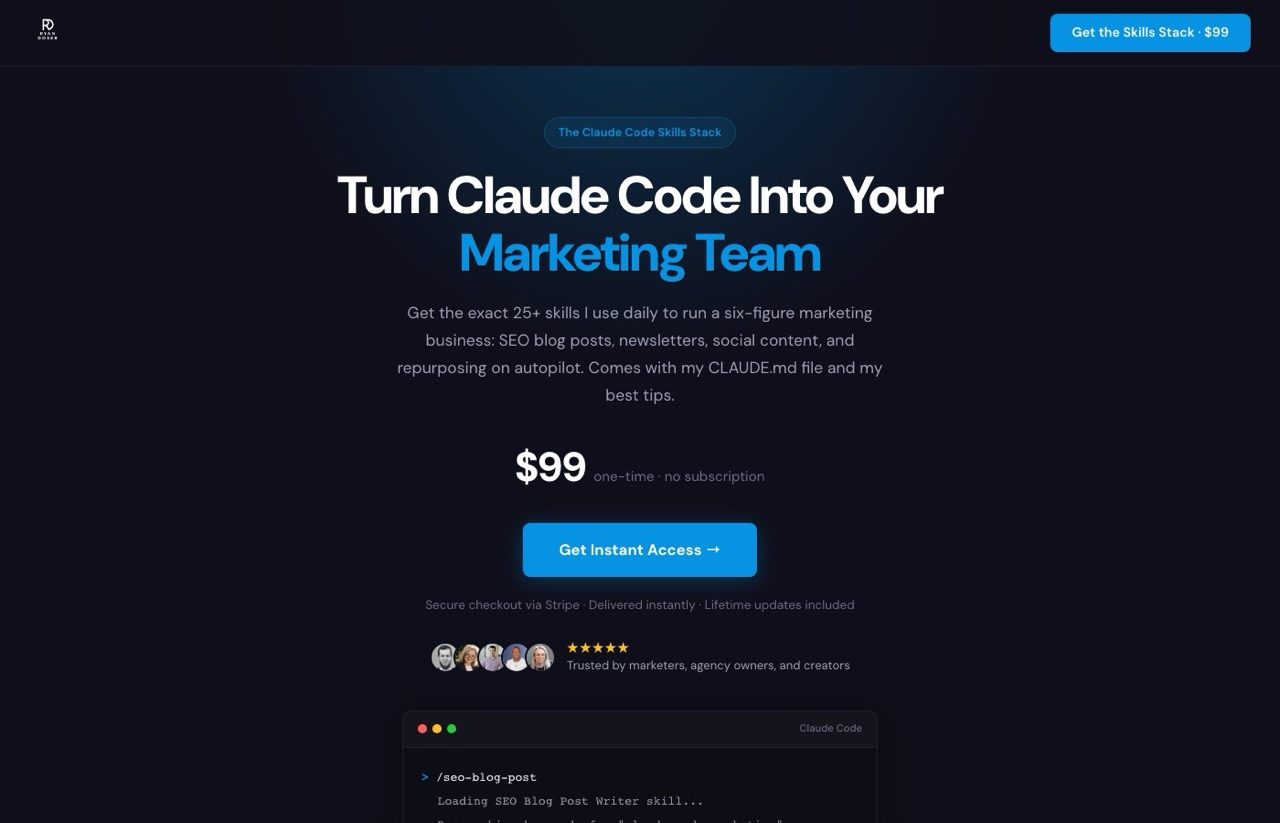
What it is: You productize your own repeatable process into something people buy once. A Claude skill, a workflow template, or a full SOP that does a specific marketing job. I lean toward skills over one-off prompt packs, because a skill is a repeatable system and a prompt is a single throw.
Who it fits: Anyone who has a marketing process worth copying. This is the most scalable idea because you build it once and sell it many times.
Realistic income: $15 to $99 per product, which adds up to $500 to $5,000 a month once you have volume and an audience.
How to start: Find the one thing you do that people always ask you about, then package it so a stranger can get your result without you. Plenty of marketers sell these as templates on a marketplace like Gumroad. I broke down the mechanics of this in my guide on how to sell Claude skills, which walks through pricing and packaging a skill someone will actually buy. If you want a working model of a productized, expertise-backed skill, my Claude Code Skills Stack is exactly that: real marketing workflows built on a decade of doing the work, not thin repo wrappers.
The downside: A skill with no audience sells zero copies. The product is the easy part. Distribution is the hard part, and that is a marketing problem you have to solve first.
10. Build a Paid AI Marketing Community
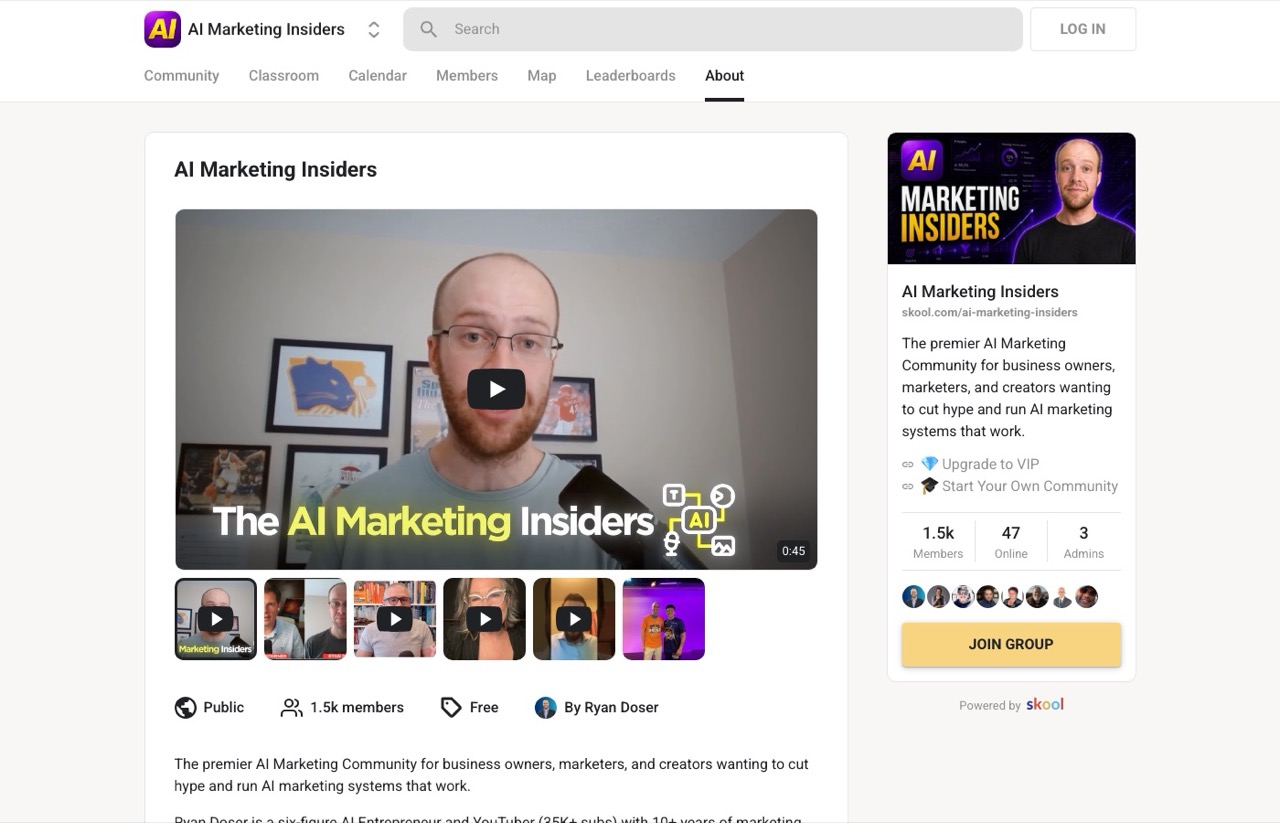
What it is: You gather marketers around a specific problem, then charge a monthly or yearly fee for the space, the resources, and the access. AI helps you produce the content, templates, and onboarding that keep members getting value. Browse the Skool discovery page and you will see hundreds of paid communities already doing exactly this. If you want to see how the good ones structure their tiers and pricing before you build your own, I broke down the best AI communities and what each one charges.
Who it fits: Marketers who like teaching and organizing more than doing client work. Full disclosure: I run one myself, so I am biased. My community admin and I recorded an honest conversation about whether you should build one at all. I will give you the honest downside anyway.
Realistic income: A small paid community of 80 to 150 members at $25 to $50 a month lands around $3,000 to $5,000 monthly. Take out your platform cost first. Skool's Pro plan runs about $99 a month plus a small per-transaction fee on top, so the platform is not free. The six-figure-a-month examples you see are outliers, not the starting point.
How to start: Pick one narrow audience and one clear promise. Start free to build trust and prove the value, then open a paid tier once people are already showing up. The AI Marketing Insiders community is my own version of this, and it started exactly that way.
The downside: An empty community is worse than no community. You have to show up daily at the start, and members leave the moment the value dries up. This rewards consistency more than any other idea here.
How to Choose Your AI Side Hustle
These are the same questions I ask before I take on any client build. Run yourself through them.
- What can you already do well? Start where your marketing skill is strongest. AI multiplies existing skill, it does not create it from nothing.
- Do you want recurring or one-off income? Newsletters and social management are recurring grind. Email sequences and voice-model builds are one-and-done projects.
- How much do you want to sell? Local installers and lead-gen require ongoing client-getting. A productized skill sells while you sleep, but only after you build an audience.
- Recurring revenue or a scalable asset? Retainers give you predictable income with a ceiling. Products give you a lower floor and a much higher ceiling.
- Can you bring judgment on top of the AI? Every idea here pays because a human decides what is good. If the plan is to hand over raw AI output, the client will cut you out and prompt it themselves.
Pick one. Get one client or one sale. Then decide if it is worth scaling. Trying all ten at once is how you end up with none.
What About the Generic "Make Money With AI" Ideas?
You will see other lists push AI model training, faceless YouTube channels, AI stock art, and self-published coloring books. I left those out on purpose.
They are real, and some people do make money with them. But they are not marketing side hustles, and they do not use the skill you already have. You would be starting from zero in a crowded, low-margin race.
If you want the broader income view, I covered the full ranked list in my guide on the best ways to make money with AI, and if you are truly starting cold, how to make money with AI with no experience is the better entry point. This post is deliberately narrower, for marketers who want to charge for what they already know.
Ryan's Final Thoughts
None of these are passive and none are get-rich-quick. Every one pays because you are selling a marketing outcome that AI makes faster to deliver, not because AI does the whole job for you. Pick the one that matches the skill you already have, land a single client, and let the results tell you whether to scale. And if you want people building these alongside you and swapping what actually works, that is exactly why the AI Marketing Insiders community exists.