
7 Years Ago I Left Corporate America (AI Has Changed Everything Now)
July 2019, day one of working for myself. I was 23.
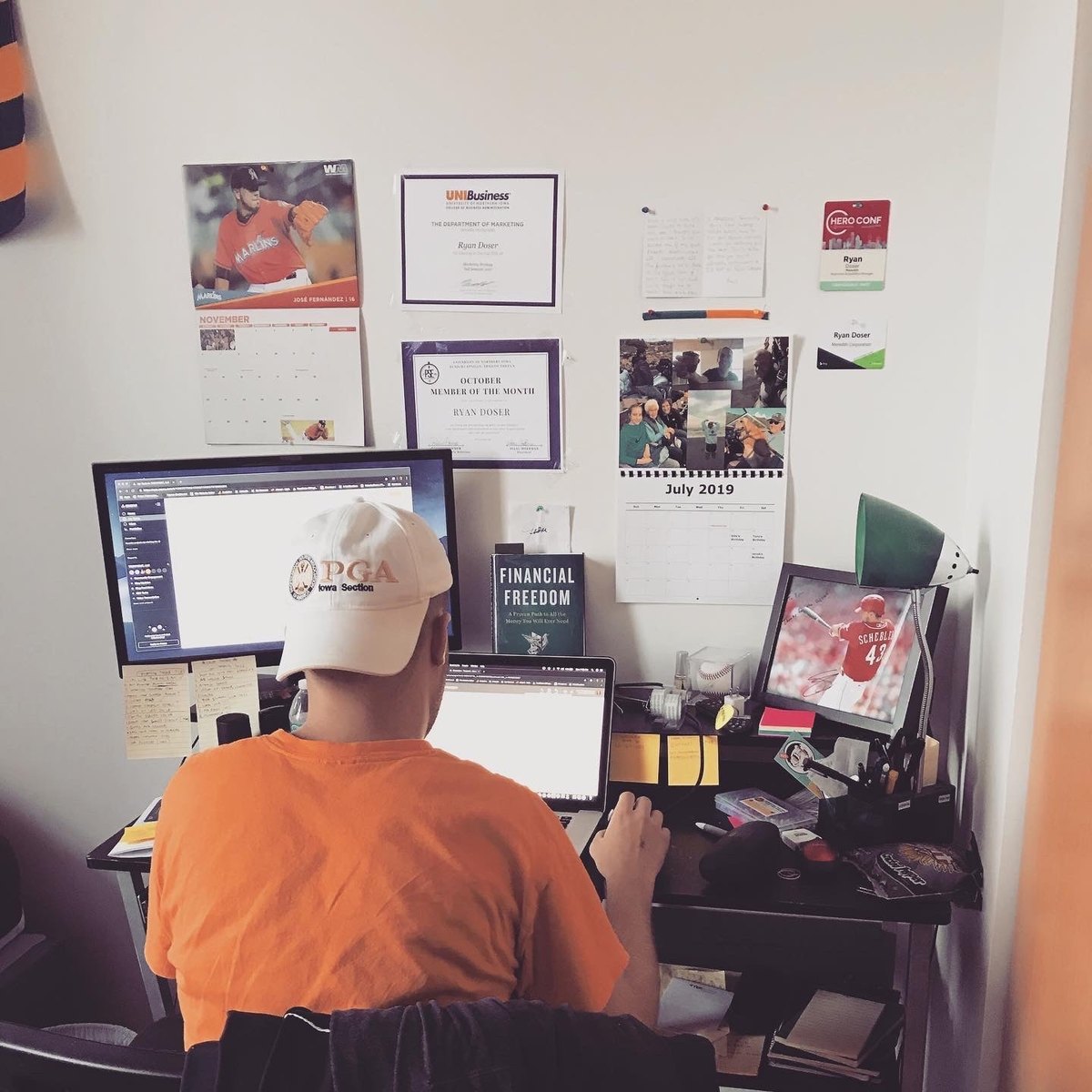
That badge on the wall is the part I notice now. One chapter had not come down before the next one started.
What the Photo Does Not Show
This looks like a leap. It did not feel like one, because I had been building the replacement for over a year.
About two months into my corporate job, I started a blog and taught myself SEO, then affiliate marketing, then email, spinning up sites outside work hours to see what would happen. None of it was a plan to quit.
Then I got my first client, and the question stopped being "should I risk this" and became "why am I still doing both?"
The Line That Made Me Go
One line from The 4-Hour Workweek stuck with me: most people choose the path of unhappiness over uncertainty because of fear of the unknown.
I am grateful for that job. Running multi-million dollar paid budgets for People, Better Homes & Gardens, and dozens of other titles at 22 was an incredible place to learn, and that team gave me my start. I just wanted to build something of my own, which is more or less what I have been doing ever since.
AI Rewrote the Job I Left
The parts of my 2019 job that ate the most hours are the parts AI absorbed first. Pulling reports, building keyword grids, producing the first draft nobody keeps.
My Claude Code and Codex setup has moved my solo output 10x to 100x depending on the task. This site is the honest example. I rebuilt it in Astro myself, and it runs SEO and publishing systems that would have taken a developer, a writer, and a strategist in 2019. That is why one person can now compete with an agency.
Lessons I Have Learned Along the Way
Seven years of running this alone surfaced a handful of things I would actually defend. Here they are.
Expertise Comes First, Tools Come Second
AI is close to irrelevant if you do not know how to move the needle on the task in front of you. It will happily produce a thousand words of confident nonsense, and you have to already know enough to catch it.
The SEO background I built at night in 2019 is what makes my AI output any good. I know what a ranking page looks like, so I know when a draft is not one. The tools did not give me judgment. They removed the ceiling on how fast I could apply it.
The Resistance Is Never Actually Technical
Every week a marketer tells me Claude Code is too technical for them. I get it, I felt the same way for months before I opened it. Then I did, and found out it is mostly a chat window and some markdown files.
The gap is rarely skill. It is willingness, and that is the one that actually compounds. From what I see across my audience and client work, very few marketers are doing their day-to-day work inside an AI coding agent, and it is not because the rest of them could not learn it.
Package What You Already Know
I used my own marketing skills on client work for months before it clicked that people kept asking me for them. Eventually I stopped treating them as private tooling and turned them into a product.
It has since done over $10,000 with almost no ongoing work. The lesson is not "sell a digital product." It is that the thing you built for yourself, the boring internal system nobody was supposed to see, is often the most valuable thing you own.
Build Assets That Compound
Hours do not compound. You sell them once and they are gone. A blog post, a video, an email list, or a skill file you own keeps working long after the day you made it.
My best YouTube videos are keyword-based, not viral. They did not spike and disappear. They rank, they sit there, and they still bring in clients years later. That is the whole difference between content as marketing and content as a lottery ticket.
Personal Brand Is the Hedge Against the Trust Recession
We are at the point where you read something, watch something, listen to something, and genuinely cannot tell whether a person made it. That is the trust recession, and it gets worse from here.
Companies that publish only from behind a logo are going to have a harder time with this than ones with a real person out front. That is why I put my name and face on everything I publish, and why founders should be visible too. Nearly every good client, partnership, and opportunity I have had in seven years traced back to someone knowing who I was first.
Distribution Is the Moat Now
Building stopped being defensible the moment anyone could ship a product in a weekend. What is still hard is getting attention and keeping it.
Here is the clearest proof I have. I reviewed a SaaS tool, and my video ranked #1 on YouTube for that tool's own name. The founder noticed, wondered who this guy outranking her product was, and eventually became a client. She was heads down building the software while the search result for it sat there unclaimed.
Ryan's Final Thoughts
I would not romanticize this. Seven years in, there are still weeks where I am the strategist, the invoice chaser, and the guy fixing the website at 11pm.
If you are sitting where I was, my advice is boring. Build the replacement first, on whatever hours you have, until the step across is short. The tools have never been better and the head start has never been shorter.
That is what this picture really is. Not a leap, just the day the thing I had been building became the main thing.