
The 4-Hour Workweek in a World of AI (What Still Works)
The 4-Hour Workweek is my favorite book of all time, and Tim Ferriss just answered what it looks like in a world of AI agents. His short version: the first two steps matter more now, because AI speeds up whatever you point it at.
Why The 4-Hour Workweek Still Matters to Me
The 4-Hour Workweek is the book that pushed me to leave a corporate marketing job in July 2019 and work for myself. I told that story, including the one line that made me go, in my post on seven years of self-employment.
Tim's answer comes from a Q&A, episode #887 of The Tim Ferriss Show, published October 21, 2026. He later posted the AI segment as its own clip, which sits near the bottom of this post.
A lot of my own marketing now runs on Claude Code, and my Claude Code Skills Stack holds the skills I use for it. Two recent cuts from that setup line up with his warning, and I'll walk through both below.
The 4-Hour Workweek DEAL Framework in 60 Seconds
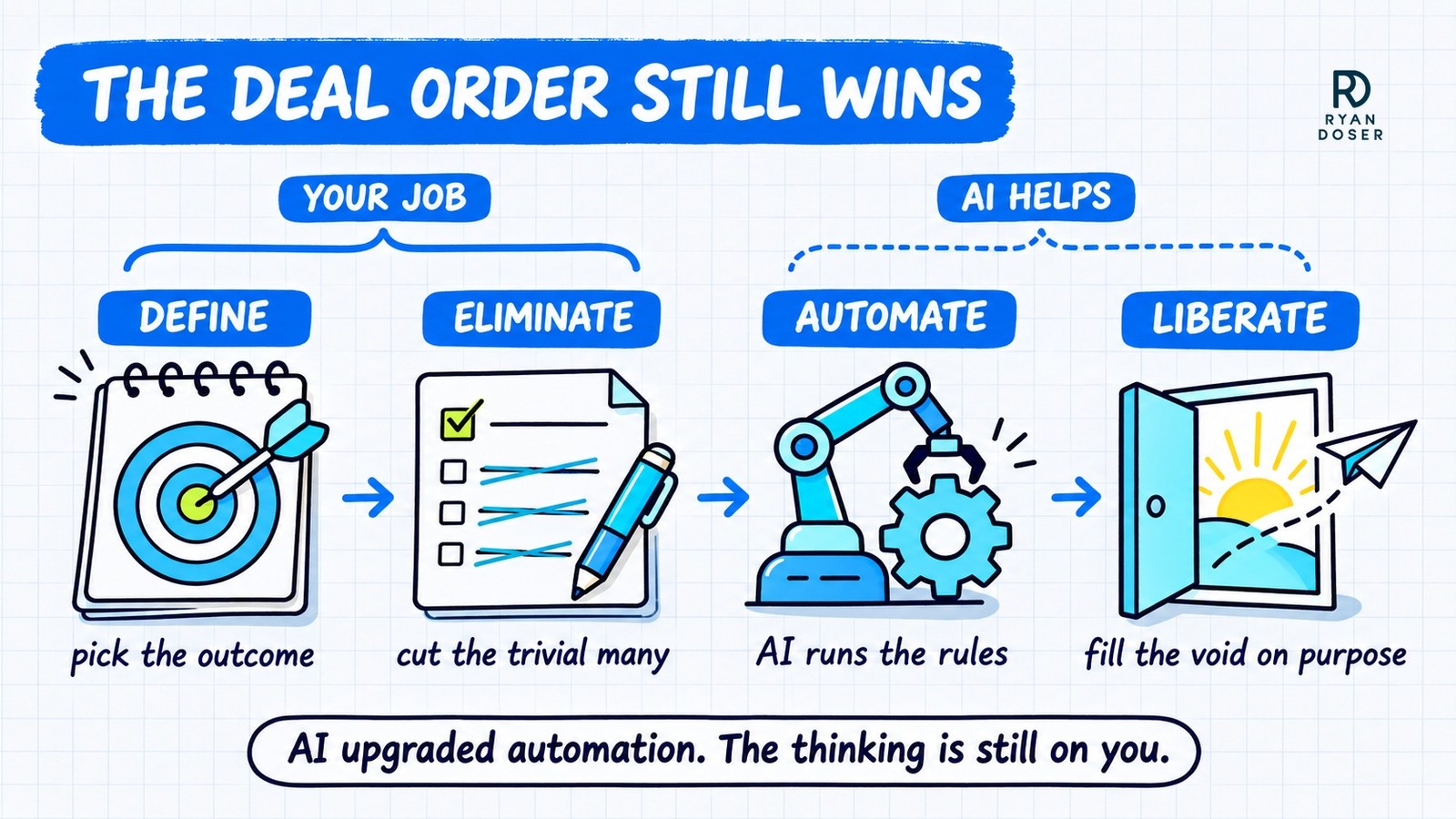
The book came out in April 2007, and its 20th anniversary lands in April 2027. The short 4-Hour Workweek summary is the four-step process Tim calls DEAL.
| Step | What Tim says it means | Where AI fits (my read) |
|---|---|---|
| Definition | Decide exactly where you want to go, then price that lifestyle in monthly income | AI can run the numbers, but picking the goal is still on you |
| Elimination | Use 80/20 analysis to cut the trivial many and keep the critical few | Matters more now, because AI speeds up whatever you keep |
| Automation | Define the rules and policies, and use processes and technology to automate as much as possible | AI can now carry out many of those rules |
| Liberation | Spend the freed-up time in enjoyable, high-impact ways | If AI does free up time, decide in advance what it's for |
Tim adds one correction himself. People tend to read the Automation step as a plan to hire virtual assistants, and he says that part gets too much airplay.
His version centers on the rules and policies that govern your life and business, and you only polish what you've already picked as worth keeping.
Tim Ferriss Says AI Multiplies the Useless
Tim says he's invested in a lot of the frontier labs, and he still estimates that 90% or more of the AI use cases he has seen create more work, not less. That's his personal observation, not a measured study.
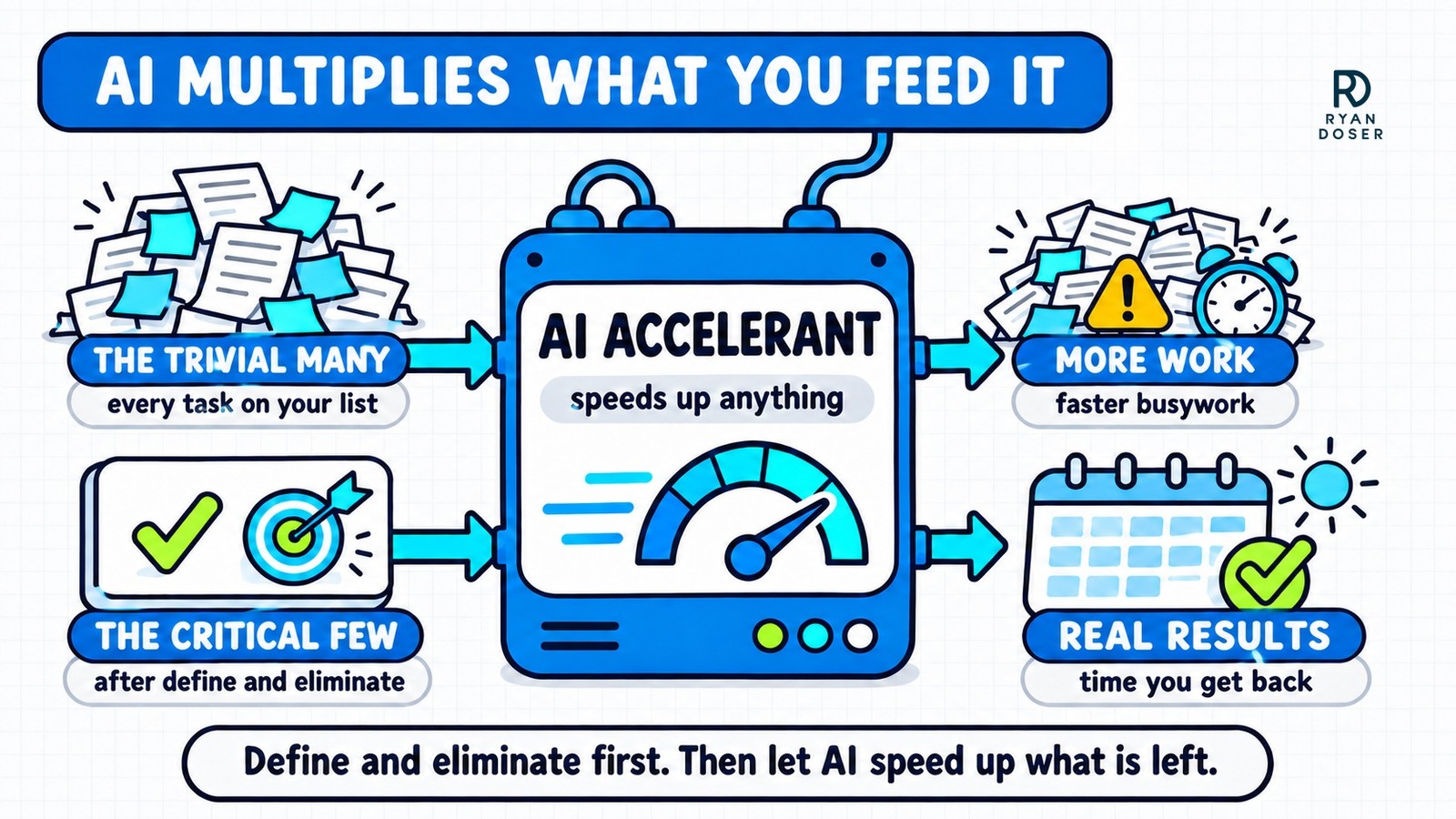
His reasoning ties straight back to The 4-Hour Workweek. AI is an accelerant that makes "more of whatever is," so if you haven't first identified the critical few, it "simply multiplies the useless."
That's why he calls AI-powered infinite leisure "a completely false promise." He argues no technology has ever delivered it, and used as a blunt instrument, he expects AI to pile on more work and more stress until you "drown in the unimportant."
I agree with him, and it's the same pattern behind plenty of AI slop. Chaos in, chaos out.
AI on the trivial many = more work, faster. AI aimed at the critical few = work that's actually worth speeding up.
What I Cut From My Own AI Marketing Workflow
AI makes it cheap to build one more workflow. That's how you end up maintaining a pile of them.
Here are two cuts I made this fall, both of which fit the Elimination step in The 4-Hour Workweek. Neither one involved automating anything new.
I Dropped Video Captions, Then Added Back One LinkedIn Post
My YouTube repurposing workflow used to hand me promo captions for LinkedIn and X on every video. On October 8, 2026, I cut them all with one instruction: "I no longer need captions or social media posts."
On November 2, I added back exactly one LinkedIn post that reuses the blog post's diagram, so one video now becomes an SEO blog post, a promo email and that single post.
AI could produce captions all day. What mattered was whether I still needed them, and I didn't.
I Retired Seven Skills Claude and Codex Never Opened
On October 19, 2026, after a setup audit modeled on one from Mark Kashef, I retired seven Claude Code skills that neither Claude nor Codex had opened in 60 days. A reference scan found nothing else in my workspace leaning on them, so they moved to an archive I can restore from.
The cleanup came with a written rule for adding anything new, whether it's a skill, a plugin, a GitHub repo or an MCP server. Is it needed on most tasks, and would today's work be worse without it?
If the answer is no, it stays out of my everyday setup. My view is that better models need fewer skills and rules, which is Tim's Elimination step pointed at an AI setup.
Where to Start If You're a Marketer
Before you automate any marketing task, ask whether it should exist at all. Start by checking these:
- Reports nobody opens or acts on
- Content formats you keep publishing out of habit, with no leads to show for them
- Channels with a full posting calendar and no pipeline behind them
- Tools and automations you'd forget about if they disappeared tomorrow
A full content calendar is not a full pipeline. Cut first, and the list of things worth automating can get a lot shorter.
Where The 4-Hour Workweek Needs Context
In the same Q&A, a listener asked which of Tim's ideas he wishes people would stop following. He said he couldn't name a blanket answer, because he edits his books to stay evergreen and cuts anything too timely.
His caveat is about life stage, the author's and yours. He wrote The 4-Hour Workweek at 29, he's 49 now, and he suggests reading any book with the author's chapter of life in mind.
My take: it's easy to read the book as an escape plan when you're young. Once a family or a team depends on you, Definition and Elimination are the parts I'd lean on.
He also calls the book a curated set of principles going back centuries, picked to age well while the tools keep changing. His reading tip follows from that: old books full of principles, like The Effective Executive by Peter Drucker.
It was first published in 1967, the original edition runs under 200 pages, and Tim calls it dense with tactics and principles, with outdated parts that are easy to update.
Why Filling the Void Matters More With AI
Tim also wishes more people paid attention to one chapter. "Filling the Void," in the Liberation section of The 4-Hour Workweek, is about what you do with your time once work stops eating all of it.
He calls it a critical step for heading off "digital malaise and overwhelm" and a growing sense of meaninglessness. My take is that AI raises the stakes, because an hour it frees up can get refilled by default unless you decide in advance what it's for.
Watch Tim Ferriss on The 4-Hour Workweek and AI
Here's the clip in full, just under eight minutes long. It covers DEAL, the 90% estimate, the Drucker pick and the Filling the Void chapter in his own words.
The Workweek Question AI Can't Answer for You
AI can now take on much of the A in DEAL. A script can flag what you never use, but deciding what you want and what to stop doing is still your call.
Those two calls are still the hard part of The 4-Hour Workweek, nearly twenty years after it came out. Define first, cut hard, then let the machines speed up what's left.
4-Hour Workweek FAQs
Is The 4-Hour Workweek still relevant?
Yes, if you read it as a set of principles rather than a tool list. Tim Ferriss argues the DEAL framework holds up with AI and that Definition and Elimination matter even more today, since AI speeds up whatever you point it at. The part that gets overplayed is the virtual assistant setup, which Tim himself says gets too much airplay.
What does DEAL stand for in The 4-Hour Workweek?
DEAL stands for Definition, Elimination, Automation and Liberation, the four steps the book is built around. Definition sets your goal and the monthly income it takes. Elimination uses 80/20 thinking to cut low-value work. Automation uses rules, processes and tools to run as much of the remaining work as possible. Liberation covers using the freed-up time well, including the Filling the Void chapter.
What does Tim Ferriss say about AI and The 4-Hour Workweek?
In episode #887 of his podcast, published October 21, 2026, Tim calls AI an accelerant that multiplies whatever it's given, useless work included. He estimates that 90% or more of the AI use cases he has seen end up adding work rather than removing it. That figure is his personal observation rather than a study, and his fix is to define and eliminate before automating anything.
When was The 4-Hour Workweek published?
The 4-Hour Workweek first came out in April 2007, so its 20th anniversary lands in April 2027. Tim Ferriss wrote it at 29 and says he edits his books to stay evergreen, cutting anything too timely. In his October 2026 Q&A, he argues the DEAL framework still holds with AI and that its first two steps matter more than ever.
What is Tim Ferriss' 80/20 rule?
It's the Pareto principle, which Tim borrows rather than invents: a small share of your inputs, like tasks, customers or channels, drives most of your results. In The 4-Hour Workweek, he uses it in the Elimination step to find the few inputs worth your time, then cut or limit the rest. The same test works on an AI setup.