
Zapier vs n8n in 2026 (Just Use Claude Code)
I spent a year maintaining a Zapier vs n8n style workflow to do a job that no longer needed a workflow. That is the part these comparisons never get to.
They argue about price per task and how hard the builder is to learn. Both are real, and neither is what decided it for me.
So this comparison has three columns instead of two. Zapier, n8n, and the option both companies have a business reason to leave out, which is skipping the workflow builder entirely and letting an agent call the tools directly.
My conflicts up front. Blotato is a client of mine, my account there is comped, and links to it are affiliate links.
I have no relationship with Zapier or n8n and I pay for neither today.
Where my knowledge stops, so you can weigh the rest: I ran my publishing through n8n for a long stretch on their cloud plans, and I have used Zapier for years on smaller jobs. I have never self-hosted n8n.
The self-hosting sections below come from their documentation, not from my own incidents.
Zapier vs n8n: What You Are Actually Choosing Between
Start with the thing that matters more than any feature list, which is what each company charges you for.
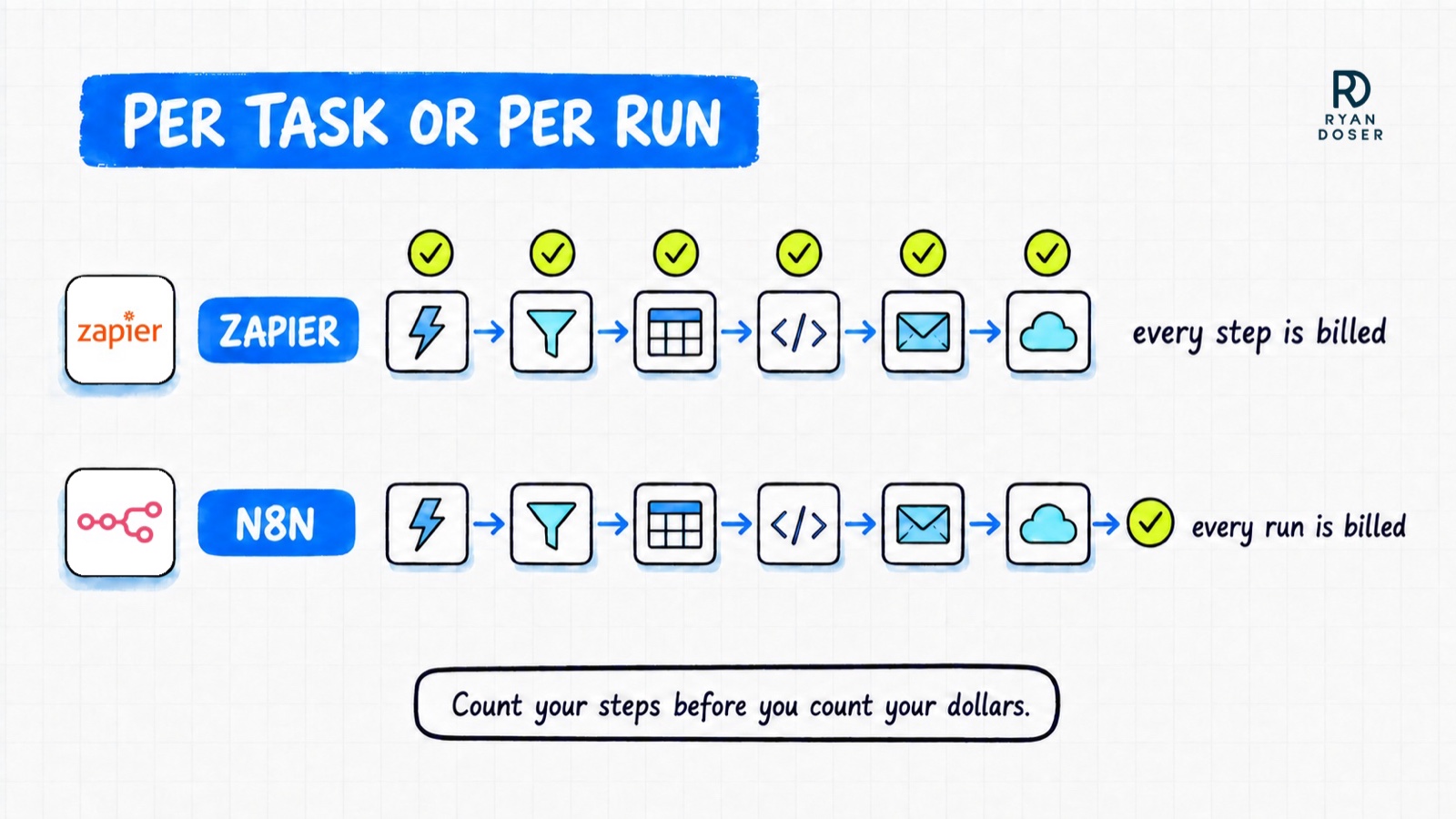
Zapier bills by task. A task is roughly one action your workflow performs.
The free plan gives you 100 tasks a month on two-step workflows.
Paid pricing is indexed to volume, so the entry number only holds at the smallest tier. Professional starts at $19.99/month for 750 tasks and Team at $69/month, both on annual billing, and every tier costs more month to month.
Zapier connects to 9,000+ apps, which is the widest library in the category by a distance.
n8n bills by workflow execution instead. One execution is a single run of your entire workflow, no matter how many steps it contains.
Starter is $20/month for 2,500 executions with unlimited steps, Pro is $50/month for 10,000, and Business is $800/month for 40,000. All are annual rates, and all include unlimited users.
It reaches about 2,000 integrations, well short of Zapier's library, though an HTTP request node covers anything with an API.
You can also self-host the community edition, where the software is free and you pay for the server instead.
| Zapier | n8n | Claude Code | |
|---|---|---|---|
| Billing unit | Per task (one action) | Per execution (one full run) | Model tokens |
| Entry paid price | $19.99/mo annual | $20/mo annual | $20/mo Claude Pro, plus a publishing tool |
| Cost of a 50-step job | Up to 50 tasks | 1 execution | Tokens for one conversation |
| Free tier | 100 tasks/mo, 2 steps | Free trial, or self-host free | No |
| Self-hostable | No | Yes, community edition | Already runs locally |
| Behavior | Deterministic | Deterministic | Probabilistic, varies per run |
| Breaks when | An app changes its API | A node or token expires | The model misreads the task |
| Learning curve | Lowest | Steepest | You must be fine in a terminal |
| Best at | Simple app-to-app triggers | Complex multi-step logic | Judgment calls on varied input |
Read the billing row twice, because it is the whole ballgame for content work. A fifty-step social workflow costs one execution on n8n and up to fifty tasks on Zapier.
Put real numbers on it. Say you publish 20 pieces of content a month and each one runs an eight-step workflow.
That is 160 billable tasks on Zapier, which clears the free tier and puts you on a paid plan. On n8n it is 20 executions against an allowance of 2,500, so you are nowhere near the ceiling and the step count never entered the math.
Scale it to 500 runs a month and the gap stops being academic. Zapier is metering 4,000 tasks while n8n is still counting 500 executions on a $20 plan.
That gap is why I moved off Zapier for publishing years ago, and I wrote up the full reasoning in my guide to Zapier alternatives for social posting.
Where Zapier Genuinely Wins
Most comparisons written by n8n fans skip this part, which makes them useless to anyone actually deciding.
Zapier has roughly 9,000 app connections. If the obscure tool your business depends on has an integration anywhere, it is probably here.
It is also the only one of the three your non-technical teammate can maintain without you. That matters more than automation people admit.
If your workflow is genuinely two or three steps, form fills to a spreadsheet, new customer to a Slack message, Zapier is the correct answer and the per-task model never bites you.
The model only punishes you when one input triggers many actions. That is content work almost by definition, and it is exactly the shape Zapier prices worst.
Where n8n Genuinely Wins
The per-execution billing is the headline, and it is a real structural advantage rather than a marketing line.
Complexity is free. Adding a twentieth step to a workflow costs nothing extra, so you build the logic the job actually needs instead of the logic your invoice can tolerate.
You can also self-host it, which is the reason a lot of technical operators pick it. Your data stays on your infrastructure and there is no per-seat conversation.
Two honest costs. It is the steepest of these to learn, and on the Starter cloud tier you only keep seven days of execution history, which is short when you are debugging something intermittent.
The bigger cost is the one nobody prices. Every node you add is a node you maintain.
Both of Them Already Ship AI Features
Before the third option, deal with the obvious objection, because a comparison that ignores it is not worth reading.
Both vendors shipped agent tooling, and it is genuinely good. Zapier MCP connects Claude, ChatGPT and Cursor to its 9,000+ app library, alongside Copilot for building Zaps from a description.
n8n went further into the canvas. It has an AI Agent node, LangChain nodes, and the ability to expose a workflow as its own MCP server.
So "can an agent drive it?" is no longer the question that separates these tools. The answer is yes on both.
The distinction that survives is where the agent sits. Both vendors put an agent inside a workflow you still design, maintain and pay for per task or per execution.
The third option removes the workflow. That is a different architecture, not a different feature, and it is the part neither company can sell you.
The Third Option: Skip the Workflow Builder
Here is the part that took me too long to work out, and it started as a complaint rather than a strategy.
As I put it to my community at the time: we used to go back and troubleshoot all these nodes in n8n, API keys were broken, something did not work, and I would scratch my head and take screenshots and upload them to Claude to try to get through it.
Read that again, because I did not notice what I was describing until later. I was using an AI agent to debug the automation that existed so I would not have to do the work manually.
The agent was already the more capable half of that arrangement. It was just stuck in a support role.
A workflow builder exists to solve one problem: software cannot make judgment calls, so you pre-decide every branch and encode it as nodes. That assumption held for a decade and it is the reason these tools are shaped the way they are.
It stopped being universally true. When the thing running your automation can read a video, decide which moments matter, write a caption in your voice, and call a publishing API, most of the branching you were encoding by hand is work it can just do.
Here is what mine actually is, since a vague description would be fair to criticize.
A scheduled job fires on my own machine and opens a Claude Code session with a written instruction, not a diagram. It reads the source video, picks the moments worth clipping, writes a caption per platform in my voice, and calls a publishing API over MCP.
In n8n that same job was a canvas of nodes: a trigger, a transcription step, branching logic per platform, a formatting node for each caption, and an error path I had to design in advance. The agent version is a paragraph of English and a cron entry.
What it costs: a Claude subscription I already pay for, plus the publishing tool. There is no per-task meter and no per-execution meter, so the cost of a run scales with how much thinking it does rather than how many steps I drew.
Now the failure modes, because they are real and the vendors never list theirs either.
It fails differently than a workflow does. A broken node throws an error you can see, while an agent that misreads the task produces something plausible and wrong, which is worse because nothing alerts you.
Mine once reported a finished run against an empty folder, because the rendering job was still processing when the conversation ended. A workflow builder would have caught that with a wait node I had explicitly drawn.
So I write the checks back in. The agent has to confirm the files exist before it moves on, which is me re-adding, in English, the one thing the node graph gave me for free.
That is the honest shape of this trade. You give up guaranteed repeatability and you get back the hours you spent maintaining branches.
It is the least deterministic option of the three, and I go deeper on that tension in my conversation with an automation expert about whether n8n is dead.
Deterministic vs Probabilistic Is the Real Decision
One word separates these tools, and it is not price.
Zapier and n8n are deterministic. You build the route and the workflow fires the same way every single time.
An agent is probabilistic. Run the same instruction twice and you can get two slightly different results.
For mission-critical work, deterministic wins and it is not close. If you are sending a thousand client invoices, you need the same output a thousand times, and a fresh roll of the dice on each run is unacceptable.
Nobody cares if a morning content summary varies slightly in phrasing. People care enormously if a billing run does.
So the question is not which tool is better. It is whether variation in your particular job is a defect or a feature.
Content is the rare category where variation is closer to a feature. Ten captions that read slightly differently is the goal, not a bug report.
Which One Should You Pick?
Answer one question and this resolves faster than any feature table.
Does your automation require judgment, or just plumbing?
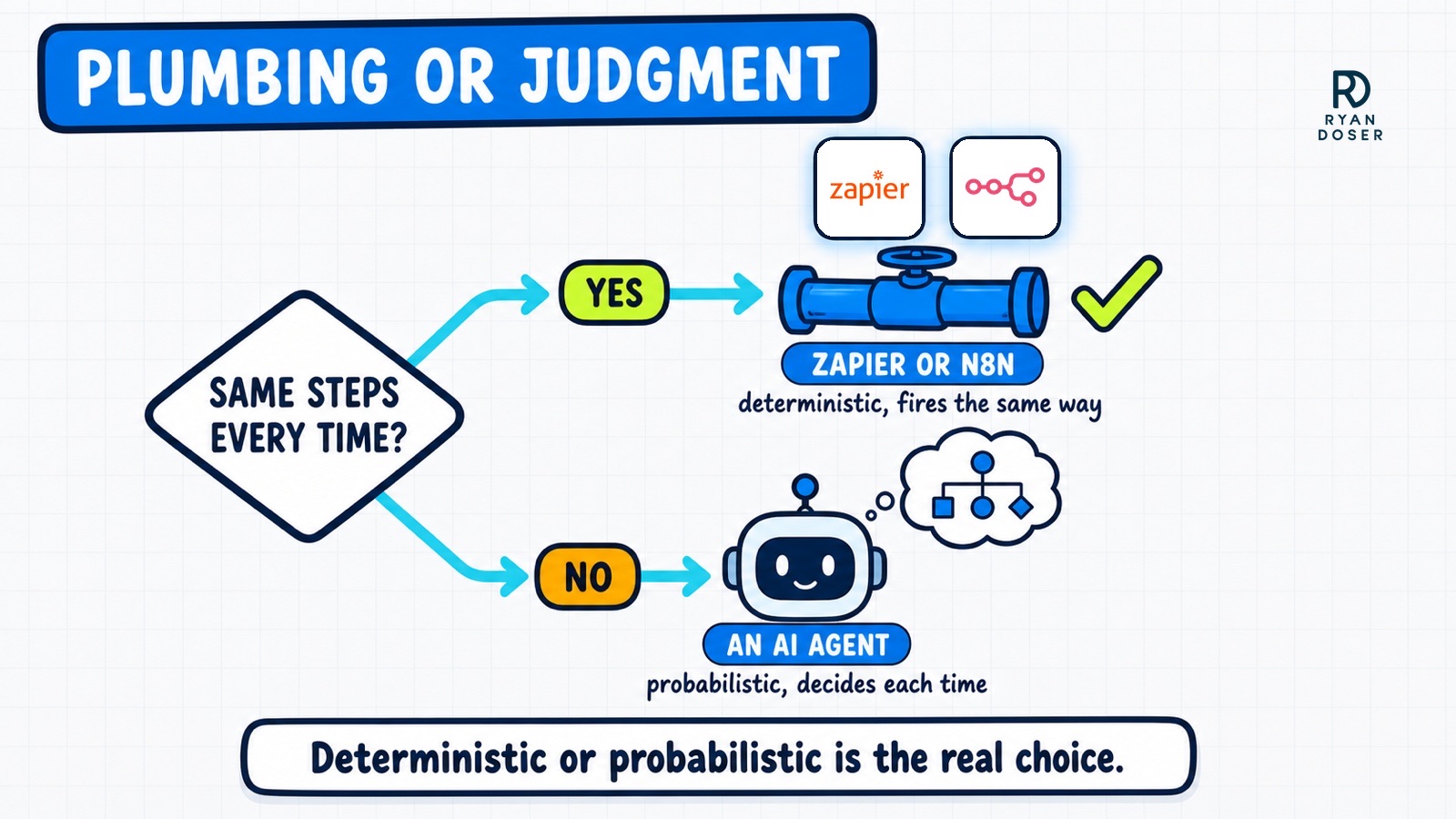
Plumbing means moving data between apps with no decisions in the middle. Pick Zapier if it is simple and you want it maintained by anyone on your team, or n8n if it is complex and you want complexity to stay free.
Judgment means something has to read, weigh, and decide before acting. That is where an agent earns its place, and where a node graph turns into a maintenance project.
Most real setups are a mix, and mine still is. I keep deterministic tools for anything where a wrong result is expensive, and let the agent own the judgment-heavy content work.
If the agent path is the one you want, the piece people underestimate is publishing. An agent that writes a great post still needs somewhere to send it, and per-platform API approvals are their own project.
That is the job I hand to Blotato, at $29/month flat for 20 connected accounts, because the bill does not move when I add an account or post more often. I compared it honestly against the self-hosted option in Postiz vs Blotato, including where Postiz is the better pick.
Ryan's Final Thoughts
The Zapier vs n8n framing assumes you need a workflow builder and are only choosing which one. For a lot of content work in 2026, that assumption is the thing worth questioning.
Zapier is right for simple plumbing maintained by a team. n8n is right for complex deterministic logic where you want the steps free and the data yours.
An agent is right when the work needs judgment and you are tired of encoding every branch by hand.
What I would not do is pick based on a comparison page written by either company, including the parts of this one where I have money on the table. Open both pricing pages, count what one piece of your content actually costs in tasks and in executions, and let that number decide.
Zapier vs n8n FAQs
Is n8n cheaper than Zapier?
Usually, and the reason is the billing unit rather than the sticker price. Their entry tiers are close on paper, at $19.99/month for Zapier Professional and $20/month for n8n Starter, both on annual billing. Zapier charges per task, so a fifty-step workflow can bill many times over. n8n charges per execution, so that same workflow costs one. The more steps you run, the wider the gap.
Is n8n harder to learn than Zapier?
Yes, noticeably. Zapier is the easiest automation tool to hand to a non-technical teammate, and that is its genuine advantage. n8n expects you to think about data structures and node connections, which is why it handles complex logic better. Budget real time for n8n if you have never used a node-based builder.
Can Claude Code replace n8n?
For judgment-heavy work, often yes. For mission-critical deterministic work, no. n8n runs identically every time, while an agent is probabilistic and can vary between runs. Use an agent where variation is acceptable or even desirable, like content, and keep a deterministic tool where a wrong result is expensive, like billing or client deliverables.
Is n8n free?
The community edition is free to self-host, and you pay in server costs and maintenance instead of subscription fees. Cloud plans start at $20/month billed annually for 2,500 workflow executions. Zapier's free tier gives you 100 tasks a month on two-step workflows, which is enough to test the concept and not much else.
Can Zapier replace n8n?
For simple app-to-app automation: yes. Zapier is easier to build in and easier to hand to a teammate. For high-volume or complex workflows: no. Zapier bills every action while n8n bills the whole run once, so a 50-step job costs up to 50 tasks against 1 execution. For self-hosting: never. Zapier is cloud-only, so if your data must stay on your own infrastructure it cannot replace n8n at any price.
Which is better, n8n or Make or Zapier?
It depends on the billing shape your work has. Zapier wins on app coverage and ease, at roughly 9,000 integrations. Make sits in the middle, cheaper than Zapier because it bills per operation rather than per task, with a more visual builder than n8n. n8n wins at volume and complexity because one execution covers unlimited steps, and it is the only one of the three you can self-host. I ranked all three plus the agent-native options in my guide to AI automation tools.
Is there anything better than n8n?
For deterministic workflow automation, not really at the price. n8n is the cheapest option at volume and the only one of the three you can self-host. What beats it is a different architecture rather than a better builder: when the work needs judgment on varied input, an AI agent calling tools directly removes the workflow instead of optimizing it. For anything that must run identically every time, n8n still wins.
Is there anything better than Zapier?
For most high-volume work, yes. n8n is cheaper at scale because it bills per execution rather than per action, Make sits between the two on price, and an AI agent can replace the workflow entirely when the job needs judgment. Zapier stays the better answer for simple two-step automations, for the widest app library at 9,000+, and for teams without a technical maintainer.
Which is better for social media automation?
Neither one publishes for you, which is the detail most comparisons skip. Both are orchestration layers that still need a publishing tool with platform API access behind them. Social posting is many actions per piece of content, so per-task billing punishes it hardest, making n8n or an agent the better fit over Zapier.
Disclosure: some links in this post are affiliate links, specifically Blotato. If you buy through them I may earn a commission at no extra cost to you. Blotato is also a client of mine and my account there is comped rather than paid. I have no relationship with Zapier or n8n. I only recommend tools I actually use. Full disclosure.