
Lovable vs Claude Code: Why a Non-Coder Picks Claude Code
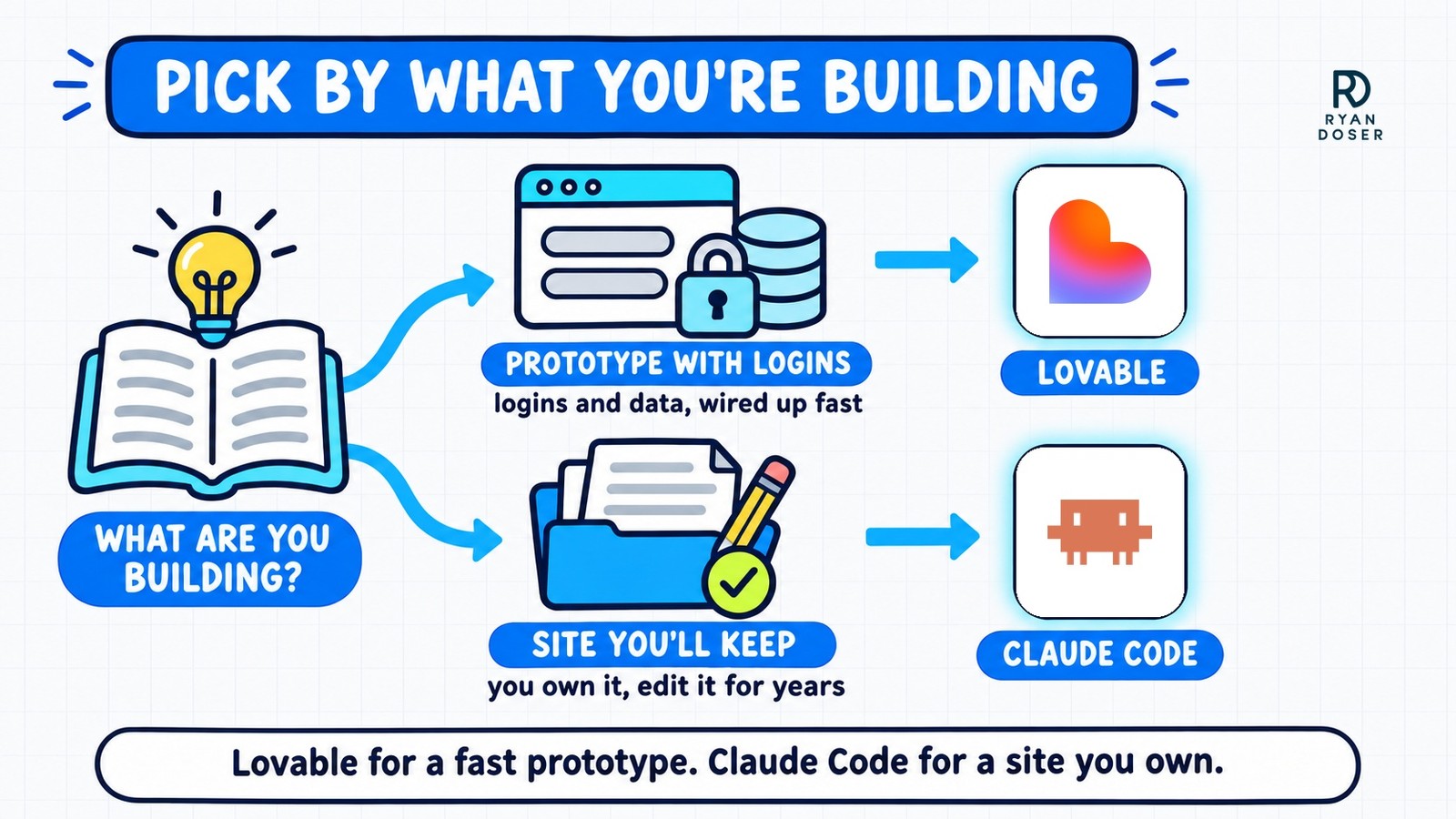
My answer to Lovable vs Claude Code splits by project: Lovable for a fast app with logins and a database, Claude Code for a site I want to control and keep editing for years. Four AI assistants told non-coders to pick Lovable on November 21, so here's where they're right and where I disagree.
Lovable vs Claude Code: My Short Answer
Lovable is a browser-based AI app builder with built-in hosting and a backend. Claude Code is Anthropic's AI coding agent, which writes and edits the code for websites, apps and other software from plain-English instructions.
Both tools can put a business site online. The split comes down to what you want handled for you:
- Pick Lovable if you want user logins and saved data working this week, you'd rather not manage files or hosting, and you're fine with Lovable choosing the AI model.
- Pick Claude Code if you want to choose the model, keep the files and hosting in your own accounts, and make sweeping edits long after launch.
Here's the Claude Code side in practice: Aaron Makelky and I building a Des Moines tire shop's homepage live from one short prompt.
Know my bias before the comparison. I sell Claude Code products, including my Claude Code Skills Stack, and I use Claude Code and Codex every day.
Four AIs Told Non-Coders to Pick Lovable
On November 21, ChatGPT, plus Claude, Gemini and Perplexity through their APIs, each got the Lovable vs Claude Code question from a non-developer's point of view, with web search on. All four said Lovable and framed Claude Code as a developer or technical tool.
Claude's answer went furthest, saying Claude Code "requires you to be a developer working in a real repository." That was one answer per assistant on one day, so treat it as a sample, not a study.
For a web app with logins, they have a point. On a marketing site, my experience says otherwise, and I've never been a developer.
I rebuilt ryandoser.com on Claude Code and Codex in early 2026. By mid-October it had led to over $50,000 in digital product sales, plus clients and email subscribers.
My Des Moines septic rank and rent site runs on the same stack. It was bringing in about three to five leads a week as of October 15.
Those results show a non-coder can build and run a business site on Claude Code. They can't show how the same sites would have done on Lovable.
You talk to Claude Code the way you'd brief a contractor. It runs in a desktop app, VS Code, JetBrains editors and the web, so the black terminal window is optional.
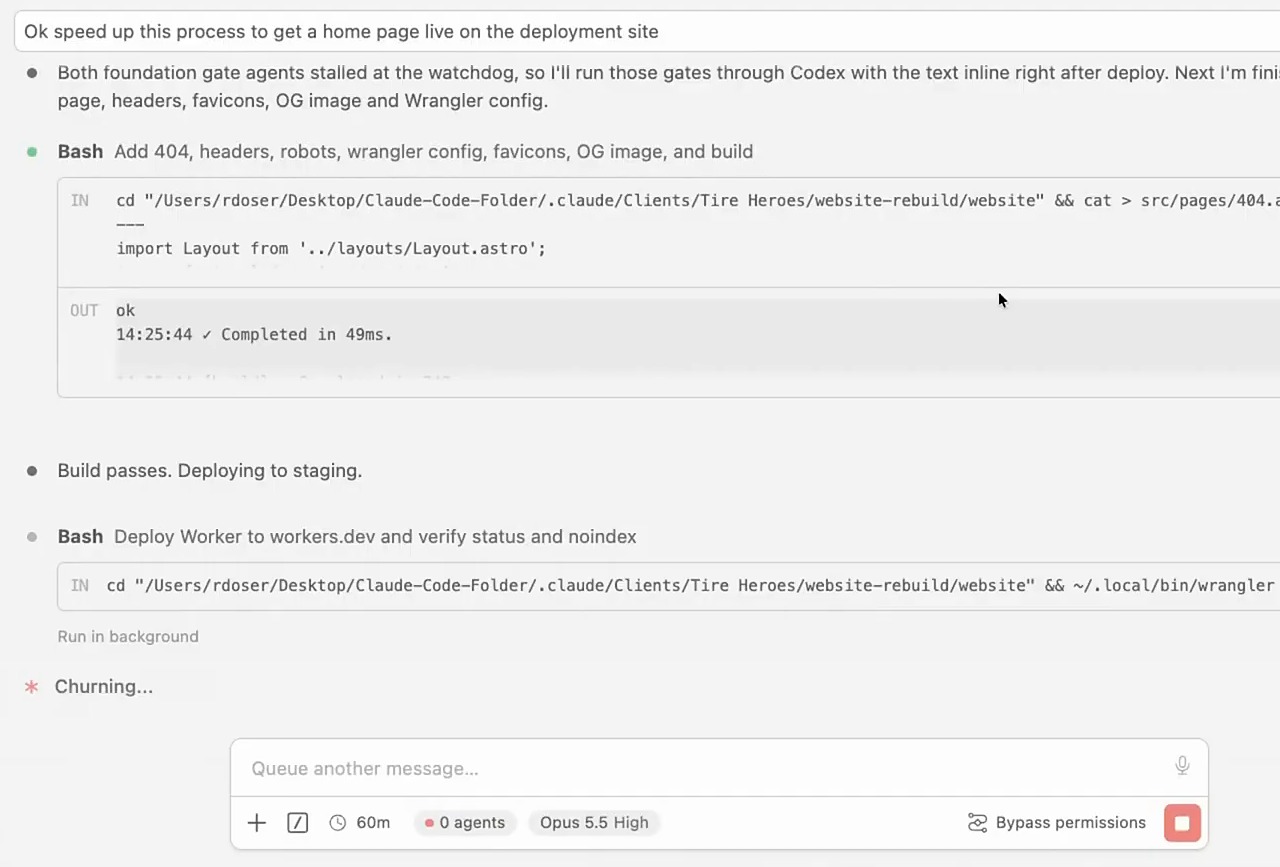
The tradeoff is upkeep. You'll set up free accounts at GitHub and Cloudflare, and you're responsible for the hosting, plus logins or a database if your project needs them.
My guide to vibe coding a website walks through that first setup step by step.
Lovable vs Claude Code Side by Side
Both get pitched as "describe it and it builds it," and that part is true of each. The table covers the parts that differ.
| As of Nov 21, 2026 | Lovable | Claude Code |
|---|---|---|
| Where you build | A chat window in your browser | Desktop app, VS Code, JetBrains or a terminal on files on your computer, or a cloud copy on the web version |
| Who picks the AI model | Lovable | You, from a model menu |
| How usage is measured | Credits, charged by the size of each job | Claude plan limits that reset every 5 hours and every week |
| Cheapest paid plan (monthly billing) | Pro, $25/mo with 100 monthly credits | Claude Pro, $20/mo |
| Free option | 5 credits a day, capped at 30 a month, invite-only publishing, no custom domain | None (not on Claude's Free plan) |
| Logins and database | Built in (Lovable Cloud) | You set them up with a service you choose |
| Where the code lives | Lovable, with two-way GitHub sync on every plan | Your computer and your GitHub account |
| Hosting | Included | Your own account, such as Cloudflare's free plan |
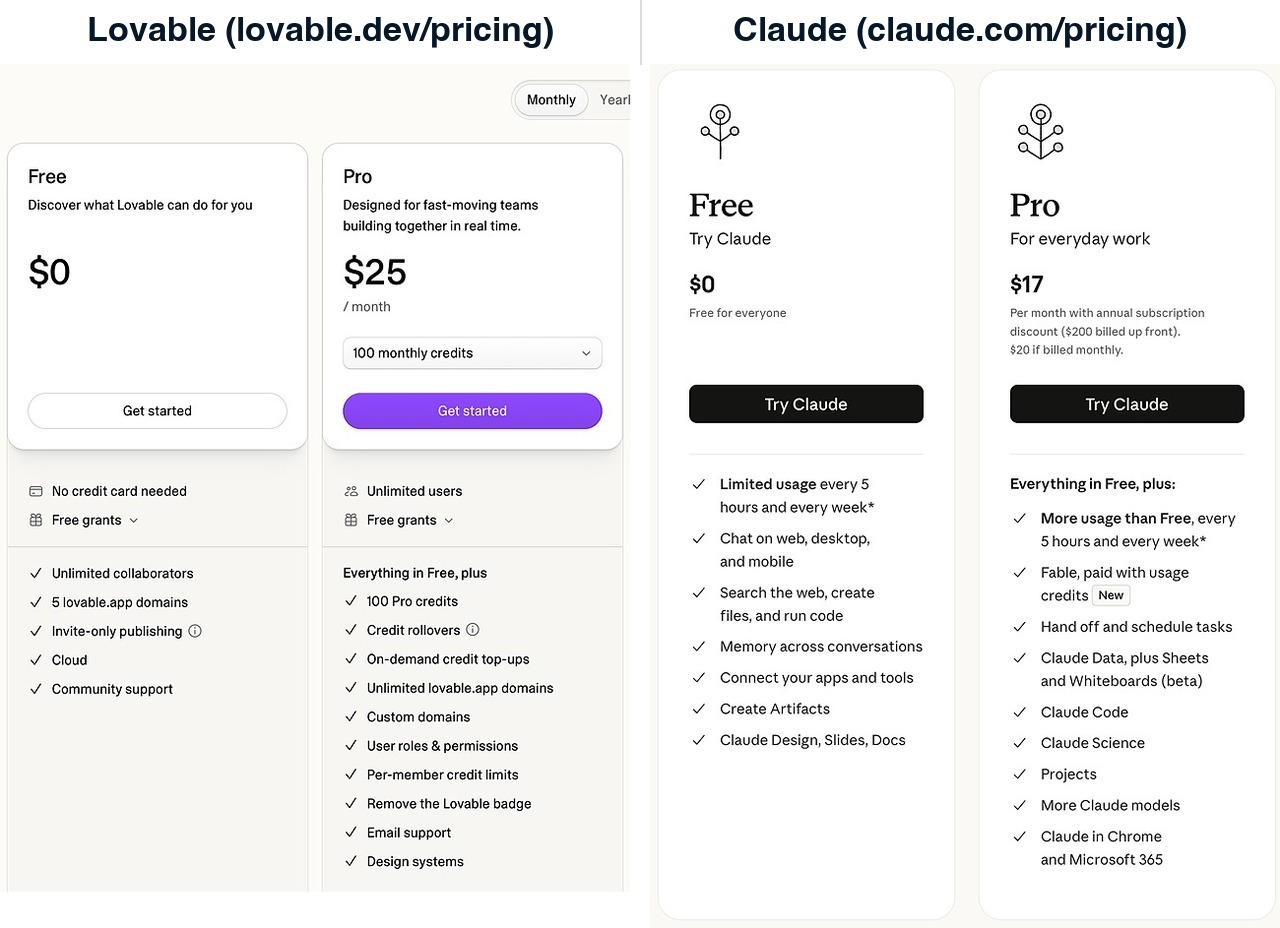
Lovable meters work in credits that grow with the job. Its own credits page lists 0.5 credits to make a button gray and 2 for a landing page with images, and says actual usage varies.
Claude Pro uses limits that reset every five hours and every week instead. For scale, I pay for a $200-a-month Claude plan because I run nine sites.
Readability by AI search is the other thing to check. In my 749-site test of AI website builders in October, ChatGPT could quote 7.7% of lovable.app homepages on Lovable's older stack and 85.0% on its newer one.
Most of the 302 Lovable sites sampled (73.5%) were still on the older stack. The test covered existing lovable.app homepages and ChatGPT only, so it can't tell you how a project you start today will fare.
Where Lovable Beats Claude Code
In any fair Lovable vs Claude Code comparison, Lovable's biggest win is getting an app with user accounts and a database online fast. Its built-in backend, Lovable Cloud, wires up logins and data storage for you, and hosting comes with it.
Claude Code can build that kind of app too, but you pick and connect those pieces yourself. A non-coder feels that extra work on day one.
Lovable also skips the setup. You don't need a GitHub account or a hosting account before your first preview, and the Free plan lets you try it at no cost.
My own Lovable experience is thin. I've used it once, and for a business site I don't recommend it, for the model and ownership reasons below.
Aaron is the one who built on Lovable and moved off it after a friend asked where his code lived. That story, and the "Lovable tax" argument we had on the show, are in is Lovable worth it.
Who Picks the AI Model in Lovable vs Claude Code
This is the difference I personally care about most. Lovable's FAQ says it chooses the model behind its build, plan and chat modes, "so you cannot pick a specific model for building."
Claude Code gives you a menu instead. Here's mine mid-build, with Opus 5.5 selected and effort set to high:
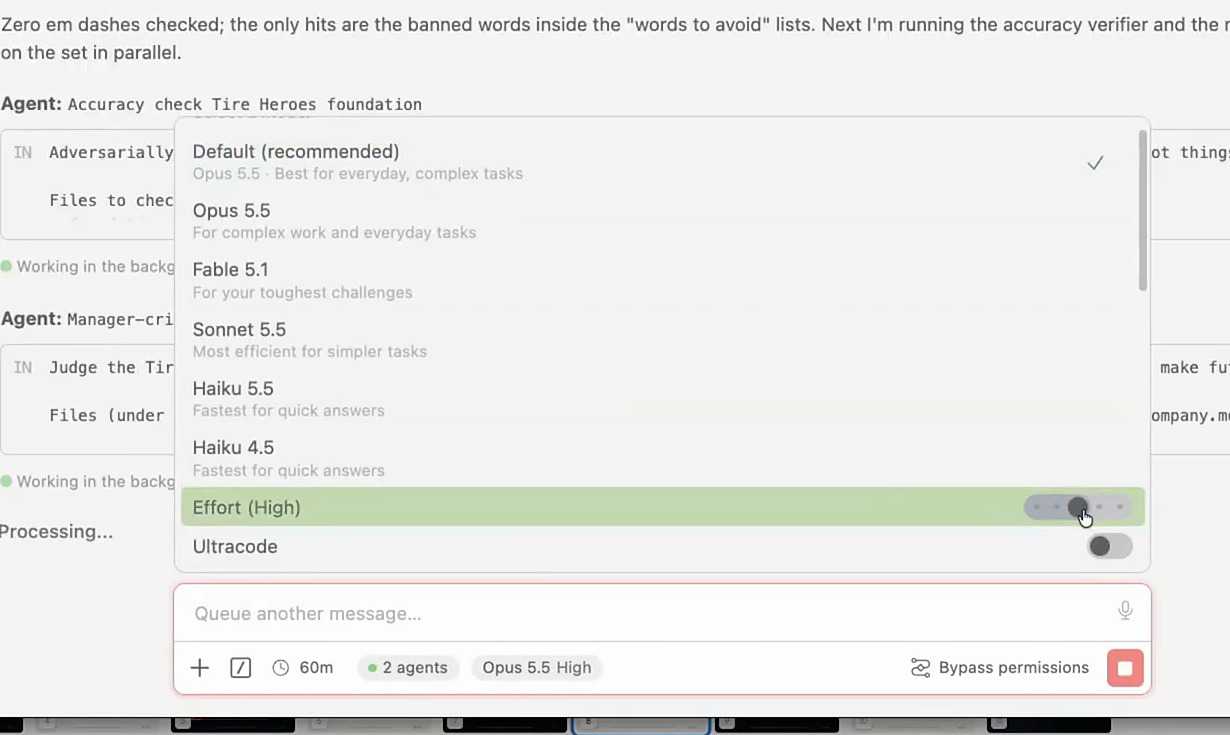
That choice has two practical effects. You can send a full build to Opus and a quick text fix to Sonnet, which Claude's own menu labels "most efficient for simpler tasks," and you can move to a better model the day it ships.
I run most site work on Opus 5.5 on high and have Codex check it. Lovable's GitHub sync makes that kind of second opinion possible there too.
With Claude Code, the files live on your computer and Claude pushes them to your own GitHub repo, where any agent you give access can open them.
What Lovable vs Claude Code Costs for a Year
Here's one simple five-page marketing site priced both ways, on monthly billing as of November 21, 2026:
- Lovable: Pro at $25 a month comes to $300 a year, and a custom domain needs a paid plan.
- Claude Code: Claude Pro at $20 a month comes to $240 a year, with GitHub and Cloudflare hosting at $0 for a site this size.
Both sides add a domain, about $10 a year for a .com. Billed yearly, the plans drop to $250 and $200, so the gap stays around $50 to $60, which is too small to decide anything.
The bigger factor is overlap. Claude Pro also covers your writing, research and the rest of your Claude work, so if you already pay for it, Claude Code adds no new subscription.
Lovable vs Claude Code After You Cancel
Lovable deserves credit here. Its docs say published apps stay live on the Free plan after you cancel, and two-way GitHub sync works on every plan, so your code can sit in your own repo.
The backend is the harder part. Lovable's ownership docs list managed or self-hosted Supabase as the supported destinations for its built-in backend, and say moving the database alone doesn't move your logins.
For a brochure site that stores no data, the backend barely matters, and either tool leaves a live site behind. Once logins, saved data or even a contact form run through Lovable Cloud, that's the work you'd face if you ever leave.
On the Claude Code side, the files live in your GitHub account and the site runs on your hosting account. Canceling Claude leaves it online and open to another tool like Codex.
That matters most in year two. On our Lovable episode, I put it this way: "I can make updates in a matter of seconds now across site wide, adding internal links."
Here's a real one from my site's git history. On November 20, 13 minutes after the commit that published my Lovable alternatives post, one custom follow-up command I built for Claude Code added links to it from six older pages and tightened the new post, all in a single commit.
In Lovable, a multi-page job like that is billed in credits by its size, and the docs give examples, not a fixed price per job. With Claude Code, it came out of the same Claude plan I use for everything else, with no per-job meter.
Lovable's docs also say edits made in a tool like Claude Code and synced back use no Lovable credits. If that's where your edits end up, a simple custom-domain site leaves Lovable as a $25-a-month layer doing hosting that Cloudflare's free plan already covers.
Build the Site Where It Will Live
If you're testing an app idea with logins this week, Lovable's Free plan, which publishes to invited testers only, is a fair way to find out whether the idea holds up. My five picks for builders that start in a folder you own are in my Lovable alternatives roundup.
If the site has to earn money for years, my Lovable vs Claude Code pick is Claude Code. You pick the model, the files and hosting sit in your accounts, and a multi-page update comes out of a plan you already pay for.
Lovable vs Claude Code FAQs
Can a non-developer use Claude Code?
Yes. I'm a marketer who doesn't write code, and both ryandoser.com and my Des Moines septic site were built with Claude Code and Codex. You type plain instructions in the desktop app, VS Code or the web. The hard part is setting up free code storage and hosting, then keeping the site running. For an app with logins and a database, expect more work than in Lovable.
Is Claude Code cheaper than Lovable?
Slightly, on paper. As of November 21, 2026, Claude Pro, which includes Claude Code, costs $20 a month billed monthly, and Lovable Pro costs $25 for 100 monthly credits. Hosting a simple site on Cloudflare adds $0, and both need a domain. Heavy building can outgrow Claude Pro's limits, and Lovable charges more credits for bigger jobs, so price both against your own workload.
Can I use Lovable and Claude Code together?
Yes. Lovable's Git sync keeps your project in a GitHub repository with two-way sync, so you can open that repo in Claude Code, commit changes and see them back in Lovable. Lovable's docs say edits you make and commit outside Lovable use no Lovable credits. Only commits on the synced branch show up, and the built-in backend still runs through Lovable.
Is Claude Code free?
No. As of November 21, 2026, the cheapest subscription that includes Claude Code is Claude Pro at $20 a month, or $17 a month billed yearly. Developers can also pay per use with prepaid credits through a Claude Console account. Lovable is the one with a free tier: 5 credits a day, capped at 30 a month, with invite-only publishing and no custom domain.