
Is the Higgsfield Content Factory a Scam? The Faceless AI Math
The Higgsfield Content Factory turns a one-line "What if" idea into a finished faceless video, and in the days around its launch it was pitched online as a money printer. I reran Mark Quadros's math with Higgsfield's own prices: a one-minute video costs about $2.71 in credits on the Ultra plan ($3.15 by Higgsfield's own estimate), while $1,000 a month in platform payouts takes 1 to 2.5 million qualified TikTok views.
What the Higgsfield Content Factory Actually Does
Higgsfield launched the Content Factory on October 22, 2026. You type a question like "What if light got slower every day?" and it writes the script, picks characters, generates scenes with voiceover and edits the video.
Videos run from 15 seconds to 5 minutes, with up to four episodes per run. Higgsfield's Content Factory launch post prices a one-minute video at 63 credits, which it estimates at about $3.15.
That launch post makes no income claims. It even tells you to check medical, scientific and historical claims in the narration before you publish, which is work the hype videos skip.
That checking step is where most AI content falls apart, and it's the part I keep for myself. My Claude Code Skills Stack holds the research and content skills I run for my own marketing.
Who Sold the Higgsfield Content Factory as a Gold Rush
The income pitch came from the people posting about it. Mark Quadros, who calls himself a B2B video strategist, collected the posts he could find about the Higgsfield Content Factory from October 21 to 23 and counted 79 of them, with 928,850 views between them.
By his count, 42 sold making videos with less work and 24 sold making money with it. Lines like "Holy F*CK this is the next gold rush" did the selling.
Higgsfield's own blog was selling the faceless-channel dream months before this launch. Its June 16, 2026 post titled "Recreate a $39,500/Month Faceless YouTube Channel With AI" says it "analyzed a faceless channel making nearly $39,500 every single month," then tells you to "start scaling your channel hands-free."
The only channel that post names is Bright Side, linked as the "target channel" for its script prompt, and it never says how the $39,500 was measured or whose earnings they are. It also skips what a typical channel earns, which is the number a buyer would need.
Higgsfield also pays creators to post its videos. Its Higgsfield Earn page promises "a payment for every approved video" and tells creators to "BOOST YOUR EARNINGS BY 130%," so some of the excitement in your feed may be paid, though I can't tell which of Mark's 79 posts, if any, were.
A paid post should say so, and the FTC's Disclosures 101 guide counts "the brand paying you" as a connection the post has to make obvious. I covered Earn's payout caps and why I turn down Higgsfield's sponsorship offers in my Higgsfield alternatives breakdown.
The Higgsfield Content Factory Math, Platform by Platform
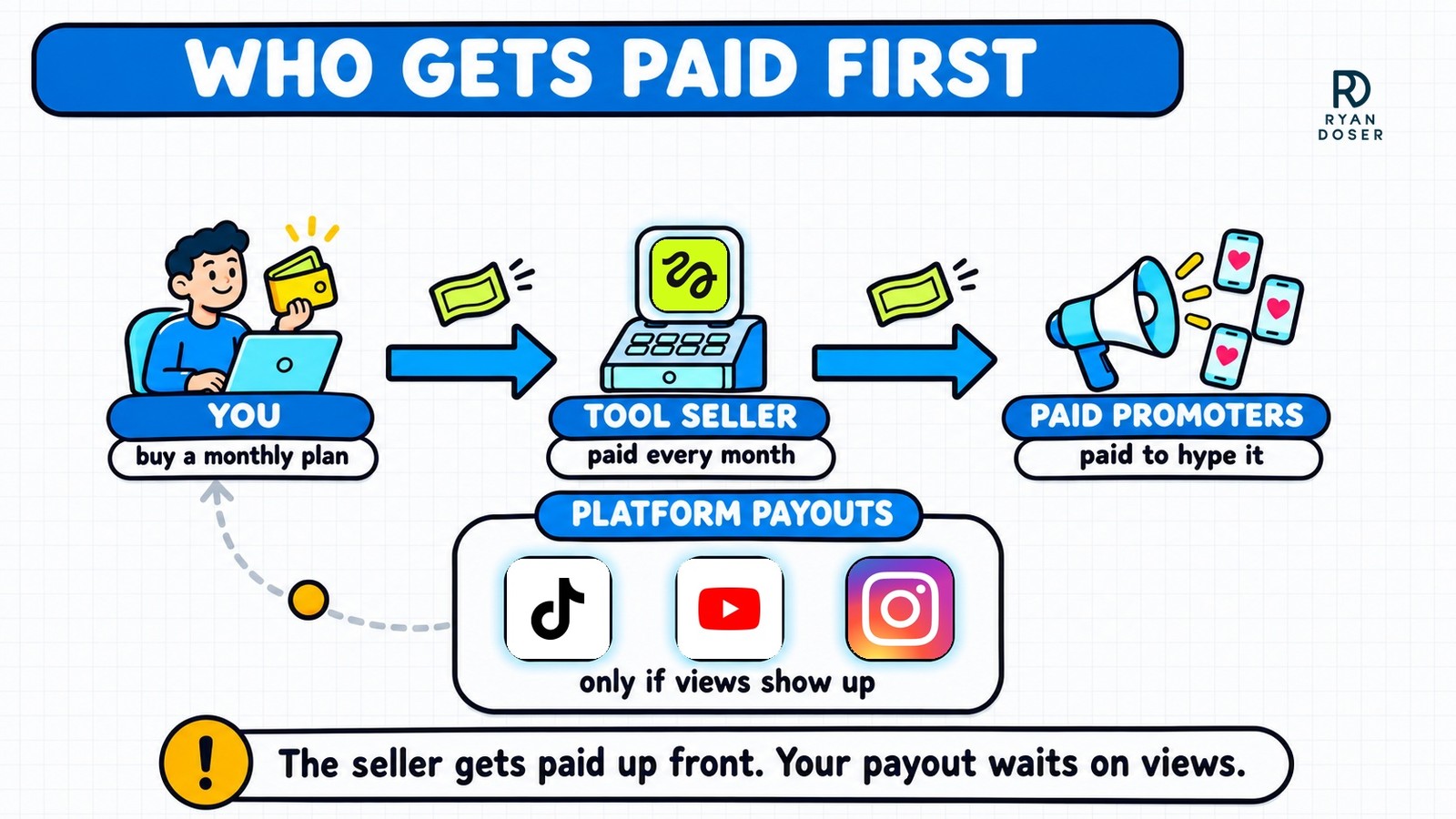
Start with the cost. As of November 11, 2026, Higgsfield's Ultra plan lists at $129 a month on monthly billing for 3,000 credits, enough for 47 one-minute Content Factory runs at about $2.71 in credits each.
A sale this week drops Ultra to $65 a month on yearly billing, which roughly halves that. Mark budgeted 30 videos per Ultra plan at $4.30 each, so Higgsfield's own 63-credit price makes each video cheaper than he assumed, and the conclusion still lands in the same place.
The payout side is where it breaks. Here is what $1,000 a month in platform payouts takes, before the plan and your time, if you max out Ultra at 47 one-minute videos.
| Platform (read Nov 11, 2026) | Pays per 1,000 views | Views for $1,000 | Average views per video (47 videos) | Before you earn anything |
|---|---|---|---|---|
| TikTok Creator Rewards | About $0.40 to $1.00 (estimate) | 1 to 2.5 million qualified views | About 21,000 to 53,000 | 10,000 followers and 100,000 views in 30 days |
| YouTube Shorts | About $0.07 to $0.20 (estimate) | 5 to 14.3 million views | About 106,000 to 304,000 | 1,000 subscribers and 10 million Shorts views in 90 days |
Neither platform publishes a fixed payout rate, so I built the ranges from published estimates. The TikTok range is Metricool's March 2025 estimate, and the Shorts range comes from AIR Media-Tech's 2026 study of 274 channels.
AIR puts US-heavy channels at about $0.33 per 1,000 views, which still means about 3 million Shorts views for $1,000.
Mark used flat rates of $0.60 and $0.05 per 1,000 views, which put him at 1.7 million TikTok views or 20 million Shorts views. The entry gates come from TikTok's Creator Rewards page and YouTube's Partner Program rules, and Creator Rewards only pays on videos at least one minute long.
Mark puts Instagram Reels at nothing for most accounts. He also figures about an hour per video to write, check, fix and post, which turns 47 videos into 47 hours a month.
So the plan is the easy part. The hard part is a new account clearing those gates, then averaging tens of thousands of views per upload.
Platform Rules Faceless AI Content Factories Run Into
Even if the views come, both platforms reward originality over volume. On July 15, 2025, YouTube renamed its "repetitious content" policy to "inauthentic content" and clarified that it covers "content that is repetitive or mass-produced."
YouTube clarified that policy in July 2026, spelling out three types of "inauthentic content" that can't be monetized, TechCrunch reported.
TikTok's Creator Rewards program defines original content as "designed, filmed, and produced by you" and showcasing "your expertise, talent, or creativity." TikTok decides how a Higgsfield Content Factory video measures up, and a template question plus one button gives you little to point to.
You'd also be entering a crowded feed. In Kapwing's November 2025 AI slop report, 104 of the first 500 Shorts shown to a fresh YouTube account were AI-generated, so a faceless AI content factory starts out competing with a lot of lookalikes.
How to Spot a Misleading AI Content Demo
Much of the hype runs on demos that skip the messy middle. Video editor Vlad Sateev took apart several viral "Claude edited this whole video" clips in the breakdown below.
In one clip Vlad points to, the Mac clock jumps from 1:39 PM to 3:29 PM between cuts, almost two hours the viewer never sees, while the creator credits the AI with the whole edit.
In another, the first link in the description goes to Higgsfield, and Higgsfield published its own blog post built around that video. Vlad calls that a red flag but says he isn't sure about the relationship.
Borrowing from Vlad's breakdown, run these checks before you buy the Higgsfield Content Factory or anything else a demo sells you:
- Watch the on-screen clock and the cuts. A gap of hours means you didn't see how the work got done.
- Open the description. A tool link can be an affiliate link or a sponsorship, so look for a disclosure.
- Ask whose money it is. An income figure without the channel and how it was measured proves nothing.
I hit the same wall when I tried to replace my video editor with AI. The tools save time on pieces of the job, and the demos make it look like the whole job.
Where a Higgsfield Content Factory Is Worth Running
Mark still runs a content factory, and he ran one for enterprise SaaS clients from 2019 to 2024 with human writers and editors. What changed is what the factory feeds.
His old one fed the $400 to $600 links he sold inside the articles. Today's slop factories feed ad revenue paid out in fractions of a cent per view.
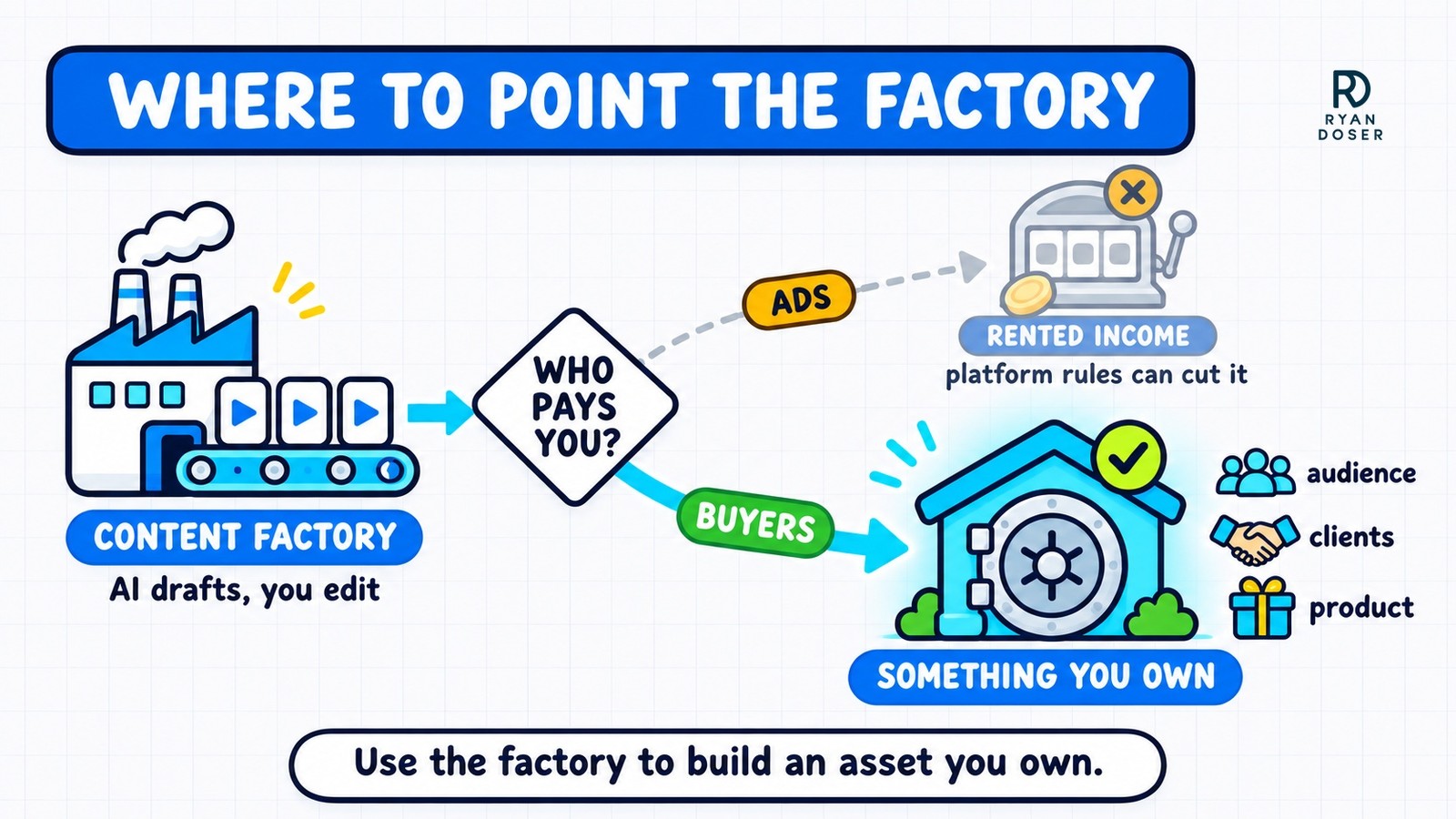
So if you use the Higgsfield Content Factory, point it at buyers. Use it for ad hooks, product explainers or short videos that send viewers to your offer, and judge it on leads and sales instead of views.
Mark's test is worth running on any money idea: "Who pays you, and can they stop tomorrow?" If the honest answer is a platform payout, you're renting the income.
My list of AI side hustles for marketers that actually pay starts from skills someone already buys.
Buy the Tool for Videos, Skip the Payout Dream
The Higgsfield Content Factory makes usable faceless videos for about $3 a minute in credits. What I'd call a scam is the income pitch around it: that one button gets you a faceless channel paying thousands a month, pushed partly by a company with a paid creator program.
The math in this post builds on Mark Quadros's X article on the Higgsfield Content Factory, published November 11, 2026, where he did the original cost and payout math. Credit to Mark (@dherealmark on X) for the research behind it.
Higgsfield Content Factory FAQs
Is the Higgsfield Content Factory a scam?
The tool itself turns a "What if" idea into a faceless video for 63 credits a minute, per Higgsfield's launch post. The misleading part is the income pitch around faceless AI channels, including Higgsfield's June 2026 blog headline about a "$39,500/Month Faceless YouTube Channel" that never says how the figure was measured, and an Earn program that pays for approved creator videos.
Is Higgsfield legit?
Higgsfield is an established company that announced a $400 million Series B in August 2026, and its video tools work. Judge its marketing separately from its software. Because its Earn program pays per approved creator video, treat glowing posts as possible ads unless they disclose otherwise, and price any plan in credits per finished video before you buy.
How much does a Higgsfield Content Factory video cost?
Higgsfield prices a one-minute Content Factory video at 63 credits and estimates that at about $3.15. On November 11, 2026, the Ultra plan listed at $129 a month on monthly billing for 3,000 credits, which covers 47 one-minute runs at about $2.71 each. A sale that week cut yearly billing to $65 a month, and retries cost extra credits.
Can you make money with a faceless AI content factory?
Not reliably from platform payouts alone. At published estimates, $1,000 a month in payouts takes 1 to 2.5 million qualified TikTok views or 5 to 14.3 million Shorts views, after you pass each platform's follower and view thresholds. YouTube and TikTok also reward original work over mass-produced content, so pointing the factory at a product you sell gives each view a bigger job.