
Will AI Replace Marketing Jobs? (Who Still Gets Hired)
Nick LeRoy runs SEOjobs.com, a job board for SEO roles, and his answer to will AI replace marketing jobs is a rule you can test on your own role: "if you can bullet point your job, then you're replaceable by AI." From the hiring side, he sees entry-level hires and marketers with two to five years of experience "getting impacted most," while proven people still get hired.
Will AI Replace Marketing Jobs? The Short Answer
Nick sees the job market from both sides, as a solo SEO consultant and as the guy running an SEO job board. He joined me on AI Rabbit Holes to explain who AI is actually pushing out.
Nick's short answer is a split: AI is replacing the marketing tasks you can write down as a checklist, which hits junior roles hardest, while marketers who prove judgment and results keep getting hired.
He put the hard part plainly. The checklist crowd "genuinely is the larger portion of SEOs and they are being replaced."
In his words, "These are the jobs that aren't becoming available."
My own take on camera covered more ground. A traditional marketing job, like the one I started in, is one "where half of those jobs could be replaced by AI now."
Nick's split matches the huge gap I see in my own work. Plenty of SEOs still follow a plugin's green lights, while others build agents and skills, like the GitHub repos and content decay systems I run behind the scenes.
My Claude Skills Stack holds the skills I run for my own marketing.
Will AI Take Over Marketing Jobs? The Market Split in Two
A year ago, Nick says, he would have simply called the SEO job market down. It's still down, but now he sees two markets.
Senior people who have led teams or proven themselves as consultants are "still very healthy," in his words, because they're seen as the people who can train the AI. People with two to five years of experience and entry-level hires are "what's getting impacted most."
His blunt version: "AI can do everything that an intern or right out of school SEO can do. Faster, cheaper, better."
Supply makes it worse. Nick says the supply of SEOs is now higher than the demand, and employers in a down market want "one level above for the pay below."
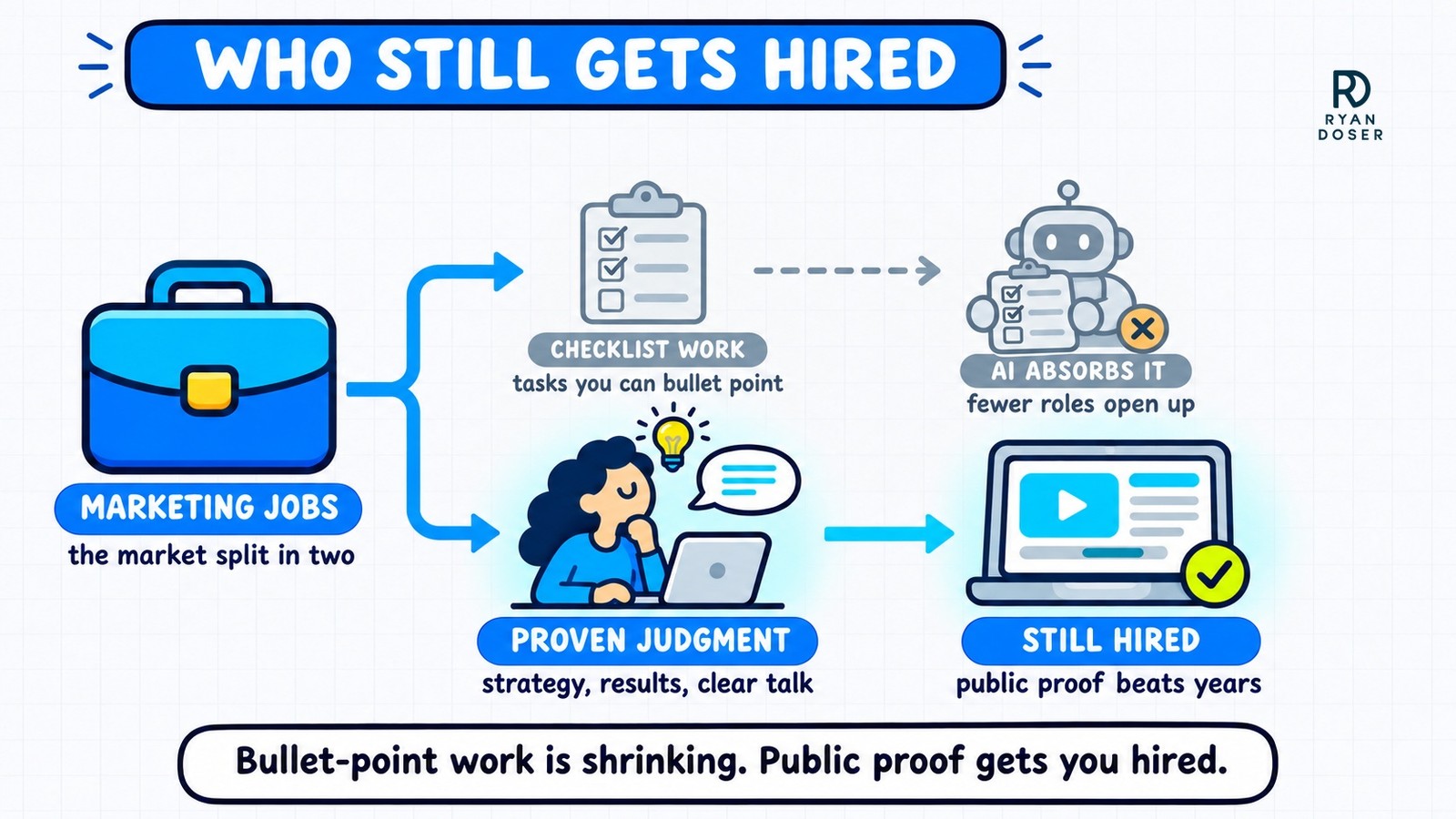
So "will AI replace marketing jobs?" gets a split answer. On Nick's read, AI is removing the bottom rung most of us climbed, and that hurts new grads long before it touches a senior strategist.
Will AI Replace Marketing Jobs Like Yours? Try the Bullet-Point Test
That bullet-point rule comes from a post Nick wrote. He means people who follow somebody else's SOP well but never built the playbook themselves.
On the episode I called this group checklist SEOs, a term I credited to Nick (his own word for it is checkbox SEO). Think Yoast or Rank Math: all the lights are green, so you hit publish without asking about search intent or whether the article fits your ICP.
It's a close cousin of what I called button clickers in my post on AI replacing marketing agencies.
Here's his line turned into a quick self-check. Write down what you did last week, then sort where the hours went:
- Following steps: work someone could hand you as a list, like changing title tags and meta descriptions.
- Making calls: deciding what to publish and why, or picking the work that moves revenue.
- Showing results: outcomes you can point to, like leads you drove or a page you got ranking.
Most tasks mix all three, so go by where the hours land. If most of your week is following steps, that's the part of your job most exposed to AI, and the fix is shifting time toward the other two.
What 279 SEOs Actually Fear About AI
Nick's survey didn't ask "will AI replace marketing jobs?" outright. It ran October 6-24, 2026, and 122 of 279 SEO and search professionals said they're more concerned about AI than 12 months ago.
That's the 43.7% figure. It comes from one question asking people to compare against how they felt a year earlier, so it measures rising worry.
Separately, 33.0% said they're very or extremely concerned that AI could hurt their job or income within two years.
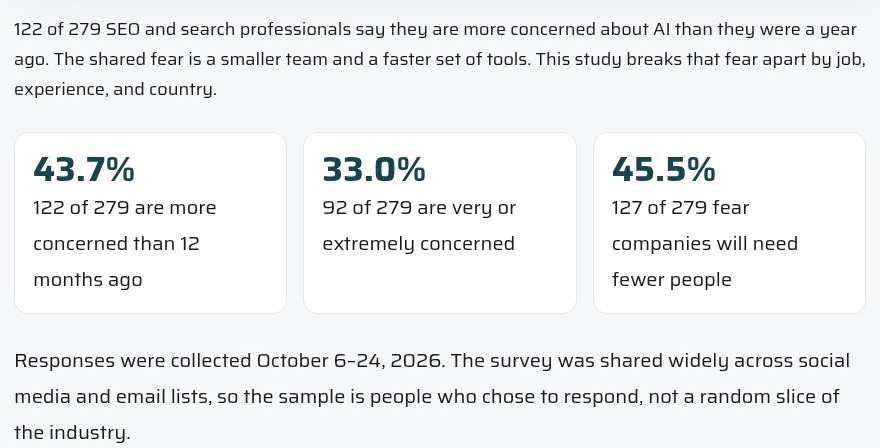
The bigger story is what they fear. In Nick's survey of 279 SEOs, where people could pick more than one fear, the most-picked option was companies needing fewer people (45.5%), while 24.4% named their own role being eliminated and 24.0% named entry-level jobs disappearing.
Nick's own summary on the study page: "The fear is a smaller team, not a deleted job."
Read it with the sample in mind. It's self-selected, and it skews senior: 180 of the 279 have 11 or more years of experience, while only 34 have under six.
When I tracked 2026 layoffs, most tech layoffs with a stated reason gave no AI reason, though a stated reason only tells you what the company chose to say.
Why Years of Experience Stopped Being Enough
Laid-off SEOs reach out to Nick with 6, 11 or 22 years of experience. He has to tell them "that is no longer the differentiator."
He goes further: if you've done this for 15 years and can't get a job, "that's reaffirming that you very likely know the checkbox SEO."
My own question to Nick was blunter: "What does years of experience mean anymore?" As I put it, someone could spend three years changing title tags and meta descriptions that don't move the needle and still list those three years on a resume.
My hot take on the episode was that the industry spent years rewarding vanity metrics like traffic and impressions. AI is exposing who knows how to generate leads and make money, and who just knew how to get cheap traffic that never converted.

Nick's counterexample came from one of his last agency jobs. An entry-level hire "never made the same mistake twice," and by his estimate she learned 80% of what he'd picked up over a dozen years within one year.
When he hires, he looks for passion, not necessarily for SEO, and resilience.
"I can teach you SEO. I can't teach you how to get up after you've fallen off the horse 99 times."
When laid-off veterans with 15 years in reach out, Nick's question is simple: how do you stand out?
How to Get a Marketing Job in 2026
My own path into marketing is gone. Back then, I cold applied to Meredith Corporation, they found ryandoser.com on Google, and I got an interview without knowing anyone.
As I said on the call, "those days are over." If you're a new grad asking "will AI replace marketing jobs?", Nick and I land on the same answer: build proof before you apply.
His more pessimistic answer, for a nervous college senior, was to "change directions, go into a trade." He was clear that he's "not saying that everybody should do this," and his guess is that a plumber or mason out of trade school makes $50 to $70 an hour, versus the $18 an hour of his first professional job.
For anyone who wants a marketing job anyway, here's the playbook from the episode:
- Build a site in your own name (new to it? start with how to vibe code a website). Nick's advice for anyone stubborn enough to stay in the field is to "be able to rank for your name, be able to be found in the search."
- Start a YouTube channel, podcast or website, and learn how to rank things and make money from them. On the episode I called YouTube the ultimate parasite, because it can bring you traction at every stage of the funnel.
- Bring a result you can point to. Nick's hypothetical is a candidate with no SEO job who built a YouTube channel to 15,000 subscribers and $2,000 a month: "That is how you skip those two years that nobody gets anymore."
- Learn to explain your work in plain words. Walk into the C-suite talking about robots.txt and server logs, Nick says, and "you've already lost."
- Stay humble. As Nick put it, you don't know everything, and neither does he. Communication and humility were the "two things" he told listeners to work on to stand out.
The bar for juniors is higher than it used to be. Nick says leaders would hire entry level "only if they can already do things that a two or three year experienced person would do."
My own study of what AI marketing jobs ask for shows AI asks climbing with seniority. That lower entry-level rate is no free pass, since the study cites CXL's read that employers assume juniors already know AI.
If you're job hunting, Nick's board doesn't charge job seekers, and I ranked SEOjobs.com second in my roundup of AI job boards for marketers (I know Nick personally, and he pays me nothing for that spot). His SEO for Lunch newsletter is where he shares his spicier takes each week.
Bullet-Point Work Shrinks, Proof Gets You Hired
Will AI replace marketing jobs? On Nick's read, it's taking the step-following work first, and that hits the people trying to break in hardest.
So build the proof before you apply. A site that comes up when someone Googles you, plus a project with numbers behind it, says more than any line on a resume.
Will AI Replace Marketing Jobs FAQs
Will marketing be replaced by AI?
My read after this episode is no, not as a whole profession, but the entry door is shrinking. Nick LeRoy, who runs SEOjobs.com, says AI is replacing the marketing tasks you can write down as a checklist. In his October 2026 survey of 279 self-selected, mostly senior SEOs, where people could pick more than one fear, the most-picked was smaller teams (45.5%), well ahead of losing their own role (24.4%).
What marketing jobs are safe from AI?
No title is guaranteed. The work Nick LeRoy sees holding up is the kind you can't hand over as steps: strategy, choosing what moves revenue and explaining it to leadership. He says senior people who have led teams or proven themselves as consultants are "still very healthy," and he named communication and humility as the two skills that set people apart.
Is marketing still a good career with AI?
It can be, but the old way in is mostly gone. Nick LeRoy's most pessimistic advice to a nervous college senior was a trade, though he said not everyone should follow it. My advice for anyone set on marketing is to start a website, YouTube channel or podcast and learn to drive results, because results are something a hiring manager can check for themselves.
How do I get a marketing job with no experience?
Make yourself findable and show a result. For my first marketing job, I cold applied to Meredith Corporation, and they found my website on Google, which landed me the interview. Nick LeRoy's view is that a candidate who built something with numbers behind it, like a YouTube channel that earns money, can skip the two years on the job that employers now expect from entry-level hires.