
SEO Content Strategy in 2026: Why Volume is No Longer a Moat
Search SEO content strategy and page one hands you a glossary definition, a nine-step checklist, and a starter guide. Every one of them describes how to plan, and none describe how to publish.
That split is the whole argument here. Volume and planning both got cheap, and what you publish is the only half left that decides whether you rank.
Why Volume Stopped Working as an SEO Content Strategy
The ranking pages are not wrong. They are thorough about a job that stopped being scarce.
That gap is the whole problem in 2026. Anyone can generate a hundred blog posts this afternoon, so a plan for what to write is no longer scarce.
The scarce thing is a reason for your specific page to exist.
I walked through this full system on the Big Moves AI podcast, including the parts that only work because of the SEO background underneath them.
That background is the caveat I lead with every time. You cannot skip the fundamentals and expect a tool to cover for you.
Some links below are affiliate links, disclosed in full at the end of this post.
If you want the skill files I use to run this, they live in my Claude Code Skills Stack.
The short version
- Your video is the strategy. Publishing from first-hand material beats planning what to write about.
- Subject matter expertise is the input, not the tool. Volume without it produces pages nobody cites.
- One keyword per asset. No persona map, no funnel diagram, no calendar.
- Own the distribution. Traffic you rent through an algorithm is not an asset.
- Encode the plan as a file. A strategy document gets ignored. An instruction file runs every time.
The SEO Content Strategy I Actually Run
Here are the four decisions that replaced the nine-step plan.
1. Start With the Video, Not the Keyword Map
Most strategy guides have you pick topics from a spreadsheet months ahead. I pick one target keyword before I record, then make the video.
The research still happens. It just takes minutes now, because a skill file pulls the SERP, reads the top-ranking pages, and hands back the internal links while I go record.
That is what commodity means here. The planning work did not disappear, it stopped being the thing that separates two sites.
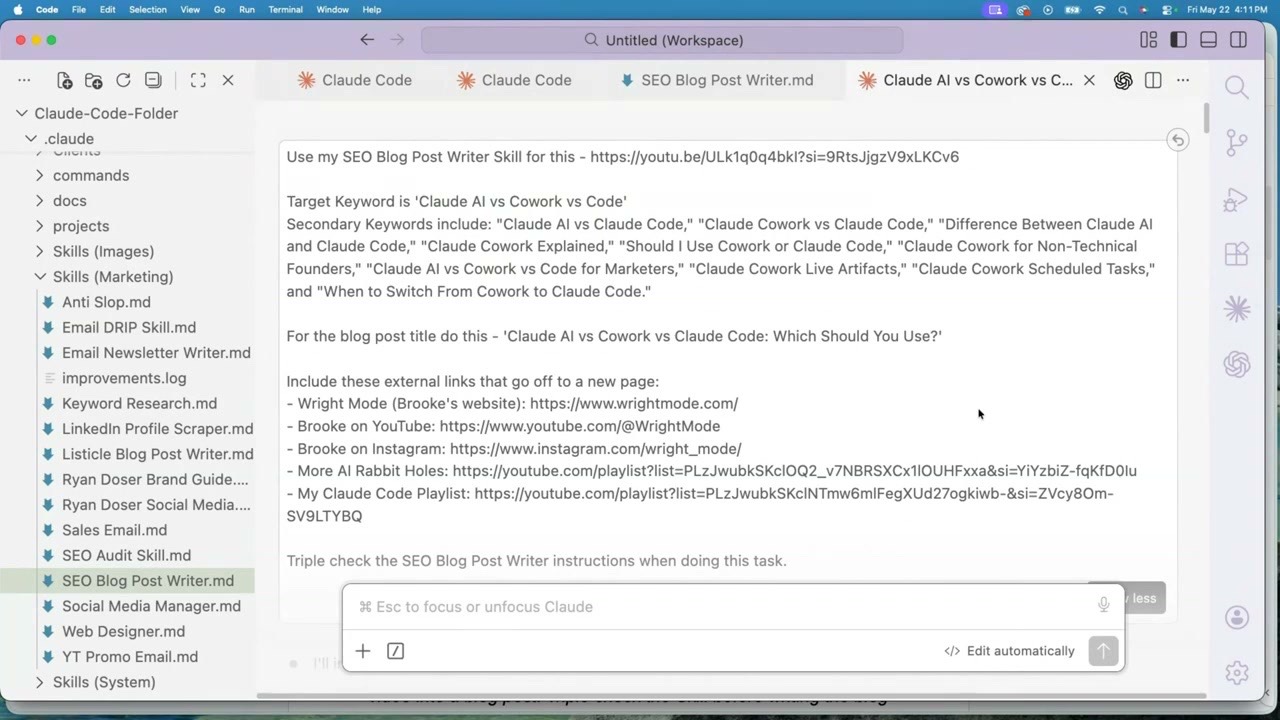
The video comes first because it is the part that cannot be faked. Recording forces you to actually know the topic.
Everything downstream is a repackaging of material that already exists. That is a different job than inventing content to fill a calendar slot.
The mechanics of that handoff are their own topic, and I covered them step by step in my guide to repurposing YouTube videos into blog posts.
2. Treat Expertise as the Bottleneck
We are in an age where AI agents can write a million blog posts. That makes quality and subject matter expertise matter more, not less.
Pushing volume without either one produces pages that rank for nothing and get cited by nobody. That is not hypothetical anymore, and I checked what a tool built purely for volume actually ranks for on its own domain. If you want people worth learning the craft from, I keep a vetted list.
Google's own helpful content guidance asks whether a page demonstrates first-hand expertise. That question is much harder to fake than a word count.
The honest limitation here is that this raises the floor rather than removing it. If you do not understand what an H1 does or why search intent matters, no workflow will save the output.
3. Write for Citations, Not Just Blue Links
The goal is to take up as much of the results page as possible, and a lot of that carries over into how models answer.
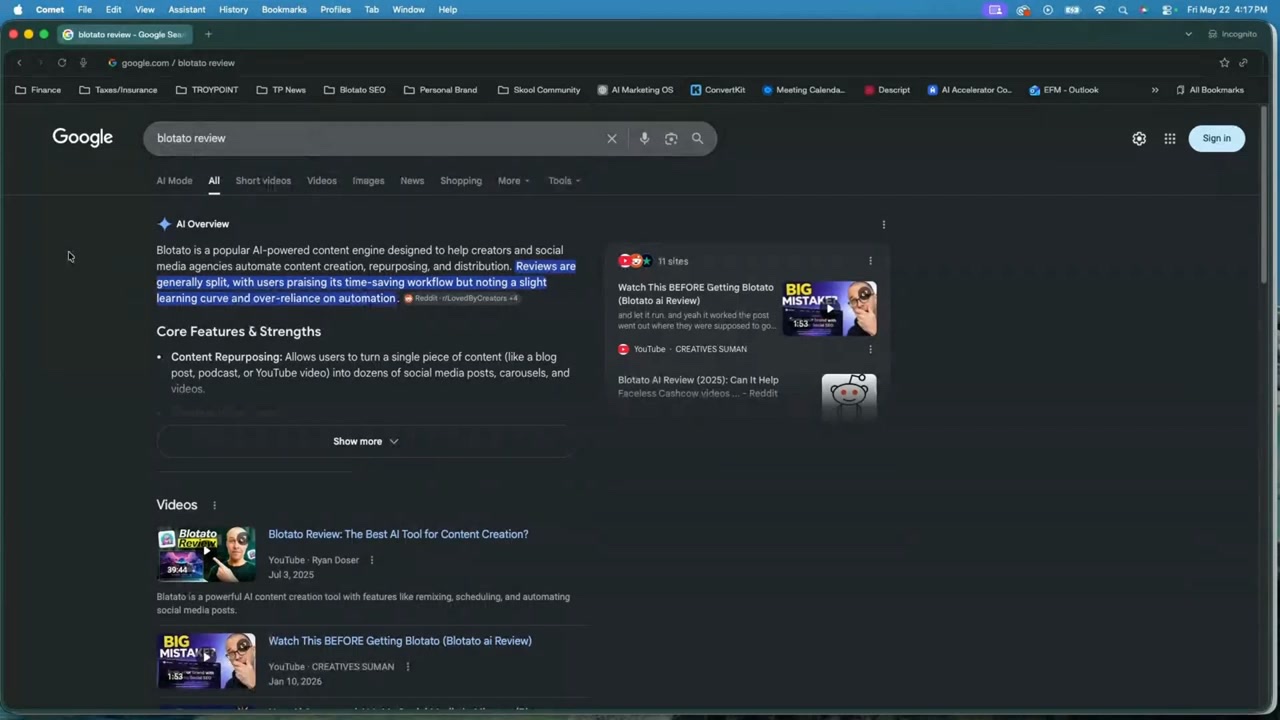
Being named inside an answer is its own outcome. It does not always come with a click, and it still builds the association that gets you recommended later.
Google documents how pages surface in AI features, and the requirements are ordinary indexable content rather than a separate track.
Structure decides whether you get lifted. Clear headings, direct answers, and clean comparison tables give a model something extractable.
I go deeper on the citation side in my AI SEO strategy breakdown.
4. Own the Distribution You Build
The name of the game in 2026 and beyond is owning your distribution instead of renting it.
Every post I publish points somewhere I control. An email list is the asset, and the ranking is just the delivery mechanism.
Rankings move and algorithms change.
A list of people who asked to hear from you does not reset when Google ships an update.
What Three Months of This SEO Content Strategy Looks Like
Here is the Search Console curve from the experiment, and the shape matters more than any single number on it.
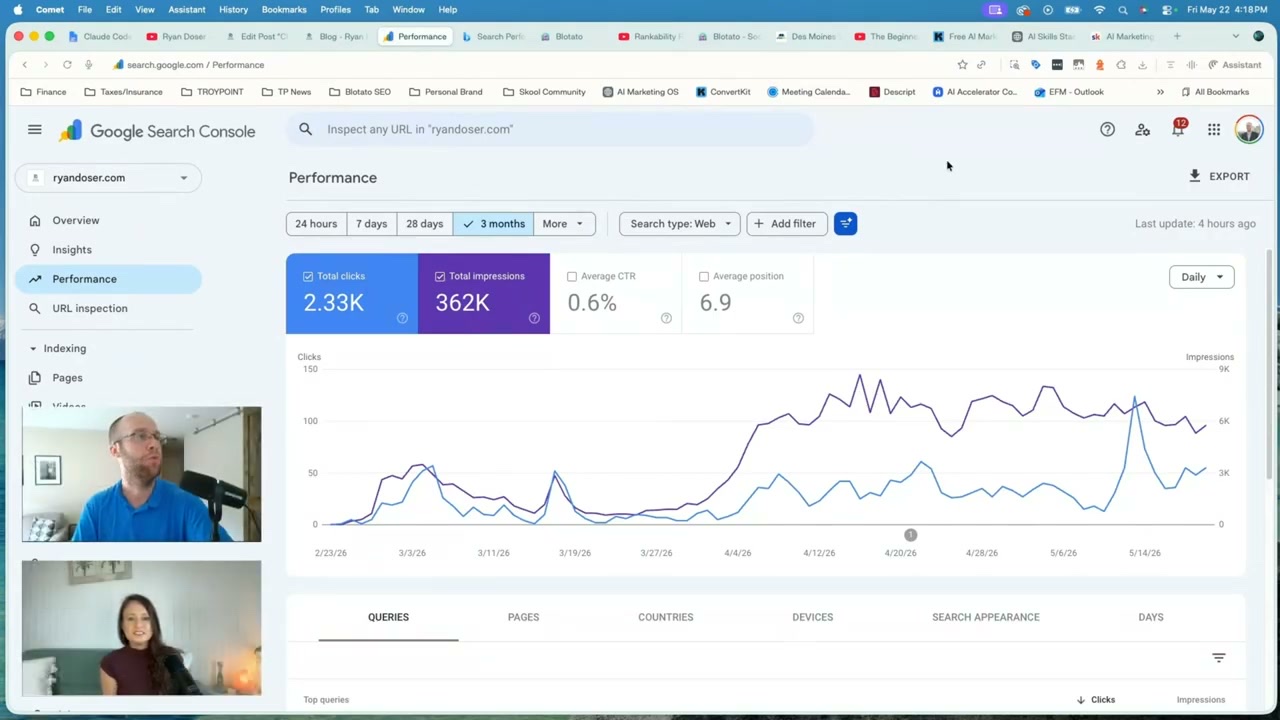
Look at the dip through late March. Early results faded before anything compounded, which is exactly where most people quit and decide the approach does not work.
The domain had little to no authority when this started, and no backlink campaign ran alongside it. The climb came from publishing against real search demand, repeatedly, with nothing else propping it up.
I want to be careful about what that proves. It shows the approach works on a fresh domain in a niche I know well, not that it transfers to every industry at any competition level.
The running cost is the part that surprises people. One Claude Max plan at a hundred a month covers the whole publishing side.
I have run the same fundamentals on a throwaway local service site to check they were not a fluke of this niche, and that build is covered in my post on SEOmaxxing boring businesses.
Where This Approach Falls Short
This is not a universal replacement for planning, and pretending otherwise would be dishonest.
If you run content for a team of eight, you need shared documentation that a spreadsheet handles better than my head does. Skip the calendar there and people duplicate work.
The approach also assumes you produce original material. Without video, podcasts, or genuine first-hand testing, there is nothing to repackage, and you are back to inventing topics from a keyword tool.
One more limit worth naming. A single-operator system scales to the number of hours you have, which is the tradeoff you accept for skipping the process overhead.
Ryan's Final Thoughts
Keep the planning steps. They take an afternoon now instead of a quarter, and that is exactly the point.
Deciding what to write stopped being the hard part the moment models could draft anything. Having something worth saying, and a repeatable path from saying it to publishing it, is where the advantage moved.
Pick one keyword and make the thing only you can make.
Then send the traffic somewhere you own.
SEO Content Strategy FAQs
What is an SEO content strategy?
An SEO content strategy is the plan governing what you publish, how it targets search demand, and how it converts readers. Most published versions center on audits, personas, and content calendars. My version centers on publishing from first-hand material against one target keyword per asset, then routing that traffic to a channel you own.
Do I still need a content calendar for SEO in 2026?
Not if you work alone and produce original material. A calendar solves coordination across a team, which is a scheduling problem rather than a ranking one. When your publishing rate is limited by how much genuine expertise you can record, the calendar tracks capacity you already know.
How long does an SEO content strategy take to show results?
On my own site, Search Console showed steady click and impression growth roughly three months into the experiment, starting from zero on a domain with little to no authority and no backlink campaign behind it. That was a niche I know deeply, which matters more than the timeline. Competitive niches and unfamiliar topics take considerably longer.
Is AI-generated content bad for SEO?
The generation method matters less than whether the page deserves to exist. My view is that quality and subject matter expertise matter more now than ever, precisely because anyone can produce enormous volume cheaply. Content grounded in real testing and genuine expertise still wins, whether or not a model helped write it.
Should I write blog posts or make videos first?
Make the video first when you can. Recording forces a level of understanding that writing from a keyword tool does not, and it gives you a source asset to repackage into posts, email, and social. The hardest part of this whole system is producing consistent high-quality long-form video.
Disclosure: some links in this post are affiliate links. If you buy through them I may earn a commission at no extra cost to you. I only recommend tools I actually use. Full disclosure.